Table of Content
- Introduction
- The Eddy Current Technique Family at a Glance
- Conventional Eddy Current Testing (ECT)
- Eddy Current Array (ECA)
- Pulsed Eddy Current (PEC)
- Remote Field Testing (RFT)
- Near Field Testing (NFT)
- Alternating Current Field Measurement (ACFM)
- Related Electromagnetic Techniques That Are Not Eddy Current
- How to Choose the Right Technique
- Conclusion
- FAQs
Introduction
Eddy current testing (ECT) is a type of electromagnetic non-destructive testing (NDT) that can be used to detect a variety of discontinuities, including cracks, corrosion, material loss, and more, in conductive materials. As time passed, the traditional ECT has been developed into a variety of specialized techniques that address certain inspection problems not solved by conventional eddy current testing methods.
There are various techniques that inspectors may use today, including Eddy Current Array (ECA), Pulsed Eddy Current (PEC), Remote Field Testing (RFT), Near Field Testing (NFT) and Alternating Current Field Measurement (ACFM). They have unique benefits depending on the material, defect location, inspection environment and asset type. This guide will look at these techniques, explain how they are different, and show you where you can use each technique.
The Eddy Current Technique Family at a Glance
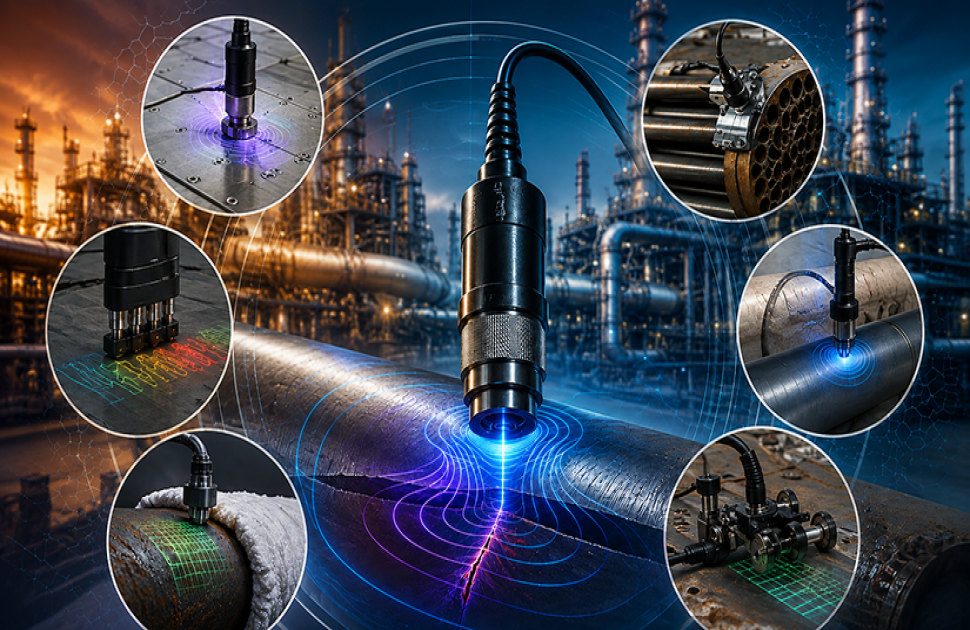
The eddy current testing family consists of 6 main techniques: Conventional Eddy Current Testing (ECT), Eddy Current Array (ECA), Pulsed Eddy Current (PEC), Remote Field Testing (RFT), Near Field Testing (NFT), and Alternating Current Field Measurement (ACFM). Each technique is developed to address a particular shortcoming in conventional ECT, and addresses different industrial inspection applications.
How the Techniques Relate to Each Other
These are all examples of a more general family of techniques called Electromagnetic Testing (ET). The basis of this family is Conventional Eddy Current Testing (ECT), which is performed on conductive materials by inducing eddy currents in the material and detecting flaws.
Conventional ECT had its limitations and specialized techniques developed as inspection requirements increased in complexity. Multiple coils increase speed of inspection with ECA; PEC detects corrosion via insulation; RFT inspects ferromagnetic tubes; NFT is used to detect and size surface cracks via coatings and underwater in carbon steel tubes; and ACFM detects and sizes surface cracks via coatings and underwater.
These techniques are not competing techniques, but they complement each other in order to address different inspection problems.
Conventional Eddy Current Testing (ECT)
The most common eddy current inspection technique is the conventional Eddy Current Testing (ECT) which is the foundation of some other advanced electromagnetic techniques. The principle is the application of an alternating current to a probe coil which produces a changing magnetic field that generates eddy currents in the conductive test material. A change in these currents caused by cracks, corrosion or material change is detected as a change in electrical impedance.
ECT can detect surface and near surface defects well, and is suitable for checking the surface and near surface defects of aircraft structures, heat exchanger tubes, fastener holes, welded parts, manufactured parts, etc. It does not require couplants, nor does it require direct contact, so that it does not take long to inspect and can be done with little surface preparation.
Advantages
- Sensitive to very small surface cracks
- Immediate inspection results
- Portable equipment
- No couplant required
- Capable of complicated component designs
Limitations
- The skin effect, which causes limited penetration.
- A small inspection area with single-coil probes.
- Not as effective as on thicker ferromagnetic materials
- Needs skilled operators to use for signals
For localized inspections with an objective of detecting only small surface defects, conventional ECT is still the preferred inspection method.
Eddy Current Array (ECA)
Conventional ECT is an advanced version of Eddy Current Array (ECA) which has multiple coils in a single probe. By scanning a wider area at a time, instead of one narrow path at a time, the probe can scan much faster and provide a much better inspection, which was the major advantage.
The data from each coil is independently obtained and advanced software software integrates the signals to create detailed inspection images. The technique also generates coded inspection records, which make it easier to report, trace back and compare with previous inspections.
ECA has been extensively adopted for aircraft structural inspection, welded joints, pipelines, pressure vessels, storage tanks and other large metallic surface areas due to its productivity and accuracy. It is becoming an effective alternative to Liquid Penetrant Testing (PT) and Magnetic Particle Testing (MT) in many applications to detect surface cracks.
Advantages
- Scans larger areas in one scan
- Faster than conventional ECT
- Maintains a digital inspection log for the lifetime of the product.
- Improves inspection consistency
- Reduces overall inspection time
Limitations
- Increased equipment and training requirements.
- More advanced data analysis
- Limited penetration depth as conventional ECT
ECA is suitable for inspections which demand high productivity and wide coverage along with reliable digital documentation.
Pulsed Eddy Current (PEC)
Pulsed Eddy Current (PEC) is intended to measure wall loss and corrosion under insulation, coatings and fireproofing, without removing the protective layer. PEC is different from traditional ECT because a broadband electromagnetic pulse is sent into the material, and the return pulse is analysed as it decays. This allows for inspectors to be able to visualise the areas that are affected by the corrosion even if the steel surface is inaccessible.
PEC is commonly applied to inspect insulated pipelines, storage tanks, pressure vessels and process equipment in the oil and gas, petrochemical, and power generation sectors. It is especially useful for Corrosion Under Insulation (CUI) programs as it decreases the requirement to remove insulation and therefore time and money.
Please be aware that PEC is a screening process not a thickness gauge. It is used to pinpoint areas where there may be wall loss and enables follow-up inspections to be carried out by the inspector by methods like Ultrasonic Testing (UT).
Advantages
- Identifies corrosion using insulation and coatings
- Minimizes insulation removal
- Rapidly inspects large areas
- Saves inspection time and expenses
Limitations
- Screening tool, not for measurement of thickness.
- Available for ferromagnetic steels only.
- Lower resolution than localized method or technique of NDT
Remote Field Testing (RFT)
A variation on the eddy current method that has been developed to inspect ferromagnetic tubes, like those used in boilers, heat exchangers and condensers, is called Remote Field Testing (RFT). Traditional ECT is not effective on such materials, due to the limited penetration of eddy current, caused by the presence of magnetism in the material. The drawback is overcome by RFT with broad-spaced coils for the exciter and receiver that measure the electromagnetic field that has passed through the wall of the tube.
The distinctive operating principle ensures virtually equal sensitivity of both internal (ID) and external (OD) defects allowing RFT to be very effective for the detection of corrosion, erosion, pitting and wall thinning defects in carbon steel tubing.
RFT is most often applied in power plants, refineries, and industrial heat exchangers where it is important to ensure the integrity of the tubes for the safe operation of the equipment.
Advantages
- Equal sensitivity to ID and OD defects
- Perfect for tubes that are ferromagnetic.
- Accurately identifies corrosion and wall loss
- Inspection of heat exchangers is reliable.
Limitations
- Ferromagnetic tube materials are used primarily.
- Less effective than traditional ECT
- Not as suitable for non-ferromagnetic materials
RFT is one of several specialized techniques for ferromagnetic tube integrity — see the full comparison of tube inspection methods, including IRIS and advanced electromagnetic options.
→ Read: What is Remote Field Testing
Near Field Testing (NFT)
Another special eddy current test is Near Field Testing (NFT), which has been designed for carbon steel fin-fan and air cooler tubes. Every coil is very close to the tube, so the electromagnetic field is very close to the tube's inner surface, this will make it extremely sensitive to the changes inside the tube caused by corrosion and erosion.
NFT is not a full tube inspection test like RFT, but is designed to be a test for the inside diameter (ID). Therefore it is very useful for such applications where the main problem is internal corrosion as in air-cooled heat exchanger in refinery and petrochemical plants.
Note however that NFT is not particularly sensitive to external (OD) damage and is therefore inappropriate if the primary inspection target is external corrosion.
Advantages
- Excellent detection of internal corrosion.
- Carbon steel tubes are completely inspected in an accelerated manner.
- Ideal for fin-fan and air cooler use.
- Low preparation of tubes needed
Limitations
- Is unable to reliably detect external corrosion
- It can only be used in certain tube applications.
- Not suitable for general surface inspections
For deeper insight into defect morphology in ferrous tubes, Remote-Field Array (RFA) technology takes electromagnetic tube inspection a step further — see how it works.
→ Read: Near Field Testing (NFT)
Alternating Current Field Measurement (ACFM)
Alternating Current Field Measurement (ACFM) is a non destructive crack detection method which detects perturbations in the uniform electromagnetic field as opposed to the changes in coil impedance. This means that no protective coatings or marine growth needs to be removed from surfaces for inspectors to see and measure surface-breaking cracks.
ACFM is commonly employed for the inspection of welded structures, offshore platforms, pressure vessels, storage tanks and marine assets. It can be used with coatings and under water, which decreases preparation time and yields a reliable crack size.
Acronyms used by this new NDT technique are similar to those used in other fields of airflow, but ACFM is an acronym for Alternating Current Field Measurement.
Advantages
- Identifies and measures surface cracks
- Uses coatings and paints to accomplish works
- Can be used underwater for inspection
- No need to clean the surface, as is done in composting.No need to clean the surface, as is done in composting.
Limitations
- Only surface breaking defects allowed.
- Must position a probe correctly
- Not used to detect volumetric flaws
Want to get certified in ACFM inspection? This Level I course covers electromagnetic theory, probe operation, and signal interpretation for real-world crack detection.
→ Read: Alternating Current Field Measurement (ACFM) Level I Course
Not all electromagnetic inspection techniques are from the eddy current family. Magnetic Flux Leakage (MFL) is a method using magnetic flux leakage in magnetised ferromagnetic materials for the detection of corrosion and metal loss; Electromagnetic Acoustic Transducer (EMAT) is a method that uses an electromagnetic wave to generate ultrasonic waves for flaw detection and thickness measurement. Both are electromagnetic NDT techniques, but they are not considered to be eddy current testing techniques as they utilize different physical principles.
How to Choose the Right Technique
The type of eddy current testing technique used will be dependent on the inspection goal, material and asset condition. Rather than the technique, first determine what is to be inspected.
If You Need to Inspect Surface Cracks
For small, localized surface or near-surface defects in conductive materials, Conventional Eddy Current Testing (ECT) is usually the best choice. It is highly sensitive and quick to result, which is suitable for the aircraft parts, fastener holes, and machined parts.
If You Need Faster Coverage Over Large Areas .
For large surfaces, welded joints or parts that need digital inspection records, Eddy Current Array (ECA) is the preferred choice. The multiple-coil probe can scan a larger area within one pass, which will increase productivity, but not sacrifice defect detection.
If Corrosion Is Hidden Beneath Insulation
Pulsed Eddy Current (PEC) is the most practical solution, when the inspection target is a carbon steel with insulation, coatings or fireproofing. It rapidly scans for wall loss without taking insulation off the wall and indicates areas that need to be investigated in detail.
If You're Inspecting Carbon Steel Tubes
If tubes are ferromagnetic, they can be analyzed with Remote Field Testing (RFT) which has balanced sensitivity to external and internal defects. Near Field Testing (NFT) can be used to detect the internal damage of fin-fan or air cooler tubes and is more sensitive to the inside diameter than the outside but does not provide good sensitivity to the outside damage.
If You Need to Detect and Size Surface Cracks
Alternating Current Field Measurement (ACFM) is a great option for welded structures, offshore assets or painted parts where coating removal is not feasible. It can detect and size surface-breaking cracks through coatings and even detect under water without surface preparation, which decreases the inspection time.
In the end, no one eddy current method will work for every application. The selection of the appropriate method will depend on the material, type of defect, accessibility and inspection requirements.
Conclusion
Eddy current testing has advanced significantly since its introduction as a traditional ECT to a host of specialized applications tailored to specific inspection problems. ECT is the preferred method for surface inspections of localized areas, ECA increases the speed of surface inspections, PEC can detect corrosion under insulation, RFT can inspect ferromagnetic tubes, NFT can find and measure internal corrosion in carbon steel tubes, and ACFM can find and size surface cracks through coatings.
Inspectors will be able to use the strengths and weaknesses of each method to ensure that the inspection is most effective, efficient and to give the best possible results. These techniques are not mutually exclusive methods; they are used together with each other and are significant tools used in today's asset integrity and non-destructive testing programs.
FAQs
1. What is the difference between ECT and ECA?
ECT performs inspections with just one coil, ECA performs inspections with multiple coils, which provides a faster inspection of larger areas and generates digital inspection records.
2. What is the most suitable eddy current method to be used for heat exchanger tubes?
For ferromagnetic heat exchanger tubes, RFT is better whereas for non-ferromagnetic tubes, ECT is more common. For the detection of the internal corrosion in carbon steel fin-fan tubes, NFT is preferred.
3. Which eddy current technique works through insulation?
Pulsed Eddy Current (PEC) is used to inspect carbon steel through insulation, coatings and fireproofing and is ideal for corrosion under insulation (CUI) screening.
4. Which eddy current technique is suitable for carbon steel?
Depends on the application. PEC identifies corrosion under insulation, RFT is a corrosion inspection of ferromagnetic tubes, NFT is a corrosion inspection of the inside of tubes and ACFM is a surface crack detection.
5. Is ACFM an eddy current testing technique?
Yes, Electromagnetic eddy current method for detection and measurement of surface-breaking cracks through coatings and underwater.
6. Can one eddy current technique replace all the others?
No, Each technique is used for a different inspection task and the selection of which technique to use depends on the material, the type of defect and the requirement for the inspection.