Table of Content
- What Is Near Field Testing (NFT)?
- The Principle: Working Inside the Transmitter's Near-Field Zone
- Applications: Fin-Fan and Air Cooler Tubes
- Common damage mechanisms identified include:
- When to Use NFT: NFT vs RFT, ECT, and IRIS
- Comparison of Tube Inspection Methods
- Limitations of Near Field Testing
- Conclusion
- Frequently asked questions (FAQs)
Corrosion, erosion and fouling turn up in most heat exchanger, air cooler, fin-fan and boiler systems eventually, and they gradually weaken the tubing. Many of these assets run under high pressure and high temperature, so even a small patch of internal damage can lead to expensive downtime or an unplanned failure. Choosing the right tube inspection method is a large part of getting preventive maintenance right.
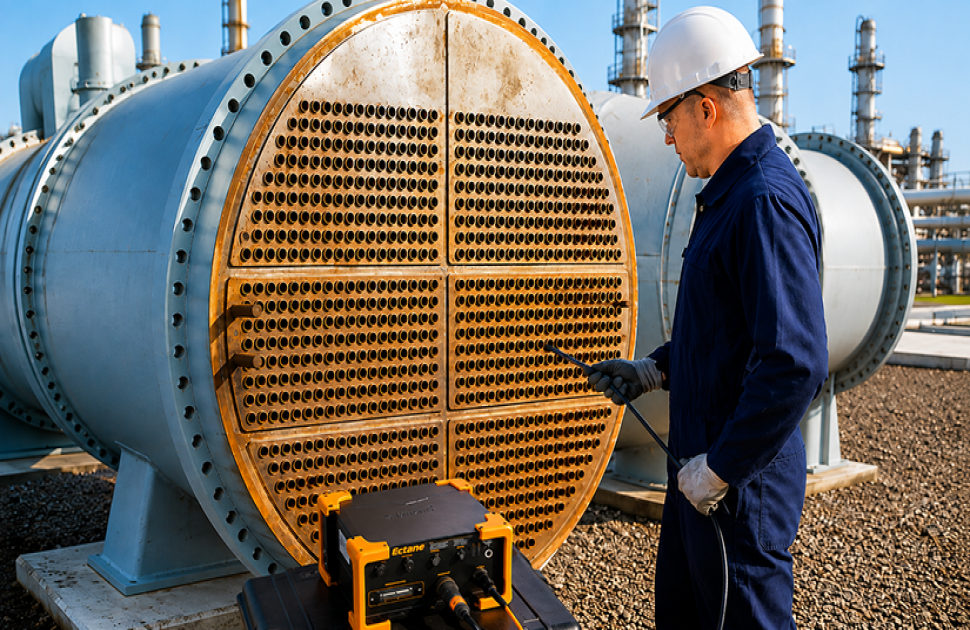
Near Field Testing (NFT) is one of several electromagnetic inspection techniques that have been developed for carbon steel tubing where the damage is typically on the inside surface. Compared with conventional eddy current testing or Remote Field Testing (RFT), NFT concentrates on the inner wall of ferromagnetic tubes, which makes it particularly valuable for fin-fan and air cooler tubes.
This guide covers how NFT is used, why it performs so well on finned carbon steel tubes, where it applies, and the limitations inspectors should be aware of when choosing it.
What Is Near Field Testing (NFT)?
Near Field Testing is an electromagnetic NDT method for inspecting the inside surface of carbon steel tubes. It finds corrosion, erosion, pitting and other defects on the tube's inner wall without removing the fins and without damaging the tube.
One point of confusion worth clearing up early. "Near field" also means something in antenna theory, wireless communication and radar, and it is not the same thing. In NDT, near field testing refers specifically to this electromagnetic tube inspection method for ferromagnetic tubing.
NFT deliberately concentrates its sensitivity on the inner surface of the tube, where flow-driven damage almost always begins. That focus is why it has become the preferred method for fin-fan coolers in refineries, petrochemical plants, power stations and chemical processing facilities.
The Principle: Working Inside the Transmitter's Near-Field Zone
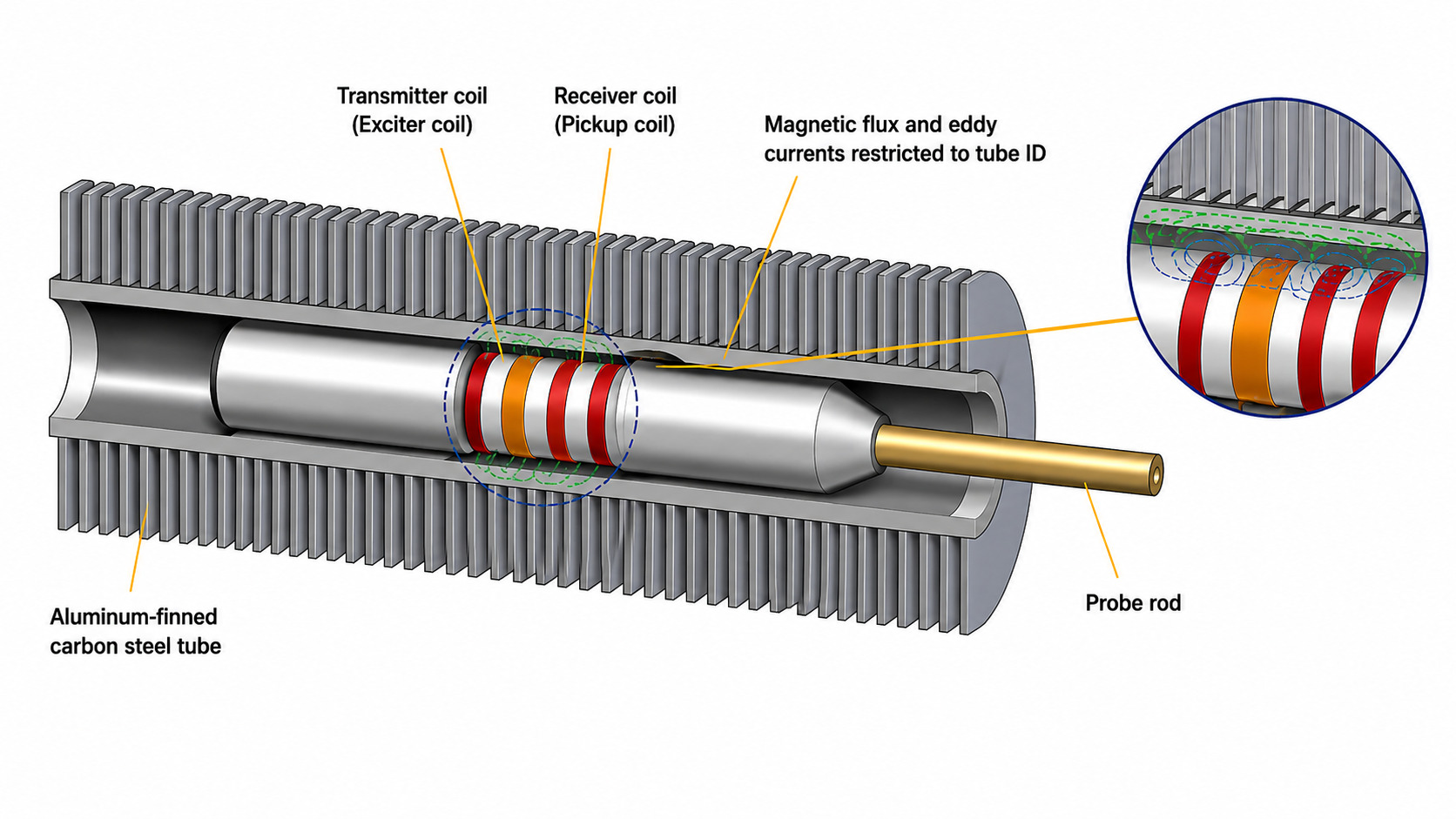
NFT is usually explained in one line: the probe operates in the near-field region of the transmitter's field. That is accurate, but it does not explain much on its own. The useful comparison is with RFT, because the difference between the two comes down mainly to one design decision.
An NFT probe carries two coils mounted close together on a body that slides through the tube. In Remote Field Testing, the receiver sits roughly two tube diameters from the transmitter, far enough that the direct field has decayed and the only thing left to measure is a field that has crossed the tube wall twice. NFT does the opposite. The coils sit close together, so the receiver stays well inside the transmitter's near-field zone and reads the direct field rather than a remote one. NFT also runs at a considerably higher frequency than RFT, which reinforces the effect by keeping the induced currents shallow.
The consequence is straightforward. The eddy currents induced by the transmitter are concentrated in the inner portion of the tube wall and fall away sharply with depth. Because so little of the field reaches the outer surface, defects on the inside diameter (ID) produce a strong, clean signal while those on the outside diameter (OD) barely register.
NFT is particularly effective at identifying:
- Internal corrosion
- Erosion and erosion-corrosion from high-velocity flow
- Localized pitting
- Internal wall thinning
Structural elements such as support plates, tube supports and tubesheets cause little interference, because they sit outside the near-field zone the probe senses. In other electromagnetic methods these structures are a genuine nuisance: they distort the magnetic field, they mask indications, and separating a real defect from a support plate signal takes experience. With NFT they largely disappear from the data.
That means cleaner inspection data, less interpretation burden on the inspector, and better sensitivity to internal damage. The resulting signal gives the maintenance team a clear picture of where internal metal loss has occurred and how severe it is, well before the tubes start leaking.
Applications: Fin-Fan and Air Cooler Tubes
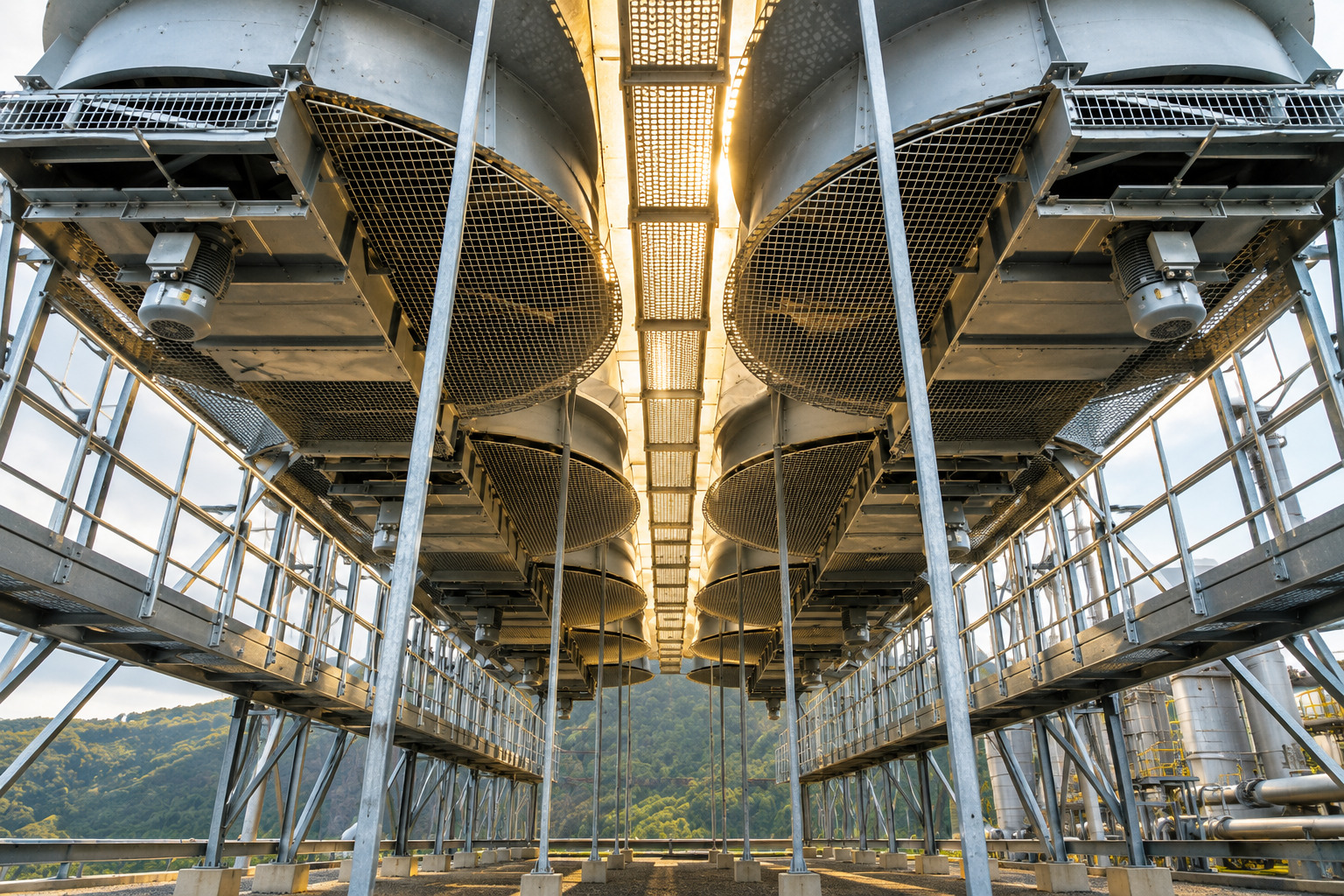
NFT is used mainly to inspect carbon steel finned tubes in air-cooled heat exchangers. These units are common throughout:
- Oil and gas facilities
- Petrochemical plants
- Refineries
- Fertilizer plants
- Power generation facilities
Finned coolers create a specific inspection difficulty. The external aluminum or steel fins make the tube surface effectively unreachable, and stripping fins off a bundle just to examine the tube condition underneath is impractical and expensive. Nobody does it as a routine inspection step.
Since NFT inspects from inside the tube, the external fin structure has virtually no effect on the inspection at all. That is why fin-fan tube inspection is one of the best use cases for the method.
Near Field Array (NFA) extends NFT capabilities by enabling faster inspection of large tube bundles with improved coverage.
→ Read: Sizing Small Volumetric Defects in Fin-Fan Air Cooler Tubes
- Common damage mechanisms identified include:
In addition to air coolers, NFT is also used on:
- Water-cooled heat exchangers
- Carbon steel condenser tubes
- Process heat exchangers
- Selected ferrous piping systems
- Boiler tubes, but only where internal deposit-related wall loss is the specific concern. Most boiler tube programs use RFT, MFL or IRIS instead, because fire-side damage matters and NFT cannot see it.
Modern inspection systems also offer Near Field Array (NFA), which places a ring of sensing elements around the probe body rather than relying on a single coil pair. Nothing moves or rotates. The array covers the full circumference of the tube in one pull, which improves circumferential resolution and increases productivity on large tube bundles. NFA is especially valuable during large-scale shutdown inspections, where the number of tubes you can get through before the unit comes back up is the constraint that matters most.
When to Use NFT: NFT vs RFT, ECT, and IRIS
Choosing the right tube inspection method comes down to one question, and it is worth asking it plainly:
Will the damage be found only on the inside surface, or does the entire tube wall need to be evaluated?
If internal corrosion or erosion is the only concern, NFT offers high sensitivity with fewer of the interpretation problems that come with Remote Field Testing. If external corrosion or total wall loss needs to be assessed, another method will serve you better.
Tube inspection method selection goes beyond NFT. Here's a complete guide covering all tube inspection roles, techniques and when each method applies in industrial assets.
→ Read: Tube Inspection Role
- Comparison of Tube Inspection Methods
When maintenance engineers are confident the degradation is on the inside of the tube, NFT is the right call. Typical applications include cooling water systems, hydrocarbon processing and refinery air coolers where corrosive fluids run through carbon steel.
Where external corrosion, fire-side damage or total wall condition needs assessing, Remote Field Testing or IRIS (Internal Rotary Inspection System) will give a far more complete evaluation. A common and sensible pattern is to screen with NFT and then verify the worst indications with IRIS.
Limitations of Near Field Testing
NFT is an excellent tool for certain applications, but it is not a general-purpose tube inspection method. Knowing where it stops is what lets inspectors build a defensible inspection program around it.
The biggest constraint is that NFT only sees the inside surface of the tube. External corrosion, OD pitting and external wall loss will generally not be detected, because so little of the field reaches the outer wall.
NFT is also limited to carbon steel and other ferromagnetic tubing. Austenitic stainless, copper alloys, titanium and brass are non-ferromagnetic and go to conventional eddy current testing instead. Note that not all stainless is the same: ferritic and duplex grades are ferromagnetic, which is why RFT works on them and conventional ECT does not.
NFT does not measure wall thickness the way ultrasonic techniques do. It detects and sizes internal metal loss relative to a calibration standard, which tells you roughly how much material has gone from a given location rather than what is left. Where an actual remaining-thickness figure is required, ultrasonic methods such as IRIS are the tool.
Another limitation is that NFT is not a crack detection method. It responds well to volumetric loss, meaning corrosion, erosion and pitting, but it is not optimized for fatigue cracking or stress corrosion cracking. A clean NFT report is not evidence that a tube is crack-free.
For all these reasons, NFT is rarely used as the only NDT method on an asset. It works best as one part of a broader inspection strategy.
Conclusion
Near Field Testing is an important technique in electromagnetic tube testing, and its value comes from how narrowly it is targeted. Because its operating principle keeps the transmitter and receiver inside the electromagnetic near-field zone, it is highly sensitive to ID corrosion, erosion and pitting, with very little interference from support plates and tubesheets.
Its biggest advantage is inspecting finned and air cooler tubes that cannot practically be inspected from the outside. NFT will not measure external wall damage and it will not give you a wall thickness figure, but for fast, accurate detection of internal deterioration in ferromagnetic tubes there is little that beats it.
The decision comes down to the damage mechanism you expect. Where internal corrosion is the primary concern, NFT is one of the most effective and convenient inspection methods available.
Frequently asked questions (FAQs)
1. What is the difference between NFT and RFT?
Coil spacing, and everything that follows from it. Near Field Testing places the transmitter and receiver coils very close together, so the receiver reads the direct field and sensitivity stays at the inside surface of the tube. In Remote Field Testing the receiver sits about two tube diameters from the transmitter, so the measured field has crossed the wall twice and detects defects on both the inside and outside surfaces.
2. Can Near Field Testing detect external corrosion?
No. NFT is designed to inspect the inner surface of ferromagnetic tubes. External corrosion, outside diameter pitting and OD metal loss are not reliably detected, because the electromagnetic field stays concentrated near the inner wall. If external corrosion is a credible mechanism on your tubes, use RFT or IRIS.
3. Does NFT work on stainless steel tubes?
Austenitic grades, no. Those are non-ferromagnetic and go to conventional eddy current testing, along with titanium and copper alloys. Ferritic and duplex stainless are ferromagnetic, so they are not ruled out on magnetic grounds, but NFT is rarely specified for them in practice because the fin-fan application that drives its use is a carbon steel one. Check the actual grade rather than assuming all stainless behaves the same way.
4. Why is NFT commonly used for fin-fan coolers?
Because the external fins on carbon steel tubes make outside inspection impractical, and removing them is expensive and destructive. NFT inspects from inside the tube, so the inspector can find internal corrosion and erosion without touching the fins at all, which cuts both maintenance cost and turnaround time.
5. What types of defects can Near Field Testing detect?
Internal corrosion, erosion, erosion-corrosion, flow-accelerated corrosion, pitting and localized internal wall loss on the inside surface of carbon steel tubes. It is not intended for accurate crack detection or full wall thickness measurement.
6. What is Near Field Array (NFA)?
An advanced form of NFT that uses multiple sensing elements arranged around the probe circumference instead of a single coil pair. Nothing rotates. The array covers the full tube circumference in one pull, which improves inspection coverage, boosts productivity and reduces inspection time on large tube bundles such as refinery air coolers and heat exchangers.