Table Of Content
1. What is Eddy Current Testing Equipment?
- Inside an Eddy Current Instrument: The Core Parts
- Oscillator / Signal Generator and the Coil (Probe)
- Bridge and Signal Processing
2. Types of Eddy Current Testing Machines
- Handheld and Portable Flaw Detectors
- Automated and In-Line Systems
3. Portable Eddy Current Testing Equipment
4. Probes: The Business End of the Equipment
5. Accessories That Complete an Eddy Current Testing System
6. Features Available in Today's Equipment
7. How to match equipment to the job
11. Frequently Asked Questions
Eddy current testing (ECT) is a widely used non-destructive testing (NDT) technique for inspecting electrically conductive materials. It can find surface and near-surface defects, measure conductivity, measure the thickness of the coating and detect corrosion by electromagnetic induction.
Eddy current testing machines deliver fast, accurate and repeatable inspections across aerospace, automotive, power generation, and oil and gas. The equipment itself has changed considerably over the years, ranging today from handheld portable flaw detectors to fully automated production-line systems.
This article outlines the main types of eddy current testing equipment — instruments, machines, probes and accessories, how they work together, and what to consider when selecting a system for a particular application.
What is Eddy Current Testing Equipment?
Eddy current testing equipment is a full inspection system that is used for electromagnetic induction to test a conductive material. It comprises a generator and analyser unit, a probe that induces and measures the eddy currents, and the supporting accessories. It can be used as portable, benchtop or automated systems, and is capable of detecting high accuracy cracks, corrosion, material loss, and conductivity variations.
Inside an Eddy Current Instrument: The Core Parts
Although there are variations in the size and function, all eddy current instruments have three major components: a signal generator, signal processing electronics, and a display interface. Together, these components generate the electromagnetic field, interpret the changes it undergoes in the test object, and present the results to the inspector.
Oscillator / Signal Generator and the Coil (Probe)
The instrument produces high-frequency alternating current which is passed to the probe. The coil of the probe generates a magnetic field which causes eddy currents to form in the conductive material. The instrument detects changes in the coil's impedance — its resistance and inductive reactance — caused by discontinuities such as cracks, corrosion and material loss. Because both components are measured, the amplitude and the phase angle of the signal can be assessed, which is what allows genuine defects to be separated from lift-off and other benign variations.
Operating frequency is one of the most important variables in an eddy current inspection, alongside material conductivity, magnetic permeability, probe design and lift-off. Higher frequencies increase sensitivity to surface-breaking defects, while lower frequencies allow deeper penetration into the material. In many modern instruments, they are available with multi-frequency capability for inspecting various material properties at once.
Eddy current density is highest at the surface and falls off with depth. The standard depth of penetration (δ) is the depth at which the current density drops to about 37% of its surface value, and it is calculated as δ = 1 / √(π·f·μ·σ), where f is frequency, μ is magnetic permeability and σ is electrical conductivity. In practice this means frequency is chosen as a trade-off: high frequency for fine surface cracks, lower frequency when subsurface or far-side defects must be detected.
Bridge and Signal Processing
The probe coil forms one arm of an AC bridge circuit. The bridge is balanced, or nulled, on a defect-free area of the part so that any subsequent imbalance corresponds to a change in the material being inspected.
The returning signal is analyzed to differentiate true defect from interference due to lift-off, surface roughness, geometry and electrical noise. Digital filtering, auto-balancing, phase rotation and conductivity analysis increase the accuracy of inspections and decrease false indications.
Display and Data Output
Eddy current instruments present inspection results on impedance plane displays, strip charts and waveform screens. Eddy Current Array (ECA) systems add C-scan imaging, which builds a two-dimensional map of the scanned area and makes defect sizing and positioning far easier to interpret. Modern instruments offer USB, Wi-Fi, Bluetooth, Ethernet and cloud connectivity, which support digital reporting, data storage and improved traceability.
Types of Eddy Current Testing Machines
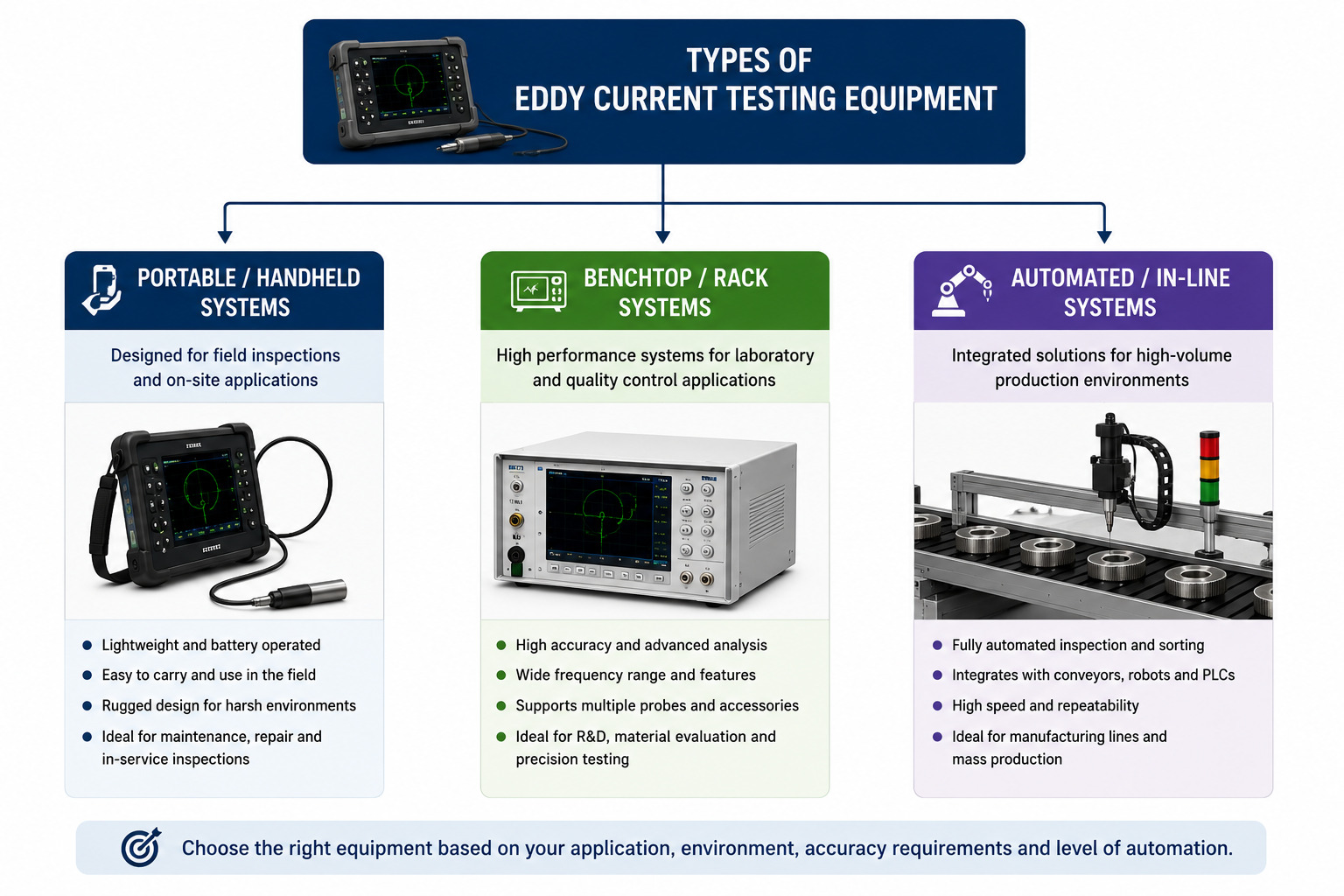
Eddy current testing machines come in three basic setups, each suited for different inspection applications.
Benchtop and Rack Systems
These systems are used in laboratories and quality control departments where high accuracy and repeatability are essential. They are capable of advanced signal analysis, wide frequency ranges, and can be coupled to scanners and analysis software to applications like conductivity testing, coating thickness or precision component inspection.
Handheld and Portable Flaw Detectors
Portable instruments are lightweight, battery powered and built for inspection at the asset rather than in the laboratory. They cover the majority of routine field work and are the most widely deployed category of eddy current equipment. Portable systems are covered in more detail in the next section.
Automated and In-Line Systems
Designed for high-volume manufacturing, automated systems integrate with conveyors, robotics and PLCs to inspect parts continuously and reject defective items without operator intervention. They are widely employed to inspect tubes, wires, bearings, fasteners and various production parts.
Portable Eddy Current Testing Equipment
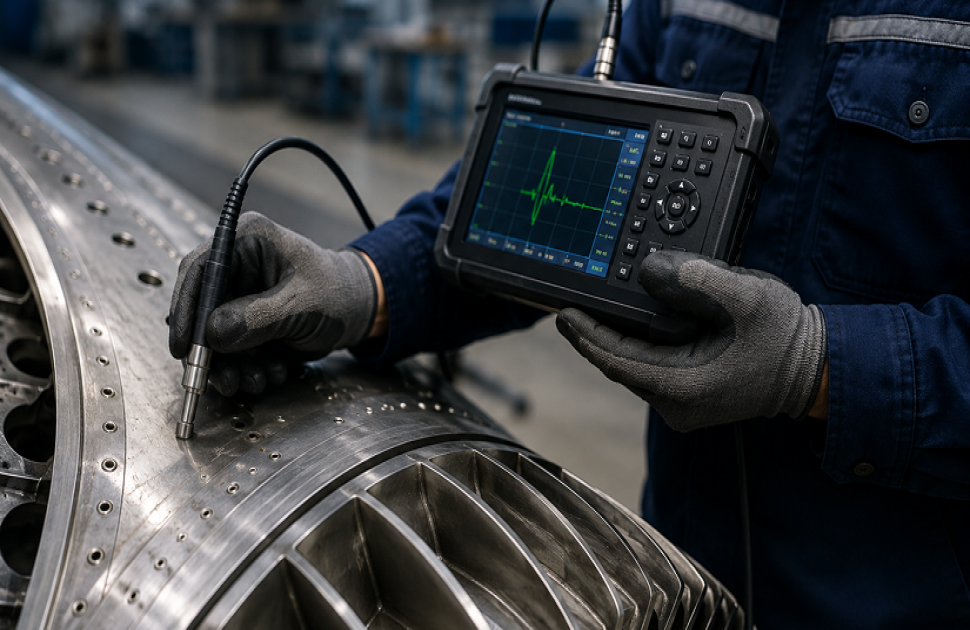
Portable equipment lets the inspector work at the asset instead of removing components and sending them to a laboratory, which is often the single largest saving an eddy current programme delivers. Inspecting in place shortens outage windows, avoids disassembly damage, and allows a suspect indication to be re-examined immediately rather than at the next shutdown. This is why portables dominate in aerospace maintenance, power generation outages, refinery turnarounds, railway axle and wheel inspection, and shipbuilding.
The factors to take into account when choosing a portable unit are battery life, display resolution, environmental protection, wireless connectivity, probe compatibility, and software compatibility. Many of the features that were previously exclusive to lab equipment, such as multi-frequency operation, digital filtering, and onboard data recording, are now available in portable devices. When maximal processing capacity, analytical depth, and reproducibility are needed, benchtop systems continue to be the norm.
Probes: The Business End of the Equipment
The sensing element that generates and detects electromagnetic signals, directly affecting the sensitivity and coverage of inspection, is called the probe. The surface probes examine flat or curved surfaces, pencil probes are used for inaccessible areas, encircling coils examine the rods and tubes, bobbin probes inspect the heat exchanger tubing, rotating probes inspect fastener holes and ECA probes can be used to scan the surface of large areas quickly. A range of interchangeable probes, depending on need, are used by inspectors, as there is no one-size-fits-all type of probe.
Probes are just one part of the system. Here's the complete guide covering probe types, techniques and applications for every eddy current inspection scenario.
→ Read: Eddy Current Testing
Accessories That Complete an Eddy Current Testing System
Accessories to enhance the accuracy and efficiency of the inspection are also part of an eddy current inspection system. Calibration standards can be used to check instrument performance, probe holders and scanners allow for consistent positioning and accurate location tracking by the probe. Other add-on features like extension cables, carrying cases, spare batteries and inspection software make field work easier and reporting simpler.
Features Available in Today's Equipment
Modern eddy current instruments combine faster electronics with far more capable onboard software than earlier generations. Multi-frequency and mixed-frequency operation is now standard on mid-range instruments, allowing several defect depths or material properties to be assessed in a single pass. Frequency mixing is routinely used to suppress unwanted responses such as tube support plate signals.
Digital filtering, auto-balancing and phase rotation are handled in software, which makes setup faster and reduces reliance on operator technique. Touchscreen interfaces have largely replaced knob-driven front panels, and onboard storage with automated report generation means data can be captured, reviewed and exported without a separate PC.
How to match equipment to the job
The type of eddy current testing equipment to be used depends on the application being inspected, the material being inspected, the working environment and future needs. Portable systems for inspections in the field and benchtop (and automated) systems are more capable for laboratories and production lines.
When comparing equipment, take into account compatibility with probes, operating frequency, software compatibility, calibration needs, and scalability over a long time—not only the cost of the machine. The right instrument is the one matched to your defect type, material, access constraints and reporting requirements — not necessarily the one with the most features.
Equipment matching is just the starting point. Here's the complete selection guide covering criteria, frequency ranges, probe compatibility and decision frameworks for every application.
Equipment matching is just the starting point. Here's the complete selection guide covering criteria, frequency ranges, probe compatibility and decision frameworks for every application.
→ Read: How to Choose Eddy Current Instruments
Limitations
Eddy current testing applies only to electrically conductive materials, which rules out most plastics, ceramics and composites. Penetration is limited, so it is primarily a surface and near-surface method rather than a volumetric one. Ferromagnetic materials require either magnetic saturation or specialised techniques because permeability variations can mask real indications. Surface finish, edge effects, part geometry and probe lift-off all influence the signal, and results depend heavily on the qualification of the operator and on correct calibration against representative reference standards.
→ Read: How to Choose Eddy Current Instruments
What's Coming Next
The direction of travel in eddy current testing is towards greater automation and more intelligent handling of inspection data.
AI-assisted signal interpretation is the most active area of development. Machine learning models trained on large sets of classified signals are being used to flag likely indications and reduce the variability that comes with manual interpretation. These tools are being introduced as decision support rather than replacement — the qualified inspector still owns the call — and adoption across the industry is still at an early stage.
Robotic and cobot-mounted inspection is expanding beyond fixed production lines. Crawler and arm-mounted array probes are being used on tanks, pressure vessels and turbine components where manual scanning is slow, repetitive or difficult to access safely.
Cloud-based data management is moving from single-instrument storage towards fleet-level platforms, where records from multiple sites can be reviewed centrally and trended over time. Combined with digital twin platforms, this allows eddy current results to feed directly into asset integrity models, shifting inspection from a periodic pass-or-fail check towards continuous condition monitoring.
Quick Reference Tables
Table 1: Comparison of Eddy Current Testing Equipment
Table 2: Common Probe Types and Their Applications
Table 3: Equipment Selection Checklist
Frequently Asked Questions
1.What is the difference between an eddy current testing machine and a probe?
The entire inspection system, including the electronics that produce and process the signal, the display, the software, and the accessories, is included in an eddy current testing machine. The sensing component that creates eddy currents in the component and measures the ensuing changes in impedance is called a probe. In actuality, the two are inseparable: a probe cannot provide any useful output without an instrument to drive and interpret it, and an instrument cannot inspect anything without a probe.
2. How much does eddy current testing equipment cost?
Cost depends mainly on channel count, frequency range and degree of automation. Basic single-frequency portable flaw detectors sit at the entry level, multi-frequency portables and benchtop analysers occupy the mid range, and ECA instruments and fully automated in-line systems represent the highest investment. Probes, calibration standards, scanners and software licences are usually priced separately and can add significantly to the total. Buyers should request a quotation based on their specific application, since probe and fixture requirements often influence total cost more than the instrument itself.
3. Can portable eddy current testing equipment replace benchtop systems?
For on-site inspections and maintenance, portable systems are best, whereas benchtop systems provide more processing power and analytical capabilities for laboratory testing and advanced quality control.
4. Can one eddy current instrument work with multiple probes?
Yes. Most modern eddy current instruments will accommodate the interchange of probes for surface crack detection, tube inspection, conductivity measurements and ECA inspections.
5. Which industries use eddy current testing equipment the most?
The eddy current testing field is very broad, and is widely used in aerospace, automotive, oil and gas, power generation, railways, marine, nuclear and manufacturing industries for quality control and asset integrity inspection.
6. How often should eddy current testing equipment be calibrated?
The frequency of calibration is determined by manufacturer recommendations and industry standards. Before an inspection, instruments are usually checked against a standard, and calibrated regularly to obtain accurate and reliable results.
Conclusion
The Eddy current testing equipment is now a sophisticated range of instruments, probes, software and computer automated systems for providing rapid, accurate and reliable inspections for a wide range of applications. When choosing the appropriate eddy current testing machine, the application to be inspected, portability, probe compatibility, operating frequency, and data management are all factors to consider.
Modern ECT equipment is getting smarter, more efficient and more effective for predictive maintenance and asset integrity management as new technologies, such as ECA, artificial intelligence, cloud connectivity, robotics and digital twins, continue to emerge and develop. This knowledge of the strengths of each type of equipment and the ability to match it with the equipment's specific needs allows organisations to better improve the reliability of their inspection, minimise downtime and make future investments that will support the organisation's long-term operational performance.