
- Introduction
- Pulsed Eddy Current (PEC) Testing – An explanation
- How Pulsed Eddy Current Testing Works
- PEC vs Conventional Eddy Current Testing
- Applications of Pulsed Eddy Current Testing
- Limitations of Pulsed Eddy Current Testing
- Using PEC Correctly: Screen Broadly, Confirm Selectively
- Conclusion
- Frequently Asked Questions (FAQs)
Introduction
Insulation and/or fireproofing are typically applied to industrial pipelines, pressure vessels, storage tanks and structural steel to enhance energy efficiency and equipment protection. These protective layers prolong asset life, but may allow corrosion to go undetected until substantial wall loss has occurred. The cost, time and effort involved in removing insulation for routine checks is often unnecessary.
Pulsed Eddy Current (PEC) is a viable alternative. It is an electromagnetic non-destructive testing (NDT) method that can be used to check the carbon steel components for corrosion without stripping away the insulation, coatings, or fireproofing. Identification of potential wall loss areas means that detailed inspections are only made where necessary, reducing the inspection cost, minimising downtime and improving maintenance planning.
The article will describe the principles behind pulsed eddy current testing, how it differs from traditional eddy current testing, typical applications and the limitations of the inspectors considering corrosion under insulation.
Pulsed Eddy Current (PEC) Testing – An explanation
Pulsed Eddy Current (PEC) testing is an electromagnetic non-destructive testing (NDT) screening technique that can identify wall loss in carbon steel components without removing them from the structure, with or without insulation, coatings, and fireproofing. It is extensively utilized for corrosion under insulation inspection due to its ability to quickly detect general corrosion, which reduces the need for removing insulation or causing disturbance.
PEC can be used to inspect insulated metal assets, whereas ultrasonic thickness testing is typically done with direct access to the metal surface. It does not give a point measurement, but estimates the average remaining wall thickness in the area which is being inspected by the probe. Therefore, PEC is mainly used as a screening tool for scanning areas that need to be inspected with other techniques, like ultrasonic testing (UT).
How Pulsed Eddy Current Testing Works
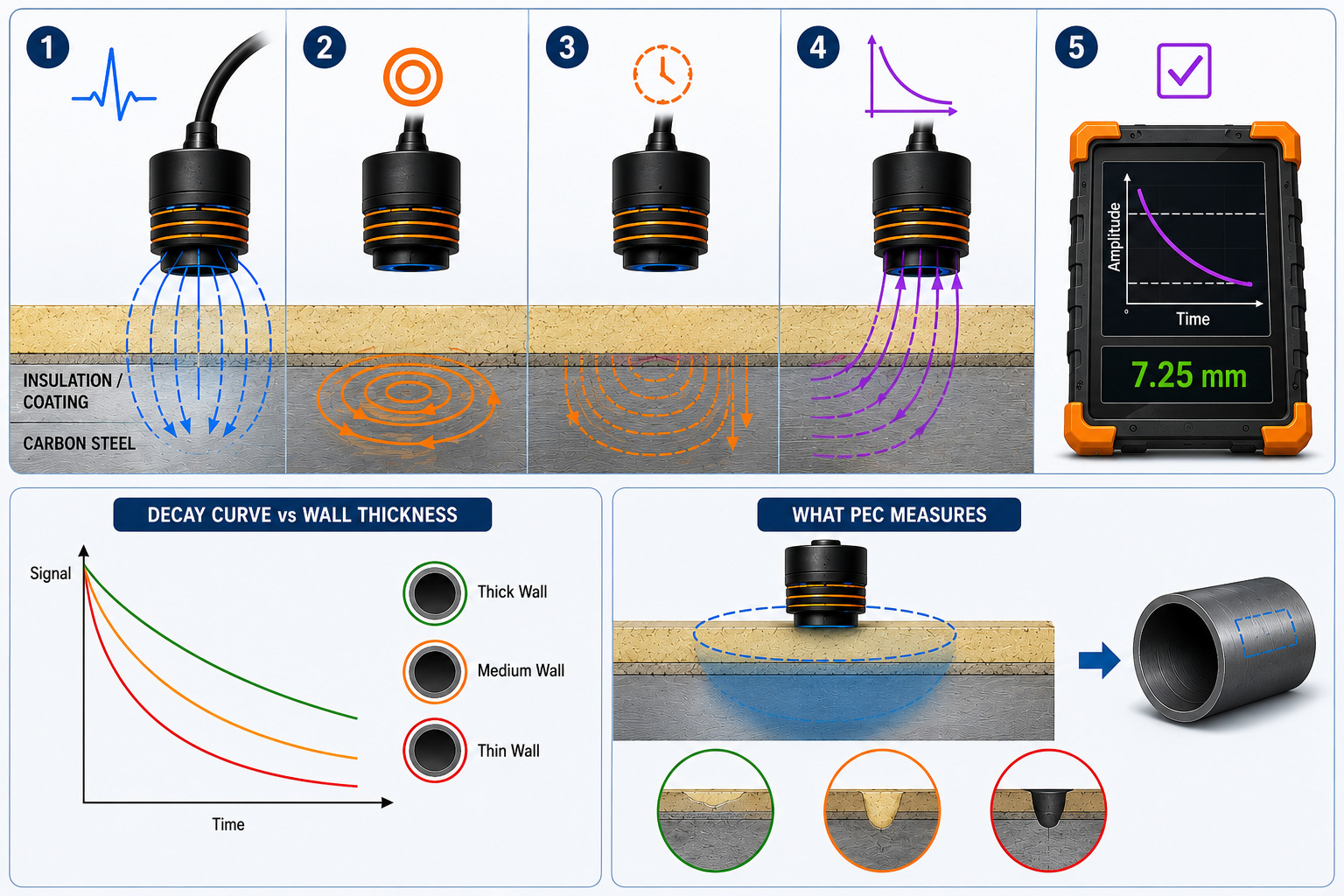
PEC testing works based on the principle of electromagnetic induction. A short magnetic pulse is created by a probe and then passed through the insulation and into the carbon steel. The magnetic field interacts with the steel, creating eddy currents which can be distributed throughout the thickness of the wall. The currents' decay over time give information on the remaining thickness of the wall.
PEC is different from traditional eddy current testing which relies on a steady alternating current, rather PEC examines material's transient response following each pulse. This enables it to both identify and map concealed corrosion under non-metallic barriers without exposing the metal.
Pulse vs Continuous Excitation
The standard eddy current testing method is based on the continuous sinusoidal signal at one or more frequencies. This method works well for finding small surface and near surface defects like fatigue cracks or localized corrosion in conductive materials that can be accessed.
It's a different kind of testing when it comes to PEC. The probe is not transmitting a continuous signal, but rather a short electromagnetic pulse. Each pulse has a wide frequency spectrum and thus the magnetic field will pass into the steel with various depths during the measurement cycle.
As the whole response is recorded within one pulse, PEC is able to assess the integrity of the steel wall, not just the surface defects. This makes it especially well suited for screening insulated carbon steel parts for general loss in the wall.
Diffusion Through the Wall and the Decay Curve
Once the pulse enters the carbon steel it creates eddy currents throughout the material. Upon termination of the excitation pulse, these currents become weaker over time, which leads to a decay of the magnetic field over time. This changing magnetic response is recorded by the probe, and is called the decay curve.
The decay curve is determined primarily by the amount of steel under the probe. The thicker sections have a longer memory, which means that the induced magnetic energy decays slower. These areas will decay faster, resulting in a steeper decay curve, if the wall thickness is reduced due to corrosion.
Modern PEC instruments use calibration data and signal-processing algorithms to estimate the average remaining wall thickness within the area being inspected by analyzing this decay. This method measures total metal loss from corrosion, rather than searching for individual cracks.
Reading Remaining Wall Thickness
PEC does not measure thickness directly, as does an ultrasonic thickness gauge. Rather, it attempts to calculate the thickness of the wall based on the measured decay characteristics and the reference data for the calibration standards with known thickness.
The slower the decay rate the thicker the wall, and the faster the decay rate the thinner the wall. These signal characteristics are translated into an estimated remaining wall thickness or percentage of wall loss so that inspectors can easily identify areas that may need further inspection.
Although these estimates are sufficiently accurate for screening purposes, they should not be considered a substitute for detailed thickness measurements. Ultrasonic measurements are normally used to confirm areas of substantial wall loss prior to making maintenance decisions.
The Probe Footprint: Why PEC Measures an Average
All PEC probes measure a relatively large area of inspection rather than a single point. Therefore, the reported thickness is an average of the thickness of the steel under the probe.
The larger footprint allows inspectors to scan large areas much faster than the point-by-point inspection techniques, and is therefore very effective in large pipelines, pressure vessels, and storage tanks.
Averaging does however mean that in the measurement if one or more defects is isolated, it only has a limited impact on the measurement. If only a small portion of the footprint is affected by corrosion, it is not likely to significantly alter the overall response, while if there is widespread corrosion throughout the footprint, then the signal will be much stronger.
This is why pulsed eddy current is ideal for determining overall wall loss and not for the detection of localized pitting or small defects. If areas of concern are detected, further testing is required, such as ultrasonic thickness testing to give more detailed measurements that can confirm the extent of the corrosion.
PEC vs Conventional Eddy Current Testing
Both methods use electromagnetic induction, but have different inspection purposes. Conventional Eddy Current Testing (ECT) is used to identify surface and near surface defects in conductive parts, whereas Pulsed Eddy Current (PEC) testing is used to survey carbon steel parts for general loss of wall thickness due to insulation or other non-metallic barriers.
Therefore PEC is viewed as a corrosion screening technique and conventional ECT as a flaw detection technique.
The conventional ECT is more sensitive to localized defects while the PEC test is able to speed up the inspection of the insulated assets by identifying areas to be further inspected.
For a deeper look at how standard eddy current methods detect surface and near-surface flaws, see our detailed guide on conventional eddy current testing.
→ Read: Eddy Current Testing Explained
Applications of Pulsed Eddy Current Testing
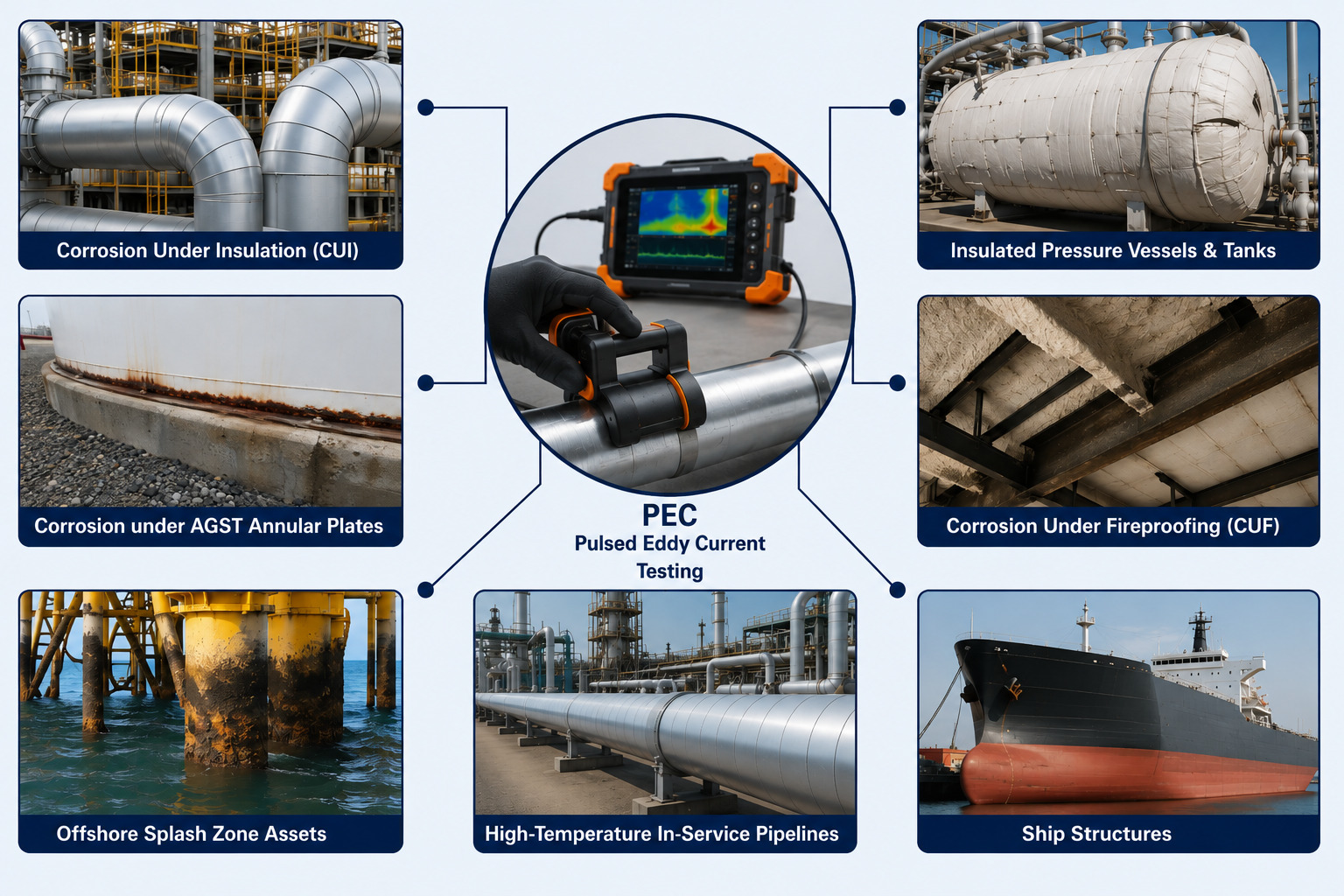
The major benefit of pulsed eddy current testing is the testing of carbon steel products through insulation, coating and fireproofing without losing these protective layers. This means that it is a useful way to scan big industrial applications and save time and money on inspection.
Corrosion Under Insulation (CUI)
The most common application of PEC testing is corrosion under insulation. The moisture between the damaged insulation and the steel surface can slowly corrode the metal surface without being seen. Integrated with Pec, inspectors can inspect for loss of wall thickness in insulated pipelines and equipment without removing the insulation, which helps to make corrosion under insulated equipment and pipelines inspection faster and cheaper.
Corrosion Under Fireproofing (CUF)
The insulation materials used for fireproofing do not only shield structural steel from high temperatures, they can also help to trap moisture that leads to corrosion. Routine inspection by removing fire-proofing is costly and disruptive. PEC can assess the condition of carbon steel under fireproofing and determine areas that need specific follow-up inspection.
Corrosion Under Pipe Supports
Moisture and dirt is always present in pipe supports, which is good breeding ground for corrosion. In these areas it may be difficult to access the area to be inspected, so PEC offers a practical screening solution, by inspecting the surrounding steel structure without dismantling the support and without removing insulation.
Insulated Pressure Vessels and Storage Tanks
Insulation is used for large pressure vessels and heated storage tanks as a measure to increase thermal efficiency. It is difficult to access all parts by removing the insulation. PEC can be used to quickly inspect a large surface area and identify if there is any thinning or damage to the wall – reducing the need to remove insulation.
Structural Steel
Insulated or fireproofed steel is commonly used in industrial facilities to hold up important pieces of machinery. Through PEC testing, these members can be evaluated for possible concealed corrosion and be prioritized for repairs, before structural integrity is compromised.
Offshore Splash Zone Assets
Offshore platforms, having their splash zone continuously exposed to seawater, humidity and salt spray, are highly vulnerable to corrosion. PEC can be used to inspect pipelines and structural items in such harsh conditions without having to prepare their surfaces to an inordinately high degree.
High-Temperature In-Service Pipelines
In many process pipelines it is not desirable to shut down the production for inspection, as operation is required at temperatures where such inspections could not take place. PEC can sometimes be conducted through the insulation, without shutdown of equipment, to minimize downtime and assist condition-based maintenance programs.
Ship Structures
The marine vessels have an insulated carbon steel structure which has been difficult to inspect using conventional methods. PEC can be used to quickly scan these components for the presence of hidden corrosion, so that detailed inspections are only performed when necessary.
Learn more about the latest inspection advancements specifically developed for detecting corrosion under insulation.
→ Read: Advancements in NDT Inspection for Corrosion Under Insulation
Limitations of Pulsed Eddy Current Testing
The PEC test is very good as a screening test under foil insulation but is not appropriate in all inspection situations. Knowing its limits will ensure that it is used correctly and that the outcome of the inspection is interpreted correctly.
Probe Footprint Averages the Measurement
The PEC readings are not single-point readings, but are the average of the wall condition underneath the probe. This allows for a quick examination of a large area but it also makes it easier to miss isolated pits or very small defects and not have a big impact on the overall measurement. PEC is therefore a more effective means of identifying extensive corrosion rather than pitting corrosion.
Reduced Accuracy Near Edges and Complex Geometry
The magnetic field distribution is less predictable in the vicinity of nozzles, flanges, welds, supports and other sudden geometric changes. These features may impact the decay signal and affect reliability of the measurement. Ideally inspections are carried out on fairly uniform areas of the component.
Lift-Off Affects Measurement Quality
The distance between the probe and the steel surface (lift-off) directly affects the signal strength. Air gaps and variations in insulation thickness and/or weather jacketing may affect the accuracy of measurements. These effects can be minimized by good calibration, but excessive lift-off can still cause a loss of sensitivity.
Limited to Ferromagnetic Materials
PEC testing is the most commonly used testing method for carbon steel and other ferromagnetic materials. It is not appropriate for austenitic stainless steel, aluminum, copper or other non-ferrous alloys as they will not give a magnetic response that is necessary to take accurate measurements.
Cannot Identify the Exact Location of Wall Loss
PEC does not identify which surface of the wall, internal, external or throughout, is being affected by the corrosion. Further inspections are necessary if the exact location or shape of the corrosion needs to be known.
Requires Confirmation with Other NDT Methods
PEC is a screening method and a positive result should be confirmed whenever there is a significant loss in the walls. The follow-up method most commonly employed is ultrasonic thickness testing, which can give accurate thickness readings that aid in the repair and fitness for service decisions.
Using PEC Correctly: Screen Broadly, Confirm Selectively
The best use of Pulsed Eddy Current (PEC) testing is in combination with other inspection techniques. PEC is not a replacement for other NDT methods but is an excellent tool for quickly pinpointing areas where corrosion is likely and hence detailed examination can be concentrated only on those areas.
The screening of insulated carbon steel assets begins with a typical workflow using PEC. Selected areas with apparent wall thinning are then removed of insulation, and undergo ultrasonic thickness (UT) testing to provide accurate point thickness measurements and to validate the amount of metal lost. The targeted approach means that not unnecessary insulation is removed, inspection costs are reduced, there is less downtime and maintenance planning is improved.
Rapid screening and accurate thickness verification can be combined to allow the inspection of larger assets more efficiently and with confidence in the inspection results.
Looking to scale up your PEC screening? Explore the PECA (Pulsed Eddy Current Array) probe for faster, higher-coverage inspection of large insulated assets.
→ Read: PECA Pulsed Eddy Current Array Probe
Conclusion
The Pulsed Eddy Current (PEC) Inspection is an important inspection method for general wall loss on insulated carbon steel assets as it does not require the removal of insulation, coatings or fireproofing. It is also highly effective in corrosion under insulation inspection because it can easily survey large areas within a short period of time, which can not only save inspection time but also save inspection costs, and help maintenance teams discover the problem area.
But the use of PEC must be considered a screening rather than a replacement thickness measurement. Each reading is an average measurement within the probe footprint, so if the defect is local and/or the geometry is complex, ultrasonic testing or other complementary NDT techniques may be needed to confirm.
PEC, when incorporated into a risk based inspection program, provides an effective tool for improved asset management; it can be used to specify inspection areas with a greater degree of specificity, thus avoiding unnecessary insulation removal and informed decisions on maintenance to maximize equipment reliability and plant safety.
Frequently Asked Questions (FAQs)
1. How thick an insulation layer can Pulsed Eddy Current (PEC) testing inspect through?
The efficiency of the inspection will vary with the equipment, probe design, insulation material, and calibration. Most modern PEC testing systems allow the inspection of carbon steel given several centimeters of non-metallic insulation and weather cladding, but as the thickness of the insulation increases, the intensity of the signal will diminish and this could impact test accuracy.
2. Is it possible to detect pitting corrosion with PEC testing?
The best PEC results are obtained on detecting a loss of wall over the probe footprint. Small, isolated pits may not make an appreciable difference in the averaged measurement, making them difficult to detect. If localized pitting is suspected, the area is usually confirmed by ultrasonic thickness testing or other high-resolution NDT method.
3. Is PEC testing a replacement for ultrasonic thickness testing?
No. ultrasonic testing can do point by point thickness measurement judgment, and Pulsed Eddy Current testing can only be used to identify the area where the wall has potential loss. In practice, PEC is used in prioritization of inspection locations and UT is used to confirm corrosion prior to making maintenance decisions.
4. What is PECA?
Pulsed Eddy Current Array (PECA) is an enhanced version of PEC technology that incorporates multiple sensing elements into an array instead of a single probe. This enhances coverage of inspections, accelerates the rate of data collection, and creates more detailed maps of corrosion on large pipelines, vessels, and storage tanks.
5. Does PEC testing work on stainless steel?
The main use of PEC is for carbon steel and other ferromagnetic materials. Not generally suitable for austenitic stainless steel, aluminum, copper or other non-ferromagnetic alloys, since these are not the same response to pulsed magnetic fields as carbon steel.
6. Which industries commonly use Pulsed Eddy Current testing?
PEC testing is used in a vast array of industries such as oil and gas, petrochemical, chemical processing, power generation, marine and offshore. It is used quite often in insulated pipelines, pressure vessels, storage tanks, structural steel, and even fireproofed equipment, where hidden corrosion is considered to be a threat to long-term integrity of the apparatus.