
Table of contents
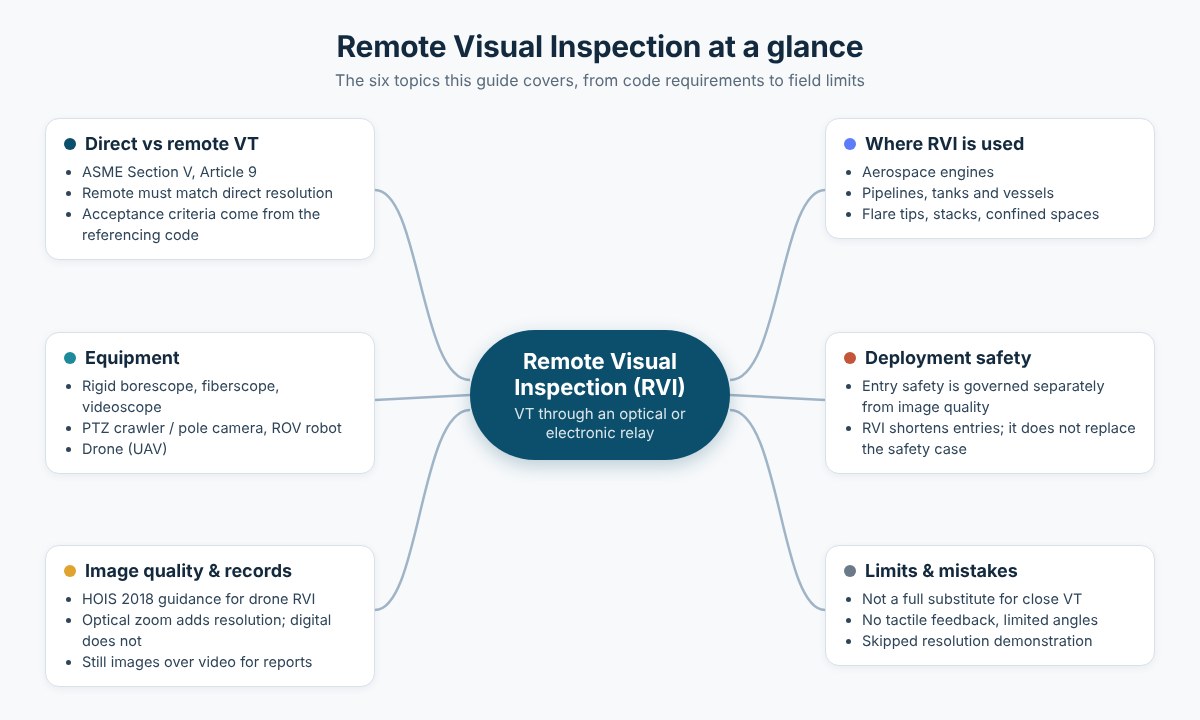
- From a mirror on a stick to a drone in a tank
- Direct VT vs. remote VT, and what Article 9 actually requires
- Equipment: what each tool is actually good for
- Image quality, documentation and recording
- Where RVI is used
- Confined-space and deployment safety
- Limits and common mistakes
- Key takeaways
- FAQs
- Further reading
- References
From a mirror on a stick to a drone in a tank
Visual testing (VT) is the oldest NDT method and still the first one run on almost every asset. Most of it, though, is no longer a technician’s unaided eye against a surface — it is a borescope threaded into an engine, a crawler rolling through a pipeline, or a drone hovering inside a tank. That shift is what “remote visual inspection” (RVI) means, and it comes with its own equipment choices, its own qualification requirements, and its own ways to get it wrong.
This hub is a working reference for asset integrity managers and MRO engineers choosing and running RVI: what separates direct from remote visual testing under ASME Section V, Article 9; what each piece of equipment — borescope, videoscope, crawler, drone — is actually good for; how image quality and documentation are judged; and where RVI is used across aerospace, pipelines, tanks and confined spaces. A companion article covers drone-specific class and regulatory acceptance in depth; this one covers the method family as a whole.
Direct VT vs. remote VT, and what Article 9 actually requires
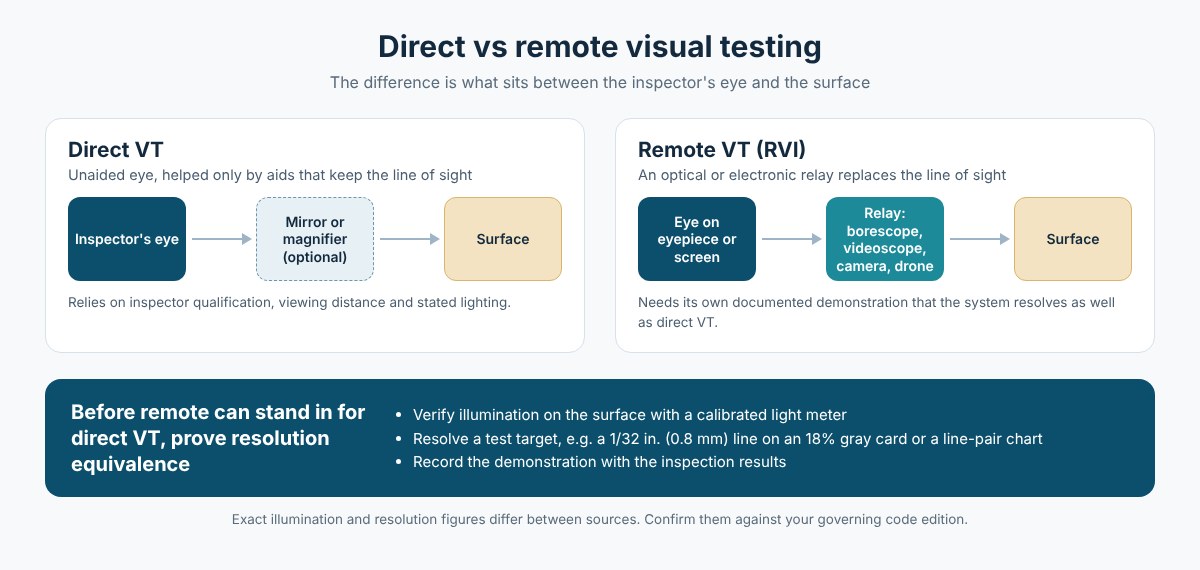
The industry draws the line based on what stands between the inspector’s eye and the surface. Direct visual examination is performed by the unaided eye, aided only by things that do not substitute an optical or electronic relay for that line of sight — mirrors to improve angle or access, magnifying lenses, corrective lenses. Remote visual examination (RVI) is any technique that interposes such a relay: telescopes, borescopes, fiberscopes, videoscopes, fixed or pan-tilt-zoom cameras, crawler and ROV robots, and drones. ASME Boiler and Pressure Vessel Code, Section V, Article 9 (“Visual Examination”) is the code most often cited for this distinction in pressure-equipment and piping work; Section V sets NDE methods only — it does not itself set acceptance criteria, which come from the referencing Code Section (Section I, Section VIII, or an API inspection code).
The requirement that carries across every source on this topic, even where exact numbers differ: a remote system has to demonstrate resolution at least equivalent to direct visual observation before it can substitute for it. That demonstration — not the hardware category itself — is what the code is actually policing.
Two specific numbers get cited for this demonstration, and secondary sources do not fully agree on them against ASME’s own text:
- A minimum illumination level on the examined surface, verified by a calibrated light meter. One secondary source puts this at 100 fc (1000 lux) and attributes it to Article 9 directly; another document instead attributes a 50 fc minimum specifically to ASME Section XI, Table IWA-2210-1 (a nuclear in-service inspection table), and states that Article 9’s own text does not carry a numeric illumination minimum. Confirm the actual figure that applies against your governing edition before treating either number as settled.
- A resolution test for the remote system: one description calls for resolving a 1/32 in. (0.8 mm) line on an 18% neutral gray card; a separate industry-magazine source instead cites roughly 3 line pairs per millimetre (lp/mm), tied to both Article 9 and BS EN 17637, tested in a real trial using a USAF 1951 resolution chart, though that source does not report the measured lp/mm result from the trial itself. These may describe the same underlying requirement in different terms, but that has not been confirmed against primary text.
One common field conflation worth flagging directly: near-vision acuity testing (Jaeger charts) is a personnel certification requirement — tied to SNT-TC-1A or ISO 9712 written practices and vision exams — not a documented Article 9 requirement on the examination system itself. Sources that tie Jaeger testing to code compliance are describing certification, not Article 9.
Equipment: what each tool is actually good for
Equipment | Articulation / reach | Optics | Recording | Best fit |
|---|---|---|---|---|
Rigid borescope | None (rigid shaft) | Relay-lens/rod-lens train; no chip camera | None inherent — needs an eyepiece/camera adapter | Straight bores, drilled holes, straight tubes |
Flexible fiberscope | Flexible, some steerable tips | Coherent fiber-optic bundle (image degrades as individual fibers break) | Limited, only via adapter | Winding paths — engine internals, valve bodies |
Videoscope | Flexible, articulating distal tip | Camera-on-a-chip (CMOS/CCD) at the tip — no fiber-bundle degradation | Native digital, often with measurement software | Same access as fiberscopes, with higher image fidelity and documentation |
PTZ crawler/pole camera | Motorized pan-tilt-zoom on a crawler or extension pole | Camera module, often with optical zoom | Native digital | Tank, vessel and pipe interiors needing wide coverage |
ROV/crawler robot | Mobile platform (tracked, wheeled or magnetic), multi-sensor | Visual camera plus optional UT probe or structured-light 3D scanner | Digital, sometimes geotagged to a 3D model via onboard localization | Confined-space vessel/tank inspection combining visual with thickness or pitting data |
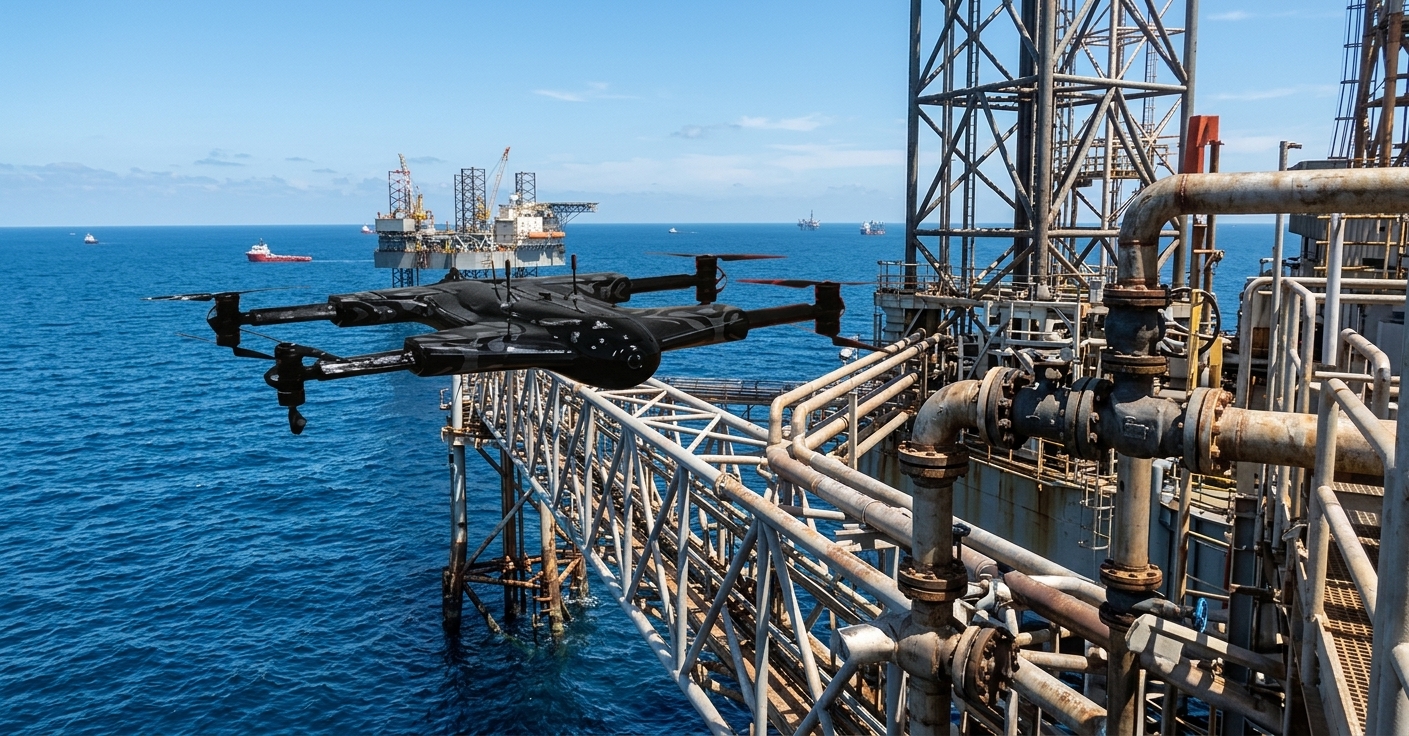
Drone (UAV) | Full 3D flight, no contact | Camera payload — sensor size and image quality vary widely by platform | Native digital; still images are generally preferred over video for final reports | Elevated or awkward external access — flare tips, stacks, tank exteriors |
The real differentiators across this list are the optical path (fiber bundle vs. chip-on-tip), articulation (fixed vs. steerable), reach and access, integral lighting adequacy, and whether recording/measurement is native or needs an adapter. Digital zoom on any of these adds magnification on screen without adding real resolution — only optical zoom or getting physically closer improves what the system can actually resolve.
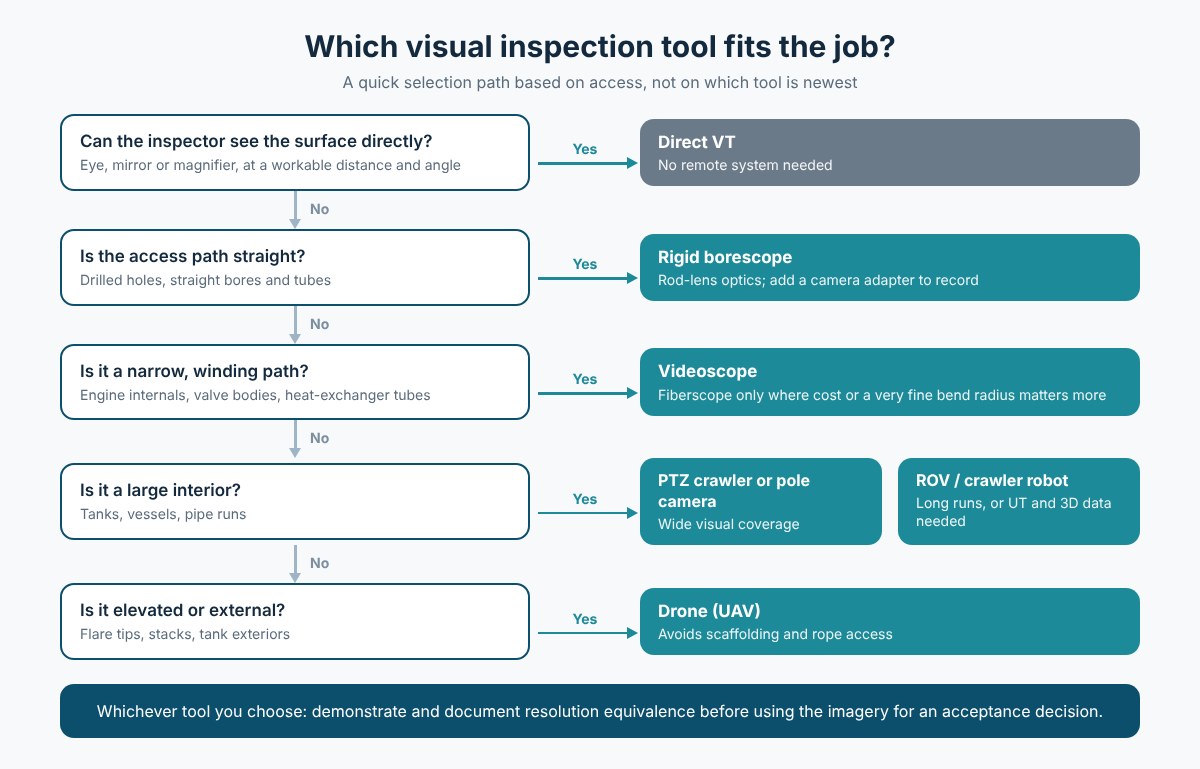
Image quality, documentation and recording
Before 2018, no published standard set a minimum image quality for drone-based external visual inspection in oil and gas, which produced inconsistent, non-comparable results across contractors. The industry body HOIS filled that gap with “Guidance on Image Quality for UAV/UAS-Based External Remote Visual Inspection in the Oil & Gas Industry,” covering three priority applications — resolution comparable to close/direct VT, coating assessment (referencing ISO 4628), and flare-tip or stack inspection — along with spatial-resolution recommendations, viewing direction, ambient light and camera settings, file formats and post-processing.
For the drones themselves, ASTM Committee F38 (Unmanned Aircraft Systems) covers airworthiness, flight safety and manufacturing conformance — it is a flight-safety standard, not an industrial-inspection image-quality standard. A dedicated article on drone-specific class-society and regulatory acceptance covers this ground further.
Two practical points apply, and one requirement does not exist publicly:
- Resolution. Whichever test method your governing spec actually cites, confirm the system meets it before relying on the imagery for an acceptance decision.
- Still images over video for final engineering reports: still frames are more reviewable and archivable than video, and sensor signal-to-noise and camera ISO settings generally matter more to usable resolution than nominal megapixel counts.
- No numeric minimum frame rate for digital RVI recording exists in any public source — treat any such figure as unsupported rather than a quoted requirement.
Where RVI is used
- Aerospace engines. Rigid and flexible borescopes reach combustion chambers and blade stages without teardown; AI-assisted videoscope software is now used to flag likely defects for a human inspector to confirm, not to replace that confirmation.
- Pipelines. Pipe-crawler robots (tracked or wheeled) carry a visual camera, sometimes paired with a UT probe, through runs too long or hazardous for a hand-held tool.
- Tanks and vessels. PTZ crawler cameras and ROV-style crawlers cover large interior surfaces; drones cover tank exteriors and, where airflow and lighting allow safe flight, can substitute for a confined-space entry on some interiors.
- Elevated and awkward structures. Flare tips, stacks and tank exteriors are the clearest drone use case — access that would otherwise need scaffolding or rope access.
- Confined spaces generally. Any of the above can substitute for a physical entry, provided the resolution-equivalence requirement discussed above is actually met and documented.
Several manufacturers are active across these equipment categories (mentioned as examples, not endorsements): RVI Infinity Innovation offers Inspector-series videoscopes and a rigid borescope; Evident (formerly Olympus Scientific Solutions) and Waygate Technologies include RVI equipment within broader inspection portfolios; and ScoutDI builds drones designed for confined-space inspection.
Confined-space and deployment safety
Image-quality guidance and confined-space entry safety are governed separately — HOIS and BINDT publish them as distinct documents, and meeting an image-quality standard says nothing about whether a drone or crawler deployment itself was done safely. Hazard identification, entry permits, atmospheric monitoring and rescue planning for confined-space work are covered in OneStopNDT’s confined-space safety guide; use RVI equipment to avoid or shorten a confined-space entry, not to skip the safety case for the entries that still happen.
Drone-specific regulatory and class-society acceptance — flight authorization, safety cases for tank and hull inspection, and what inspection data different class societies will actually accept — is covered in a companion article on confined-space drone inspection.
Limits and common mistakes
- Treating RVI as a full substitute for close visual inspection. Industry guidance explicitly warns against claiming robotic or drone-based RVI as a complete replacement for close visual inspection (CVI) — remote inspection should flag areas that then get a closer look, not replace that look entirely.
- Skipping the resolution-equivalence demonstration. Relying on remote imagery for an acceptance decision without first demonstrating and documenting that the system resolves as well as direct VT is the core compliance gap described above.
- No common image-quality basis before HOIS. Before the 2018 HOIS guidance, the lack of a shared minimum for drone image quality produced inconsistent, non-comparable inspection results across contractors.
- Conflating direct and remote qualification. Direct VT relies on inspector qualification and stated lighting; remote VT needs its own documented equipment-resolution demonstration — treating the two as interchangeable is a cited risk.
- Physical and operational limits of robotic RVI. Distance from the surface, restricted viewing angles, no tactile feedback, no surface-prep aids, and lighting difficulty in confined or dark vessels all reduce what remote systems can reliably catch compared with a hands-on inspection.
- Weak documentation. Favor still images over video for anything going into a final engineering report — they are more reviewable and archivable, and sensor signal-to-noise matters more than resolution specs printed on a data sheet.
Key takeaways
- Direct VT uses the unaided eye (plus mirrors/magnifiers); remote VT (RVI) interposes an optical or electronic relay — borescope, videoscope, crawler camera or drone.
- ASME Section V, Article 9 is the method standard most often cited for this distinction; it sets no acceptance criteria of its own, and the specific illumination and resolution numbers attributed to it vary by source and need to be verified against the current edition of the code.
- Equipment choice is about optical path, articulation and reach, not just “which is newest” — a rigid borescope, a videoscope and a drone solve different access problems, not the same one.
- HOIS’s 2018 image-quality guidance is the clearest public standard for drone-based external visual inspection; no public source gives a numeric minimum frame rate for RVI recording.
- RVI reduces or replaces confined-space entries; it does not replace the entry’s safety case when an entry still happens, and image quality and entry safety are governed by separate documents.
FAQs
What’s the difference between direct and remote visual testing?
Direct VT is the unaided eye, aided only by mirrors or magnifying/corrective lenses. Remote VT (RVI) uses an optical or electronic relay — a borescope, videoscope, camera or robot — between the eye and the surface.
Does ASME Section V set acceptance criteria for visual inspection?
No. Section V, including Article 9, sets examination methods; acceptance criteria come from the referencing Code Section or inspection code.
What illumination level does Article 9 require?
Sources disagree: one cites 100 fc (1000 lux) as an Article 9 figure, another attributes 50 fc specifically to ASME Section XI, not Article 9. Confirm against your governing edition before relying on a specific number.
Is a videoscope just a better fiberscope?
In image quality, generally yes — a videoscope’s camera-on-a-chip doesn’t degrade the way a fiberscope’s fiber-optic bundle does with use, and it natively supports digital recording and measurement. A fiberscope can still be the right tool where cost or a very fine bend radius matters more than image fidelity.
Can a drone replace a confined-space entry?
Sometimes, where lighting, airflow and resolution requirements can be met and demonstrated — but it replaces the entry, not the entry’s safety case when one is still required, and image-quality compliance is governed separately from deployment safety.
Is there an industry standard for drone image quality?
HOIS’s 2018 “Guidance on Image Quality for UAV/UAS-Based External Remote Visual Inspection in the Oil & Gas Industry” is the clearest public one, covering resolution, coating assessment and flare-tip/stack inspection.
Is there a minimum frame rate for RVI video?
No public source states one. Still images, not video, are generally preferred for final engineering reports.
Is near-vision (Jaeger) testing an Article 9 requirement?
It’s commonly discussed alongside visual inspection, but available sources tie it to personnel certification (SNT-TC-1A/ISO 9712 vision exams), not to Article 9 as an examination-system requirement.
Further reading
- Different Types of Visual Inspection — broader VT overview
- Video Borescope Selection Guide — how to choose a borescope
- Drones for Confined-Space Inspection: What Class Societies Accept — marine/offshore class-society acceptance for drone-based RVI
References
- U.S. NRC (ADAMS ML012570327), document quoting ASME Section V Article 9 definitions of direct and remote visual examination, plus the ASME Section XI illumination table — nrc.gov
- GlobalSpec, ASME BPVC Section V listing (NDE methods, no acceptance criteria) — standards.globalspec.com
- Open Exam Prep, API-653 VT/MT study guide (illumination and resolution figures, secondary/paraphrased) — open-exam-prep.com
- ASNT Source magazine, robotic RVI resolution trial referencing Article 9 and BS EN 17637, and discussion of HOIS guidance — source.asnt.org
- CIS Inspector, Jaeger vision-test product page citing ISO 9712:2022 and SNT-TC-1A — cis-inspector.com
- BINDT, announcement of HOIS image-quality guidance for UAV-based external RVI in oil and gas — bindt.org
- ASTM International, Committee F38 (Unmanned Aircraft Systems) scope — astm.org
There are no comments yet!