

Table of contents
- A drone flying the tank is not the same as the survey being closed
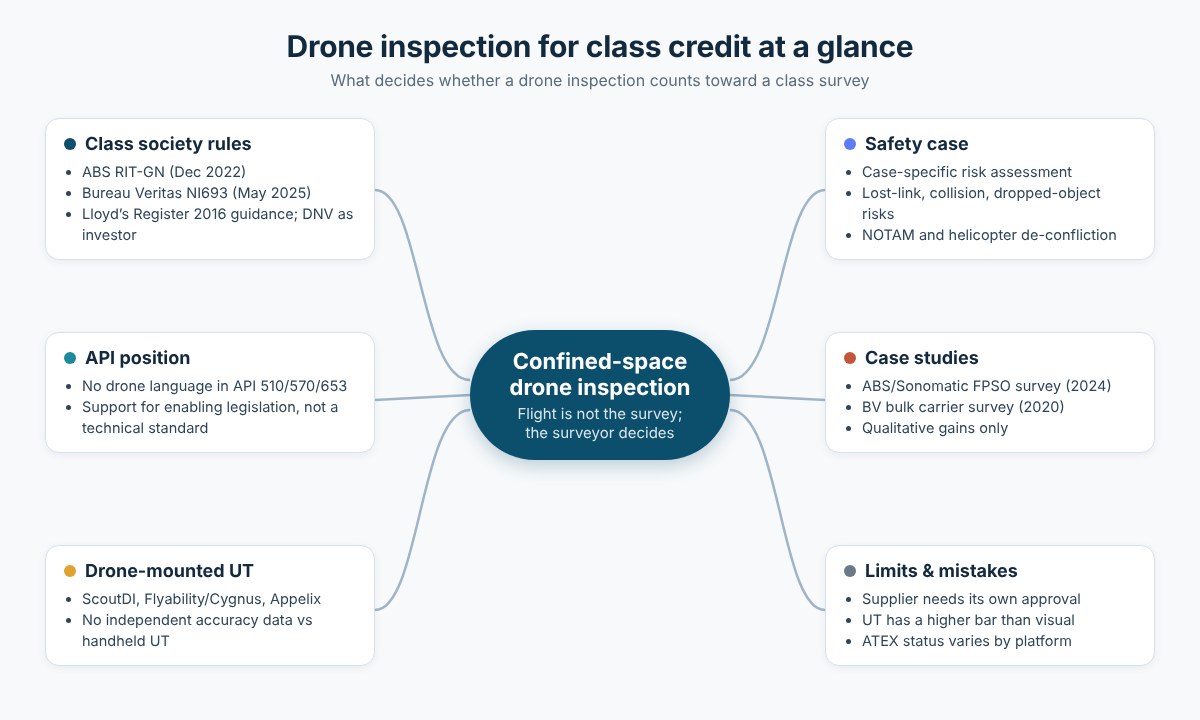
- What each class society actually permits
- Where API stands
- UT from drones, and the accuracy data nobody has published
- The safety case
- Case studies — and the data gap behind them
- Limits and common mistakes
- Key takeaways
- FAQs
- Further reading
- References
A drone flying the tank is not the same as the survey being closed
A drone can fly a ballast tank, a cargo hold or an FPSO oil tank in a fraction of the time a scaffold-and-entry survey takes. Whether that flight actually counts as the survey is a separate question, and it is the surveyor’s or the class society’s to answer, not the drone operator’s. This article is about that second question: what ABS, Bureau Veritas, Lloyd’s Register and DNV currently accept as class credit for drone-based inspection, what API’s codes do and do not say about it, where ultrasonic thickness measurement from a drone stands, and what a deployment’s safety case has to cover.
The companion hub article, Remote Visual Inspection: From Borescopes to Drones, covers the equipment and the general ASME Section V visual-testing framework. This article goes deeper into one area the hub does not cover: marine and offshore class-society acceptance.
What each class society actually permits
Society | Governing document | What it covers | Status |
|---|---|---|---|
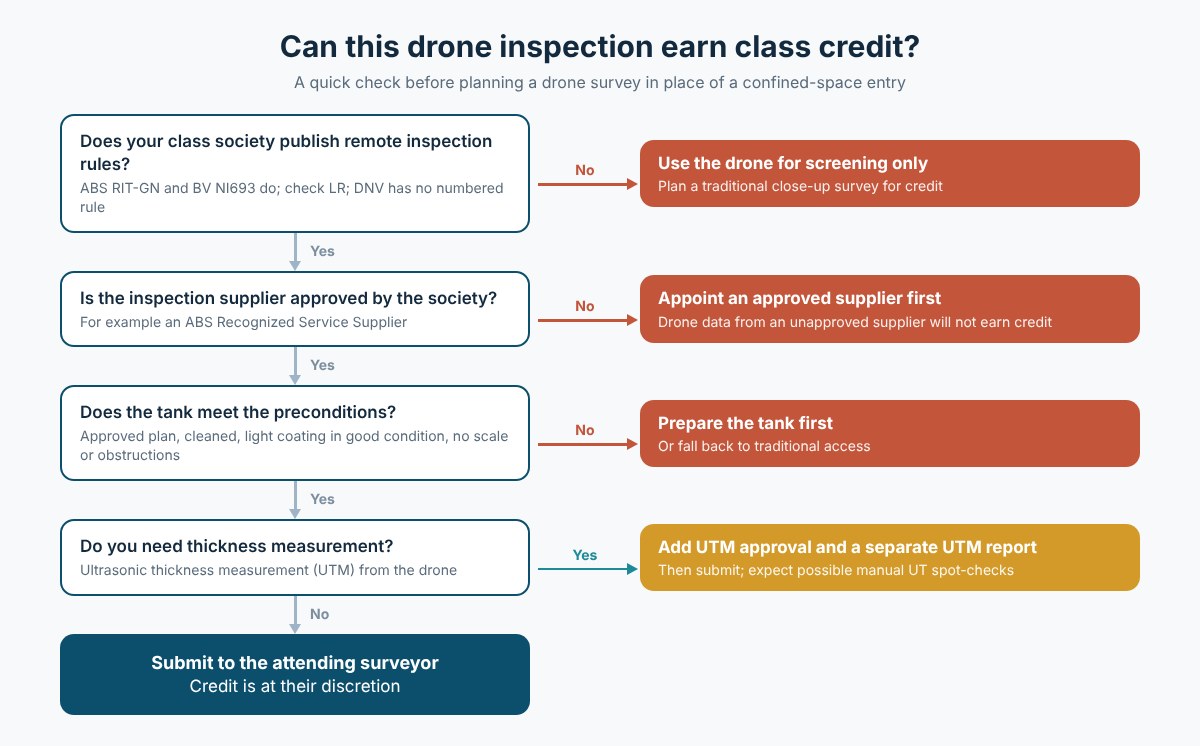
ABS | Guidance Notes on the Use of Remote Inspection Technologies (RIT-GN), December 2022 — supersedes ABS’s earlier UAV-specific guidance | UAVs, ROVs, robotic crawlers and arm/pole-mounted cameras as an alternative means of access for close-up surveys, per IACS UR Z17 | Published, numbered, in force |
Bureau Veritas | NI693 “Remote Inspection Techniques,” current edition May 2025 | Aerial drones, ROVs, crawlers and robot arms/poles for internal hull structures in enclosed spaces or tanks | Published, numbered, in force |
Lloyd’s Register | 2016 guidance notes on drones/UAS (“Phase 1”) | Regulations, personnel, quality, safety, hardware/software and operations; LR described extending this to confined spaces such as storage tanks and ship undersides as a future goal, outside the 2016 scope | Published 2016; check with LR for the current document number and close-up survey credit wording |
DNV | No numbered class guideline for drone surveys | A 2015 tank-drone test was explicitly framed as a screening step only (“if any damage is detected, a traditional close-up survey may still be required”), with a drone-survey guideline described as “in development” at the time | Active mainly as an investor (via DNV Ventures, backing ScoutDI since 2021) rather than as publisher of a numbered UAV survey rule |
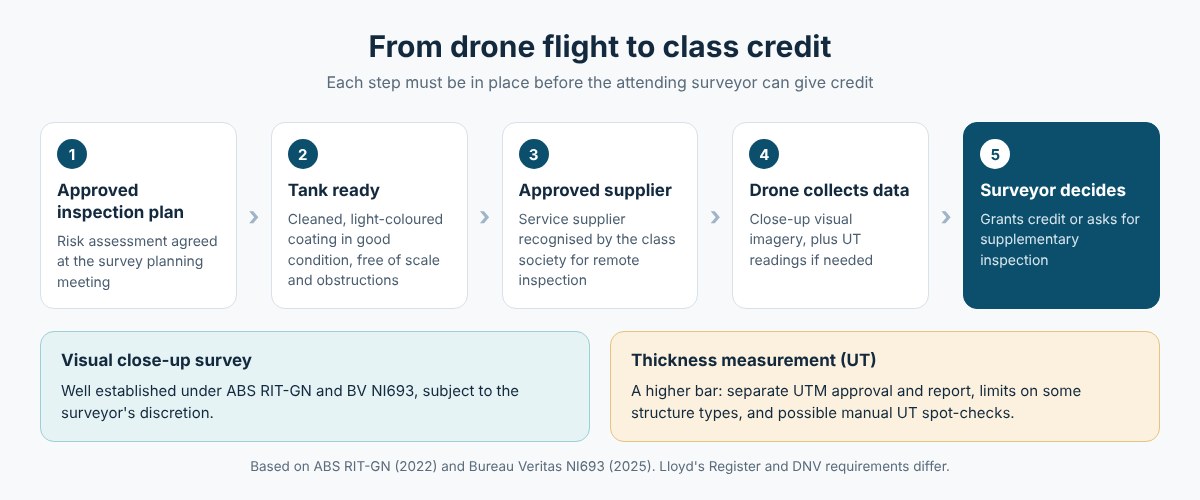
Acceptance at any of the three publishing societies is at the discretion of the attending surveyor, who may still require supplementary inspection even where RIT/drone data is submitted. Two specific technical limits recur across the published rules:
- The inspection company, not just the drone, needs to be approved. ABS requires the service supplier to be an ABS Recognized Service Supplier for close-up exams, with separate certification for hull gauging if ultrasonic thickness measurement is involved. BV similarly requires the supplier to be approved for both RIT and UTM (ultrasonic thickness measurement), with a separate UTM report required.
- Thickness measurement has a harder bar than visual. ABS’s own guidance table leaves in-water NDT without a specific recommendation rather than endorsing or ruling it out, and separately notes some structure types (e.g., inclined hopper plates) still need further technology development before RIT thickness measurement works reliably there. BV requires that temporary access still be provided for thickness measurement unless the RIT platform itself can perform it.
Where API stands
Unlike the marine class societies above, API 510 (pressure vessels), API 570 (piping) and API 653 (tanks) do not explicitly address drone or UAV inspection in their code text. API’s clearest documented position on drones is institutional rather than technical: in 2016, API publicly supported an FAA Reauthorization provision allowing UAS use for inspection and emergency response at oil and gas facilities, refineries and pipelines, with API’s midstream director framing it as “another means to safely conduct preventative inspections”.
API has no standalone recommended practice on drones. Newer editions of API RP 580, or of 510/570/653 themselves, may add drone-specific language, so check the current edition before relying on either position.
UT from drones, and the accuracy data nobody has published
Several companies now offer ultrasonic thickness measurement from a drone-mounted probe rather than visual-only inspection:
- ScoutDI, a Norwegian company, offers a “UTM Payload” — live UT with a built-in surface brush and couplant deployment — on its tethered Scout 137 Gen 3 confined-space drone.
- Flyability’s Elios 3, paired with Cygnus Instruments probes, offers a UT payload in 2.25 MHz single-crystal and 2/5/7.5 MHz twin-crystal configurations; the 2.25 MHz probe is stated by the vendor to meet IACS requirements for marine thickness measurement.
- Appelix offers exterior-shell UT drones for aboveground storage tanks (API-650/653-type assets), with an integrated gas-sniffer payload rated for hot-work permits in Class 1 Division 2 (ATEX Zone 2) hazardous locations.
None of these systems has publicly available, independently verified data comparing its accuracy or repeatability with handheld UT. Vendor pages describe their measurements as “accurate” and “repeatable” without supporting figures or a stated comparison method. The only published number is throughput — “several hundred measurements per hour” for aerial robotic UT systems in general — which says nothing about accuracy. Treat any accuracy claim for drone-mounted UT as a vendor claim until an independent figure is published, and confirm separately with your class society whether its own rules require parallel manual UT spot-checks regardless of the drone data — both ABS and BV guidance lean this way for at least some structure types (see above).
The safety case
ABS’s RIT-GN is the most concrete public source on what a drone deployment’s safety case needs to document:
- A case-specific risk assessment, finalized at the survey planning meeting and folded into the Survey Planning Document.
- Named risk categories: hazardous-area explosion risk, dropped objects, collisions, lost-link (UAV-specific), and other personnel risks.
- A RIV (remote inspection vehicle) operations plan covering the team, emergency procedures and incident response.
- A safety-case extension may be required for night operations, at the operator’s discretion, rather than as a standalone mandatory document.
- UAV-specific airspace coordination: filing a NOTAM where relevant, and a 30-minute de-confliction window around any scheduled helicopter activity.
- Tank preconditions before credit is given: an ABS-approved inspection plan, a cleaned tank, light-colored coating in good condition, and freedom from scale or obstructions.
The UK’s Oil & Gas UK (now OEUK) trade association published offshore drone guidelines, which drone-service provider Cyberhawk publicly welcomed. The guidelines are industry-backed, but their detailed ATEX, retrieval-plan and exclusion-zone requirements are not publicly available. This is trade-association guidance, not a publication from the UK’s statutory regulator (HSE) — the two should not be conflated when citing it. We are not aware of a dedicated HSE publication on confined-space drone safety cases.
Equipment certification has historically lagged the ambition: a 2015 DNV GL test required the tank to be certified gas-free and safe for entry before flying at all, specifically because no ATEX-certified commercial drone existed yet at that time. Confirm current ATEX/explosive-atmosphere certification status for your specific platform before assuming it is solved.
Case studies — and the data gap behind them
- ABS, FPSO cargo oil tank special survey, Gulf of Mexico, 2024. Sonomatic, Geo Oceans and AUAV performed an entirely robotic special survey for Shell — all gauging and visual work done robotically, with zero personnel tank entry — and ABS signed it off as meeting full special-survey requirements. No quantified time, cost or defect-count data was published.
- ScoutDI / Shell “Turritella,” 2024. The first ABS class sign-off for a robotic FPSO cargo tank inspection was achieved on Shell’s “Turritella” FPSO. Separately, in the same year, ScoutDI also performed an unrelated autonomous cargo-tank inspection on a Klaveness Combination Carrier (a bulk/combination carrier, not the Turritella FPSO) during a transit between New York and the Bahamas. Both are described publicly only in a DNV Ventures article about its own portfolio company, with no independently verified outcome data.
- Bureau Veritas, IMO Enhanced Survey Programme intermediate survey, Italy, 2020. BV performed close-up inspection and ultrasonic thickness measurement of two cargo holds on a bulk carrier entirely by drone, with flag-state pre-approval (a statutory ESP ship) and a BV-certified operator approved for both RIT and UTM. BV described it as “survey ready on an operational basis,” with only qualitative claims (less staging, less work at height) and no numeric comparison.
- DNV GL / Scout Drone Inspection / Altera Infrastructure, Petrojarl Varg FPSO, 2020. An AI crack-detection drone test in a 19.4 m oil tank, run as a technology-qualification step rather than a rule change. Industry context cited qualitatively (“a single traditional survey can exceed $1 million,” tank interior exceeding 50°C, time savings of “several scales of magnitude”) but with no controlled before/after comparison or defect count.
The pattern across these cases is the same: qualitative safety and efficiency claims, but no independently audited comparison of time, cost or defects found against a traditional confined-space-entry survey. The industry is still at the qualification and first-sign-off stage (2015–2024), not yet at the point of published comparative performance data. Treat any specific percentage time or cost saving for drone-based confined-space inspection with caution unless it is independently sourced.
Limits and common mistakes
- Assuming the drone flight itself is the survey. Credit is given at the attending surveyor’s discretion under the relevant society’s RIT rules, not automatically because a drone collected the data.
- Forgetting the supplier needs its own approval. Both ABS and BV require the inspection company — not just the drone — to hold specific recognitions (close-up survey, and separately UTM, for thickness work).
- Treating thickness measurement like visual inspection. Visual RIT credit is well-established; thickness measurement from a drone is newer, has published limits on some structure types (ABS gives no specific recommendation for in-water NDT and flags some inclined surfaces), and may still need a manual UT spot-check in parallel.
- Citing drone-UT accuracy figures that do not exist publicly. No vendor publishes independently verified accuracy or repeatability data against handheld UT, so any specific tolerance needs its own source.
- Confusing a trade association’s guidance with a statutory regulator’s. OGUK/OEUK’s 2016 offshore drone guidelines are industry-backed but are not an HSE publication — keep the two separate when citing either.
- Assuming ATEX certification is a solved problem for every platform. It wasn’t in 2015, and platform-by-platform certification still needs confirming today rather than assumed.
Key takeaways
- ABS (RIT-GN, Dec 2022) and Bureau Veritas (NI693, May 2025) both publish numbered, in-force rules permitting drone-based remote inspection techniques for close-up survey credit; Lloyd’s Register has 2016 guidance whose current status should be checked with LR; DNV currently acts as an investor (via DNV Ventures) rather than publisher of its own numbered drone-survey rule.
- Credit is always at the attending surveyor’s discretion, and the inspection supplier — not just the drone — needs its own class approval, with a separate approval needed for ultrasonic thickness measurement.
- API 510/570/653 contain no explicit drone-specific code language; API’s documented position on drones is institutional support for enabling legislation, not a technical standard.
- Multiple companies (ScoutDI, Flyability/Cygnus, Appelix) offer drone-mounted UT, but no independently verified accuracy/repeatability data against handheld UT is publicly available for any of them.
- Public case studies — ABS/Sonomatic 2024, ScoutDI/Shell 2024, BV Italy 2020, DNV/Petrojarl Varg 2020 — reports qualitative safety and efficiency gains with no independently audited time, cost or defect-count comparison against traditional confined-space entry.
FAQs
Does a class society automatically accept drone inspection data?
No. ABS and BV both publish rules permitting it as an alternative means of access, but acceptance is at the attending surveyor’s discretion, who may still require supplementary inspection.
Does API 510, 570 or 653 explicitly allow drone inspection?
None of the three codes contains explicit drone-specific language. API’s documented position on drones is institutional (supporting enabling legislation), not a technical standard within these codes.
Can a drone replace a confined-space entry for a class survey?
For visual close-up survey, yes in principle under ABS and BV rules, subject to surveyor discretion and tank preconditions (cleaned, properly coated, obstruction-free). For thickness measurement, the bar is higher — some structure types still need a manual check.
Is drone-mounted UT as accurate as handheld UT?
No vendor has published independently verified data comparing the two. Treat vendor accuracy claims as unverified until an independent figure is available.
What does a drone deployment’s safety case need to cover?
Per ABS’s published guidance: a case-specific risk assessment, named risks (explosion, dropped objects, collisions, lost-link), an operations plan with emergency procedures, airspace coordination (NOTAM filing, helicopter de-confliction), and tank preconditions before credit is given.
Is OGUK/OEUK’s drone guidance the same as an HSE requirement?
No. OGUK (now OEUK) is a trade association; its 2016 offshore drone guidelines are industry-backed but are not a publication from the UK’s statutory regulator, HSE. Don’t cite one as the other.
Has any drone-based confined-space inspection published hard cost or time savings?
Not yet. Public case studies give qualitative claims only, with no independently audited percentage, dollar figure or defect-count comparison against a traditional survey.
Does DNV have a published rule on drone surveys?
No. DNV has no numbered class guideline specific to drone surveys; its current role in this space (via DNV Ventures) is as an investor, not a rule publisher.
Further reading
- Remote Visual Inspection: From Borescopes to Drones — the parent hub covering equipment and the ASME Section V visual-testing framework
- Drone Inspection — general drone-inspection benefits
- Confined Spaces — confined-space entry hazards, permits and hierarchy of controls
References
- ABS, “Guidance Notes on the Use of Remote Inspection Technologies” (RIT-GN), December 2022 — ww2.eagle.org PDF
- Bureau Veritas, NI693 “Remote Inspection Techniques,” May 2025 edition — rulesexplorer-docs.bureauveritas.com PDF; case study: marine-offshore.bureauveritas.com
- International Institute of Marine Surveying, on Lloyd’s Register’s 2016 drone/UAS guidance notes — iims.org.uk
- DNV news releases: “Surveys without scaffolds: DNV GL conducts drone inspection of ship tanks,” 2015 — dnv.com; “Autonomous drone inspections move step closer after successful test,” 2020 — dnv.com
- DNV Ventures, “Supporting ScoutDI’s journey towards safer autonomous inspections,” December 2024 — dnv.com
- Hydrocarbon Engineering, “API: unmanned aerial vehicles for oil and gas safety,” April 2016 — hydrocarbonengineering.com
- Vendor UT payload pages: ScoutDI UTM Payload — scoutdi.com; Flyability Elios 3 UT Payload (Cygnus Instruments) — mfe-is.com
- ASNT, “UT Drones in Material Evaluation: Automated Exterior UT Inspections of Aboveground Storage Tank Shells in Class 1 Division 2 (ATEX Zone 2) Hazardous Locations” — notourblog.asnt.org
- Oilfield Technology, on Oil & Gas UK’s 2016 offshore drone guidelines — oilfieldtechnology.com
- BINDT, “Sonomatic achieves class sign-off for entirely robotic FPSO cargo oil tank special survey,” September 2024 — bindt.org

There are no comments yet!