Table of Content
- Introduction
- Eddy Current Testing Standards: Why Eddy Current Testing Standards are important
- The Four Categories of Eddy Current Standards
- ASTM Standards for Eddy Current Testing
- ASME Requirements: Section V, Article 8
- ISO and EN Standards
- Calibration and Reference Standards
- What a Compliant Eddy Current Procedure Must Contain
- Guidance on How to Determine Which Standard Will Be Used for Your Inspection
- Conclusion
- FAQ
Introduction
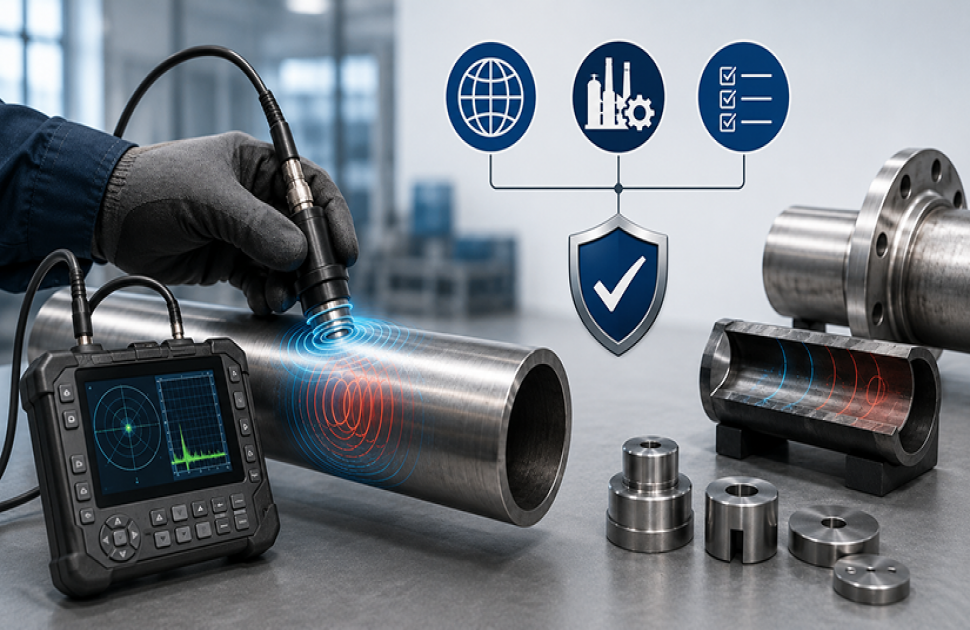
Eddy current testing (ECT) is used to quantify coating thickness, assess electrical conductivity, inspect tubes and bars, and find surface and near-surface discontinuities. ECT is intrinsically restricted to surface and near-surface volumes since it only operates on electrically conductive materials and the induced current density decreases with depth in accordance with the skin effect. The regulatory regulations provide very strict guidelines for frequency selection, probe type, and reference standards because standard depth of penetration relies on test frequency, permeability, and conductivity. Therefore, using the appropriate eddy current testing standard is essential for a reliable inspection.
Governing inspection requirements may be specified in a purchase order, construction code, material specification or client requirement. That document may refer to an NDT method standard which serves as the basis for a written inspection procedure.
This guide outlines the key requirements of the major ASTM, ASME, ISO and EN specifications for eddy current testing and how to determine which of those specifications is applicable to a specific inspection.
This same standards-governance logic applies across NDT methods, see our foundational guide to NDT as a discipline.
→ Read: What Is NDT? (Non-Destructive Testing)
Eddy Current Testing Standards: Why Eddy Current Testing Standards are important
Typically, an eddy current inspection process is carried out in a specific technical sequence:
Contract / purchase order → Construction / product code → NDT method standard → Written inspection procedure
The applicable standard determines the examination method, the required equipment, the reference standards, and how results are recorded and evaluated.
The appropriate standard also depends on the product. Although the underlying physical principle is identical, the governing standards are not. Tubes, bars, wire rope, coatings and heat-exchanger tubing are each covered by different documents.
This same standards-governance chain applies across NDT methods, ultrasonic testing follows a comparable structure.
→ Read: Ultrasonic Testing Standards and Codes
The four categories of Eddy Current Standards
Eddy current standards can be categorized into four practical categories.
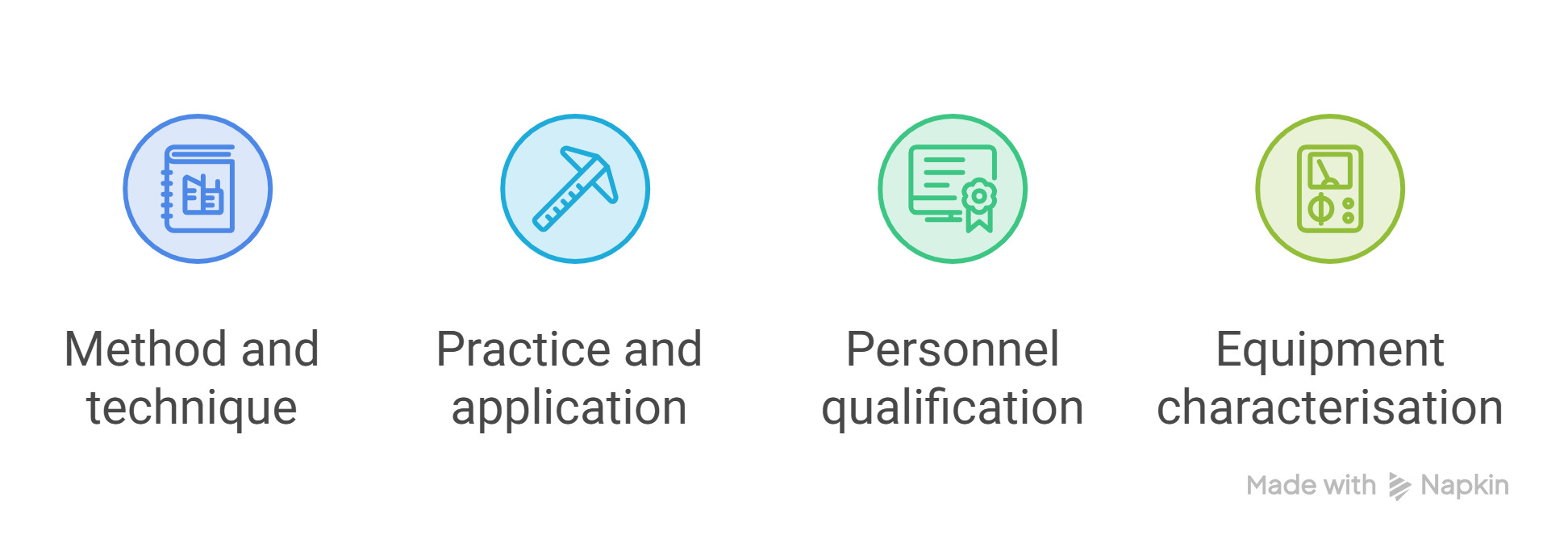
Method and technique standards
These define how the examination is carried out: technique, equipment set-up, calibration principles and evaluation. This category includes ASME Section V Article 8 and various ASTM practices.
Practice and application standards
These are used to examine a specific product or application, for example, tubing, bars, wire rope, coating thickness or conductivity.
Personnel qualification standards
These establish the standards for NDT staff certification and qualification. While ASNT SNT-TC-1A and ANSI/ASNT CP-189 are utilized on the majority of North American and ASME projects, ISO 9712 is the predominant scheme in Europe and much of Asia. A personnel qualification program is never a replacement for a method standard, and none of these documents specify how an examination is conducted.
Equipment characterisation standards
These define the characteristics of instruments, probes and complete systems, and the methods for verifying them. The ISO 15548 series is the principal example.
The best strategy to prevent citing the incorrect document in an inspection procedure is to keep these sections separate.
Separating these categories makes it easier to avoid mistakes in inspection procedures.Personnel qualification standards are covered in more depth in our dedicated training path.
→ Read: Eddy Current Testing Course
ASTM Standards for Eddy Current Testing
Numerous standards for electromagnetic examination are published by ASTM. The material, the product form, and the inspection's goal determine which document is appropriate.
ASTM Standard | Application | Scope |
|---|---|---|
ASTM E309 | Steel tubular products (magnetic saturation) | Eddy current examination of steel tubular products using magnetic saturation to suppress permeability variations in ferromagnetic material. |
ASTM E215 | Seamless aluminum-alloy tube - equipment standardization | Standardizing eddy current equipment using reference standards containing artificial discontinuities |
ASTM E243 | Copper and copper-alloy tubes | Electromagnetic examination of copper and copper-alloy tubes. |
ASTM E426 | Seamless and welded tubular products — austenitic stainless steel, titanium and similar alloys | Nonferromagnetic seamless and welded tubular items are examined by eddy current. excludes grades of martensitic or ferritic stainless steel. |
ASTM E571 | Nickel and nickel-alloy tubular products | Electromagnetic examination of nickel and nickel-alloy tubes. |
ASTM E690 | Nonmagnetic heat-exchanger tubes | In-situ electromagnetic examination of heat-exchanger tubes. |
ASTM E1004 | Electrical conductivity | Eddy current measurement of electrical conductivity. |
ASTM E376 | Coating thickness on metal substrates | Measurement of coating thickness using magnetic-field or electromagnetic methods. |
ASTM E1571 | Ferromagnetic steel wire rope | Electromagnetic (magnetic flux) analysis for localized defects (LF) and loss of metallic area (LMA). |
ASTM E1316 | NDT terminology | Standard terminology used in the section on electromagnetic testing and other non-destructive tests. ISO 12718's ASTM equivalent. |
ASTM E543 | NDT agency qualification | Standards for organizations carrying out NDT, frequently used in conjunction with ECT technique standards in client requirements and procurement orders. |
This is why there is no single ASTM standard for eddy current testing.
For instance, ASTM E1004 is devoted to electrical conductivity and ASTM E376 to coating thickness. Standards for tubular products vary depending on material and type of product.
The ASTM document is selected on the basis of the product and the inspection objective, not simply because an eddy current instrument is being used.
ASME Requirements: Section V, Article 8
When invoked by the applicable referencing code or specification, the requirements for performing eddy current examination are provided in ASME BPVC Section V, Article 8.
Article 8 covers aspects including examination procedures, equipment, techniques, calibration, examination, evaluation and documentation. Specialty applications, like heat-exchanger tubing, are also covered by ASME Section V.
Acceptance criteria are not automatically in Article 8
This separation matters. Article 8 specifies how the examination is performed; the acceptance criteria come from the referencing code. A construction or piping code may require an eddy current examination and will state its own accept/reject limits. Performing an examination to Article 8 therefore demonstrates that the method was applied correctly — it does not, on its own, establish that the component conforms to the construction code.
Article 21 for Pulsed eddy current
In the 2021 edition of ASME Section V, Article 21, "Pulsed Eddy Current (PEC) Technique for Corrosion Screening," introduces pulsed eddy current. It is not a flaw identification method; rather, it is a screening technique for average remaining wall thickness through insulation, coatings, and weather jacketing. It has its own equipment, procedure, and qualification standards. Article 21 is not satisfied by adherence to Article 8, and vice versa.
Article 26 — Eddy Current Standards
Subsection A of ASME Section V contains the examination procedures, while Subsection B comprises documents that have been adopted by reference. Subsection B, Article 26 lists the eddy current standards adopted by ASME. These standards are published as SE-designated versions of ASTM publications, such as SE-243, SE-309, SE-426, SE-571, and SE-690. When a referring code calls upon ASME Section V, the SE-version that was adopted in the Code's contract edition—rather than the most recent ASTM revision—is relevant.
Article 8 sits within a much larger code, see the full structure of ASME Section V for context on where eddy current examination fits.
→ Read: ASME Section V Overview
ISO and EN StandardsISO has several complementary standards related to eddy current principles, terms, equipment and personnel.
ISO 15548 — Equipment characteristics
The ISO 15548 series deals with the characteristics and verification of eddy current equipment.
The ISO 15548-1:2026 lays down the general purpose eddy current instrument characteristics and their verification, and ISO 15548-2 covers the characteristics of probes and their verification.
These are equipment standards, NOT universal product inspection standards.
ISO 15549 — General principles
ISO 15549:2019 sets out the general principles for eddy current examination of products and materials and serves as the basis for more specific application documents.
ISO 20669 — Pulsed eddy current
Pulsed eddy current testing of ferromagnetic metallic components is covered by ISO 20669. It is frequently used in conjunction with API RP 583 for corrosion under insulation (CUI) screening and is the ISO equivalent of ASME Section V, Article 21. PEC is not covered by standard eddy current documents like ASME Article 8 and ISO 15549.
ISO 12718 — Vocabulary
ISO 12718:2019 defines the terminology used in eddy current testing. It is particularly useful on international projects, where inspectors, manufacturers and governing documents may come from different standards systems.
ISO 9712 — Personnel qualification
The qualifications and certification criteria for industrial NDT workers, including eddy current testing, are outlined in ISO 9712:2021. Instead, employees in North America and on the majority of ASME work are certified to ANSI/ASNT CP-189 or qualified to an employer-written practice based on ASNT SNT-TC-1A. Personnel must be qualified in line with the referring code, which establishes the appropriate system, according to ASME Section V, Article 1. There is no standard examination process for any of these documents.
EN product standards
There are precise eddy current requirements in European tube and product specifications. The EN ISO 10893 series has largely replaced the EN 10246 series, which formerly covered non-destructive testing of steel tubes, including automated electromagnetic and eddy current testing. For instance, EN ISO 10893-2 replaced EN 10246-3 for automatic eddy current testing of steel tubes. Ask the buyer if the succeeding EN ISO document is applicable if an older contract still references an EN 10246 part.
ASTM vs ISO terminology
When expressing comparable technical concepts, ASTM and ISO may choose different terminology or organize their materials differently. The corresponding terminology references are ASTM E1316 and ISO 12718. Examine the definitions provided in the particular standard and edition being worked to when working on multinational projects. Similar-looking terms don't always have the same meaning.
Calibration and Reference Standards
The term “standard” used in eddy current testing can also refer to a physical reference specimen, and not a published technical document.
An eddy current reference standard produces a known, repeatable response that is used to set up and verify the inspection system. It may be a notched tube, a machined specimen, a conductivity block, a coating thickness reference or another specified artifact.
ASTM E215, for example, specifies reference standards containing artificial discontinuities for standardizing equipment used to examine seamless aluminum-alloy tubes. ASTM E1004 relies on reference blocks of known electrical conductivity.
The general principle is that the reference standard must conform to the governing inspection standard. A generic reference block should never be substituted simply because it produces a strong or convenient signal.
Browse our full range of eddy current probes and calibration reference standards to match your procedure's requirements.
→ Read: Eddy Current Probes & Reference Standards
What a Compliant Eddy Current Procedure Must Contain
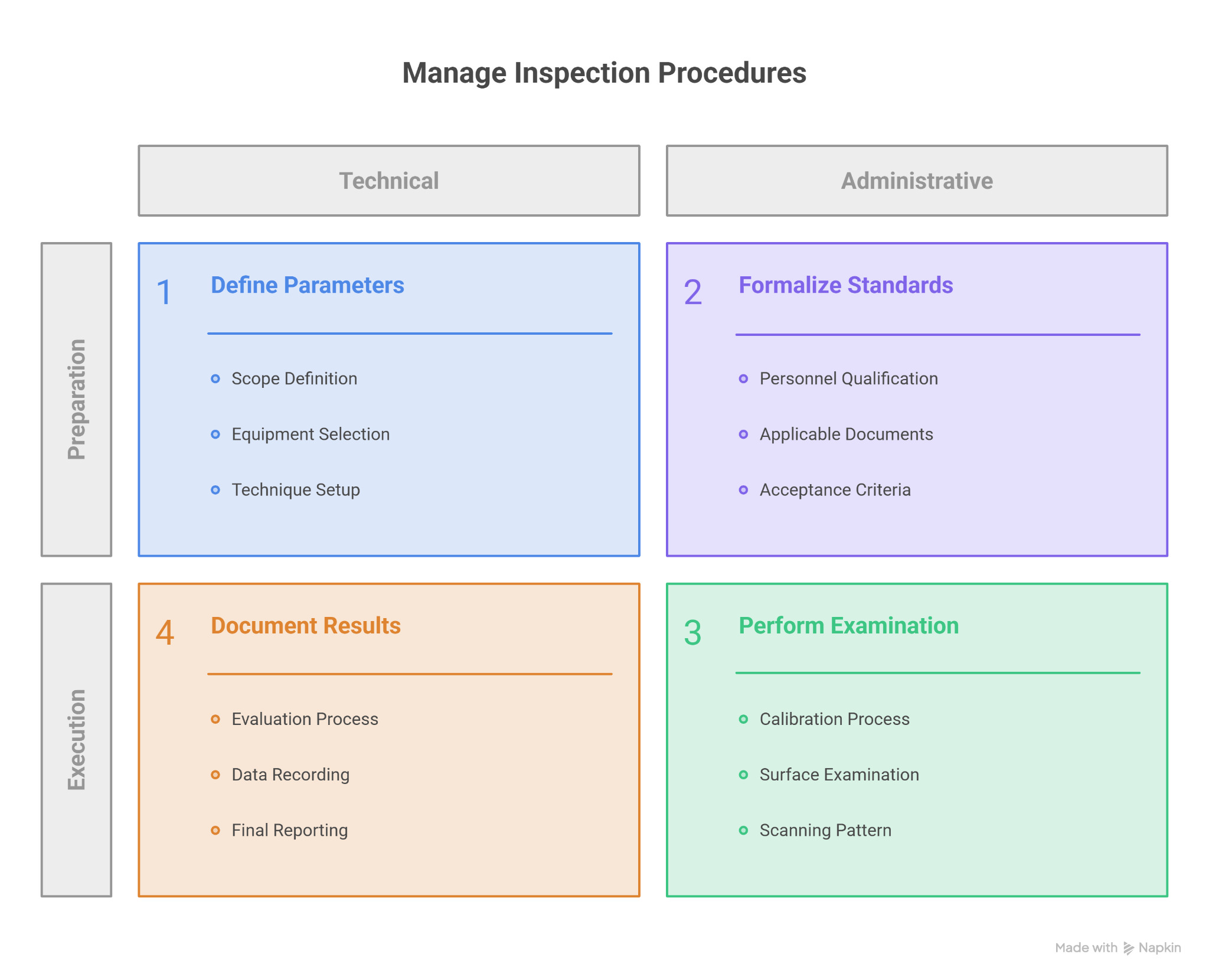
Generally, a written eddy current procedure will cover the following:
- Scope: Components, material and dimensions as well as inspection objective.
- Applicable documents: Construction code, product specification and NDT method standard.
- Personnel: Required qualification level, certification scheme and any project-specific approvals.
- Equipment: Instrument, probes, coils, cables, software and accessories.
- Technique: Probe arrangement, frequency, sensitivity, scanning pattern, speed and coverage.
- Calibration: Reference standard and required calibrations.
- Examination: Surface condition, accessibility, scanning and coverage.
- Evaluation: Process for assessing relevant and non-relevant indications.
- Acceptance criteria: Construction code, product specification or client requirement.
- Recording: Signal data, instrument settings, indication locations and traceability to the component.
- Reporting: Results of inspection, equipment, personnel, standard used, and acceptance requirements.
This is the typical structure of a controlled ECT procedure. It is a general framework, not a quotation from or complete checklist for any single ASTM, ASME or ISO standard.
Guidance on how to determine which standard will be used for your inspection
Selecting the correct standard becomes straightforward when it is approached as a fixed sequence.
Step 1: Determine the component.
Identify if it is a tube, pipe, bar, wire, heat-exchanger tube, coating, weld or other item. Differentiate between ferromagnetic and non-ferromagnetic materials also.
Step 2: Determine the governing specification.
Identify which document governs the work – is it from ASME construction code, ASTM material specification, an EN/ISO product standard, a client specification or a purchase order?
Step 3: Identify the invoked ECT method
Once the governing document has been located, find out which eddy current method or product standard it refers to. The chain should be followed in the following order and only runs in one direction: Component → Specification or governing code → ECT method standard → Written inspection protocol
Step 4: Set staff needs
Establish which qualification scheme applies — ISO 9712, ASNT SNT-TC-1A, ANSI/ASNT CP-189, or a scheme nominated by the client or employer — and the required certification level.
Step 5: Confirm equipment requirements and calibration needs
Verify the requirements for the instrument, probe, calibration setup, reference specimen, artificial discontinuities, and the verification checks.
Step 6: Make sure that the edition is confirmed
Verify the precise edition mentioned in the purchase order or contract. For an ongoing project, the most recent edition may not always be the most appropriate. Unless the parties officially agree in writing otherwise, the edition specified in the contract is applicable.
For the full method breakdown behind this selection process, see our complete eddy current testing pillar guide.
→ Read: Eddy Current Testing: A Complete Guide
Conclusion
Understanding eddy current testing standards means more than memorizing ASTM numbers or knowing that Article 8 exists. The standards operate at several different levels.
ASTM provides product and application requirements. When called for in a referencing code, ASME Section V Article 8 is an important framework for eddy current examination. There are general principles, terminology, equipment-characterization needs, and personnel qualification requirements provided by ISO, and product standards (EN/ISO) cover specific European applications.
Starting with the component and the controlling contract or code, determining which ECT method standard it invokes, determining the personnel and equipment needs, and verifying the edition specified in the contract are the safest steps.
When used regularly, this ensures that the acceptance criteria, staff credentials, reference standards, and assessment methodology are all in line with the real project needs.
FAQ
Which is the primary ASTM Standard for eddy current?
No single ASTM standard applies to all applications of ECT. Various standards cover tubes, heat-exchanger tubing, conductivity, coating thickness, bars, wire rope and other uses.
What does ASME Section V Article 8 say?
The requirements for eddy current examination are outlined in Article 8 and include written protocols, tools, methods, calibration, testing, assessment, and documentation. It is applicable when a referring code or specification calls upon it.
Are there any acceptance criteria in Article 8?
No, Article 8 contains no universal accept/reject limits. Acceptance criteria come from the referencing construction code, product specification or client requirement.
What is ISO 15548 used for?
ISO 15548 covers characteristics and verifications of equipment used in eddy current examination such as equipment and probes.
What is ISO 15549?
ISO 15549 lays out the general principles for eddy current examination of products and materials.
Is ISO 9712 an eddy current method standard?
No. ISO 9712 is a standard for personnel qualification and certification. It is not a substitute for the relevant ECT examination standard.
What is eddy current calibration standard?
It is a specimen of physical material for the purpose of standardizing or checking an ECT system. It should be designed and used in accordance with the governing inspection standard.
What is the right ECT standard to choose?
Identify the component and material, determine the governing code or specification, locate the ECT method standard it invokes, confirm the personnel and calibration requirements, and verify the edition named in the contract.


There are no comments yet!