Researchers have developed a new ultrasonic denoising method designed to improve defect detection in heavy-haul railway infrastructure, addressing one of the key challenges faced during ultrasonic inspection of small-radius rail curves. The study, published in Communications in Transportation Research, presents a multi-feature fusion framework that enhances the identification and localization of rail defects by suppressing complex noise while preserving defect signals.
Heavy-haul railways are widely used for transporting bulk commodities such as coal and mineral resources. Under prolonged high-axle-load operations, rails in small-radius curve sections experience significant wheel-rail interaction forces, accelerating the formation of defects including head checks and bolt-hole cracks. If left undetected, these defects can eventually result in rail fractures.
Ultrasonic testing remains the primary non-destructive testing (NDT) technique used to inspect heavy-haul railway tracks. Inspection vehicles acquire ultrasonic A-scan signals to detect internal rail defects. However, inspections conducted in curved rail sections are often affected by structural vibrations caused by wheel flanges, low-frequency disturbances, and high-frequency electrical noise. These non-Gaussian noise components overlap with defect echoes in both the time and frequency domains, making defect identification significantly more challenging.
The research team noted that existing signal processing approaches are often unable to address the complexity of real-world inspection environments.
“Traditional denoising methods assume relatively simple noise characteristics,” the researchers explain. “But in real heavy-haul environments, noise is strongly coupled and non-Gaussian. Simply applying low-pass filtering or single-domain feature extraction is often insufficient.”
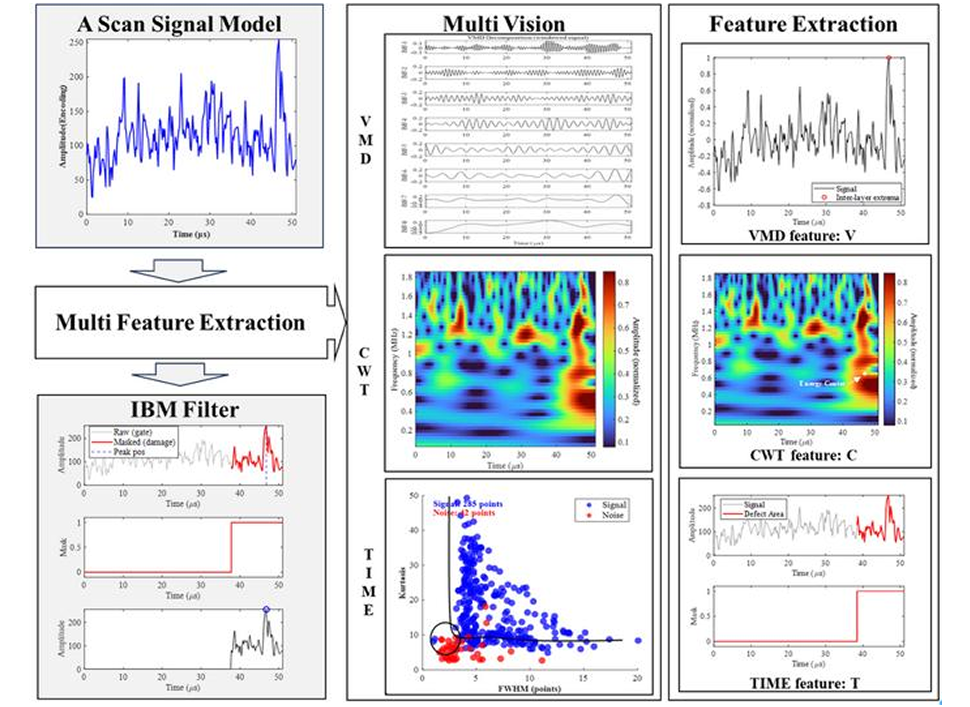
To address this limitation, the researchers first developed a physics-based ultrasonic A-scan signal model capable of representing defect echoes alongside structural vibration noise, low-frequency interference, and high-frequency electrical noise. The model provides a theoretical framework for understanding the limitations of conventional denoising methods under complex field conditions.
Building on this model, the team introduced a multi-feature fusion filtering framework based on an Ideal Binary Mask (IBM) approach. The method combines three complementary feature extraction techniques: Variational Mode Decomposition (VMD)-based inter-layer correlation analysis to identify synchronized defect responses, Continuous Wavelet Transform (CWT) time-frequency clustering to detect characteristic energy patterns associated with defect echoes, and sliding-window waveform morphology analysis using kurtosis and peak-width features to distinguish impulsive defect signals from background noise.
Rather than combining extracted features through conventional vector concatenation, the framework performs decision-level feature fusion using physically interpretable indicators from the time, frequency, and modal domains. These fused features are then used to generate an indexed binary mask that selectively retains defect-related signal components while suppressing unsupported noise.
The proposed approach was evaluated using 285 simulated noise-contaminated defect signals derived from real ultrasonic inspection data. According to the researchers, the framework successfully achieved accurate defect localization in more than 90% of the test cases. Compared with single-feature signal processing methods, the multi-feature fusion approach significantly reduced missed detections and minimized large localization errors.
The researchers stated that improving defect localization at the A-scan level also enhances the accuracy of B-scan image reconstruction while preserving peak signal amplitude, supporting more reliable condition-based maintenance of heavy-haul railway infrastructure.
Looking ahead, the research team plans to extend the framework to multi-channel ultrasonic inspection systems, where coupled noise across multiple inspection channels presents additional challenges for defect detection.