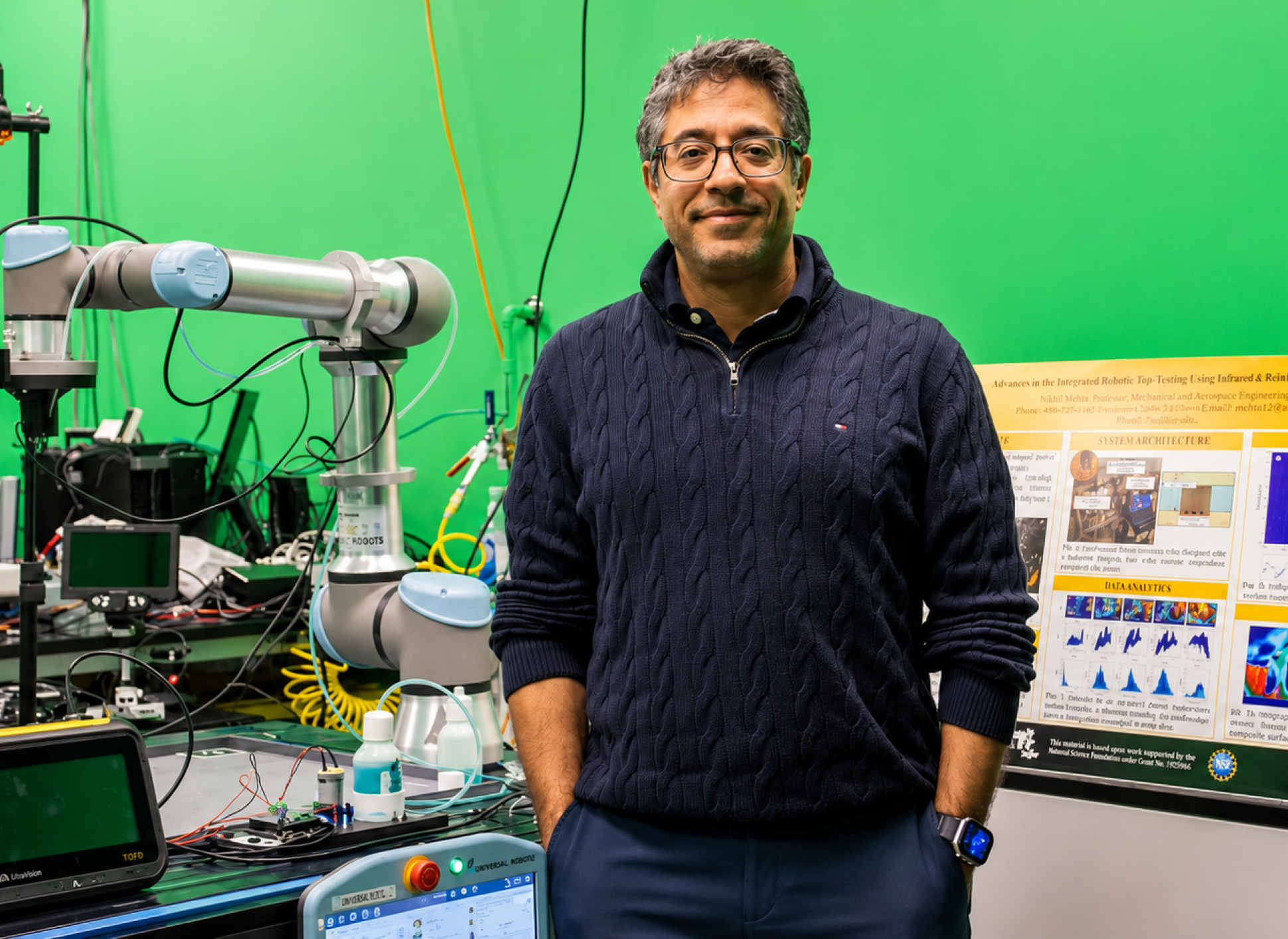
Arizona State University researcher Ehsan Dehghan-Niri has been named a fellow of the American Society for Nondestructive Testing (ASNT), recognizing his contributions to nondestructive testing and evaluation, applied research, education and workforce development.
Dehghan-Niri, an associate professor of manufacturing engineering in the School of Manufacturing Systems and Networks at Arizona State University’s Ira A. Fulton Schools of Engineering, has built his work around advancing inspection technologies while strengthening pathways for the next generation of manufacturing and NDT/E professionals.
The ASNT Fellow designation recognizes researchers who have demonstrated professional distinction and made significant, ongoing contributions to nondestructive testing and evaluation.
“I was genuinely excited and honored when I learned about the recognition,” Dehghan-Niri says. “This is especially meaningful because it’s also representative of the outstanding students, colleagues and collaborators I have had the privilege to work with throughout my career.”
Research focuses on smarter NDT/E
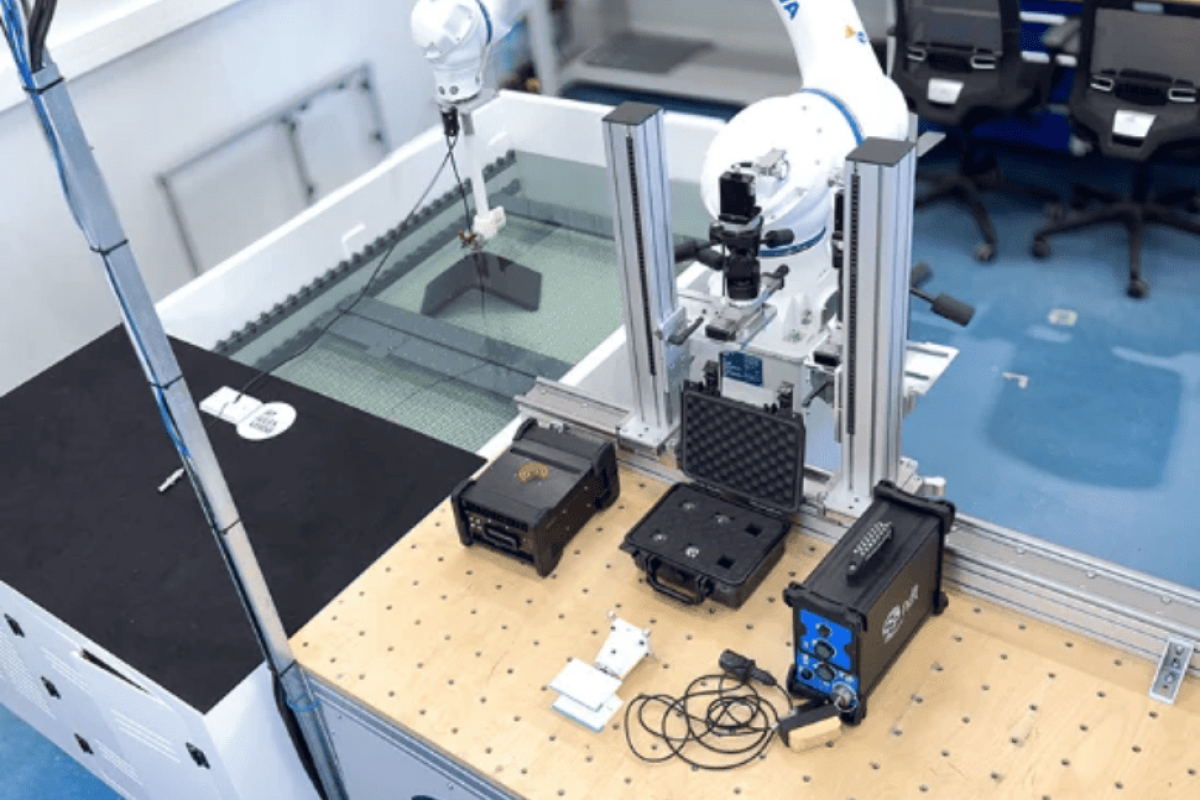
As director of ASU’s Intelligent Structures and Nondestructive Evaluation (ISNDE) Lab, Dehghan-Niri works across bioinspired acoustic sensing, robotic inspection and in-situ quality control for advanced manufacturing.
His research includes acoustic-based in-situ monitoring for additive manufacturing, an area he began studying during his time at General Electric. The work has evolved toward detecting problems and improving part quality during production rather than relying solely on inspection after fabrication.
The research direction has also drawn recognition from industry experts.
“The demands on NDT/E in our competitive world are beyond the fringes of our current capabilities,” says Shant Kenderian, principal scientist in the Space Materials Laboratory at The Aerospace Corporation and a longtime mentor of Dehghan-Niri. “Professor Dehghan-Niri’s research is pushing the frontiers of NDE technology into the future.”
For the NDT/E sector, the research brings inspection closer to the manufacturing process, with acoustic-based monitoring, robotics and in-situ quality control forming key areas of Dehghan-Niri’s work.
Linking NDT and manufacturing education
Dehghan-Niri’s work also extends to workforce development through his role as principal investigator and director of the Certification to Degree in Manufacturing Consortium (C2D).
The initiative connects industry-oriented certification training with university degree pathways and incorporates technologies including virtual reality, cyber hands-on laboratories, simulation tools, AI-assisted instruction and in-person training.
The program has trained more than 300 people and aims to provide flexible and scalable manufacturing education for traditional students, veterans and other nontraditional learners.
“Perhaps the most important outcome has been creating a modern educational platform that serves learners with different backgrounds and career goals,” Dehghan-Niri says. “We have also helped introduce the concept of connecting industry certifications with university degrees, creating a bridge between nondegree training and higher education.”
The consortium grew from a $3.5 million award through the U.S. Department of War Manufacturing Engineering Education Program and involves collaboration with educational institutions and defense manufacturers. Its work addresses workforce requirements in manufacturing and nondestructive testing.
Focus on the future of NDT/E
The intersection of NDT/E, manufacturing and workforce development has also been highlighted by Binil Starly, director and professor in the School of Manufacturing Systems and Networks and a collaborator of the consortium.
“Professor Dehghan-Niri’s recognition as an ASNT Fellow reflects not only his outstanding contributions to nondestructive evaluation, but also the growing influence our school is having in shaping the future of manufacturing,” Starly says. “His group’s work exemplifies how we can translate academic innovation into safer, more resilient manufacturing systems and a stronger technical workforce.”
Looking ahead, Dehghan-Niri is focused on the role of artificial intelligence, robotics and automation in inspection and professional training. His areas of interest include bioacoustics, autonomous NDT/E and emerging educational technologies.
His broader objective remains centered on connecting technical research with safety, education and workforce development.
“Ultimately, I hope people will say that my work helped make the world safer through research and education,” Dehghan-Niri says. “Beyond individual projects, I hope to build sustainable educational and research programs that continue creating opportunities long after my own career.”
Reference: https://news.asu.edu/20260831-university-news-advancing-future-nondestructive-testing