ICOME 2, a two-year research and development project with a budget of €1.152 million, aims to automate non-destructive testing (NDT) of large, thick naval composite structures. Building on an 18-month feasibility study, the project brings together IRT Jules Verne, Naval Group, Chantiers de l’Atlantique and SolidSail Mast Factory (SMAF) to improve inspection reliability and reduce testing times without slowing manufacturing.
The initiative focuses on automating or semi-automating the NDT process, from data acquisition to analysis. It also aims to accommodate variations in component geometry and surface condition, while improving defect mapping and inspection traceability.
ICOME Study Evaluates Three NDT Methods
The initial ICOME study examined naval composite structures with thicknesses ranging from 10 to 60 mm. Its experimental programme compared three NDT methods: X-ray radiography, conventional ultrasonics and air-coupled ultrasonics, which can operate without direct contact with the inspected component.
Testing was conducted on five types of flat reference specimens containing artificial defects, including monolithic and sandwich structures. Preliminary results presented by Naval Group and IRT Jules Verne at COFREND 2026 highlighted the strengths and limitations of each method.
On one monolithic panel, air-coupled ultrasonics overestimated the apparent area of detected defects by approximately a factor of two. Conventional ultrasonics detected nearly all the introduced defects but failed to identify defects at foam-to-foam interfaces in a sandwich specimen. X-ray radiography also showed limitations in detecting planar defects.
The findings remain preliminary and are limited to flat reference specimens containing artificial defects. Conventional ultrasonic testing used a single-element probe, which the researchers plan to replace with a multi-element probe in subsequent work.
Development of Robotised Ultrasonic Inspection
Beyond comparing inspection methods, the original ICOME project led to the design of manual NDT end-effectors and the identification of an automation scenario and its associated technical challenges.
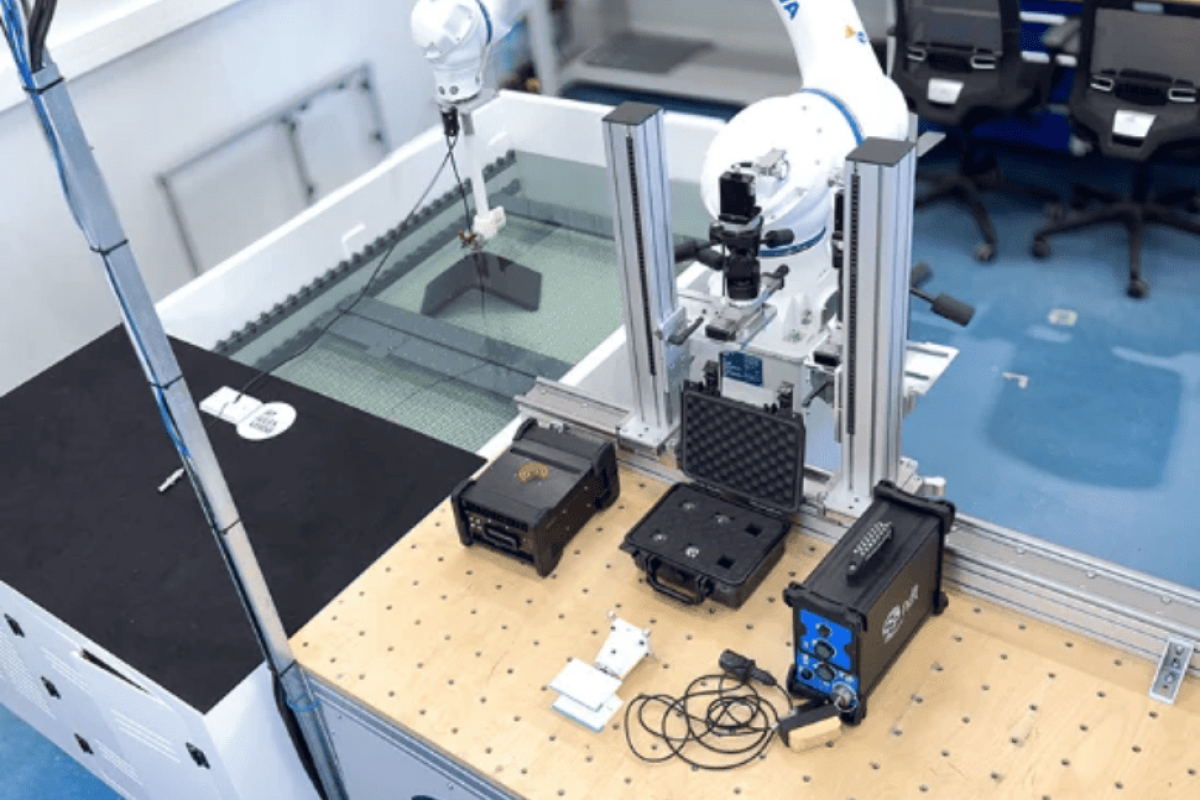
These findings informed the development direction for ICOME 2, which targets a robotised phased-array ultrasonic inspection solution. Phased-array technology uses multiple electronically controlled elements to steer the ultrasonic beam, supporting inspection of composite structures with varying geometries.
The project aims to automate or semi-automate data acquisition while adapting to differences in component shape and surface condition. Automating data analysis and defect mapping is another central objective, with the goal of improving traceability and helping inspectors concentrate on areas that require closer examination.
Broader Industrial Applications
The participation of SolidSail Mast Factory, which manufactures composite masts for wind-assisted propulsion, expands the consortium’s industrial context beyond naval defence.
By developing automated inspection processes for large, thick composite structures, ICOME 2 aims to address manufacturing challenges associated with inspection time and reliability. The project seeks to ensure that NDT can support production requirements while providing consistent data for defect assessment.
With a two-year programme and a budget of €1.152 million, ICOME 2 builds on the feasibility study’s experimental findings to advance automated composite inspection, from data acquisition through to defect analysis and mapping.