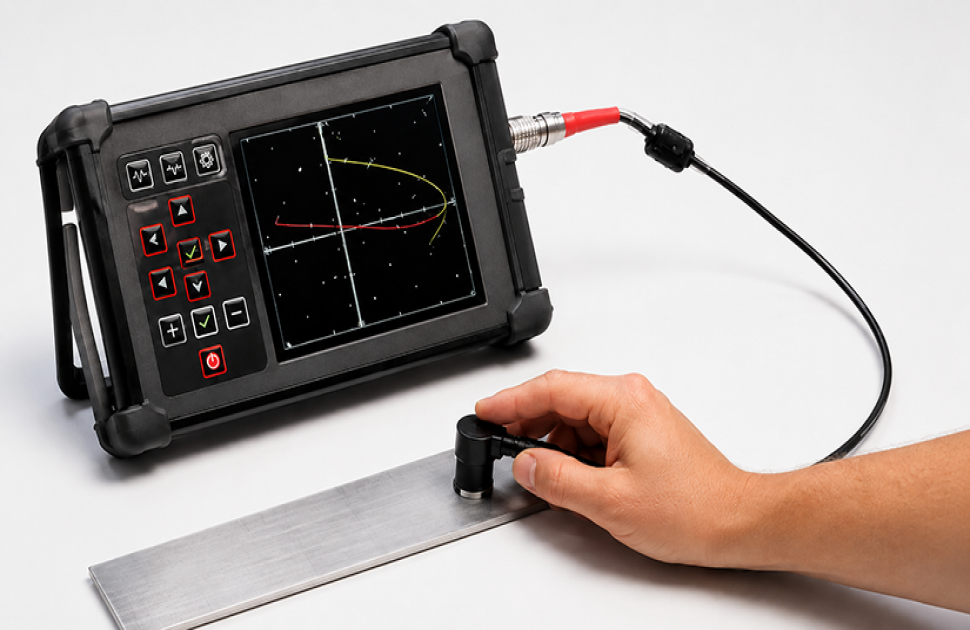
Table of Content
- Introduction
- What Is Conventional Eddy Current Testing?
- How It Works
- Probes and Equipment Used in Conventional ECT
- Where Conventional ECT Is Still Used
- Conventional ECT vs Array and Advanced Techniques
- Limitations of Conventional ECT
- Conclusion
- FAQs
Introduction
Notwithstanding the fact that advanced technologies like Eddy Current Array (ECA), Pulsed Eddy Current (PEC), Remote Field Testing (RFT) and Near Field Testing (NFT) have been developed, Conventional Eddy Current Testing (ECT) is still one of the most widely used electromagnetic non-destructive testing (NDT) methods. Although newer methods provide more extensive coverage and/or special capabilities, conventional ECT remains the preferred method for many localized inspections due to its portability, simplicity, and low cost.
This article provides an explanation of the working principles, equipment employed, suitability range of conventional ECT and comparison with modern eddy current inspection methods.
What Is Conventional Eddy Current Testing?
The conventional Eddy Current Testing (ECT) is an electromagnetic inspection technique that applies a single-coil or a few coils, each operating independently in a single inspection channel. While Eddy Current Array, Pulsed Eddy Current, Remote Field Testing or Near Field Testing are all examples of conventional ECT methods, they can only provide local inspections through manual scanning and single channel measurements, and are best suited to the need to detect flaws and evaluate materials at specific locations.
Exact Section Heading: What Is Conventional Eddy Current Testing?
Want the full picture of eddy current testing, from historical evolution to AI-based signal analysis? Explore our complete guide.
→ Read: Eddy Current Testing Explained
How It Works
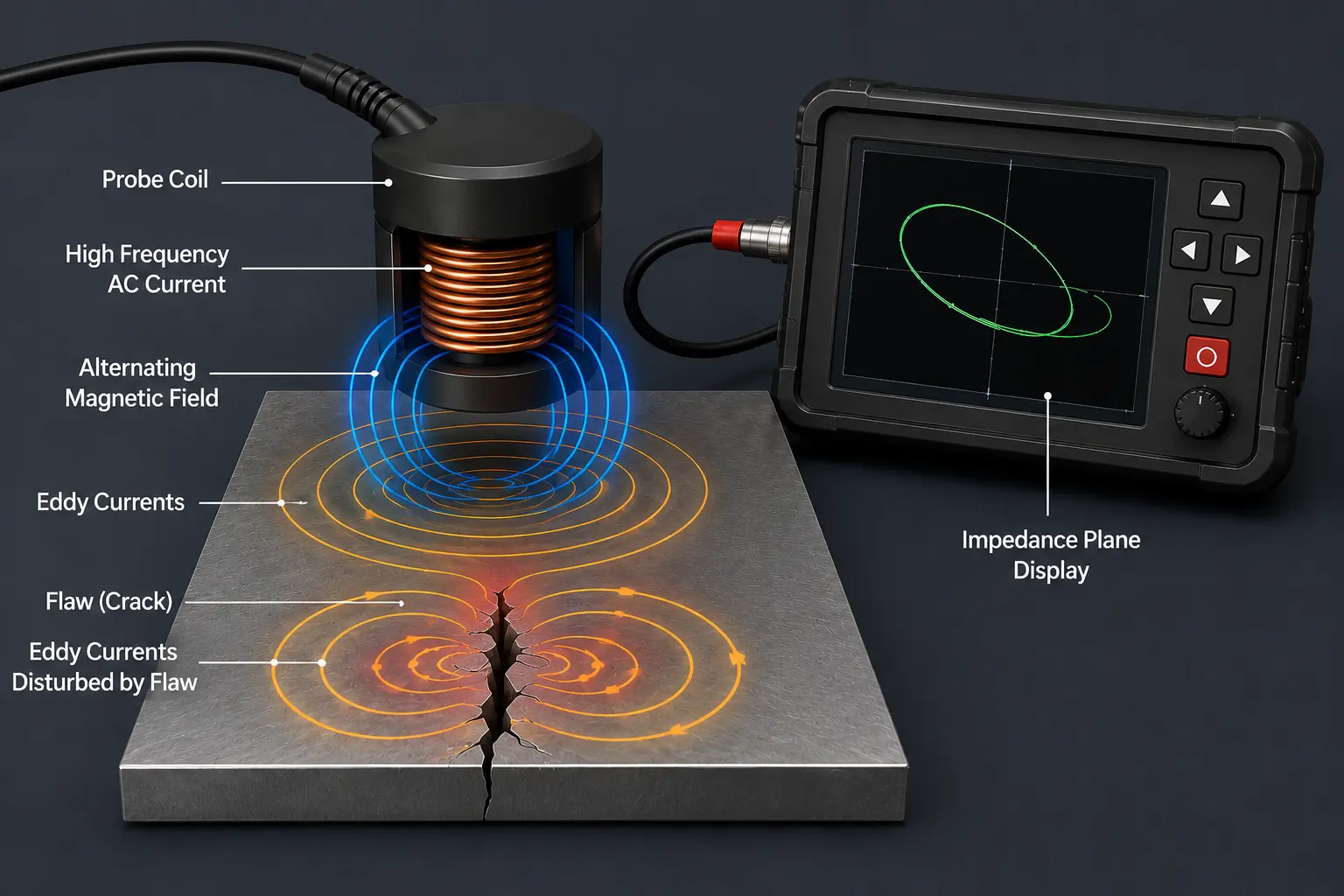
In conventional ECT, the current is a modified Alternating Current (AC) passed through an inspection coil, resulting in a fluctuating magnetic field encircling the coil. As the coil approaches a conductive material, this magnetic field creates electrical currents that circulate within the object (eddy currents).
When the eddy current flow breaks through a crack, corrosion, change in material properties or thickness, the flow of the eddy current is disturbed. This disturbance changes the electric impedance of the inspection coil. This instrument automatically detects these changes in impedances and shows them on an impedance plane screen where inspectors can spot possible defects.
The inspection is non-contact with the test surface, due to the nature of the inspection being carried out by an electromagnetic interaction. With conventional ECT, the results are immediate and the procedure is particularly effective for surface and near surface discontinuities.
Probes and Equipment Used in Conventional ECT
Conventional' is also used to describe the hardware configuration for the test as well as the inspection method. Conventional ECT normally uses one active inspection coil or a small system of coils, as opposed to array systems, which use dozens of coils at once.
Want hands-on certification in eddy current basics? This Level I course covers probe selection, impedance plane displays, and data recording systems in detail.
→ Read: Eddy Current Testing Level I Course
Common Coil Configurations
Absolute Coils
Absolute probes rely on the changes in conductivity, thickness or defects using a single sensing coil. They are generally employed to inspect and measure the properties of materials.
Differential Coils
Differential probes have two coils which are arranged to compare neighbouring sections of material. The material properties of the uniform cancel out and small defects become easier to observe, with the reduction of background noise.
Reflection Coils
With reflection probes, different transmitter and receiver coils are utilized. They offer greater sensitivity for certain inspection applications and are often employed when a greater signal stability is desired.
Common Probe Types
- Pencil Probes – Perfect for small cracks around fasteners, weld toes, corners and complex geometries.
- Surface Probes – These are for scanning a flat or mildly curved surface to detect fatigue cracks or corrosion.
- Bobbin Probes – These are used to check the entire circumference as it is being inserted inside the heat exchanger tubes or condenser tubes.
- Encircling Probes – Circumstances surrounding the production inspection of bars, rods and tubes with high speed defect detection.
Typical Equipment Features
Usually the modern conventional ECT instruments contain:
- Single frequency or multi-frequencies operation
- Digital impedance-plane display
- Gain and phase controls that are adjustable.
- Conductivity measurement capability
- Data Storage (on some instruments)
- Portable battery-powered operation
Manual scanning is a key feature of traditional ECT. The flexibility of the probe allows it to be proficiently used for local inspections, but not for large area coverage as it is not an encoded array system.
Choosing between single-frequency and multi-frequency eddy current instruments? Our selection guide breaks down which setup fits your inspection depth and application.
→ Read: Eddy Current Instruments Selection Guide
Where Conventional ECT Is Still Used
Conventional ECT is still widely used in many industrial applications which require only localised high sensitivity inspections, while advanced eddy current techniques have broadened the scope of inspections.
Weld toes & small radii
Stress concentration is a common site for fatigue cracks to start, especially at weld toes. These localised areas can be scanned with great sensitivity using conventional pencil probes. In this relatively small area, one can often use a single coil that will be both quicker and cheaper than a system of arrays.
Bolt and Fastener Holes
The aircraft and industrial equipment has thousands of fasteners and their holes that need to be inspected periodically. Small cracks around these openings can be reliably detected using special rotating probes or bolt-hole probes. Because the inspection is done on individual holes and not on large surfaces, conventional ECT is still used in the industry as the standard inspection method.
Spot Checks and In-Service Verification
Special attention is required after repair and for routine checks to ensure that maintenance teams have information about specific areas. Conventional ECT allows a rapid spot check that doesn't require extensive setup and encoded scanning. The portable equipment can be readily transported to areas that require confined space entry, which makes it useful to inspect in the field.
Conductivity Measurement and Alloy Sorting
The traditional method for electrical conductivity measurement is used to confirm heat treatment, to distinguish between grades of material and to distinguish between similar-looking alloys. Conductivity measurement is often used for the quality control of manufacturing because of its real-time, non-destructive measurement output.
Coating Thickness Measurement
Eddy current instruments can be used to measure non-conductive coatings on conductive substrates. The thickness of the coating is measured locally, so only one-coil probe is necessary so as to get accurate and efficient measurement without the need for complex scanning systems.
Production Sorting of Bars and Tubes
Encircling probes are used to check bars, rods and tubes for surface conditions during manufacturing. Normal ECT can be used to quickly inspect continuous products and keep production speed high. The single inspection channel is adequate since each product is individually passed through the probe.
Power Generation and Nuclear Applications
Bobbin probes are still widely used in power plants and nuclear facilities for steam generator tubes and heat exchanger tubing inspections. Inspection by these procedures must be able to detect tube degradation and test thousands of tubes quickly. Bobbin probes are used for routine screening and are generally the preferred choice, as they are proven to perform well, provide rapid inspection rates and have established inspection procedures. Advanced techniques are normally used for follow-up inspections where greater detail in the characterization is needed.
Conventional ECT vs Array and Advanced Techniques
Where inspections are of a small area, individual components or routine maintenance, conventional ECT is still the preferred approach. Lower cost of equipment, easy setup and great portability make it a practical choice for field inspections and production sites.
Eddy Current Array is beneficial where large areas must be inspected, where the inspection needs to be recorded and be traceable, and where the inspection needs to be kept for a long time. With Array systems, the time spent on scanning is minimized for large inspections; and the risk of missing defects between scan paths is minimized.
Other electromagnetic methods offer capabilities in addition to conventional ECT for specialized applications. Pulsed Eddy Current (PEC) is the preferred method for corrosion monitoring through insulation, Remote Field Testing (RFT) is the most common method for ferromagnetic tubes and Near Field Testing (NFT) is used to inspect finned and air-cooled heat exchanger tubes.
Limitations of Conventional ECT
Although it is ubiquitous, traditional ECT has a number of limitations:
- It is only capable of probing conductive materials.
- The detection depth is limited, and therefore is most useful for detecting surface and near surface flaws.
- The surface roughness, geometry changes, and lift-off variations may affect inspection results.
- Large area scans take a long time as they only inspect a small area per scan.
- The quality of the inspection is highly dependent on the operator and scanning method.
- Conventional ECT on the other hand, does not normally create a permanent inspection record unless an encoded system is used.
Many of these restrictions gave rise to Eddy Current Array systems which offer enhanced coverage and repeatability as well as better documentation of the inspection process, and without changing the basic magnetic principles.
Conclusion
Despite the current development of NDT methods, the role of the conventional Eddy Current Testing method remains important in modern NDT due to the capability of providing fast, reliable and cost-effective inspections for localized applications. Single-coil ECT is the preferred solution for portability, simplicity, and quickness to deployment when inspecting weld toes, fastener holes, heat exchanger tubes or sorting production materials, when large area coverage is not more important.
While there have been a number of advanced technologies developed and introduced into the inspection market, including Eddy Current Array, Pulsed Eddy Current, Remote Field Testing and Near Field Testing, these technologies complement, but do not supplant, traditional ECT. The choice of the technique will depend on the inspection goal, component geometry, material and required inspection coverage.
FAQs
1. What is the difference between conventional Eddy Current Testing and Eddy Current Array?
Conventional ECT is performed using 1 or a few coils while Eddy Current Array is performed using multiple coils to provide a faster inspection, better coverage, and digital inspection record of a larger area.
2. Is conventional Eddy Current Testing obsolete?
No. Conventional ECT is still widely used for spot inspections, bolt-hole testing, tubing inspection and conductivity measurement due to its portability, reliability and cost effectiveness.
3. What probes are used in conventional Eddy Current Testing?
Pencil, surface, bobbin and encircling probes are examples of common probes. Depending on the inspection application, they may employ either absolute or differential coil designs or reflection coil designs.
4. Can conventional ECT inspect steel welds?
Conventional ECT is able to inspect steel welds with appropriate probes and frequencies, depending on the magnetic characteristics of the material and inspection criteria.
5. What industries use conventional Eddy Current Testing?
Common applications of conventional ECT include crack detection, tubing inspection, alloy sorting and quality control in aerospace, power generation, nuclear, manufacturing, automotive and petrochemical applications.