Table of Contents
- Introduction
- What Are Automated and Robotic Eddy Current Testing Systems?
- Why Automate Eddy Current Inspection?
- Types of Automated and Robotic ECT Systems
- What Automation Adds to the Data
- Where Automated and Robotic ECT Is Used
- AI and Automated Defect Recognition
- Limitations and When Manual ECT Is Still Better
- Conclusion
- FAQs
Introduction
Traditionally Eddy Current Testing (ECT) has been performed by a technician physically moving a probe over the area of interest. This is still useful for targeted inspections, but it makes manual scanning difficult if parts are complex, large, have frequent inspections, or are hard to access.
Automated and robotic eddy current testing systems overcome these limitations by providing control of the movement of the probe, recording the position of the probe and producing digital inspection data. This leads to a more repeatable, traceable and efficient ECT process.
What Are Automated and Robotic Eddy Current Testing Systems?
Mechanised eddy current testing involves an automated scanner moving the ECT probe along a predetermined path, with the position encoded with the inspection signal. Robotic eddy current testing takes this one step further and the inspection system is moved by a robot around, over, and/or through the component.
The distinction matters. Automation refers to the way the probe is operated and robotics also encompasses how the inspection system gets to the part.
In the case of a computer-controlled gantry scanning a fixed component, for instance, the computer is programmed to control the gantry's movement. Robotic is a magnetic crawler with an ECT Probe placed across a tank. They both can generate encoded inspection data, but they have different mechanical functions.
This automation/robotics distinction sits within a wider set of ECT variants — for the full breakdown of manual, automated, and specialized eddy current methods, see our complete guide.
→ Read: Types of Eddy Current Testing
Why Automate Eddy Current Inspection?
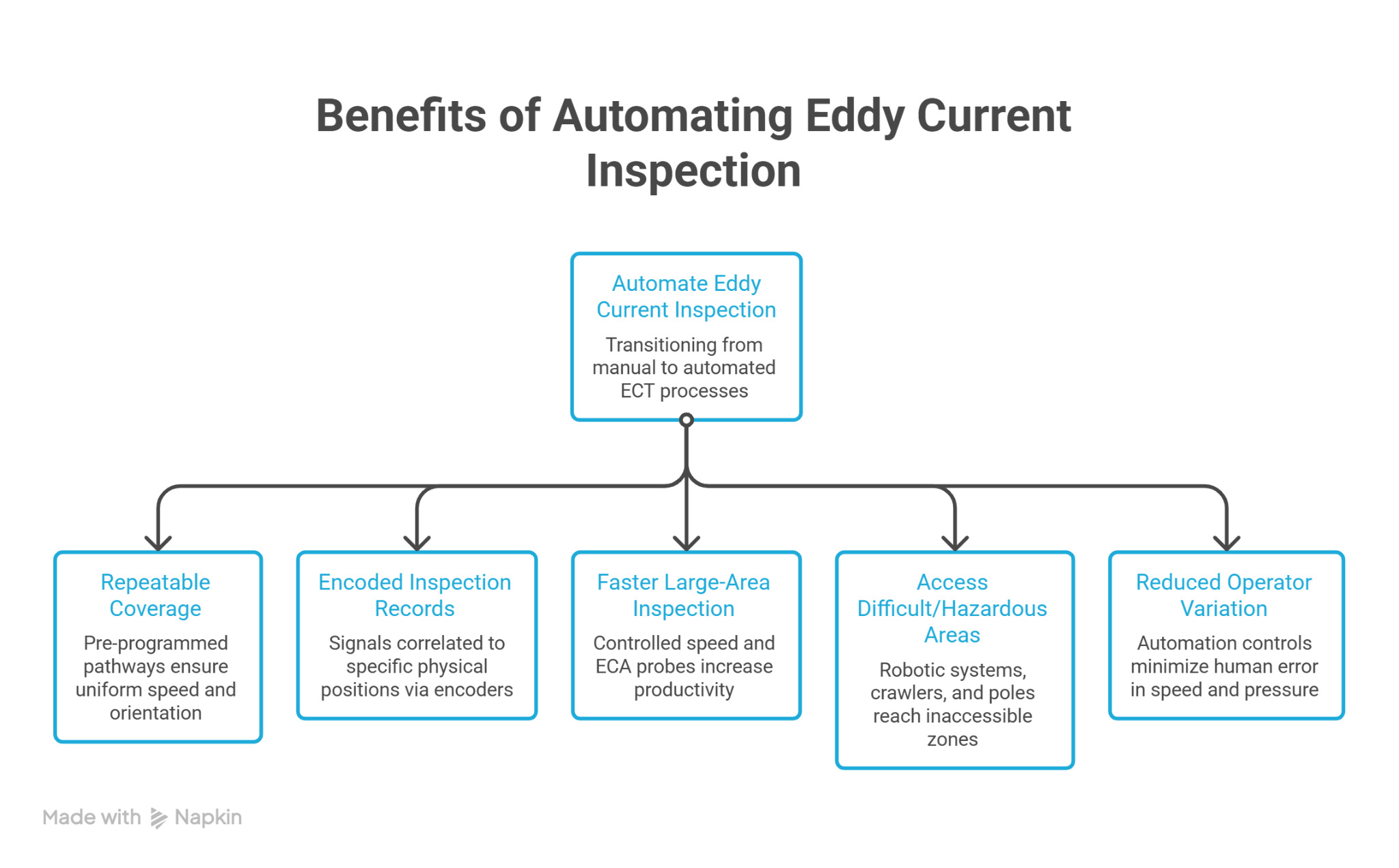
Automation solves a number of issues with manual ECT.
Repeatable coverage
The technician must scan at a constant speed and spacing and probe orientation is important in manual scanning. Automated system travelling on a pre-programmed pathway, assisting to deliver more uniform coverage between scans and inspections.
Encoded inspection records
The conventional ECT trace records the electrical response, but is not necessarily indicative of the exact physical site of the response. The signals are correlated to specific positions and presented as mapped inspection results by adding the data of the encoders to automated systems.
Faster large-area inspection
Automated scanners can scan with a controlled speed for long distances. Using Eddy Current Array (ECA) probes increases the productivity benefit since more sensing elements can cover a larger area in each pass.
Difficult and hazardous access
Robotic systems can place probes where they might be hazardous or inaccessible for technicians to place them. For inspecting large structures or structures at heights, magnetic crawlers or pole mounted systems can be used as well as other platforms or robots.
Reduced operator variation
Manual ECT may differ depending on the technique of the technician, such as probe speed, pressure, positioning and scan overlap. A source of inspection variation is reduced by the automation controls, since they detect movement.
Types of Automated and Robotic ECT Systems
These systems can be classified according to the manner in which the ECT probe is carried and moved.
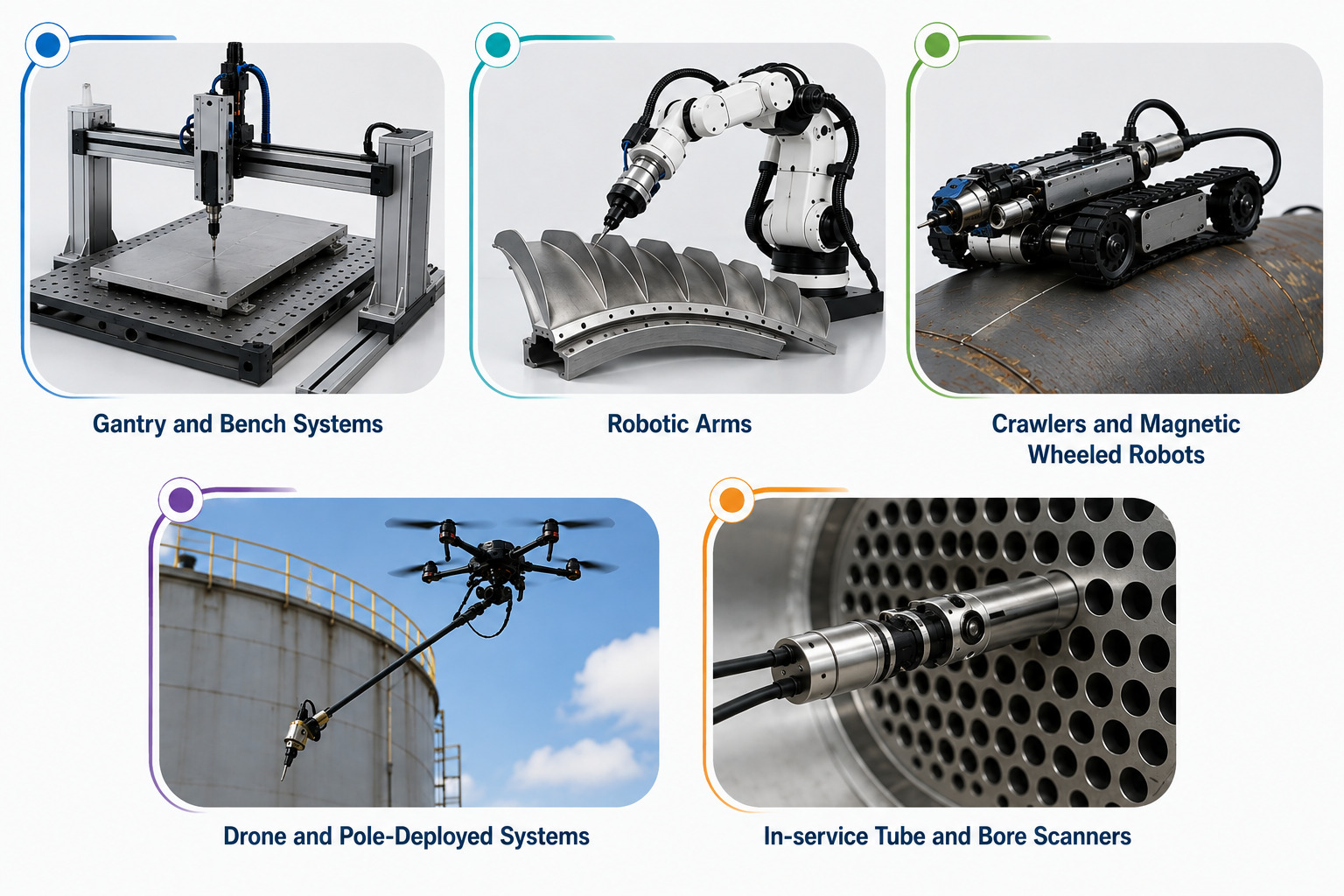
Gantry and bench systems
The fixed mechanical axes move an ECT probe over a stationary component of the system and are called gantry systems. Bench systems are controlled arrangements, with specialized fixtures.
They are appropriate for manufacturing applications where the same part needs to be measured over and over. Common applications include manufactured components, plates, rings, wheels and machined parts.
Robotic arms
Robotic arms offer several degrees of freedom which enable the ECT probes to move around complex surfaces.
They are especially useful for parts such as turbine blades, discs, and other parts of the engine in the aerospace industry for which a simple linear scanner would not be able to maintain the desired probe orientation.
The robot will save the position and response to the inspection in the ECT instrument while programmed on the surface path.
Crawlers and magnetic wheeled robots
Crawler systems enable robotized inspection in large structures that can't be easily accommodated in a fixed scanner.
The magnetic wheeled robot can be used for transporting ECT or ECA probes over suitable magnetic surfaces. They are used in storage tanks, ships, vessels, hulls and are used for large metal structures.
The robot is controlled during the movement and the ECT response and location is recorded during the inspection.
Drone & Pole-based systems
Positioning inspection sensors at high and/or hard-to-reach places can be achieved by using pole-mounted and aerial systems.
In the case of ECT however, it is necessary to keep the probe at an appropriate distance and angle from the surface. Stability, lift-off, positioning accuracy and signal quality are thus important factors to consider.
In-service tube & bore scanners
Automated tube scanners regulate the movement of probes within heat-exchanger tubes and other tubular components, and automatically measure the ECT data in the tubes throughout the process.
The same system can be applied to bores, holes and internal shapes. They are especially useful when hundreds or thousands of tubes need to be checked, as there is consistent scanning and digital records with automated acquisition.
Robotic arms are the go-to choice for aeroengine components like discs and blades, where a fixed scanner can't hold the probe orientation needed on a curved surface.
→ Read: Automated Eddy Current Testing for Aeroengine Components
What Automation Adds to the Data
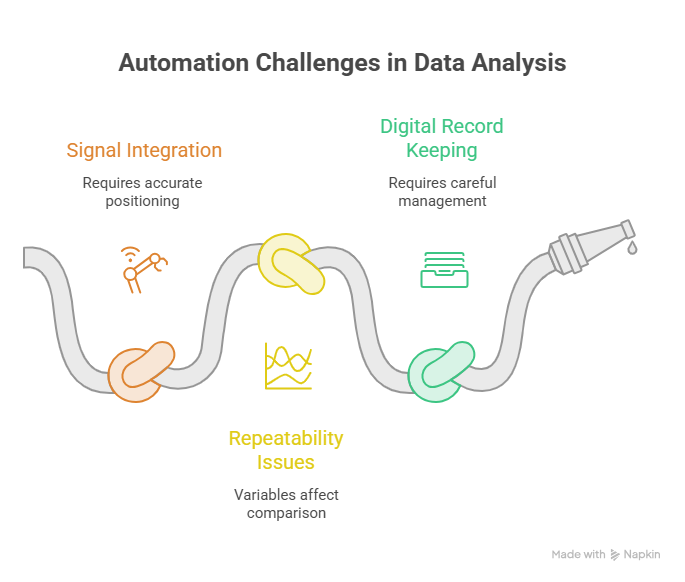
One of the biggest benefits of automated ECT is not the robot itself, but the integration of inspection signals with accurate positioning.
You can use a manually acquired impedance trace to determine if a signal has changed. An encoded automated scan will be able to indicate the location of this change and how it relates to surrounding scan data.
This enables maps to be produced like C-scan maps where the responses from the ECTs are plotted by physical location.
For example:
ECT response + X position + Y position = mapped inspection result
An analyst is not just looking at individual signal changes, but the distribution of indications throughout an area under inspection.
Repeatability between inspections
Inspection comparison is also more convenient for encoded scanning. In subsequent outages with controlled scan paths, the datasets can be compared to explore asset behavioural changes in terms of indications location, amplitude and/or pattern.
Two sets of data are not automatically comparable when they are automated. There are still variables involved in the inspection such as surface condition, scan parameters, probe and calibration to be controlled.
Digital inspection history
Digital records may be kept as a part of the inspection records of an asset. They can support:
- An inspection of this standard will be followed by a review of indications.
- Independent analysis of suspect signals
- Redoing the analysis with better computer software.
- Comparing with future inspection data
- Identifying areas checked by inspection
- More consistent reporting
Array probes and automation
When combined with ECA technology, the benefits are increased.
An array of sensing elements measures a much wider path than a conventional probe. If the array is scanned in a predetermined pattern, more area can be scanned in a single pass.
Automation steers the probe to where the inspection is required, and array technology boosts the amount of data it can collect on that journey.
Where Automated and Robotic ECT Is Used
Aerospace
Engine parts like discs, blades and airframe structures can include complex geometries and critical surface defects. These surfaces can be controlled by robotic arms and unique scanners.
Nuclear and power generation
There's a lot of tubing, components, and metallic structures in power-generation facilities that need to be inspected on a regular basis, and digital records that can repeat it are valuable. Automated tube inspection is especially beneficial for large populations of heat-exchangers.
Oil and gas
Large metallic structures, such as storage tanks and vessels may need a high percentage of coverage. Electromagnetic inspection technologies can be brought to surfaces difficult to scan or slow to scan with a robotic crawler.
Rail
In automated inspection, the geometry of rail components and other repeat-production parts are largely consistent, so they are suitable for automated inspection. High throughput inspection can be achieved by using fixed scanners and automated handling.
Production-line inspection
The geometry of parts and the type of inspection required are repeatable in manufacturing environments, making them ideal for automation. Automated ECT can be incorporated into the production cells for inspection at specific points during production.
Crawlers and magnetic wheeled robots aren't the only robotic platform used in NDT — see how robotics is being applied more broadly across inspection disciplines, from oil & gas tanks to nuclear tubing.
→ Read: Robotic Systems in NDT
AI and Automated Defect Recognition
There are also changes in the analysis workload, thanks to automation.
Thousands of signals may be found in large encoded ECT datasets, especially if tube bundles or large surfaces are being inspected. Software may help with the ability to detect signal patterns, to classify indications, and to highlight areas for the analyst to review.
The application of machine learning for the specific tasks in ECT interpretation (defect classification, depth estimation, etc.) is also being worked on.
AI should not be considered a substitute for skilled staff, though.
Existing automatic defect-recognition systems mostly help analysts and don't take the place of them.
Technical competence and qualification in inspection procedures, calibration, data-quality assessment, indication evaluation and final decision on acceptance remain in need of appropriate technical competence and qualification.
Limitations and When Manual ECT Is Still Better
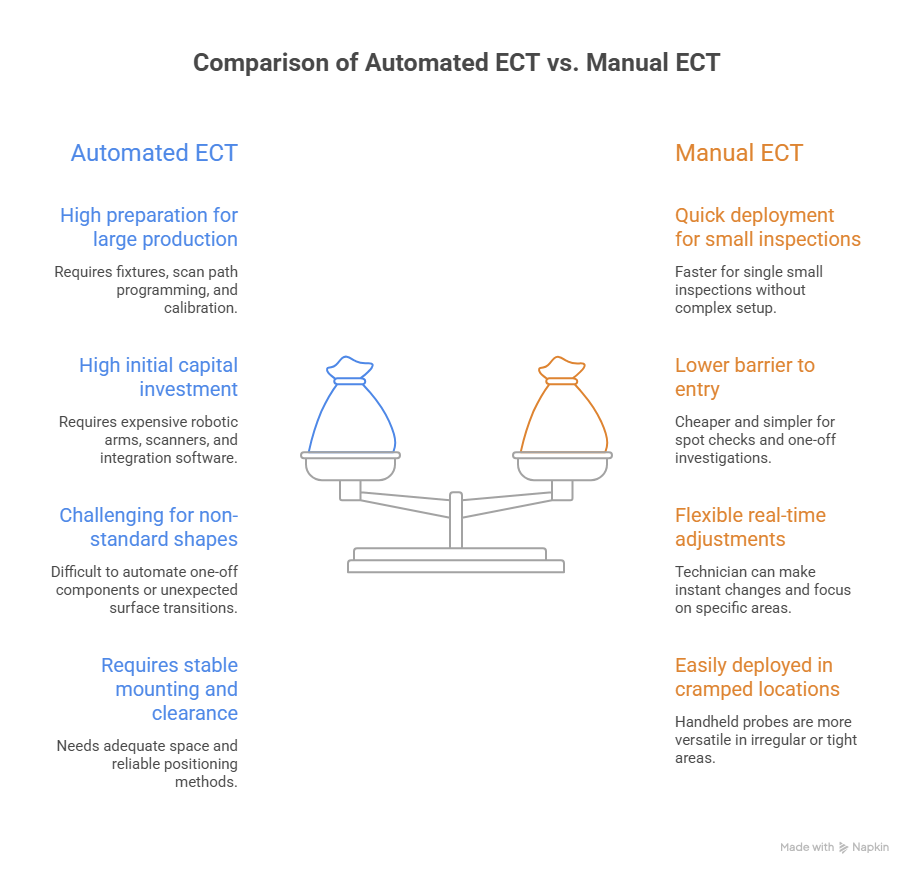
While automation is not always the optimum solution for all inspections, it can be.
Setup and programming time
Automated equipment needs to be set-up. Fixtures may be needed for components, scan paths must be programmed and calibration must be made.
This preparation may be beneficial for larger production amounts. Manual scanning might be quicker for a single small inspection.
Cost and justification
Expensive investment in robotic arms, scanners, encoders, array probes, software and integration equipment are all potential components.
When volume, value, coverage, safety, repeatability, or other factors make the business case for inspections stronger, then it is good to make the investment.
Unpredictable geometries
The best automation is when the inspection route can be determined. It can be challenging to automate one-off components that have geometry that isn't standard, have damage to the surface area, or have unexpected transitions.
A technician is able to make instant changes, switch the orientation of the probe, or focus on a particular area.
Fixturing and access
Automated systems may need a stable mounting, adequate clearances and a reliable method of positioning the component or scanner.
A handheld probe can be more easily deployed in cramped and/or irregular locations.
Qualified personnel are still required
A robot may move the probe, but not decide whether the inspection procedure is suitable or whether an indication is acceptable or not.
There is still a need for personnel who carry out and interpret ECT to be appropriately qualified and authorized under relevant certification and employer requirements.
When manual ECT wins
When it comes to a small spot check, weld toes and localised investigation or one-off access, a technician with a pencil probe could still be quicker, simpler and cheaper.
The aim should not be to automate all ECT inspections. It should be used to automate inspections where controlled movement, repeatability, coverage, access, or data volume offers a measurable benefit.
Conclusion
A move towards automated and robotic eddy current testing is the shift from just gathering an ECT signal to more important aspects of where, how and repeatedly that signal is gathered.
Automated systems automate the movement of the probe and the recording of its position, and the robotic systems are added for mobility or multi-axis access. The most beneficial value for inspection managers is the repeatable coverage, the encoded positional data, digital records, array-probe coverage and enhanced access.
But, automation is not without its practical constraints. Manual ECT may be preferable for small or variable inspections due to programming, fixturing, equipment cost or geometry restrictions.
Therefore, both approaches, automation and robotics working where repeatability, coverage and access can be achieved with them will be used in the most effective NDT programmes, coupled with the skilled technicians where flexibility and speed are more important.
FAQs
1. What is the difference between automated and robotic ECT?
Automated ECT involves using a mechanised system to conduct a consistent path from the probe and capturing the position data. The mobile or multi-axis platform is also used for Robotic ECT, to move the probe to and around the component. Automation controls are used to sense motion, and robotics offers the flexibility of access as well.
2. Does automated ECT replace the inspector?
No. Qualified personnel are still needed to set up the inspection procedure, calibrate and carry out system checks, evaluate the data quality, interpret indications and decide on acceptance. Automation can eliminate repetitive manual tasks, and promote consistency, but it does not eliminate competent NDT personnel.
3. What certification is needed for automated ECT?
Requirements vary based on the certification scheme, industry, employer, contract, and jurisdiction. ISO 9712 addresses qualification and certification of people who undertake ECT and ASNT have recognised routes for certification. Further on-the-job training or certification may be necessary as well.
4. Is automated ECT worth it for small inspections?
Not necessarily. It may take longer than manual scanning for a small inspection to setup, program and fixturing. A competent technician with a traditional ECT probe might be more efficient and less costly. More attractive automation becomes when the inspection area, production volume, repeatability requirement increases, or access issues arise.
5. Can robotic ECT systems use array probes?
Yes. Robotic/automated scanners can be compatible with ECA probes and instruments. Control of the probe is achieved by the robot and the array is used to sense a number of channels. This can give wider coverage per pass and position-resolved data which may be helpful for large or complex surfaces.
6. What is the main advantage of encoded ECT data?
Encoded data links the ECT response to the physical position of the probe. Instead of retaining only an isolated signal trace, the inspection can generate a position-based map such as a C-scan. This makes indications easier to locate, review, document, and compare during future inspections.

There are no comments yet!