Accurate non-destructive testing (NDT) of heavy rail surfaces is critical to ensuring railway safety, operational reliability, and long-term infrastructure performance. Addressing long-standing inspection challenges, researchers from Ludong University, Northeastern University, and the Beijing Institute of Control and Electronics have developed a binocular line-scanning stereo vision system that significantly improves defect detection accuracy in high-speed rail production environments.
Heavy rail inspection is particularly demanding due to harsh operating conditions, complex surface textures, unpredictable defect distribution, and continuous high-speed manufacturing lines. Conventional approaches—manual visual inspection and traditional contact-based NDT—struggle to meet these requirements at scale. Machine vision-based NDT systems, by contrast, offer non-contact inspection, seamless automation, and resilience in extreme industrial settings.
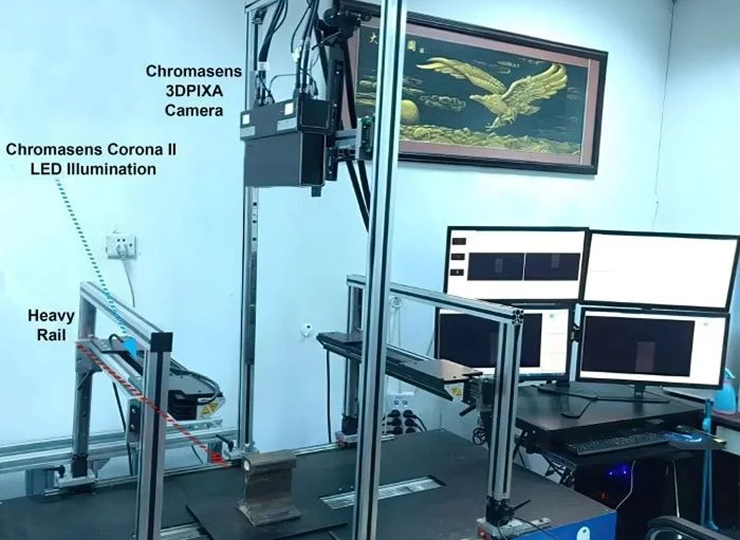
The newly developed system integrates binocular stereo vision with advanced line-scanning technology to simultaneously capture high-resolution 2D color images and 3D surface contour data. Using a Chromasens 3DPIXA-Dual 70 μm stereo line-scan camera, the solution enables precise surface characterization while maintaining inspection speeds suitable for continuous rail production.
One of the key limitations of earlier 3D stereo vision approaches—motion distortion caused by vibration, frame-rate mismatch, and installation errors—has been effectively addressed. The research team implemented a double-step cubature Kalman filter algorithm to correct nonlinear motion distortion effects. Experimental validation demonstrated a 57.3% improvement in data accuracy after correction, delivering the geometric fidelity required for reliable detection of cracks, squats, shelling, and other rail surface defects.
The system combines binocular vision measurement with triangulation principles to generate accurate depth information alongside RGB texture data. Optimized optical configuration and high-intensity LED illumination further ensure consistent imaging of rail surfaces, even under demanding industrial conditions.
By overcoming motion distortion and enabling high-speed, high-resolution inspection, the binocular line-scanning stereo vision system represents a significant advancement in automated NDT for railway infrastructure. The technology supports earlier defect identification, reduced maintenance costs, and improved safety—reinforcing the role of machine vision as a cornerstone of next-generation rail inspection and quality assurance.