Researchers at Georgia Southern University have developed an advanced ultrasonic nondestructive testing (NDT) approach that significantly improves internal crack detection in large steel structures, addressing a critical challenge in infrastructure inspection and structural health monitoring.
The research, led by manufacturing engineering graduate student Chowdhury Irtiza under the supervision of Hossein Taheri, Ph.D., Associate Professor in the Allen E. Paulson College of Engineering and Computing, integrates the Total Focusing Method (TFM) with computational simulations to enhance ultrasonic inspection accuracy. Experimental results demonstrate an approximate 15% increase in crack signal detectability compared to conventional ultrasonic testing techniques.
Conventional ultrasonic testing relies on single-element or phased-array transducers to transmit high-frequency acoustic waves, interpreting reflected signals to identify internal discontinuities. However, complex crack geometries, subsurface defects, and material heterogeneity often limit detection reliability—particularly in large-scale steel components such as bridge girders and load-bearing supports.
The Total Focusing Method overcomes several of these limitations by utilizing full matrix capture (FMC) to collect the complete set of transmit–receive data from an ultrasonic array. Post-processing reconstructs high-resolution images by synthetically focusing at every point within the inspection region.
“TFM enables the use of maximum raw echo data to generate a detailed representation of internal defects,” Irtiza explained. “By coupling this method with physics-based simulations, we can optimize inspection parameters—particularly ultrasonic frequency—without relying on costly and time-consuming trial-and-error testing.”
Frequency optimization plays a crucial role in balancing penetration depth and spatial resolution. The simulation-assisted framework developed in this research allows inspectors to identify the optimal frequency range for specific defect types and material configurations, improving defect characterization while reducing inspection time and cost.
The practical relevance of this work is underscored by recent infrastructure failures linked to undetected internal cracks, including the 2021 emergency closure of the Hernando DeSoto Bridge over the Mississippi River. Such incidents highlight the need for more reliable and data-rich NDT techniques capable of identifying critical flaws before they propagate.
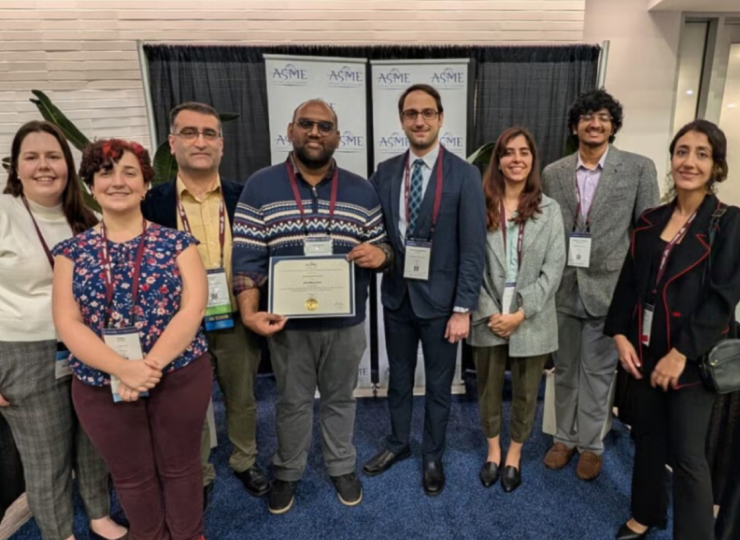
The research was recognized with the Best Research Award at the International Mechanical Engineering Congress & Exposition (IMECE), where it was evaluated alongside work from international doctoral-level research groups.
According to Dr. Taheri, the study demonstrates how advanced ultrasonic imaging techniques can transition from laboratory research to field-ready inspection solutions.
“This work contributes to the ongoing evolution of ultrasonic NDT by improving defect detectability, inspection repeatability, and decision-making confidence,” Taheri said.
Irtiza plans to continue advancing ultrasonic NDT research through doctoral studies, with a focus on expanding simulation-assisted inspection methodologies for infrastructure, manufacturing, and energy-sector applications.
As aging infrastructure and safety regulations drive demand for higher-fidelity inspection technologies, this research offers a scalable and cost-effective pathway toward more reliable nondestructive evaluation of critical structural assets.