
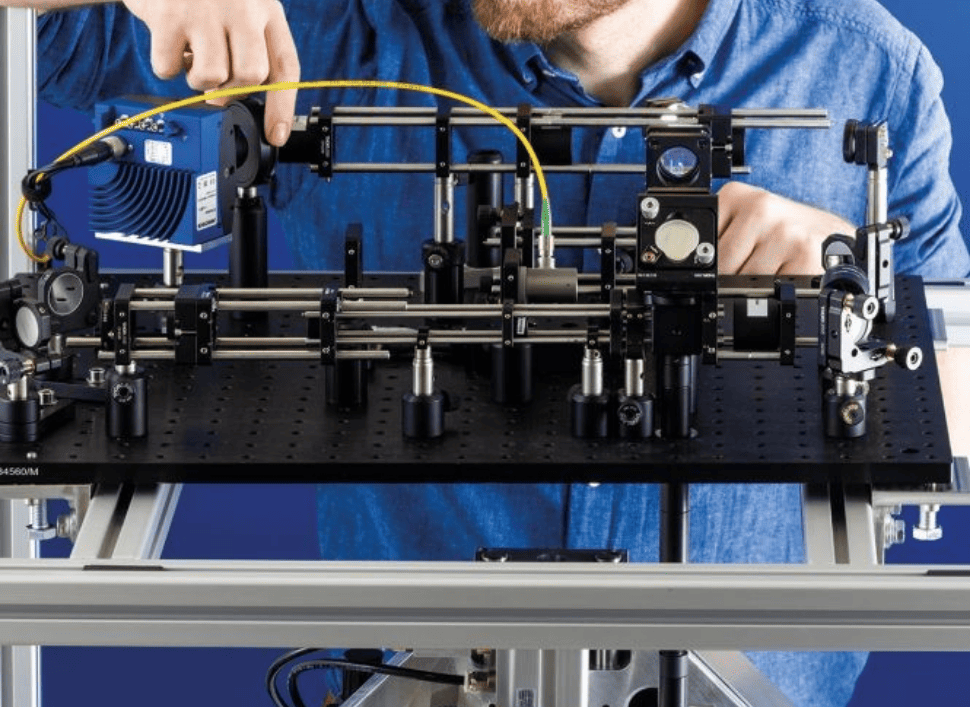
The Fraunhofer Institute for Ceramic Technologies and Systems (IKTS) has developed an optical coherence tomography (OCT)-based inspection system that enables real-time, non-destructive testing of heat-sealed seams in film packaging.
Developed as part of the OCTInline project, the system is designed to detect even the smallest defects in sealed packaging while the material is moving through the production process. The technology can inspect seal seams at production speeds of up to 25 metres per minute and detect pores as small as eight micrometres.
Reliable seal integrity is particularly important in packaging used for medical and food products, where failures in heat-sealed seams can affect the tightness and quality of the package. The OCT-based approach provides manufacturers with a method to inspect the internal structure of the seal without damaging either the packaging or the product.
OCT enables three-dimensional internal inspection
Optical coherence tomography is an imaging technology originally developed for ophthalmology. It uses near-infrared light to examine structures beneath a material's surface and generate three-dimensional images.
Conner Phillips, a researcher at Fraunhofer IKTS, explained the working principle of the technology.
„The system sends near-infrared light into the material and captures the reflected signals, which are used to create high-resolution three-dimensional images of the internal structure.“
The technique allows defects such as material flaws, air pockets and insufficiently welded areas to be identified within the seal seam.
For non-destructive testing applications, the ability to examine the internal structure without cutting or otherwise damaging the packaging provides continuous inspection during production.
Continuous inspection during the sealing process
As part of the OCTInline project, Fraunhofer IKTS researchers integrated OCT directly into a packaging machine's sealing process. This allows the seal seam to be continuously monitored while the film moves through production.
The system is capable of operating at speeds of up to 25 metres per minute while providing inspection resolution down to the micrometre range. According to Ralf Schallert, group manager at Fraunhofer IKTS, pores measuring as little as eight micrometres can be detected and visualised within the seal seam.
Achieving both high inspection resolution and production speed required the researchers to address data processing and industrial integration challenges.
„We had to find a balance point between depth of field, exposure time and the movement of the film,“ says Phillips.
The integration of OCT into the production process therefore provides a continuous non-destructive inspection approach rather than relying exclusively on checks performed after the packaging process.
OCT supports process reliability and reduces rejects
The development comes as packaging manufacturers increasingly adopt recyclable mono-films. While these materials offer environmental advantages, they can also present challenges related to seal seam quality.
Schallert emphasised the importance of continuous monitoring.
„This increases the need for continuous monitoring.“
Real-time inspection can provide information about the condition of the sealing process, including changes associated with pressure, temperature and tool wear. Such information can help identify deviations during production and support decisions regarding maintenance and tool replacement.
„Many errors occur because pressure and temperature are not optimally matched to the material, or because the tool wears out over time,“ explains Schallert. „With the OCT data, we can make such changes visible and also identify at an early stage when, for example, a tool change becomes necessary.“
For manufacturers, continuous inspection can also help reduce rejects and material consumption by identifying seal defects during production rather than after completed packaging has been produced.
Demonstrator enters industrial use
A demonstrator of the OCT inspection system has been in use at Kallfass Verpackungsmaschinen in Nürtingen since July 2026 and is being presented to potential customers.
Although the current application focuses on film packaging, Fraunhofer IKTS said the OCT systems can be adapted to different materials and inspection requirements. Potential applications also include functional coatings, ceramic components and additively manufactured parts.
The technology is particularly suited to applications where thin layers, internal structures or very small defects need to be identified.
„Wherever thin layers, internal structures or the smallest of defects need to be reliably detected, OCT can make an important contribution – from medical technology and functionalised surfaces to industrial 3D printing,“ says Schallert.
The OCTInline project demonstrates the application of optical coherence tomography as a non-destructive inspection method capable of combining high-resolution internal imaging with continuous, in-line production monitoring.