How a sound that everybody ignored became a way of listening inside a structure
Bend a bar of tin and it screams.
Not loudly, but unmistakably. A thin, dry crackle, somewhere between a creak and a tear, coming from inside the metal itself. When a Cambridge metallurgist wrote about it in 1932, he called it an observation of respectable antiquity and admitted he could find no proper explanation for it anywhere in the scientific literature.
The crystals inside the metal are rearranging themselves. Under stress, tin does not simply stretch. Its structure flips into a new orientation in sudden jumps, thousands of them, each releasing a small pulse of energy into the surrounding material. Enough of them together and you hear it. The metal is not making a noise because something has gone wrong, but because something is happening.
For most of history that was a curiosity, remarked on and set aside.
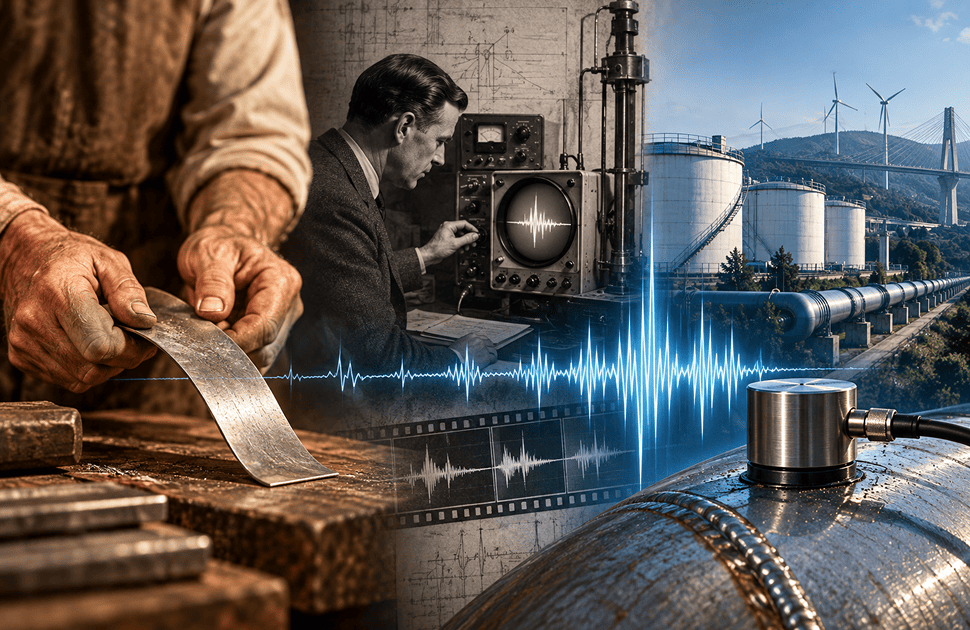
Except by the people who worked with the stuff. Long before anyone could explain twinning crystals, tin casters in Europe had a working trick. Take a used tin plate, bend it by hand, and listen. A clean sound meant clean metal. A dull sound meant the plate was full of lead and zinc you could not see. No theory, no instruments, just a trained ear. They were reading the material by the sound it made under load, centuries before anyone named the idea.
Munich, 1950
The name arrived by way of a ruined city.
After the war, the Technical University of Munich was roughly four-fifths rubble. Into that, in 1945, walked a young engineer named Josef Kaiser, who went to see a professor of mechanics with an unusual request. He wanted to research the sounds that metals make when you stress them.
It is worth pausing on how unpromising that sounded. The audible noises came from a few soft metals like tin. Steel under load is, to the human ear, silent. Kaiser's proposition was that it is not silent at all, and that if you listened properly you would find every material talking constantly, just above the range of human hearing.
There was no equipment to buy, so he built it out of scrapped military electronics. He made microphones from quartz and Rochelle salt crystals, and an amplifier that could multiply a signal a million times. His oscilloscope used an old Braun tube. The testing machine had a motor, and the motor made noise, so he worked it by hand.
Then came the problem that nearly stopped him. He could see the signals but had no way to keep them. His first recording attempt used a cine camera that ran for thirty seconds and made, in his own description, an infernal racket that drowned out the very thing he was trying to capture. He settled instead on photographing the oscilloscope trace on 16 mm film, developing it, and measuring the peaks off the photographs by hand with a measuring stick.
It worked. Kaiser demonstrated that metals under load emit a continuous stream of tiny elastic pulses, far above audible frequency, and that the pattern of those pulses tracks what is physically happening inside the material.
The thing he noticed
Then he found something stranger, and it is the reason his name is still spoken in the industry seventy-five years later.
Kaiser loaded a specimen, recorded the emissions, and released the load. Then he loaded the same specimen again. This time, almost nothing. It stayed quiet all the way up, silent past the point where it had been noisy before, and only when the load passed the previous maximum did the signals return, in his words, with their former vehemence.
The material remembered. It had a record of the worst stress it had ever survived, and it would not say anything new until you exceeded it.
The implication was enormous. You could take a structure whose history you did not know, load it carefully, listen, and work out what it had already been through, without cutting it open. That is the Kaiser effect, and it remains one of the foundations of the field.
Kaiser did not get to see where it led. He fell seriously ill, handed his work to a successor in 1957, and died the following March.
From a laboratory bench to a rocket
What happened next happened mostly in America, and quickly.
An engineer named Bradford Schofield, working on research contracts for the US military, gave the phenomenon the name it still carries: acoustic emission. Others found that making it useful in the field meant refusing to listen where humans listen. Machinery, footsteps, flowing liquid all live at low frequency. Move the listening window high enough, well past anything a person can hear, and the din falls away while the material's own signals come through clean.
By the early 1960s the method had left the laboratory. Engineers were wiring sensors to the casings of Polaris missile motors and listening while they were pressurised. In 1965 a team caught a crack beginning to grow inside a steel rocket motor case at just over half its proof pressure, and knew about it while it was happening rather than afterwards.
That is the moment the whole idea turns around. Every other inspection method answers the question of whether a flaw is present. This one answers a different question, and often a more urgent one: is anything moving in there right now?
What it became
Today the sensors sit on the floors of oil storage tanks, listening for corrosion while the tank stays full and in service. They sit on bridges under traffic, on wind turbine blades, on pressure vessels during proof tests, on pipelines running through country nobody wants to walk.
They are doing what a tin caster did, bending a plate and listening for the wrongness in the sound. The frequencies are higher, the instruments are better, and the interpretation is a profession now. The idea has not changed at all.
The metal was always talking. It just took us a very long time to work out how to listen.
Further reading
Bruce Chalmers, "The Cry of Tin," Nature, 30 April 1932.
H.M. Tensi, "The Kaiser Effect and its Scientific Background," EWGAE 2004. An account of Josef Kaiser's work and apparatus by his successor at the Technical University of Munich, drawing on Kaiser's original 1950 dissertation.
T.F. Drouillard, "A History of Acoustic Emission," Journal of Acoustic Emission, 1996.