
Table of content
- Why trade show ROI is hard to measure — and worth measuring anyway
- Pre-show: set goals and a capture plan before you book the booth
- At-show: capture leads deliberately, not incidentally
- Content capture on the floor
- Post-show: follow-up speed and cost per qualified lead
- The shows themselves
- What NDT marketing leaders actually say about exhibiting
- Common mistakes
- Key takeaways
- FAQs
- References
- Related reading on OneStopNDT
Why trade show ROI is hard to measure — and worth measuring anyway
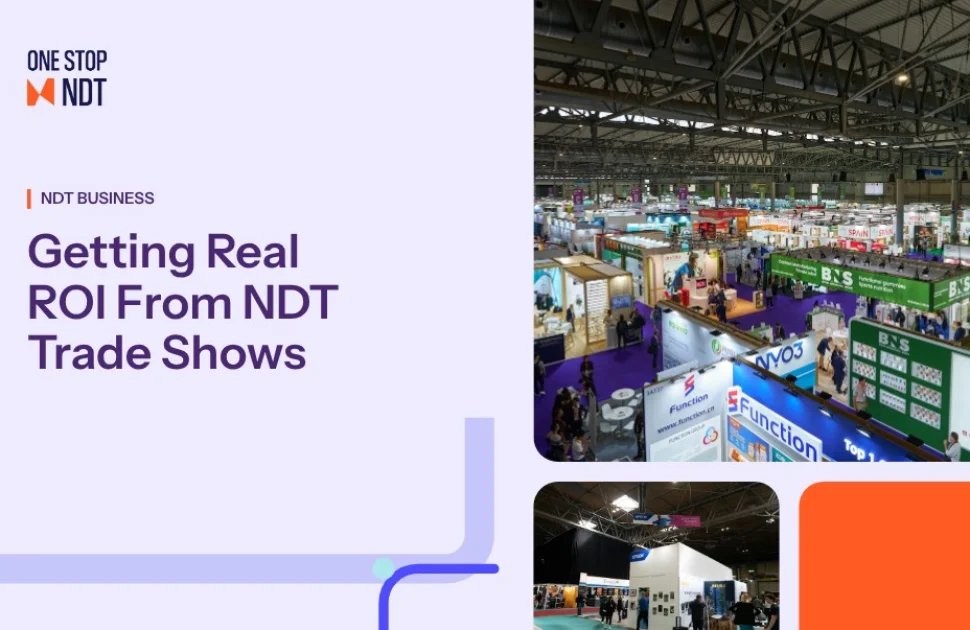
Most NDT companies exhibit at the same handful of shows every year — ASNT’s Annual Conference, ECNDT or WCNDT, NDE India, and a rotating set of regional events — and most can’t say with any confidence what they got back for the spend. Booth fees, travel, and staff time are easy to total; what’s hard is connecting a specific lead captured on the floor to a specific deal closed months later, especially in a sector where sales cycles routinely run 4–6 months or longer.
That difficulty doesn’t make the exercise pointless. It makes the plan matter more: what you capture at the booth, how fast you follow up, and what you compare it against next year are the three things that actually separate a show that pays for itself from one that doesn’t. This guide walks through the full cycle — pre-show, at-show, post-show — with real benchmark data where it exists, honest gaps flagged where it doesn’t, and what NDT marketing leaders themselves have said publicly about exhibiting in this industry.
Pre-show: set goals and a capture plan before you book the booth
Set goals before anything else gets planned: how many qualified conversations you want, which accounts you want to meet face-to-face, and what content you want to leave the show with. A target list matters more than booth size — know which existing customers, prospects, and press/analyst contacts you want to see, and reach out before the show to book time, rather than hoping they walk by.
A practical content-capture strategy, per general B2B exhibition-marketing guidance (MarketScale), is written roughly two weeks before the show and covers: the target list, a booth schedule, three narratives you want to come home with, and three deliverable formats per narrative — framed around business outcomes (“move account X forward”) rather than just a content quota. Interview priority should go first to customers and prospects visiting the booth, then internal team members demoing or speaking, then external voices like analysts or partners at the event. Where you’re planning to capture video, send interview requests to scheduled visitors ahead of time with a few prepared prompts, and book a video crew for the show’s peak coverage days rather than trying to cover everything with one person.
At-show: capture leads deliberately, not incidentally
Common lead-capture methods at B2B exhibitions include badge scanning at the booth entrance, QR codes tied to specific demos or giveaways, short in-booth surveys, and lead-retrieval apps provided by show organizers or third-party vendors. No reliable benchmark data on the relative adoption rates of these methods (what share of exhibitors use badge scanning versus QR versus an app) could be found during research for this article — treat any specific adoption percentage you see elsewhere with skepticism unless it’s sourced to a named, dated study.
What matters more than the capture method is capturing enough context to qualify the lead on the spot: which problem they came to the booth to talk about, what equipment or method they currently use, and where they are in a buying cycle. ASNT’s own exhibit-floor data (from its exhibitor information page) found 71% of attendees said they met new suppliers at the show’s expo, and 58% reported sole or joint purchasing authority — a reminder that a meaningful share of booth conversations are with people who can actually sign off on a purchase, which is worth capturing explicitly rather than assuming from the conversation alone.
Content capture on the floor
The show floor is one of the few times in the year your whole technical and commercial team, your customers, and sometimes your competitors are in the same room — worth capturing deliberately rather than relying on whoever happens to have a phone out. Per general B2B exhibition-marketing guidance, same-day turnaround matters: draft captions, follow-up emails, and recap copy the same day each interview or demo is filmed, while the context is still fresh, rather than batching everything for after the show.
After the show ends, a short recorded roundtable with your own team — while their impressions are still fresh — is a practical way to capture internal takeaways (what questions kept coming up, what competitors were showing, what resonated) that otherwise get lost once everyone’s back to their regular workload.
Post-show: follow-up speed and cost per qualified lead
Follow-up speed is the single most-cited lever in the benchmark data found, though most of the underlying studies are dated (2014–2016) and should be read as directional rather than current. A widely cited 2014 Lead Response Report found 35–50% of sales go to whichever vendor responds first. EXHIBITOR Magazine’s 2015 Sales Lead Survey found 62% of exhibition leads were contacted within 5 days, but only 22% of exhibitors managed to respond within 24–48 hours — a real gap between what’s known to work and what most exhibitors actually do. A more recent source (a 2026 “State of US B2B Events” figure, cited via a vendor blog) states 40% of exhibitors wait 3–5 days to follow up and 80% of trade show leads never receive any follow-up at all; that same source’s day-by-day conversion-decay percentages are the vendor’s own modeled estimate, not independent research. The practical takeaway that holds up across every source: follow up within 24–48 hours, and don’t give up after one attempt — separate data (SiriusDecisions) found the average salesperson stops after just two follow-up attempts, while other benchmark data suggests a majority of trade-show lead sales close within three or fewer calls.
Cost per qualified lead at B2B trade shows is commonly cited around $142 per lead, a figure widely attributed to CEIR (the Center for Exhibition Industry Research) by secondary sources — no direct link to an original CEIR study or publication year could be confirmed, so treat this as a commonly repeated industry figure rather than a precisely dated statistic. What’s more useful than chasing that number directly is tracking your own: cost per meeting held, cost per qualified contact, time from capture to first follow-up, and the share of captured contacts that turn out to be usable — metrics recommended by B2B exhibitor-marketing guidance (Integrate.com) that let you compare your own show-to-show performance even without an external benchmark.
Nurturing beyond the first follow-up compounds the value of a captured lead: a 2015 Lead Nurturing Benchmark Study found nurtured leads produce a 10–20% increase in sales opportunities, and separate Forrester research found nurtured leads generate 50% more sales at 33% lower cost than leads left to go cold.
The shows themselves
ASNT Annual Conference runs every year (2026’s edition at the Greater Columbus Convention Center, Columbus, Ohio). ASNT’s own exhibitor information for its 2026 conference cites 2,100+ attendees averaging roughly 5 hours on the exhibit floor, with 71% reporting they met new suppliers at the expo and 58% holding sole or joint purchasing authority — real, sourced figures worth planning a booth strategy around, though they vary year to year (a different year’s ASNT exhibitor page shows 2,200+ attendees, 6 hours, and 63%), so check the current year’s figures before relying on them.
WCNDT (World Conference on NDT) runs every 4 years under ICNDT. The most recent edition, the 20th WCNDT, was held 27–31 May 2024 in Incheon, South Korea, with roughly 1,000 abstracts submitted and around 200–230 exhibiting companies across approximately 354–357 booths — pre-conference and post-event sources checked gave slightly different figures for exact company and country counts (e.g., 60 vs. 80 countries, 203 vs. 230 companies), so this guide uses the approximate ranges rather than a single precise figure. No overall attendee total could be confirmed with consistency across sources checked.
ECNDT (European Conference on NDT) is ICNDT’s European counterpart; the 13th ECNDT ran 3–7 July 2023 in Lisbon, Portugal, with the 14th ECNDT confirmed for 15–19 June 2026 in Verona, Italy. No attendee or exhibitor totals were found.
NDE India, organized by ISNT (the Indian Society for Non-Destructive Testing, 5,000+ members, tracing to predecessor bodies founded in Calcutta in 1972 and Madras in 1981), runs annually; the 2025 edition was held 11–13 December 2025 in Mumbai. No attendee or exhibitor totals were found for any recent edition.
Only ASNT has solid, independently sourced attendance and purchasing-authority figures; for ECNDT, WCNDT, and NDE India, this guide uses qualitative scale language (“hundreds of exhibitors,” “thousands of attendees”) rather than inventing numbers that couldn’t be verified.
What NDT marketing leaders actually say about exhibiting
No named NDT marketing head has published a quote specifically about trade-show ROI, cost-per-lead, or follow-up process. What does exist, real and attributed, is broader commentary on what exhibitions have become in this industry.
From OSNDT’s own NDT Talks Episode 8 (“Marketing strategies in a technical niche industry”): Bernardo Ordóñez Esquivel, Marketing Director at Testia, described how exhibitions in NDT have changed: “the typical exhibition was boring. No colour, nothing really attractive” when he started in the field, versus now — “if you go to any given exhibition, you can see that marketing is already there.” He also described adjusting technical depth to the audience: at an exhibition for a specific material or technology, Testia explains NDT to a non-NDT audience without being arrogant about it, while “if we are attending ECNDT, we can be as technical as we want” because that audience already knows the subject. Ken Dobell, a fractional CMO who sat on the same panel, warned that “everyone shows up at the same trade shows and everyone sounds the same,” predicting that companies relying only on product marketing and trade shows “are going to feel pretty invisible” within five years as differentiation becomes more important.
Separately, Jean Philip, Eddyfi Technologies’ Commercial Events Coordinator, told Inspenet at ASNT 2023: “A lot of time and effort goes into making sure each event is better than the last.” The same piece described Eddyfi running two booths at that show, demonstrating its Sonyks guided wave system, a tank floor scanner, an eddy current array, and the Ectane 3 (with AI features), plus a robotics specialist demonstrating magnetic crawlers — but the source did not disclose lead volume, cost, or ROI figures.
Common mistakes
- Waiting more than 48 hours to follow up. Only 22% of exhibitors manage this per the benchmark data cited, despite follow-up speed being the single most consistent predictor of conversion across every source found.
- Giving up after one follow-up attempt. The average salesperson stops after two tries; closing a meaningful share of trade-show leads typically takes three or more touches.
- Treating a captured badge scan as a qualified lead. Capture method matters less than capturing enough context on the spot — the problem discussed, current equipment/methods, and buying-cycle stage — to actually qualify the conversation.
- Citing the “$142 per lead” CEIR figure as a precisely sourced, current statistic. It’s widely repeated but could not be traced to a dated original study — use it as a rough industry reference point, not a hard number.
- Assuming attendee/exhibitor figures for ECNDT, WCNDT, or NDE India that mirror ASNT’s. Only ASNT has solid, independently sourced numbers; treat the others with appropriately qualitative language until better data exists.
- Batching all show-floor content for after the event. Same-day turnaround on captions, follow-ups, and recap copy captures context that’s otherwise lost by the time you’re back at your desk.
Key takeaways
- Set goals and a content-capture plan before the show, not during it — a target list and a few planned narratives matter more than booth size.
- Follow-up speed is the strongest, most consistently cited lever across the available benchmark data: respond within 24–48 hours and don’t stop after one attempt.
- Track your own cost per meeting and cost per qualified contact rather than chasing an external “average cost per lead” figure that can’t be precisely sourced.
- Only ASNT has solid, independently sourced attendance and purchasing-authority data among the four shows covered here; treat ECNDT, WCNDT, and NDE India figures qualitatively until better data exists.
- No named NDT marketing head has published a quote specifically about trade-show ROI or cost-per-lead; real NDT-industry commentary used here (Testia’s Ordóñez Esquivel, fractional CMO Ken Dobell, Eddyfi’s Jean Philip) speaks to exhibition strategy and effort, not ROI figures.
FAQs
What’s a realistic cost per lead at an NDT trade show? No NDT-specific figure exists. The widely cited general B2B figure is around $142/lead, attributed to CEIR by secondary sources, but it couldn’t be traced to a dated original study — use it as a rough reference, and track your own cost per qualified contact instead.
How fast should we follow up with leads after a show? Within 24–48 hours, per the benchmark data available — only 22% of exhibitors currently manage this, despite it being the single most consistent predictor of conversion across every source checked.
Which NDT trade show has the best attendee data available? ASNT’s Annual Conference — 2,100+ attendees, 71% reporting they met new suppliers at the expo, 58% with sole or joint purchasing authority, all sourced to ASNT’s own exhibitor information.
Do we need a video crew at the booth? Not necessarily, but if content capture is a goal, general B2B exhibition guidance recommends booking one for peak coverage days and planning interview requests with scheduled visitors ahead of time, rather than relying on ad hoc phone footage.
Has any NDT company published their own trade-show ROI numbers? Not that could be found. The real, attributed commentary available from NDT marketing leaders (Testia, a fractional CMO, Eddyfi) speaks to exhibition strategy and effort, not specific ROI or lead-cost figures.
References
- OSNDT. “NDT Talks Episode 8: Marketing strategies in a technical niche industry.” onestopndt.com/ndt-talks/marketing-strategies-technical-niche-industry. [Source of Ordóñez Esquivel and Dobell quotes.]
- Inspenet. “Interview: Eddyfi Technologies at ASNT 2023.” inspenet.com/en/video-tv/interview-eddyfi-technologies-at-asnt-2023. [Source of the Jean Philip quote.]
- ASNT. Exhibitor information page (attendance, exhibit-floor time, purchasing-authority figures). asnt.org.
- ICNDT. Annual Report (WCNDT 2024 Incheon figures; ECNDT 13th/14th edition details).
- ISNT (Indian Society for Non-Destructive Testing). NDE India 2025 event listing (11–13 Dec 2025, Mumbai), membership and history.
- MarketScale. “How to Create a Trade Show Content Strategy.” help.marketscale.com.
- EXHIBITOR Magazine. 2015 Sales Lead Survey (follow-up timing figures).
- InsideSales.com. 2014 Lead Response Report.
- Momencio (vendor blog, Feb 2026, citing a “2026 State of US B2B Events” report).
- Mapp/4over4 FAQ page, citing CEIR for the “~$142 per lead” figure.
- Integrate.com exhibitor-marketing blog (recommended metrics: cost per meeting, cost per qualified contact).
- Forrester Research; 2015 Lead Nurturing Benchmark Study (nurturing-impact figures).
- NDT Marketing & Growth Playbook — the broader marketing strategy this trade-show guide fits into
- NDT Marketing Benchmark Report — cost and channel benchmarks to compare against trade-show spend
- How NDT Companies Get Found in Google and AI Search — turning trade-show content into search and AI visibility
- How to generate leads through content marketing in the NDT sector
- How to measure ROI on digital marketing campaigns
- Social media marketing for NDT companies
- NDT Talks Episode 8: Marketing strategies in a technical niche industry — source of the real quotes used in this article

There are no comments yet!