
Table of Contents
- Session Overview
- Meet the Panel
- What Actually Makes Technical Marketing Different
- Marketing as the Bridge to the Internal Experts
- The Audiences: Operator, Buyer, and the Stakeholder Nobody Markets To
- What Changed in the Last Five to Seven Years
- AI Search and the Race to Become the Reference
- Brand, Purpose and Employee Advocacy
- Depth vs Clarity: Architecture, Not Simplification
- The Next Three to Five Years
- Key Takeaways
- Frequently Asked Questions
1. Session Overview
Marketing in NDT and industrial manufacturing is not conventional B2B marketing. The technologies are complex, the buyers frequently know more about them than the marketers do, decision cycles run long, and credibility matters more than visibility. This session brought together four people who do it for a living — at an equipment manufacturer, an inspection services provider inside an aerospace group, a large industrial technology business, and from the outside as a strategy advisor.
The discussion was unusually direct about what is not working. The panel agreed that the instinct to simplify the technology is wrong, that most technical content produced today is ignored, and that much of what the industry calls marketing is actually sales enablement. It closed on a prediction worth taking seriously: within five years, the companies that win will not be the ones buyers know, but the ones AI systems cite.
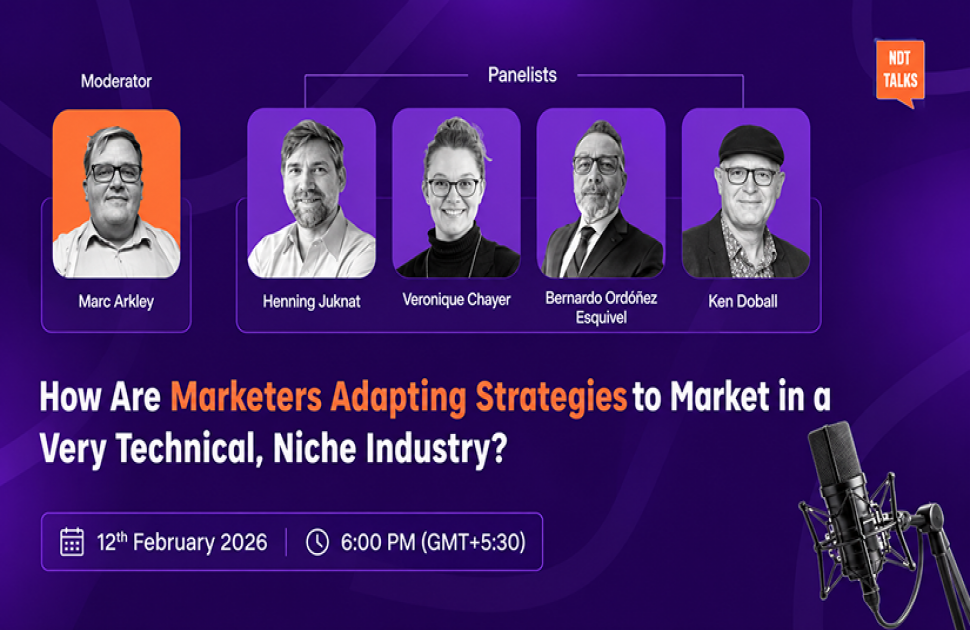
NDT Talks Episode 8 — How Are Marketers Adapting Strategies to Market in a Very Technical, Niche Industry:
2. Meet the Panel
Panelist | Role | Perspective |
|---|---|---|
Ms. Veronique Chayer | Vice President, Marketing and Communications, Eddyfi Technologies | Adapting best-in-class marketing principles to a credibility-driven technical industry |
Mr. Henning Juknat | Global Communications Leader, Waygate Technologies, a Baker Hughes business | B2C to B2B transition, corporate communications, employee advocacy and emerging markets |
Mr. Bernardo Ordóñez Esquivel | Marketing Director, Testia | Engineer-turned-marketer bridging internal technical experts and external audiences |
Mr. Ken Dobell | Fractional CMO and go-to-market strategy advisor | Category positioning, brand strategy and AI-driven search across technical B2B |
Mr. Marc Arkley (Moderator) | Customer Service Assistant and Marketing Specialist, Ether NDE | Practical, experience-driven discussion |
3. What Actually Makes Technical Marketing Different
The opening question asked where marketers most often underestimate the challenge. Ms. Chayer went straight at the most common assumption in the room.
Ms. Veronique Chayer — Vice President, Marketing and Communications, Eddyfi Technologies
“One of the biggest misconceptions with marketing in very technical industries is that it is very often misunderstood as, well, we need to simplify the technology, we need to oversimplify it. Whereas in reality, what we need to remember is that we are talking to people that more often than not actually understand way more about the technology than we do as marketers. So it is not about simplifying it — they understand it. It is about making whatever we are producing actually useful, and giving it a purpose in relation to where they are in their business and what they need to achieve next.”
Capturing Demand Is Not the Same as Creating It
Mr. Dobell agreed and pushed further, arguing that explaining complex technology is not the real challenge because it happens too late in the process to matter.
Mr. Ken Dobell — Fractional CMO and go-to-market strategy advisor
“It is really about capturing demand as opposed to creating it. There is a misconception generally in technical and industrial B2B that the audience has done the math — everyone knows who we are, it is a small industry, the buyer is interested in the spec sheet. But there is a time before all that, in every professional universe, where people are arriving at the definition of the problem and have not defined the solution. There is a moment where they are not in market. What B2B does in general is actually sales enablement. It is not really marketing at all.”
Mr. Ken Dobell — Fractional CMO and go-to-market strategy advisor
“Nobody is doing business with companies they do not trust. So everyone is technically credible, everyone has certifications, everyone has case studies. The problem really is that everyone shows up at the same trade shows and everyone sounds the same. In my mind the challenge is how to escape category convergence — where we are defining a value proposition based on what actually defines the category as a whole, which is therefore generic and product centric — and instead look for that upstream positioning that is truly differentiating. That says we are the reference, because we define the terminology and we define the category.”
Slower, but Deeper
Mr. Henning Juknat — Global Communications Leader, Waygate Technologies, a Baker Hughes business
“The fundamental thing in B2B, and B2B high tech, is you go slower but you go deeper. You have fewer customer touch points, maybe — but once you have them you need to go deeper and explain what we are doing. Our purpose is providing safety and productivity to our customers, and to everything that is a complex product or infrastructure. There is a broad diversity of industries we play in and they are quite different, so every industry might need slightly different messaging.”
His underestimated challenge was not strategic at all: accessibility. He described a persistent struggle to give existing and potential customers an easy route to reach the company and get a fast acknowledgement — something he argued matters more in deep technical markets than in consumer ones, and that is underestimated inside marketing departments and across the business.
4. Marketing as the Bridge to the Internal Experts
Mr. Ordóñez Esquivel located the difficulty inside the organisation rather than outside it.
Mr. Bernardo Ordóñez Esquivel — Marketing Director, Testia
“One of the major challenges managing marketing in the highly technical field we are in is that most people doing marketing do not have the technical side in their academic background. We need to be the bridge between our insiders — our experts, because they are the real stars in our case at Testia. The ones doing training, the ones going into inspection every single day, the ones developing engineering and the ones developing our products. We need to understand them quite well to communicate what we are developing to the rest of the audience, which is also quite knowledgeable technically.”
Ms. Veronique Chayer — Vice President, Marketing and Communications, Eddyfi Technologies
“We are here because we have skills at marketing, not because we have skills at NDT. At Eddyfi, I am entrusted with adapting the best-in-class marketing principles that we know will work, but we need to adapt them to a highly credibility-driven, highly technical industry — where your decisions will need to be defended sometimes from an operational standpoint, from a technological standpoint, but also from a legal standpoint.”
Mr. Ordóñez Esquivel added a practical development that has followed from this: marketing people going into the field alongside sales and technical staff. His argument is that understanding customer needs firsthand is not sales work borrowed by marketing — it is a precondition for building the right product with the technical team in the first place.
5. The Audiences: Operator, Buyer, and the Stakeholder Nobody Markets To
The strongest segment of the session began when Mr. Dobell reframed the messaging problem as structural rather than linguistic.
Mr. Ken Dobell — Fractional CMO and go-to-market strategy advisor
“I think it is about the architecture of the messaging versus the nature of the messaging, much more.”
He then told a story from outside NDT that made the point better than any framework could. A software company went into a meeting to sign what everyone believed was a closed deal, and lost it.
Mr. Ken Dobell — Fractional CMO and go-to-market strategy advisor
“They lost the deal and everyone was mind blown, including the buyer. So when they called the prospect and asked to come in for a debrief, the prospect said absolutely, because we want to talk about it too, we are traumatised. The prospect said, we thought you were the best, you had the best people and the best technology and we thought you were a single unified solution, and so we recommended you to the board. And the board said, thanks, we are going to go with the other guys.”
The detail that matters is who overruled the decision. The buyer group held the approved budget, held the technical authority, ran the integrations and managed a team of two hundred people worldwide. On paper the choice was entirely theirs.
Mr. Ken Dobell — Fractional CMO and go-to-market strategy advisor
“Everyone has got a boss, and there is a CEO and a CFO and a bunch of investors. What they want to know is, why do we do this anyway? Not what is the return on investment per project, or what is the cost saving versus the alternative. What they want to know is, year after year after year, why do you continue to invest your money this way? And the answer of course is growth, scale, competition, innovation, acceleration, winning in the market. It is not about an operational burden. It is about strategic business advantage.”
That group will never touch the product, and their questions operate at a completely different altitude: is the organisation simplifying its architecture, consolidating to fewer suppliers, gaining predictability over the system as a whole? As Mr. Dobell put it, are we something that plugs into their system, or are we the thing they plug everything into?
The commercial risk he identified is commoditisation: the downside of a technically expert audience is that they judge providers on engineering specifications, which is exactly the basis on which every credible competitor looks the same. The alternative is to be judged on the capability you enable.
Sector Logic: Aerospace and Automotive Buy Differently
Mr. Juknat noted the same split closer to home — the operator of the system is not the buyer, and each needs a different case. Mr. Ordóñez Esquivel then set out how far the decision logic diverges between industries.
Mr. Bernardo Ordóñez Esquivel — Marketing Director, Testia
“If you go to the automotive manufacturing side, we are talking about very low mix, high output. So every single penny counts, and most of the decisions could be driven by the price. The other way around, if you go to aerospace, it is really high mix and low output, and safety is first because of all the risk involved. Driving a car is also risky, but the potential of disaster related to an aircraft is way different. That is why money in this sector is, if not the second, normally the third thing that comes into the decision-making process. First is safety.”
Sector | Production profile | Primary decision driver |
|---|---|---|
Aerospace | High mix, low output; heavily regulated | Safety first; cost typically second or third in the decision |
Automotive | Low mix, high output | Price. Every unit cost counts at volume |
Battery and EV | Emerging, rapidly growing | Safety and reputational risk. A battery defect means a model-wide recall |
Electronics | High volume, miniaturised components | Quality control integrated into production |
Mr. Juknat highlighted battery inspection for electric vehicles as the clearest current example of an emerging market discovering NDT. Some startups and established manufacturers are only now recognising that the battery may be the most critical component in the vehicle, and that a defect reaching the field carries both a safety consequence and a recall cost that damages the brand.
His stated ambition is to move NDT from a necessity to a partner in production and design — helping avoid flaws and, over time, improving the product design itself. The distinction he drew is between being chosen because a regulation requires it, and being chosen because the customer gets better at what they do.
6. What Changed in the Last Five to Seven Years
Asked what is in the playbook now that was not before, Mr. Dobell opened with a warning that the change has not been an improvement.
Mr. Ken Dobell — Fractional CMO and go-to-market strategy advisor
“I do not want to be contrarian, but what has changed is not necessarily good news. I think strategies have become more tactical, less strategic — certainly not more strategic. We have more digital channels, more LinkedIn, more webinars, more performance marketing, a lot more marketing automation. But it is still largely reactive from what I see across industry. It is still sales led. It is still product centric. It is still built around when someone is in market. So we have modernised the tools, but we have not really modernised the thinking.”
The World Got Louder, and Usefulness Started Winning
Ms. Veronique Chayer — Vice President, Marketing and Communications, Eddyfi Technologies
“The world has gotten very loud. It is a significantly louder world, everywhere, online, on so many platforms. There is more technical content being produced today than ever before, and I think you will all agree with me that most of it actually gets ignored. What cuts through is not novelty. It is not being super loud on a platform — that is not what cuts through anymore. It is actually usefulness. The best performing content is not flashy. It is content that helps someone do their job better, justify a recommendation, or explain a decision internally.”
Ms. Veronique Chayer — Vice President, Marketing and Communications, Eddyfi Technologies
“So much noise has been added to the line that is not necessarily respecting the intelligence of the audience. In the NDT industry particularly, recognising intelligence and trust is the strongest growth lever that we have.”
From Black-and-White Booths to Marketing at the Trade Show
Mr. Ordóñez Esquivel took the longer view, and as a self-described engineer, gave himself permission to be blunt about it.
Mr. Bernardo Ordóñez Esquivel — Marketing Director, Testia
“I can remember when I started on NDT topics, the typical exhibition was boring. No colour, nothing really attractive. It was purely technical, engineering mindset, very black and white — and I am allowed to say this because I am an engineer, so I know how our mindset is. Now if you go to any given exhibition, you can see that marketing is already there. You can feel that combination of the technical side with the attractive side.”
Mr. Bernardo Ordóñez Esquivel — Marketing Director, Testia
“We are the heroes that nobody knows, because we are the ones in the background helping production so that everything goes as it should go. We keep the world going — and very few people know about it.”
7. AI Search and the Race to Become the Reference
The genuine change of the period, in Mr. Dobell's assessment, is not any channel. It is that buyers self-educate earlier, and increasingly not on your website.
Mr. Ken Dobell — Fractional CMO and go-to-market strategy advisor
“Short lists are formed before vendors know they are in the game. I went to a customer conference in November, and a company told me they had just been invited to participate in an RFP, and they were really excited because it was right in their wheelhouse — but they had never heard of the company that had issued it. So when they responded, they said, we would love to participate, thank you very much, just one question: how did you hear of us? And they said, well, we just asked Gemini what three to five companies we should include in our RFP.”
Read that sequence carefully: the shortlist was assembled by a language model, the vendor had no relationship with the buyer, and no marketing activity by the vendor influenced the selection. The AI was right in that instance, which is the part that should concern marketers most — there was no failure to correct.
Mr. Ken Dobell — Fractional CMO and go-to-market strategy advisor
“How do you control that narrative? How do you become a reference for people and for AI? We still have to keep doing SEO the way we have done it, because people still search and people still visit websites. But how do you satisfy AI agents who are categorising very differently based on entity relationships? Putting out more content, louder marketing through the same channels, is not only not going to move the dial — it can set things in the wrong direction, because it is hard to put that back in the tube if the AI engines are getting it wrong.”
He also flagged an angle most global brands overlook. Because these systems categorise partly by language and geography, being genuinely authoritative in one language or one market is not a limitation. It is an edge, and a more winnable position than competing everywhere at once.
The Practitioner's View: Obeying the Algorithm
Mr. Henning Juknat — Global Communications Leader, Waygate Technologies, a Baker Hughes business
“We have also been starting with AI engine optimisation. We had SEO, and now it is another thing — similar, but we need more bullet points and to praise the benefits even more at the top of a text, so that Gemini and ChatGPT think, hey, you are relevant. That is not really based on our experience and our capabilities. Sometimes we need to obey the algorithms, unfortunately. It is the same with LinkedIn — you might post something really good, but if the algorithm says wrong timing, then you might not be as successful.”
For the channel-level tactics behind this, see our practical guide to social platforms for NDT businesses.
→ Read: Social Media Marketing for NDT Companies
8. Brand, Purpose and Employee Advocacy
Mr. Juknat described a change that costs nothing and that most technical companies have not deliberately organised.
Mr. Henning Juknat — Global Communications Leader, Waygate Technologies, a Baker Hughes business
“In the last one or two years we have seen more and more employees getting in touch with our brand, and willing to promote our brand externally as an employer — sometimes even a proud employer — and also sharing things about new technologies, customer meetings, or an event here and there. This is something where it does not cost money. You just need to connect with your staff and tell them, these are our channels, you are invited to take part. On the first side we are very niche and very nerdy, but if you explain to family members that we provide safety and productivity to big brands, for planes, cars, smartphones, then they understand and say, wow, that is cool.”
Mr. Dobell picked this up as the most positive development the panel had identified — B2B discovering brand — and drew a distinction that is easy to blur.
Mr. Ken Dobell — Fractional CMO and go-to-market strategy advisor
“There is a difference between a corporate culture and a brand culture. A corporate culture is a way of working together that allows things to happen, a set of rules. But the brand culture is really a shared belief system. Veronique's phrase of we keep the world going — that is the sort of thing an organisation might believe as a brand. At the end of the day, it is only if the customers and the employees and all the stakeholders and partners are getting out of bed in the morning for the same reason that there is that kind of authority and reference in the market. Otherwise we are competing somewhere lower down, and then the loudness is the enemy.”
Cadence as Architecture
He then connected messaging architecture to publishing rhythm, which is the most immediately actionable idea in the session.
Mr. Ken Dobell — Fractional CMO and go-to-market strategy advisor
“If we can get messages out daily to the primary user group, that connect with their job and how they use the product — but maybe every week to their bosses about how that rolls up into efficiencies at their level, and once a month above that about safety and how it delivers those higher assurances. Then maybe once a quarter we are talking to that non-user stakeholder group that does not know, does not care, and has a completely different set of accountabilities. That is the group that needs to hear the brand culture message.”
Audience | What they actually care about | Suggested cadence |
|---|---|---|
Primary operator or user | Ease of use, reduced inspection time, day-to-day application | Daily |
Their management | How usage rolls up into efficiency at their level | Weekly |
Senior management | Safety, assurance and risk reduction | Monthly |
Non-user executive stakeholder | Strategic advantage, architectural simplification, fewer suppliers, predictability | Quarterly, and this is where brand belief belongs |
Aligned Is Not the Same as Identical
Ms. Chayer added a nuance from her own position in the supply chain that shows how many layers deep this can run within a single customer relationship.
Ms. Veronique Chayer — Vice President, Marketing and Communications, Eddyfi Technologies
“As an NDT equipment manufacturer, I want to make sure Airbus knows the value proposition from Eddyfi Technologies. When I talk to Airbus, I do not talk the same as when I talk to Testia — even though they are an Airbus company. Testia are the people that will actually use my instruments on the inspections of the aircraft. It is aligned, and it is super important to be aligned, but what resonates with Testia is not what resonates with the parent, and it is not what is going to get me in the door. I will never sell a system to Airbus. However, I need to be immensely close with Airbus to understand what matters to them.”
9. Depth vs Clarity: Architecture, Not Simplification
Asked how to balance technical accuracy against marketing clarity, Mr. Dobell gave the session's most quotable line.
Mr. Ken Dobell — Fractional CMO and go-to-market strategy advisor
“The issue is not simplification. It is hierarchy. Technical accuracy is non-negotiable, but not everything deserves homepage real estate. Engineers deserve precision, executives deserve implication, and operators deserve application. The job of marketing is not to dilute complexity. It is to architect it, layer it and structure it, so that there is a narrative spine. Business impact first, technology second — the technical proof is supporting a strategic frame. Ideally you are not buying the tool or the technology. You are buying the promised outcome.”
He traced a common organisational failure behind this. A business vision produces a strategy, which produces priorities and a roadmap, which produces a product vision and a product plan — and then a marketing plan appears to support the product plan. Nowhere in that chain is there a marketing strategy, or a marketing vision that ladders up to the business vision. In product-led organisations, marketing exists to translate and accelerate what engineering has already decided to build.
The Same Message Does Not Travel Between Events
Mr. Ordóñez Esquivel made the abstract concrete with two exhibitions his team attends.
Mr. Bernardo Ordóñez Esquivel — Marketing Director, Testia
“We will participate in an exhibition dedicated to a certain technology of materials, and most of the people there will not know about NDT or structural health monitoring. So we need to spread the word at a certain level without being arrogant — educating the audience, so they can learn how this technology helps them secure their assets. They have a technical mindset, yes, but the terminology itself may not create resonance for all of them. On the other hand, if we are attending ECNDT, we can be as technical as we want, because the people there know what we are talking about.”
His test is a single question: who is your audience? Answer that and the terminology follows, including whether you need the medical imaging analogy at all. He and Mr. Juknat both use it — explaining that NDT scans non-living things the way a hospital scans people — and both were clear it belongs outside the industry, not inside it.
The Prospect Who Knows the Problem but Not the Solution
Ms. Veronique Chayer — Vice President, Marketing and Communications, Eddyfi Technologies
“We still find, and I agree they are getting rarer, those people that know exactly what their problem is but do not know that we are the solution. They know precisely that they are looking for porosity, or that they need to monitor corrosion for a weld in a very specific place. We know it could be done through radiography, could be done through UT, could be done with eddy current — but they do not know it yet. So it goes back to audiences, and to making sure you have elements that are highly relevant and useful at different stages of the funnel, so that you can actually get to have that conversation.”
10. The Next Three to Five Years
The closing question asked what skills and mindsets marketers will need. Three distinct answers emerged.
Localisation as Credibility, Not Translation
Ms. Veronique Chayer — Vice President, Marketing and Communications, Eddyfi Technologies
“Marketers will need to focus more on localisation, and understand that it is not just translating something into a language. There is context, and that context actually leads to your credibility in that region. It is a skill that will be immensely useful for impactful marketing in the next three years, because the world is getting louder.”
The AI Content Glut
Mr. Bernardo Ordóñez Esquivel — Marketing Director, Testia
“I see a huge challenge now with AI in terms of content development. We will have a boom, and it is already happening, in content specific to the technical side. Our production capability for content has been increased tremendously using AI. After that, we need to pick exactly what makes sense to add, and give it the right visibility, to avoid getting lost among this sea of content. Even on LinkedIn nowadays a good part of the content is AI generated, and this is just the beginning.”
Mr. Ken Dobell — Fractional CMO and go-to-market strategy advisor
“For AI especially, it is less about quantitatively more content and more about how it is structured, and the entity relationships that are defined that way.”
Mr. Juknat expects AI to work both ways — inside the product, where his company is developing defect recognition and automation, and inside marketing, where the value would be delivering a more individual message to the right person at the right moment across a portfolio serving very different industries. His caution was practical: a first prompt result rarely fits the brand, so everything still has to be evaluated.
Referenced by AI, Not Known by Buyers
Mr. Ken Dobell — Fractional CMO and go-to-market strategy advisor
“I think in five years, companies that are doing product marketing and trade shows are going to feel pretty invisible. The winners are the ones that become the reference source. Trust is not who can explain the product best. It is who can define, for the category, what good looks like. No one has written the story yet on what good looks like at a very high level. That is the opportunity I see in the next three to five years.”
Mr. Ken Dobell — Fractional CMO and go-to-market strategy advisor
“Loudness is a tactic. Volume is a tactic. Narrative is strategic. In five years the winners in this industry will not be those who are known by buyers. They are the ones that are going to be referenced by AI.”
He connected this to a shift on the customer side that the industry can mirror. Enterprises increasingly do not want fifty integrations or architectural complexity — they want fewer partners, fewer suppliers and more transversality across systems. A supplier that helps them get there earns reputational credit in real market terms, which is a stronger position than solving an operational problem well.
Closing Positions
Ms. Veronique Chayer — Vice President, Marketing and Communications, Eddyfi Technologies
“Marketing in NDT is not and will not be about being louder. It will be about being precise, focused, intentional and extremely agile. And the precision concept is something that is very well understood in our industry.”
Mr. Henning Juknat — Global Communications Leader, Waygate Technologies, a Baker Hughes business
“We are a niche, yes, but we do not do niche output with a niche purpose. Every complex product is somehow something we can be embedded in — but not everyone knows that, and that is our job.”
Mr. Ordóñez Esquivel closed on the format itself, noting that this was the first event he had seen dedicated to marketing in NDT rather than to the technology.
11. Key Takeaways
- Do not simplify the technology. Your audience usually understands it better than you do. The job is to make content useful for where they are in their business, not easier to read.
- Most of what the industry calls marketing is sales enablement — capturing demand from people already in market, rather than shaping how the category is understood before they get there.
- Category convergence is the core positioning problem. Everyone is credible, everyone has certifications and case studies, everyone attends the same trade shows and everyone sounds the same.
- The operator is not the buyer, and neither is the executive stakeholder who never touches the product but approves the budget and asks why the organisation invests this way at all.
- Structure messaging by cadence: daily to users, weekly to their management, monthly on safety and assurance, quarterly to the non-user stakeholder who needs the brand-level case.
- Decision logic differs sharply by sector. Automotive is low mix, high output and price led. Aerospace is high mix, low output, with safety first and cost second or third.
- Technical content volume is at an all-time high and most of it is ignored. Usefulness cuts through, not novelty or volume.
- Shortlists are now being assembled by AI before vendors know they are in the game — one panelist cited an RFP invitation generated by asking Gemini which companies to include.
- Optimising for AI is not more content through the same channels. It is structure and entity relationships, and getting it wrong is hard to reverse once the engines have categorised you. Authority in one language or geography is an edge, not a limitation.
- The prediction to plan against: within five years the winners will not be the companies buyers know, but the companies AI systems cite as the reference for what good looks like.
12. Frequently Asked Questions
How is marketing in a technical niche industry different from general B2B marketing?
The audience typically understands the technology better than the marketer does, so the task is not explanation or simplification. Decision cycles are long, purchases are often regulated, and credibility carries more weight than visibility. There are also multiple distinct audiences inside a single customer — the operator who uses the product, the buyer who specifies it, and senior stakeholders who never touch it but approve the budget.
Should technical marketing simplify complex technology?
The panel's consistent answer was no. Simplification assumes an audience that needs the technology explained, which is rarely the case in NDT. The alternative framing offered was hierarchy rather than simplification: engineers need precision, executives need implication and operators need application. The same technical depth is retained, but structured and layered so each audience reaches the part relevant to them.
Why does most technical content get ignored?
Volume. More technical content is produced now than ever before, and much of it neither respects the intelligence of the audience nor serves a purpose for the reader. The content that performs is not the loudest — it is content that helps someone do their job better, justify a recommendation, or explain a decision internally.
How is AI changing search and vendor selection in industrial B2B?
Buyers self-educate earlier and shortlists are increasingly formed before vendors are aware of the opportunity. One example given was a company invited to an RFP by a buyer who had simply asked a generative AI assistant which companies to include. This changes the optimisation target: conventional SEO still matters because people still search and visit websites, but AI systems categorise using entity relationships, and publishing more content through the same channels does not address that.
What is the difference between capturing demand and creating it?
Capturing demand means competing for buyers who are already in market with a defined problem and often a defined solution category — which is where most B2B activity sits, and where every credible competitor looks similar. Creating demand means engaging earlier, when the problem is still being defined, and shaping how the category and its terminology are understood. The panel argued the second is where genuine differentiation is available.
How should a technical company approach employee advocacy?
The approach described was low cost and mostly organisational: connect with staff, tell them which channels exist, invite them to take part, and give them messaging worth sharing. The effectiveness comes from employees choosing to promote the company as an employer and share genuine moments — new technology, customer meetings, events — rather than from distributing corporate posts for amplification.
Where can I watch this NDT Talks session?
The full session is available on the OneStop NDT YouTube channel:
There are no comments yet!