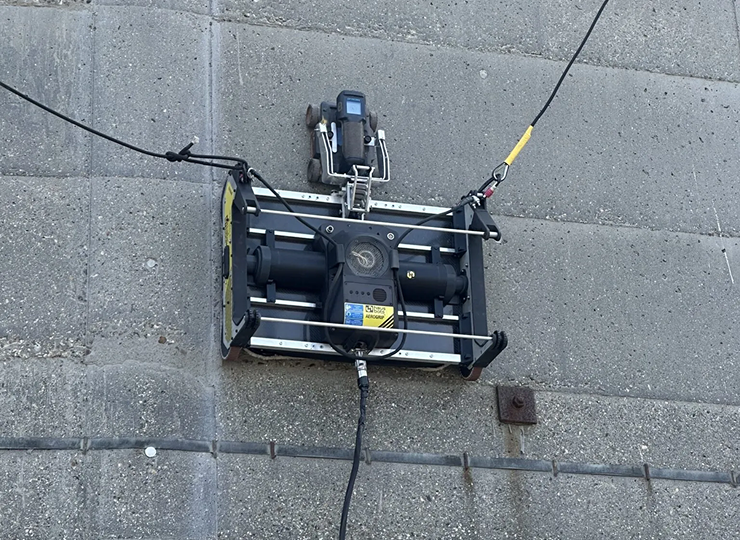
A major step forward in robotic non-destructive testing (NDT) has been demonstrated after Birmingham-based HausBots successfully carried out vertical ultrasonic tomography on a 200-metre concrete chimney at an EDF facility. The trials highlight the growing role of autonomous climbing robots in inspecting tall, hard-to-access infrastructure.
HausBots partnered with EDF and Germany’s ACS-Solutions GmbH to integrate ACS’s MIRA ultrasonic tomography system onto the company’s wall-climbing robotic platform. The system was deployed on the chimney stack to collect high-resolution subsurface imaging data—traditionally a time-consuming and hazardous task requiring scaffolding, rope access or elevated work platforms.
According to HausBots co-founder Jack Cornes, the inspections proved to be “a practical, safe and scalable method” for assessing tall concrete structures. He noted that the robotic solution produced consistent scan resolution while delivering substantial efficiencies over conventional manual techniques.
The robotic platform uses the company’s proprietary Aerogrip adhesion technology, which relies on controlled airflow and suction to grip vertical or inverted surfaces, including rough and porous concrete. During the demonstrations, the robot maintained robust adherence throughout climbs and data collection, while the MIRA ultrasonic system produced detailed tomographic images of defects, voids and reinforcement conditions below the surface.
Ultrasonic tomography is increasingly valued for structural assessment because it provides insights that visual inspection—including drone surveys—cannot capture. However, direct-contact NDT on vertical concrete surfaces typically requires significant access equipment and exposes personnel to working-at-height risks. The robotic method aims to remove these barriers by enabling more frequent, data-driven monitoring of critical assets.
The trial partners highlighted the operational advantages: quicker deployment, elimination of hazardous access methods, reduced inspection time and improved ability to gather subsurface data at scale. Industry analysts note that further validation and third-party trials will be essential before the method becomes widely adopted across the energy and infrastructure sectors.
Reflecting on the milestone, Jack Cornes said, “We are delighted to have worked with both ACS and EDF on this project, which offers yet further validation for the feasibility of robotic-assisted ultrasonic tomography for vertical structures.”
He added, “Through this project we have demonstrated that subsurface imaging can be automated and conducted at height without the limitations or risk of traditional access methods. From an operational perspective, it also significantly reduced inspection time and eliminated the need for working at height. In addition, it opens the door to higher-frequency inspections, enabling asset owners to adopt a more data-rich and proactive approach to structural monitoring. We believe it marks a significant advancement in the application of robotics for infrastructure NDT.”