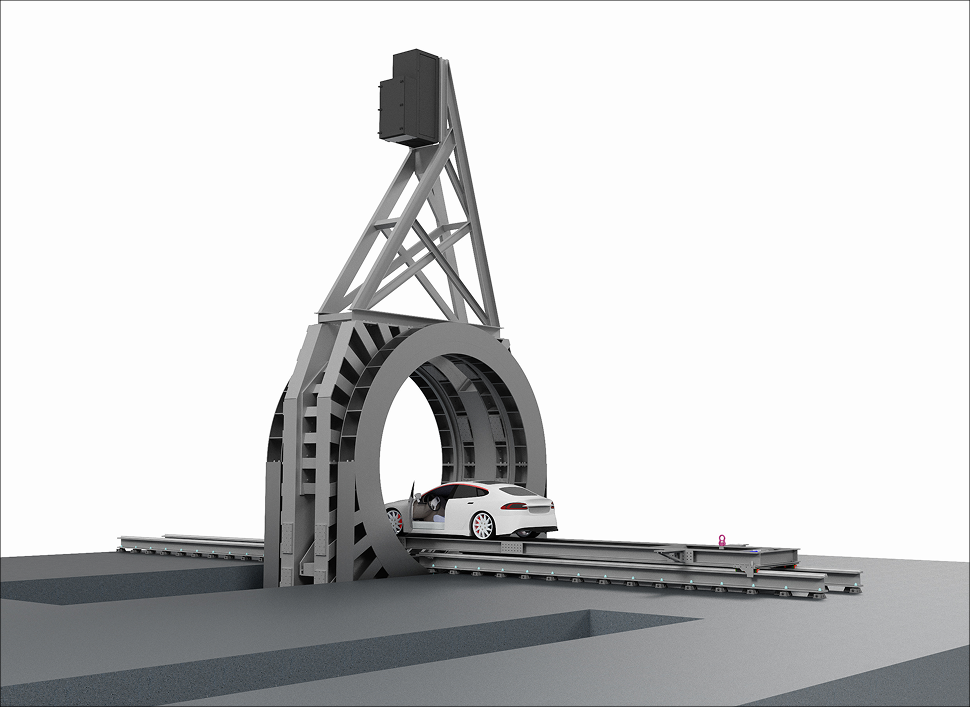
Researchers at the Fraunhofer Institute for Integrated Circuits IIS are developing an advanced high-energy computed tomography system designed to enable nondestructive testing of large and complex industrial components. The project, known as GiantEye, aims to significantly expand the capabilities of industrial CT by allowing detailed scanning of objects such as entire vehicles, high-voltage batteries, and aircraft components.
The initiative is being carried out at the institute’s Fraunhofer IIS Development Center X-Ray Technology in Fürth. By combining high-energy X-ray sources with an innovative scanning architecture, the system is expected to overcome many of the limitations associated with conventional industrial tomography systems, which often struggle with large volumes and dense materials.
Traditional industrial CT scanners require objects to fit inside the testing chamber, limiting their ability to analyze large components. Fraunhofer IIS previously addressed this challenge with its XXL CT system introduced in 2013, which can scan entire vehicles and freight containers. However, that system requires complex positioning and handling of the test objects.
The new GiantEye system introduces a gantry-based design similar to medical CT scanners. In this configuration, the radiation source and detector rotate around the object in a vertical plane while the object remains in its natural horizontal orientation. This approach simplifies handling and allows large components to be inspected without repositioning or mechanical stress that could distort measurement results.
“The technology can thus be used for the first time in a production environment, such as in initial production of complex high-voltage battery systems,” said Alexander Ennen, head of the Application-Specific Methods and Systems department at Fraunhofer IIS.
At the core of the system is a linear accelerator generating X-ray energies of nine megaelectron volts, combined with a high-precision manipulation system and advanced detectors capable of producing three-dimensional measurement resolutions of up to 100 micrometers. This configuration enables the system to penetrate thick and dense materials while maintaining high imaging accuracy with minimal artifacts.
The scanning architecture is designed to balance precision with operational efficiency, allowing routine CT examinations of large objects without extensive preparation. The horizontal gantry design also reduces measurement times and lowers the risk of damage to sensitive components, particularly in safety-critical applications such as high-voltage battery diagnostics.
Researchers expect the system to support a wide range of industrial and research applications. Potential use cases include analyzing crash test vehicles, inspecting additively manufactured parts, and performing structural diagnostics on large engine components. It may also support public safety applications by enabling detailed inspection of sealed transport units.
“There are also exciting applications in the field of public safety,” said Norman Uhlmann, Head of the Development Center X-Ray Technology. “A system like this, enabling more detailed insight in the contents of closed transport units without having to open them at great expense, represents a significant technological advance.”
According to the institute, the GiantEye system is expected to become available for industrial partners in early 2027.
“We are standing at the threshold of a new technical era and want to make our innovation available worldwide for industrial applications,” said Giovanni Del Galdo. “Our modular system architecture lets us develop customized solutions for many different testing tasks. This opens up exciting opportunities for a wide range of industries, such as the automotive, aerospace, and energy sectors.”
In parallel, the research team is working to advance data processing and automation capabilities. High-energy CT scans produce extremely large datasets, requiring new algorithms for rapid reconstruction and analysis of three-dimensional images.
“Development is also focusing on how to work with the enormous quantity of data. Our goal is not just to build a measuring instrument, but to provide an entire ecosystem for efficient use of the data,” Ennen said. “As soon as routine operations are possible, GiantEye will permanently change quality assurance and product development for large and complex systems.”