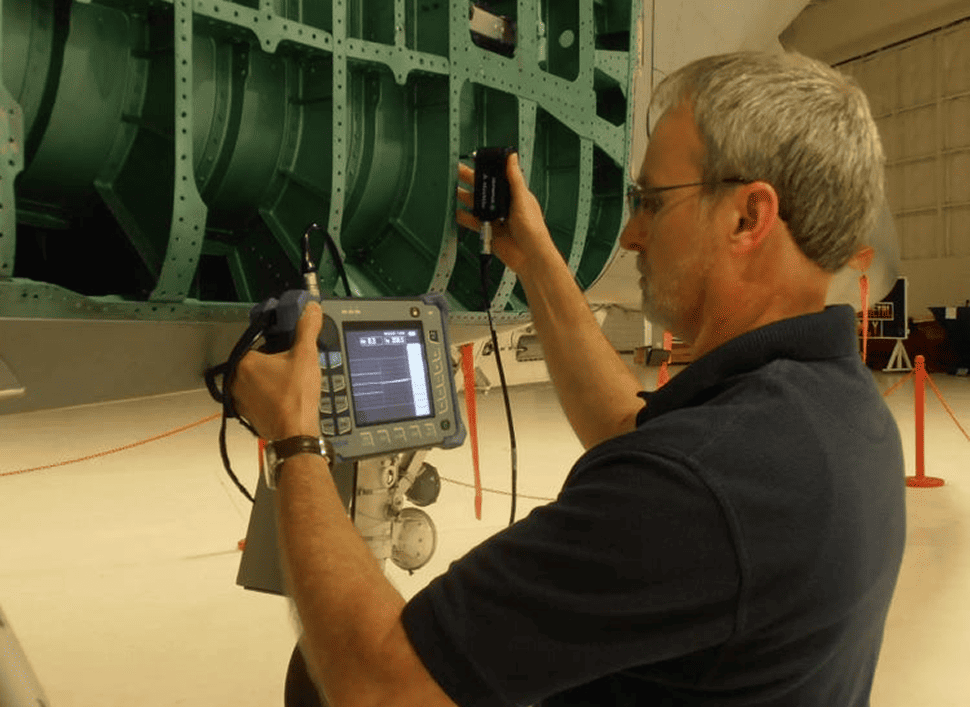
Southwest Research Institute (SwRI) has secured a contract from the U.S. Air Force Academy to characterize inspection methods for bolt holes in aging aircraft, with a focus on inspecting through bushings without removing them.
The work supports broader aircraft structural integrity efforts aimed at improving repair decisions and maintaining the safety of aging military aircraft.
SwRI has long supported the U.S. Air Force’s Aircraft Structural Integrity Program (ASIP) and the U.S. Air Force Academy Center for Aircraft Structural Life Extension (CAStLE), both of which rely on damage tolerance analysis, aircraft usage data and nondestructive inspection results to determine inspection intervals and support structural life extension.
“It’s important to inspect locations where stress can lead to damage,” said SwRI Senior Research Engineer Nathan Richter, who oversees the project. “We use nondestructive evaluation (NDE) methods in areas where cracks may form. NDE helps detect damage without altering or removing a part but its sensitivity varies with the flaw size.”
Bolt holes are considered critical inspection points because they are located in high-stress areas of aircraft structures. When cracks or wear develop around these holes, the damaged area is often repaired using a cylindrical metal sleeve, or bushing.
“Inspecting bushing-repaired holes is challenging because the bushing must be removed, risking further damage to the hole during removal and reinstallation,” Richter said.
To address that challenge, SwRI is applying low-frequency eddy current testing, an NDE method that uses electromagnetic fields to detect and characterize subsurface flaws and cracks. According to the institute, the use of low frequencies allows inspectors to evaluate the condition of repaired bolt holes without removing the bushing.
The inspection approach will be characterized using test coupons containing purposefully generated flaws produced by SwRI. The resulting data will be used to develop probability of detection (POD) curves, which are intended to define the flaw detection capability of the method across different flaw sizes.
SwRI said characterizing the performance of the inspection method is expected to give aircraft maintainers greater confidence in assessing damage progression and making repair decisions for aging Air Force platforms.
Reference: https://www.eurekalert.org/news-releases/1119916