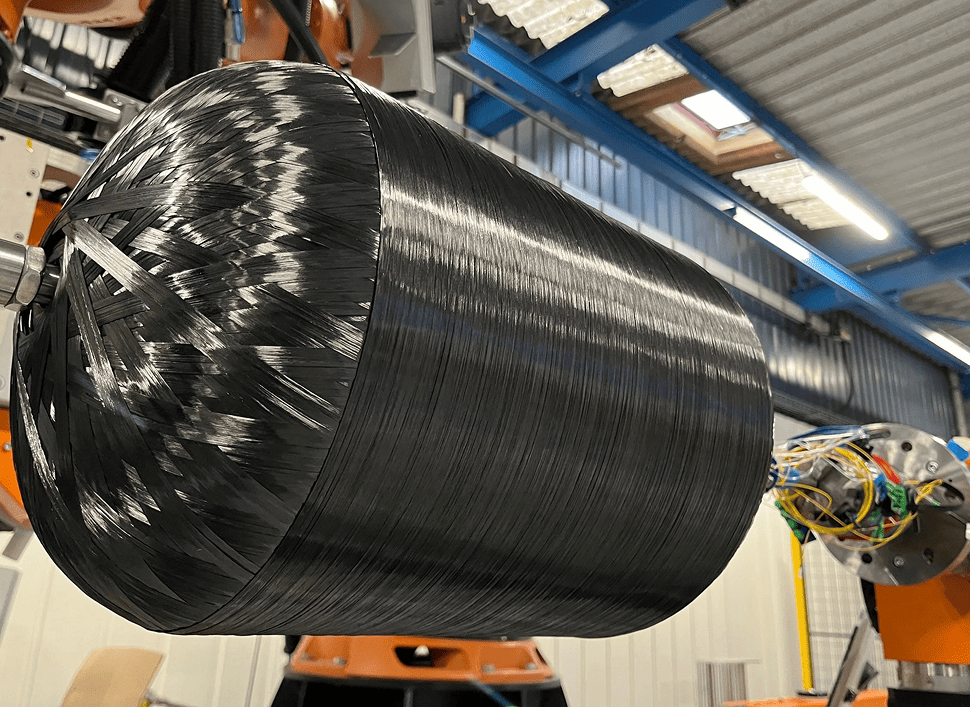
The NASA Engineering and Safety Center (NESC) has finalized a new set of technical guidelines aimed at improving the evaluation and demonstration of damage tolerance in composite overwrapped pressure vessels (COPVs), critical components widely used in launch vehicles and spacecraft.
COPVs are high-pressure storage systems used to contain propulsion and life-support fluids in spaceflight applications. Given their role in storing pressurized gases, failures can pose significant risks to missions and crew safety. The newly issued guidelines are designed to support NASA civil servants and contractors in developing and assessing damage-tolerance demonstration data for these complex systems.
The document draws on years of NESC research and technical assessments related to COPV performance and failure mechanisms. It compiles best practices for complying with key aerospace standards, including AIAA S-081 and NASA-STD-5019.
The concept of damage tolerance life replaces the earlier “safe-life” approach traditionally applied to pressure vessels. Under the damage tolerance framework, engineers assume that detectable cracks may exist before the vessel enters service. The system must then demonstrate that such cracks will not propagate to failure during its operational life.
To ensure a conservative safety margin, the guidelines apply a four-times life factor, meaning that cracks must not lead to leakage or unstable growth within four times the expected service cycles. This approach aims to ensure that structural integrity is maintained even under worst-case conditions.
The guidelines also address areas that historically have seen varying interpretations across NASA programs. By incorporating lessons from previous NESC assessments—particularly cases where damage tolerance approaches were considered unconservative—the document offers practical recommendations to reduce risk while maintaining compliance with existing standards.
Several technical aspects of COPV damage tolerance evaluation are covered in detail. These include mechanical modeling of vessel behavior, correlation between analytical models and test data, and the identification of worst-case locations for crack growth. The guidelines also highlight the importance of nondestructive evaluation (NDE) techniques in determining initial crack size and monitoring structural integrity during service.
Additional areas addressed include defining load spectra, analyzing crack aspect ratios, evaluating crack growth associated with autofrettage processes, and assessing environmentally assisted cracking. The guidelines also outline methodologies for performing damage tolerance life demonstrations using crack-growth analysis tools such as NASGRO, as well as through coupon-level or full-vessel testing.
To identify critical inspection regions, the guidelines propose an evaluation framework that considers factors such as stress and strain levels, material properties, component thickness and potential initial crack sizes. The methodology helps engineers identify the most vulnerable regions of a COPV structure, including areas involving liner materials or weld joints.
By consolidating technical insights from multiple NASA programs and industry standards, the NESC aims to provide a consistent reference for engineers working on spaceflight hardware. The guidelines are intended to strengthen fracture control practices and improve the reliability of pressure vessel systems used in both human and robotic space missions.
Reference: https://www.miragenews.com/copv-damage-tolerance-life-demonstration-1634466/