Gecko Robotics has secured its largest robotics contract to date from the US Navy under a five-year indefinite-delivery, indefinite-quantity (IDIQ) agreement arranged with the Navy and the General Services Administration, marking a significant development in the use of robotic inspection and non-destructive testing technologies for fleet maintenance.
The agreement begins with a $54 million award and carries a ceiling value of $71 million. Under the program, Gecko’s robotic inspection systems and software will be deployed to monitor the condition of 18 vessels in the US Pacific Fleet, supporting efforts to modernize inspection workflows, improve maintenance planning and strengthen ship readiness.
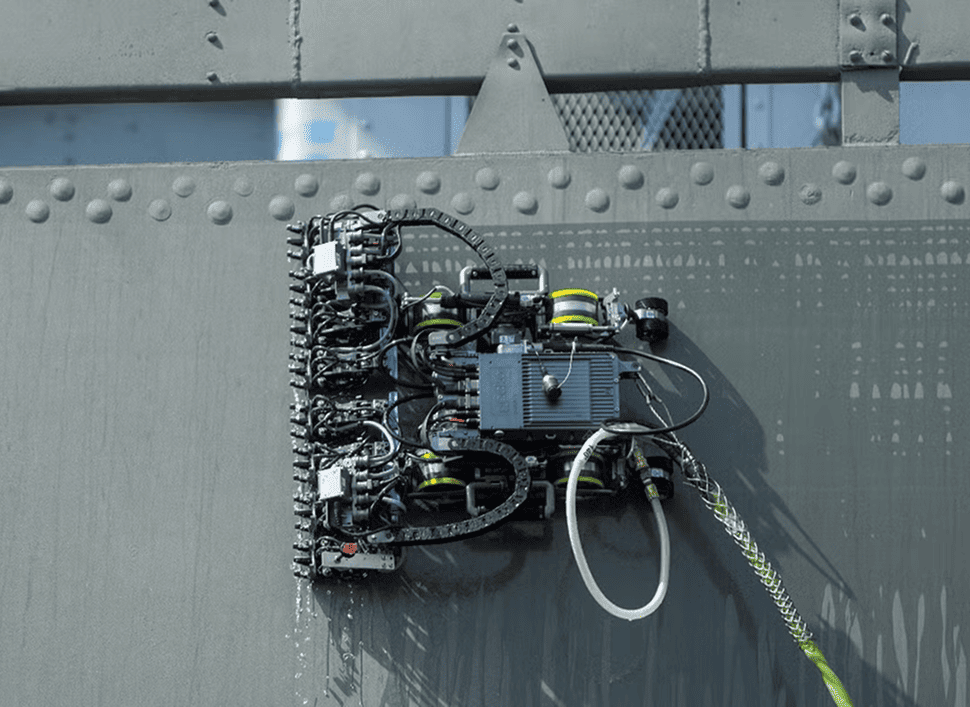
From an inspection technology perspective, the contract places robotic NDT at the center of condition assessment for naval assets. Gecko’s wall-climbing robots use magnetic adhesion to move across steel surfaces and are equipped with sensor systems including ultrasonic thickness measurement, visual inspection and other non-destructive testing tools. These systems are designed to detect corrosion, cracking and material wear while capturing high-resolution inspection data across ship structures.
The program is intended to help shift ship maintenance toward a more data-driven model. Rather than relying only on limited spot inspections, the Navy will use robotic scans to build digital records of vessel condition, creating detailed inspection baselines that can support repair prioritization and reduce uncertainty during maintenance periods.
The inspection data will also contribute to digital twin models of key ship areas, allowing maintenance teams to monitor asset condition over time and identify degradation trends with greater precision. This approach aligns with broader efforts to move toward condition-based maintenance, where inspection and repair decisions are informed by actual asset health rather than fixed schedules alone.
The use of robotic NDT is particularly relevant in naval maintenance environments, where access challenges, confined spaces and large inspection areas can limit the speed and consistency of conventional manual inspection. By collecting dense inspection data across vertical, overhead and difficult-to-access steel surfaces, robotic systems can improve coverage while reducing the need for scaffolding and minimizing personnel exposure in hazardous areas.
Gecko’s technology has previously been used in power generation, petrochemical and other heavy industrial sectors, where asset owners require repeatable, high-resolution inspection data for critical infrastructure. In the naval context, the company’s software platform is intended to combine scan results into long-term digital asset records that can be shared across ship crews, maintenance teams and engineering planners.
The rollout across 18 Pacific Fleet vessels will provide the Navy with an opportunity to standardize inspection procedures, benchmark inspection productivity and evaluate how robotic data collection can support defect detection, maintenance planning and fleet lifecycle management.
The contract also reflects growing interest in integrating robotics, digital twins and advanced NDT into large-scale asset integrity programs, particularly where maintenance efficiency and infrastructure reliability are directly tied to operational readiness.
Reference: https://www.geckorobotics.com/news/navy-idiq