
Table of contents
- Introduction
- Why couplant is needed
- Common couplant types and use cases
- Compatibility: materials, contaminants and coatings
- High-temperature couplant: thresholds and when to go couplant-free
- AUT-specific couplant delivery and field trade-offs
- Corrosion-mapping-specific coupling considerations
- Cleanup
- Key takeaways
Introduction
Couplant is the thin layer of liquid or gel that carries ultrasound from the transducer into the part, and the right choice depends on the surface temperature, the scanning method and the material being inspected. This guide compares the common couplant types, sets out the material and contaminant checks to make before use, explains temperature limits and couplant-free options for hot surfaces, and covers water delivery for automated (AUT) scanning, coupling consistency in corrosion mapping and cleanup after the scan.
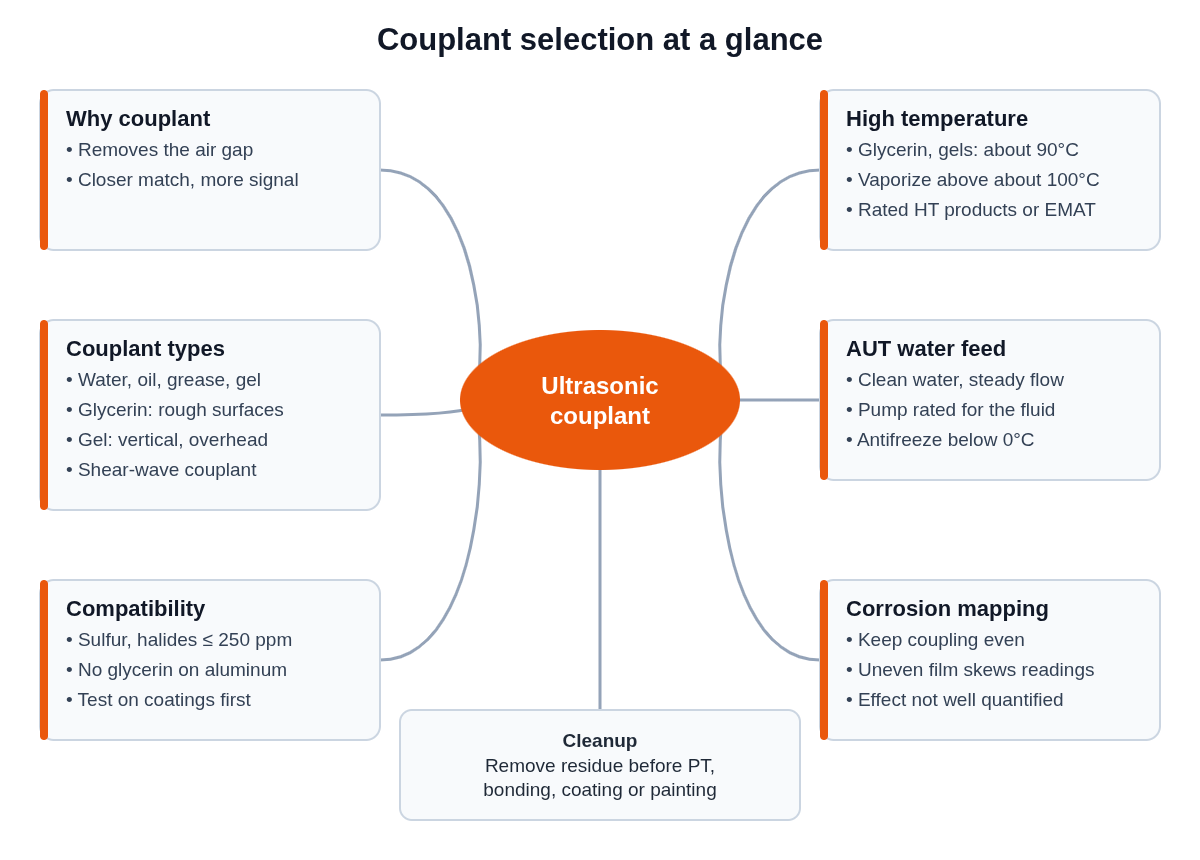
Caption: The main topics of couplant selection covered in this guide. Original diagram.
Why couplant is needed
Sound doesn’t transmit efficiently across a boundary between materials with very different acoustic impedance — and air against a transducer’s wear plate, or air against the metal or composite surface being tested, is about as severe a mismatch as ultrasonic testing encounters. Even a thin air gap blocks efficient energy transfer into the part. Couplant’s entire job is to eliminate that air gap, giving the sound a continuous path from the transducer into the material being inspected — which is why couplant choice isn’t a minor detail: the wrong couplant for the surface, temperature, or scanning setup can degrade signal quality before the rest of the inspection even begins.
Evident lists the acoustic impedance of its couplants and of common alternatives, in units of 10⁶ kg/m²s: glycerin 2.42, propylene glycol 1.61, motor oil about 1.5 and water 1.48. A higher impedance is a closer match to metals and plastics.
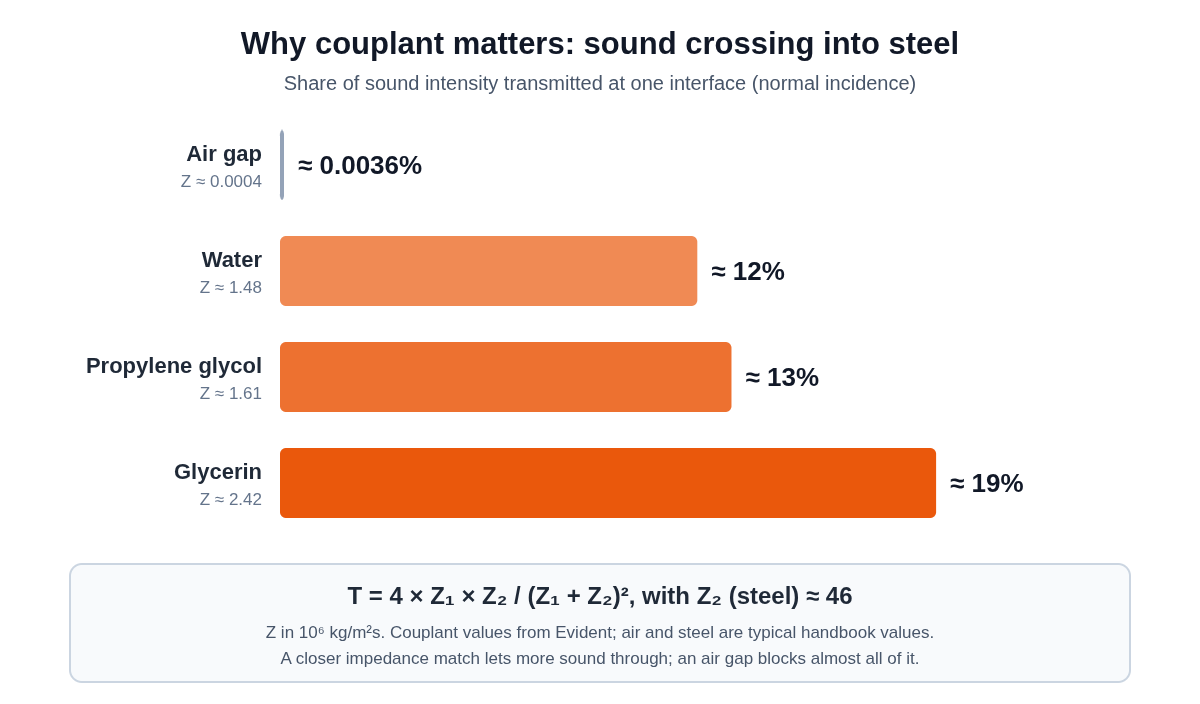
Caption: How much sound crosses into steel with and without couplant. Calculated from Evident’s couplant impedance values. Original chart.
Common couplant types and use cases
Water, oil, grease, and some gels cover routine inspection work. Glycerin has a higher acoustic impedance — a closer match to metals and plastics — and gives roughly 3–6 dB more signal on metal than propylene glycol, making it a good choice for rough surfaces or attenuating materials; its maximum recommended temperature is about 200°F (90°C). Glycerin can corrode some metals if it is left on, although Evident notes this does not occur in plastics, fiberglass or composites, and an FAA advisory circular (AC 25-29), cited by Echo Ultrasonics, says glycerin should not be used on aluminum. High-viscosity gel is the practical choice for vertical or overhead surfaces — rough sand-cast metal, fiberglass, weld scanning — because it stays in place rather than dripping, with a similar roughly 200°F (90°C) ceiling in that same product family. A separate, higher-viscosity shear-wave couplant exists specifically because ordinary liquids like oil or glycerin can’t support shear-wave transmission at all; one commonly cited product is water-soluble, applied thin, and rated to roughly 100°F (38°C).
Couplant | Best for | Temperature note | Cautions |
|---|---|---|---|
Water | Routine and automated scanning | Freezes in cold conditions | Needs a delivery system; run-off |
Oil or grease | Routine inspection | Check the product rating | Residue; clean-up |
Propylene glycol | General purpose | Common couplants vaporize above about 100°C | Lower signal than glycerin on metal |
Glycerin | Rough surfaces, attenuating material | Maximum about 200°F (90°C) | Corrosion on some metals if left on; not for aluminum |
Gel | Vertical and overhead surfaces | Up to about 200°F (90°C) for most gels | Residue; clean-up |
Ultragel II (Magnaflux) | General purpose, flaw detection and gauging | −10°F to 210°F (−23°C to 98°C) | Contains glycerin; water soluble |
Shear-wave couplant | Shear-wave transducers | About 100°F (38°C) in the product cited | Ordinary liquids cannot carry shear waves |
Compatibility: materials, contaminants and coatings
A couplant stays on the part for the length of the scan, and sometimes longer, so its chemistry matters as much as its acoustics. Four checks apply before a couplant is used on a job.
- Contaminant limits. ASME Section V Article 4 (T-433) limits couplants used on nickel-base alloys to 250 ppm of sulfur, and couplants used on austenitic stainless steel or titanium to 250 ppm of halides (chlorides plus fluorides). The wording is as quoted in a code comparison; check the edition your procedure cites.
- Low-halogen grades. Nuclear-grade couplants are typically below 50 ppm of halogens and sulfur. Magnaflux says it tests every batch for halogens and sulfur and can supply batch certificates, and Echo Ultrasonics lists under 50 ppm for its VersaSonic and UltraSoniX couplants.
- Base material. Glycerin should not be used on aluminum (FAA AC 25-29, as cited by Echo Ultrasonics). Evident notes it can be used freely on plastics, fiberglass and composites. For long exposure on ferrous metals, choose a couplant with a corrosion inhibitor; Magnaflux says Ultragel II and Sono 600 offer long-term corrosion protection.
- Coatings. Waygate Technologies says couplants must not react with the test material, especially corrosion-sensitive alloys or coated surfaces. If the coating specification does not name approved couplants, try the couplant on a small, inconspicuous area first and clean it off.
High-temperature couplant: thresholds and when to go couplant-free
Standard couplants break down well before an operating temperature anyone would call “hot” in a process-plant context: Evident says common couplants such as propylene glycol, glycerin and ultrasonic gels vaporize quickly on surfaces hotter than about 100°C (212°F), and recommends about 200°F (90°C) as the ceiling for glycerin and most gels. Even specialized high-temperature couplants dry out or solidify at very high temperatures, so they must be used quickly. The underlying failure modes — volatile liquids boiling off, gels breaking down or charring — are well understood physically. For hotter surfaces, named high-temperature couplant products carry vendor-stated ratings: Evident’s I-2 gel is rated −40°F to 1,250°F (−40°C to 675°C), its H-2 from 0°F to 750°F (−18°C to 400°C) in many open-environment applications when used per the manufacturer’s procedure, and Echo Ultrasonics’ EchoTherm/EchoTherm Extreme line is rated above 1,000°F (538°C). Echo Ultrasonics also offers several other named high-temperature and AUT-specific couplants (VersaSonic, HiTempco Plus, ProTemp, EchoTherm Discs, and the Echo HT/EchoFLOW fluid line for AUT). The sources reviewed give no numeric rating for these, so take the rating from the manufacturer’s data sheet before selecting one for a job.
Evident adds two practical points. Medium and high-temperature couplants should not be used in unventilated areas because of a small possibility of vapor auto-ignition. And at very high temperatures even specialized couplants dry out or solidify, so the scan has to be done quickly. Magnaflux gives Ultragel II an operating range of −10°F to 210°F (−23°C to 98°C) and its oil-based Sono 600 a range of 0°F to 700°F (−17°C to 371°C).
Above the range where any liquid couplant survives, EMAT (electromagnetic acoustic transducer) inspection is the best-documented couplant-free alternative: it needs no liquid coupling at all and tolerates hot, painted, or rough surfaces, with an operating ceiling commonly cited around 600°C. EMAT trades off lower signal-to-noise than piezoelectric UT, requires an electrically conductive or ferromagnetic material, and is generally weaker at detecting deep flaws.
AUT-specific couplant delivery and field trade-offs
Water dominates as the couplant of choice for automated and encoded UT scanning, largely because it can be delivered continuously and consistently through a scanner head rather than hand-applied — one documented local-immersion delivery design (a water-box arrangement that sends sound through a water column instead of a conventional wedge) is marketed by its vendor as giving “improved signal consistency, accuracy, and a limited dead zone,” plus high tolerance to surface roughness. That’s a vendor’s own claim, not independent research, and is presented here as such. A motorized couplant pump used with this kind of system is the delivery mechanism behind that consistency; matching a couplant’s viscosity to a given pump and scanner setup matters in practice, so check the pump’s rated pressure, flow rate, and maximum fluid viscosity against the couplant you plan to run through it.
Setting up the water feed
- Use clean water. Dirt can plug the tubing and the irrigation ports at the transducer; a published scanner design places a filter at the pump inlet for this reason.
- Set a steady flow. The same design describes a pump giving continuous, constant flow to the transducer face, and other designs allow the flow to be adjusted from a few drops to flooding.
- Match the pump to the fluid. Check the pump’s rated pressure, flow rate and maximum viscosity against whatever you pump.
- Plan for the cold. Plain water freezes, so use an antifreeze-rated couplant fluid below 0°C.
- Plan for run-off. Some designs recover run-off with a vacuum. If the surface must stay dry, consider a dry-coupled wheel probe.
Field conditions complicate water coupling in ways worth planning around. Cold weather is the best-documented of these: one AUT-rated couplant fluid is formulated specifically against freezing, with an operating range of −40°F to 150°F (−40°C to 65°C), a freezing point of −51°F (−46°C), and a stated use case in Arctic field conditions, despite its viscosity rising sharply (to roughly 1,398 cps) at −40°F. Where plain water coupling isn’t practical — no reliable water supply, or a surface where any liquid is undesirable — dry-coupled wheel probes are a documented alternative: one named twin-crystal wheel-probe design needs no couplant or constant water supply at all, and another needs only minimal water with a simple irrigation kit or manual pump. Environmental run-off or contamination concerns with water coupling in the field are commonly discussed among practitioners as a practical consideration worth planning for.
Corrosion-mapping-specific coupling considerations
Corrosion mapping compares point-to-point thickness readings across a scanned grid, so anything that changes signal amplitude or apparent time-of-flight inconsistently across that grid — uneven couplant thickness, trapped air pockets, a scanner head riding unevenly over a rough surface — can distort the comparison between points even when the underlying metal loss is genuinely uniform. The one directly relevant vendor claim available is that the same local-immersion delivery design discussed in the AUT section above is marketed by its maker specifically for the “improved signal consistency, accuracy” it gives in corrosion-mapping use — a vendor claim, not independent verification. Separately, published research on corrosion-mapping sizing accuracy exists (one source cites sizing error up to roughly 4% on austenitic steel, or about 2 mm on a 50 mm wall), but that error is attributed to acoustic-velocity and calibration-block mismatch, not to couplant choice specifically — a related but distinct source of error, included here for context rather than as evidence about couplant.
Cleanup
Cleanup depends on the couplant. Water-soluble products such as Ultragel II rinse off with water, and Magnaflux says isopropyl or ethyl alcohol also remove it. Echo Ultrasonics says UltraSoniX can be removed with a wet or dry cloth or a water wash, and it describes that product as containing no glycerin, which can interfere with a later penetrant inspection. Sonotech’s Humex data sheet also warns that residual humectants can interfere with later penetrant inspection or composite bonding.
- Remove residue before penetrant testing, bonding, coating or painting.
- Clean off the couplant before any protective finish is restored. A US Army technical manual calls for cleaning residual inspection materials from the part before protective finishes are restored.
- For oil-based and high-temperature couplants, follow the manufacturer’s data sheet and safety data sheet for cleaning and disposal.
- Recover or manage water run-off where the site requires it.
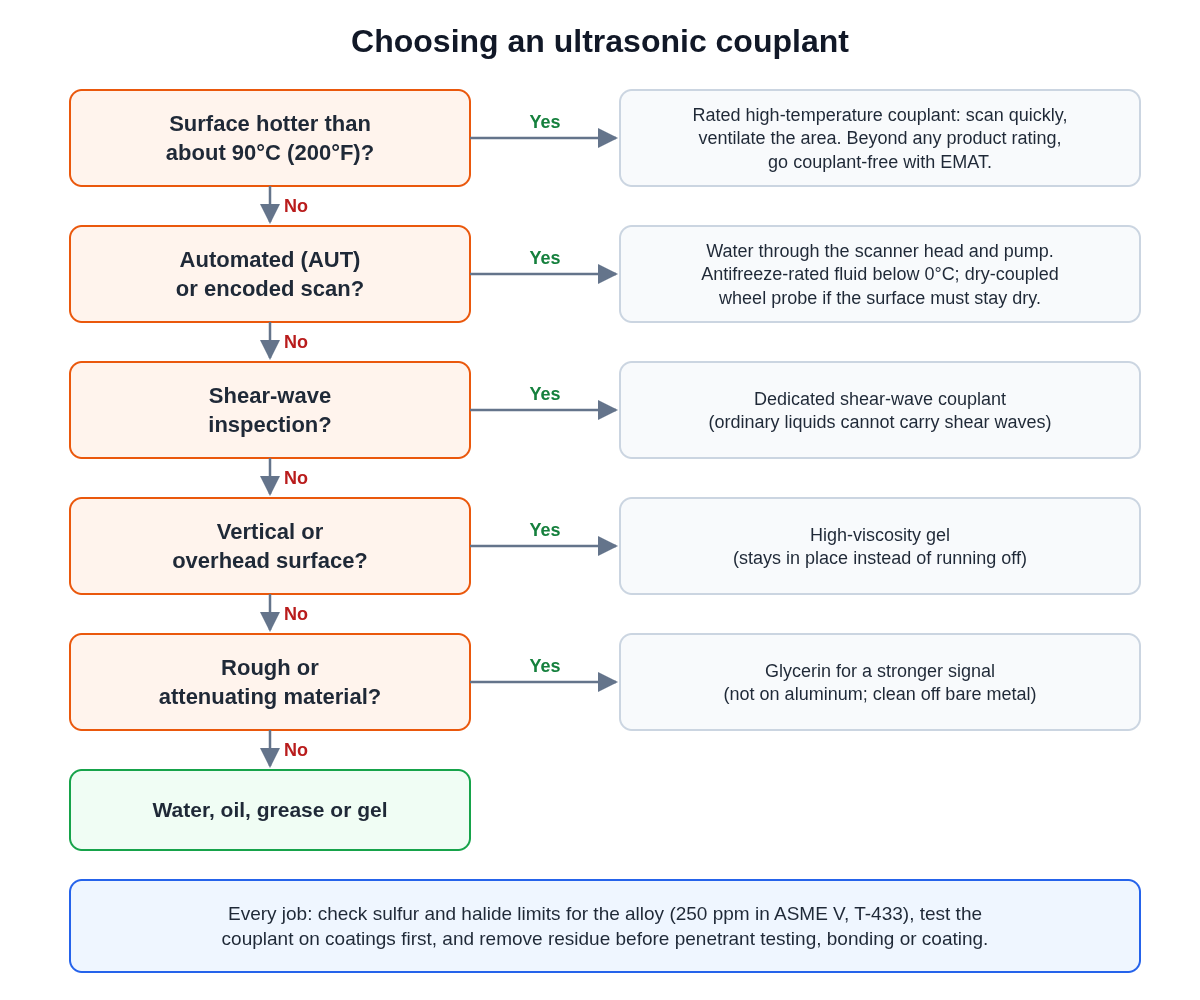
Caption: Choosing a couplant. Decision flow based on the guidance above. Original flowchart.
Key takeaways
- Couplant exists to eliminate the air gap between a transducer and the part — without it, acoustic energy barely transmits into the material at all.
- Match viscosity and chemistry to the surface and orientation: high-viscosity gels for vertical/overhead work, glycerin for rough or attenuating surfaces (with a corrosion caveat on bare metal), and a dedicated shear-wave couplant when the application needs shear waves.
- Glycerin and most gels top out around 200°F (90°C), and common couplants vaporize quickly on surfaces hotter than about 100°C; above that, use a named high-temperature product with a vendor-stated rating, or go couplant-free with EMAT at the highest temperatures.
- Water dominates AUT scanning for consistent, pump-deliverable coupling, but cold-weather field conditions need a couplant specifically formulated against freezing — don’t assume a standard fluid will stay pumpable below freezing.
- Couplant-consistency effects on corrosion-mapping accuracy specifically are under-researched in public sources; treat the physical reasoning (uneven coupling distorts point-to-point comparisons) as sound practice, not a precisely quantified effect.
References
- Evident, Ultrasonic Couplants application note — acoustic impedance values, couplant types and temperature limits.
- Evident, High-Temperature Ultrasonic Testing — I-2 and H-2 ratings, ventilation and scan-speed guidance.
- Magnaflux, Factors to Consider When Choosing an Ultrasonic Couplant — corrosion inhibition and batch halogen and sulfur testing.
- ASME Boiler and Pressure Vessel Code, Section V, Article 4 (T-433) — sulfur and halide limits for couplants; check the edition your procedure cites.
- Eddyfi, Corrosion Mapping Applications Brochure (FY24) — local-immersion delivery, couplant pump specifications and wheel probes (vendor claims, not independent research).


There are no comments yet!