
Table of contents
- Key Takeaways
- Film, CR, or DR: the question every lab eventually faces
- Image quality
- Throughput
- Consumables and capital cost
- Qualification requirements
- Cost-per-exposure model
- How to decide
- FAQs
- Related reading on OneStopNDT
- References
Key Takeaways
- Film still gives the finest image detail per dollar of equipment, but it carries recurring consumable and chemical costs, plus disposal and storage burdens, that CR and digital radiography (DR) remove.
- DR flat-panel detectors cost roughly 200 times more than a computed radiography (CR) imaging plate up front (about €150,000 versus about €750, per a Waygate Technologies comparison), but DR produces an image in seconds with no plate-scanning step.
- CR sits between film and DR on both capital cost and throughput: lower entry cost than DR, faster turnaround and no chemicals compared with film.
- There is no single published cost-per-exposure figure that fits every lab, because film, processing, plate, and detector prices vary by region, volume, and vendor. Use the ranges in this guide’s model as a starting point, then get current quotes.
- Qualification is not optional for CR or DR: expect added procedure-demonstration and documentation work under ASME Section V, Article 2, and ISO 17636-2 compared with film-only operations (see Qualifying Digital Radiography for the full requirements).
Film, CR, or DR: the question every lab eventually faces
Most welding and fabrication shops that still shoot film didn’t choose to stay on film. They simply never had a clear reason to switch. Radiographic testing (RT) uses X-rays or gamma rays to find flaws inside a weld or casting, and for most of its history that meant exposing silver-halide film, developing it in chemicals, and reading it on a light box.
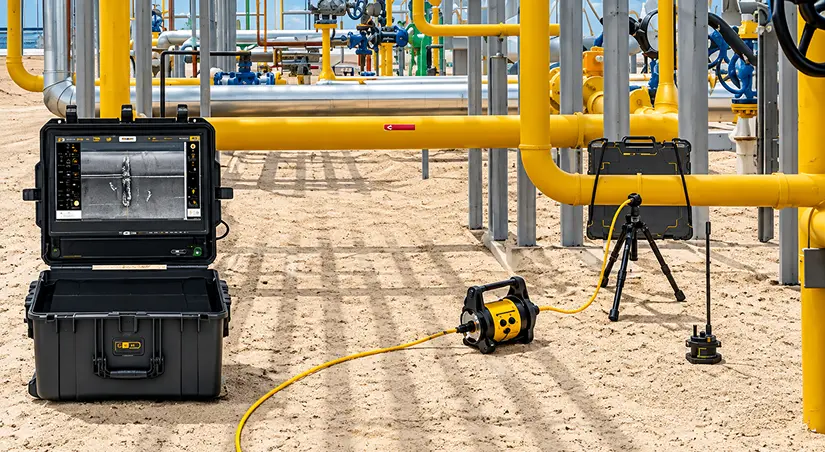
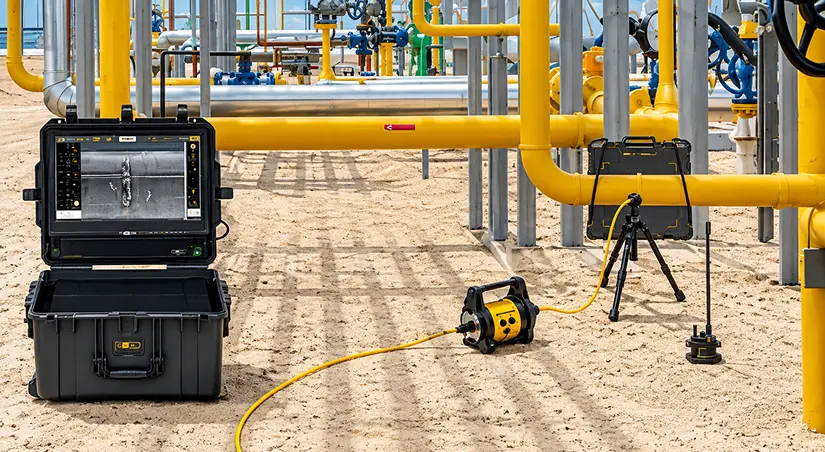
Two digital alternatives now compete with film in nearly every shop that does radiography: computed radiography (CR), which replaces film with a reusable phosphor imaging plate that a laser scanner reads out, and digital radiography (DR), which replaces film with a flat-panel detector that produces an image directly, without a separate scanning step.
The switch is not automatic. Film still has real strengths, and a DR panel is a serious capital purchase. This guide lays out what actually changes in image quality, throughput, consumables, capital cost, and qualification when a lab moves from film to CR or DR, and includes a cost-per-exposure model you can adapt with your own numbers.
For the fundamentals of how film, CR, and DR each work, see our companion explainer, “Industrial Radiography: Film, CR, DR and CT”.
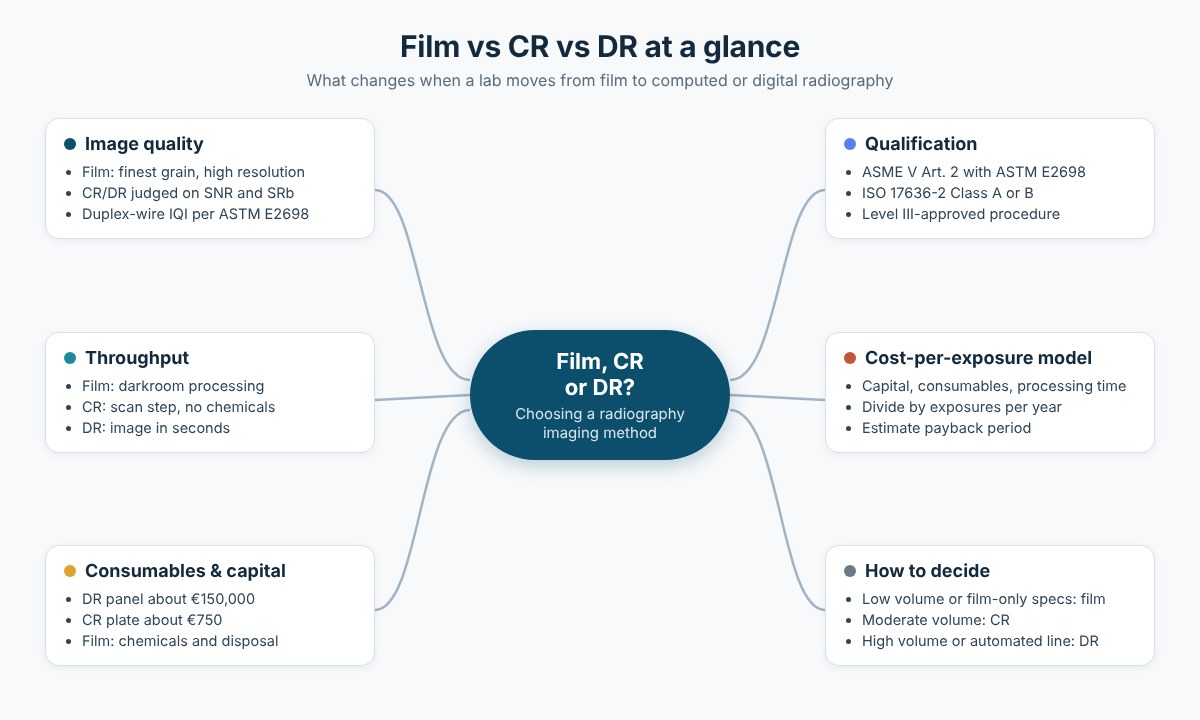
Image quality
Film’s fine silver-halide grain still gives it very high spatial resolution, which is why some aerospace and nuclear specifications still call for it. But image quality on CR and DR is not judged the same way as film density. ISO 17636-2, the standard for X- and gamma-ray weld radiography with imaging plates and digital detector arrays, judges digital image quality on two numbers: a normalized signal-to-noise ratio (SNR) and a basic spatial resolution value (SRb), with separate minimum tables for Class A (basic) and Class B (improved) technique, according to a technical summary published by VisiConsult X-ray Systems & Solutions.
In plain terms: SNR measures how much real signal stands out above random detector noise (a blurry, grainy image has a low SNR), and SRb measures how finely the system can separate two closely spaced details, checked with a duplex-wire image quality indicator (IQI) under ASTM E2698, the standard practice for radiographic examination using digital detector arrays.
DR panels generally reach higher SNR than CR plates at a given dose, because the panel converts X-rays to signal directly or through a scintillator with less noise added in the readout step, while CR adds noise when the laser scanner reads the phosphor plate. CR’s basic spatial resolution is typically coarser than a comparable DR panel’s, because the phosphor plate’s grain and the scanning spot size set a practical floor; exact figures change by product generation, so check the current manufacturer-published specification for the specific CR plate and DR panel models you are comparing.
CR and DR images used for weld acceptance must come from integrated or averaged exposures, not live fluoroscopic viewing; live imaging is too noisy to meet ISO 17636-2, per the VisiConsult summary.
Throughput
Film is the slowest of the three once chemical processing is counted: load the cassette, make the exposure, carry it to the darkroom, develop and fix it, dry it, then view it on a light box. A single weld joint often takes many minutes to turn around, and a backlog of films can sit in the darkroom queue for hours on a busy shift.
CR removes the darkroom but keeps a two-step workflow: expose the plate, then feed it through a laser scanner to read out and erase the image, according to Waygate Technologies’ comparison of the two methods. That scan step adds time the DR workflow doesn’t have, though it’s far faster than wet chemical processing.
DR is the fastest: the panel produces a viewable image within seconds of exposure, which is why DR is common on automated and robotic production lines where parts move continuously past the detector, per the same Waygate comparison.
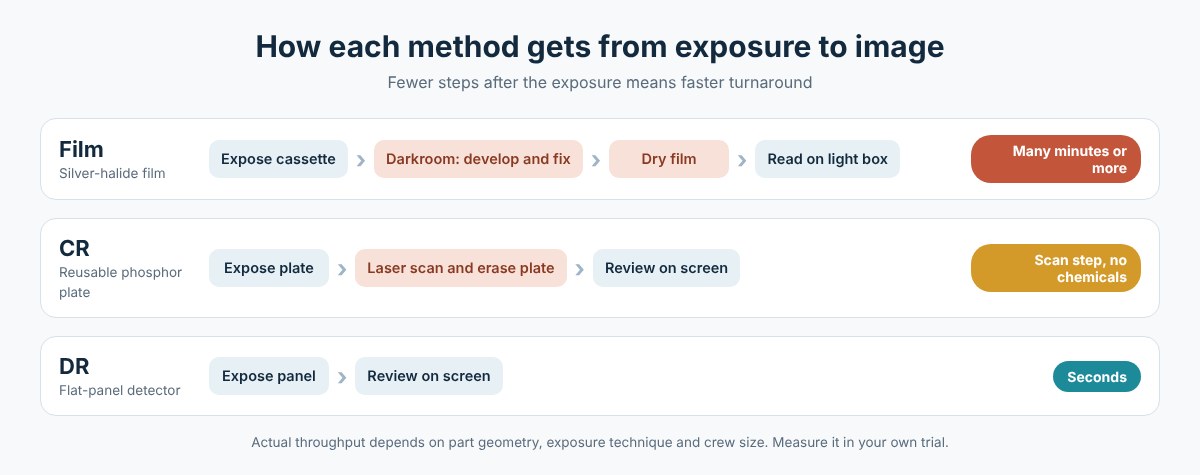
Throughput in parts per hour depends heavily on part geometry, exposure technique, and crew size, so measure it in your own trial rather than relying on a vendor brochure.
Consumables and capital cost
The clearest published capital-cost figures come from a Waygate Technologies blog post comparing CR and DR: a DR flat-panel detector costs roughly €150,000, against roughly €750 for a CR phosphor imaging plate — about 200 times the cost of a plate, as the post states directly. Waygate notes that the supporting electronics, such as the viewing workstation, cost about the same either way, so the panel itself is what drives the price gap. These are one vendor’s reference figures, not a market average, so get current quotes for your region and detector class.
Film’s capital cost is low by comparison — a cassette, screens, and a light box, or a processor if you develop in-house — but film carries a recurring, per-exposure consumable cost that CR and DR do not: film stock, developer and fixer chemicals, and their disposal as hazardous waste. CR’s plates are reusable for thousands of cycles, so its recurring cost is mostly scanner maintenance and eventual plate replacement when the phosphor wears. DR has close to zero recurring consumable cost once the panel is bought, but the panel itself has a finite service life and is costly to replace.
Current list prices for industrial X-ray film per sheet, developer/fixer cost per liter, and CR plate replacement cost vary by vendor, region, and volume — get a current vendor quote rather than relying on a general figure.
Qualification requirements
Switching to CR or DR adds qualification work that a film-only operation doesn’t have. Under ASME Boiler and Pressure Vessel Code Section V, Article 2, a digital radiography system must be used together with the referenced ASTM detector-array standards, and the user must write a procedure covering the application’s specific tests, get it approved by the Cognizant Radiographic Level III, and issue a system qualification report before production use — requirements drawn from ASTM E2698’s own scope (the standard practice Article 2 incorporates for digital detector arrays).
ISO 17636-2 similarly requires the inspection technique to state a quality class (A or B) and meet the SNR and basic spatial resolution minimums for that class, verified with a duplex-wire IQI, per the VisiConsult summary cited above. Digital qualification is not harder in principle, but digital systems add detector-specific steps — baseline evaluation, periodic stability checks, and documentation — that a film-only shop never had to do. See Qualifying Digital Radiography for the full breakdown of these requirements.
Cost-per-exposure model
There is no single cost-per-exposure figure for film, CR, and DR that fits every lab. The table below separates published reference figures from illustrative estimates, so you can replace the estimates with your own vendor quotes.
Cost line | Film | CR | DR | Basis |
|---|---|---|---|---|
Capital cost (detector/equipment) | Low (cassette, screens; a processor if used) | About €750 per imaging plate | About €150,000 per flat-panel detector | Published figures (Waygate Technologies blog) |
Supporting electronics (workstation, viewer) | N/A | Roughly the same as DR, per Waygate | Roughly the same as CR, per Waygate | Published (Waygate Technologies blog) |
Per-exposure consumable cost | Film sheet plus developer/fixer chemicals per shot — typically the largest recurring cost in a film operation | Near zero per exposure; plate reused thousands of cycles until replacement | Near zero per exposure once the panel is bought | Estimate: get a current per-sheet or per-liter price from your supplier |
Processing/scanning time cost | Darkroom labor plus chemical disposal, shop-dependent | Scanner cycle time, no chemicals | Minimal; image available within seconds | Workflow per Waygate; cost is an estimate |
Qualification/training cost per technician | Baseline NDT radiography training only | Added detector-specific baseline evaluation and procedure work, per ASME Section V Art. 2 and ASTM E2698 | Added detector-specific baseline evaluation and procedure work, per ASME Section V Art. 2 and ASTM E2698 | Requirement per ASME Section V and ASTM E2698; cost per technician is an estimate |
How to use this model: replace every estimate with a quote from your own film supplier, chemical supplier, or detector vendor, then divide each cost line by your expected exposures per year to get a true cost-per-exposure. A rough payback calculation is: (DR capital cost − CR or film capital cost) ÷ (film’s per-exposure consumable cost × exposures per year) = years to payback. Waygate’s own post notes that DR selection “requires careful consideration” of this payback period, without giving a figure, so use inputs from your own operation.
How to decide
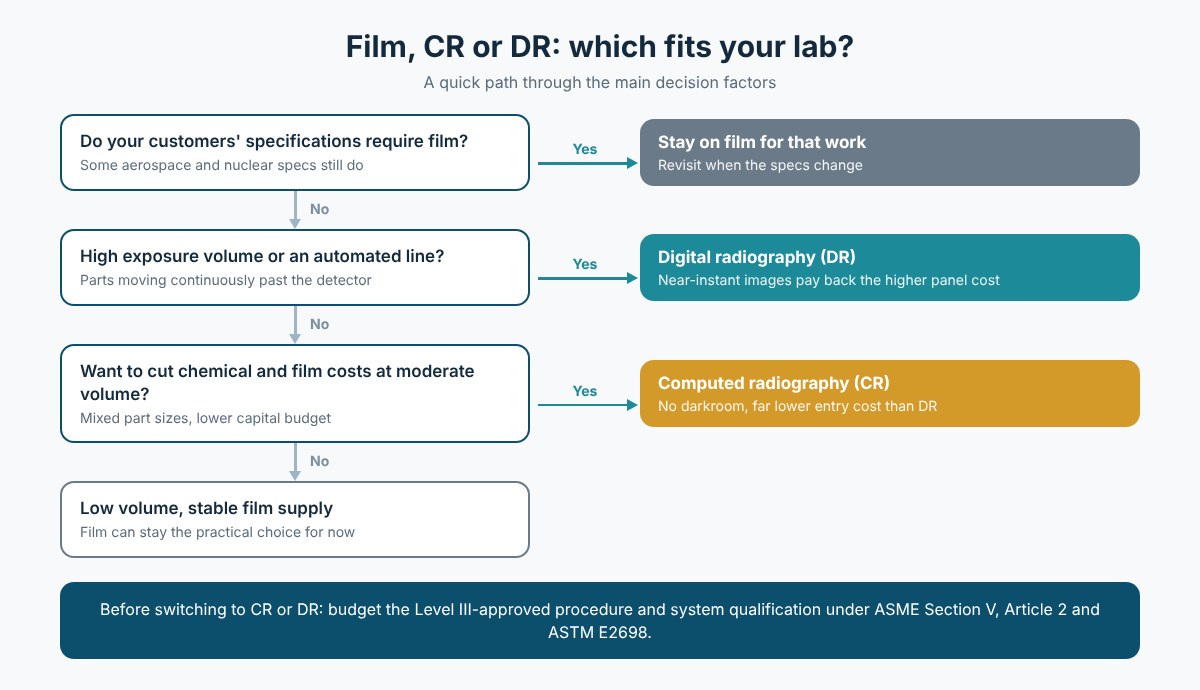
Stay on film, for now, if your exposure volume is low, your current film supplier relationship is stable, and your customers’ specifications already require film (some aerospace and nuclear specs still do).
Move to CR if you want to cut consumable and chemical costs and speed up turnaround without the largest capital outlay. CR is often the practical middle step for shops with moderate exposure volume and mixed part sizes.
Move to DR if you run high exposure volume, especially on an automated or robotic line, where DR’s near-instant image and lack of a scanning step pays back the higher panel cost through labor and cycle-time savings, per Waygate’s description of DR’s fit for production environments.
Whatever you choose, confirm with your Cognizant Radiographic Level III that the system qualification and procedure demonstration required under ASME Section V, Article 2, and ASTM E2698 are budgeted into the switch — this is often underestimated.
FAQs
Is DR always better image quality than film?
Not always. Film’s grain still gives very high spatial resolution, which is why some specifications retain it. DR typically wins on SNR at a given dose, but basic spatial resolution varies by panel model.
Can I use CR and DR equipment to meet the same code requirements as film?
Yes, but the qualification path is different. ASME Section V, Article 2, requires the DDA-specific tests in ASTM E2698 in addition to a written, Level III-approved procedure; ISO 17636-2 requires meeting SNR and basic spatial resolution minimums for a stated quality class. See Qualifying Digital Radiography for details.
How long does a CR or DR panel last before it needs replacing?
Service-life figures vary by manufacturer and usage, and no single figure applies across vendors. Ask the specific vendor for a warranty and expected-life statement.
Does switching to digital radiography reduce radiation dose to the technician?
Not inherently — dose depends on technique and exposure parameters, not the detector type. Some published figures claim lower dose with digital techniques; treat any such figure with caution until you can check its source.
- Industrial Radiography: Film, CR, DR and CT
- Qualifying Digital Radiography: ASME V Art. 2, ISO 17636-2, ASTM E2698
- RT Systems Buyer’s Guide
References
- Computed Radiography vs. Digital Radiography, Waygate Technologies blog — source for CR/DR capital cost figures (about €750 vs. about €150,000) and workflow comparison.
- Testing according to DIN/ISO/EN 17636-2, VisiConsult X-ray Systems & Solutions — summary of ISO 17636-2 quality classes, SNR, and IQI requirements.
- ASTM E2698-18e1, Standard Practice for Radiographic Examination Using Digital Detector Arrays — scope and qualification/procedure-demonstration requirements.
Prices and standards last checked: October 28, 2026. Always confirm the current edition of a standard before using it in a formal procedure.
There are no comments yet!