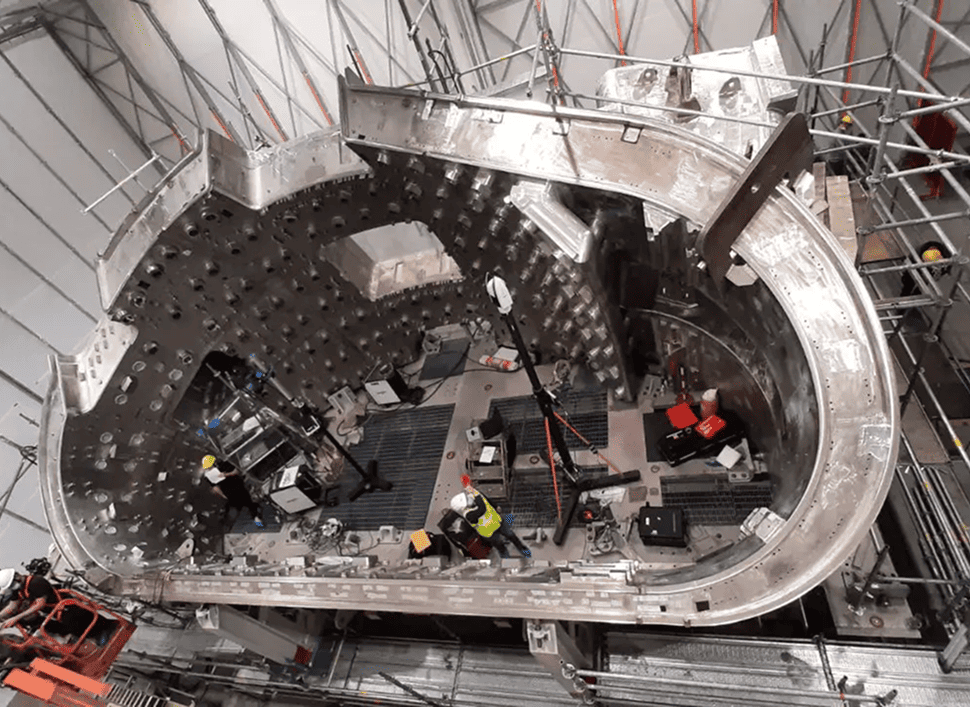
Radiographic testing using X-ray inspection is currently underway on vacuum vessel sector #1 at ITER, marking a critical step in verifying the integrity of repaired welds that will form part of the tokamak’s core structure.
Since 2024, ITER teams have been repairing the critical bevel joints where individual vacuum vessel sectors will eventually be joined inside the tokamak pit. After restoring the geometry of these joints by filling low areas or removing excess material, radiographic testing is conducted to confirm weld uniformity and compliance with stringent technical specifications.
“We use X-rays to check right down to the heart of these thick metal shells to make sure that the repair is compliant,” says Miguel Dapena-Febrer, ITER’s Radiation Safety Coordinator who oversees radiographic testing to ensure operations are conducted under strict radiation protection conditions. “This is a very important process that requires powerful X-ray generators, and it needs to be done in very specific conditions.”
Radiographic testing forms part of ITER’s broader non-destructive testing programme, which verifies welding quality and other mechanical interventions. The programme began in 2016 on the cryostat base and has since expanded significantly, with multiple radiographic teams now performing up to 60 tests per week.
Vacuum vessel sector #1 is the fifth sector to undergo radiographic inspection. The process involves examining weld quality to depths of several tens of millimetres, with more than 20 passes sometimes required over a single test area. Two sets of radiographic tests conducted on accessible areas of the sector have already confirmed the effectiveness of the repairs. With the sector now positioned vertically in tooling, the remaining bevel regions have become accessible for final testing.
Extensive radiation protection measures are implemented during testing. Inspections are carried out during nights or weekends to minimise personnel exposure, lead-filled protective bags weighing between 17 and 24 kilograms are arranged around the sector, and testing teams wear dosimeters to ensure exposure remains within regulatory limits.
Thomas Antonini, Momentum Construction Manager overseeing the operation, highlighted the importance of precise setup during testing.
“All preparations went smoothly and the testing has started successfully,” says Antonini. “With lessons learned over time on similar operations, we have been able to secure the process, which is good for our assembly schedule.”
Advances in radiographic technology have significantly reduced inspection times. Early inspections relied on gammagraphy, which required approximately four hours per film. Current X-ray generator-based testing has reduced this to about one hour. When welding of the vacuum vessel modules begins in the tokamak pit, a linear accelerator is expected to further reduce inspection time to as little as 10 minutes per film, necessitating enhanced radiation protection measures.
Radiographic testing on vacuum vessel sector #1 is scheduled for completion by the first week of March.
Reference: https://www.iter.org/node/20687/making-invisible-visible