A new ultrasonic sensing technology capable of detecting structural defects in real time, even in extreme and hard-to-access environments, has been developed by researchers at Korea Research Institute of Standards and Science (KRISS). The innovation is expected to significantly enhance safety monitoring in high-risk industrial settings such as nuclear power plants, hazardous chemical storage facilities and underwater structures.
KRISS announced that a research team led by Dr. Seung Hong-min, senior researcher in the Nondestructive Measurement Group, has developed a non-destructive testing (NDT) sensor that can detect defects omnidirectionally without requiring direct contact with the inspection surface. The research findings were published in the international journal Mechanical Systems and Signal Processing on November 6 last year.
Non-destructive testing plays a critical role in industrial safety by enabling the detection of internal defects without damaging structures. However, conventional ultrasonic sensors typically require close contact with inspection surfaces, limiting their use in environments exposed to high temperatures, corrosive materials or restricted human access.
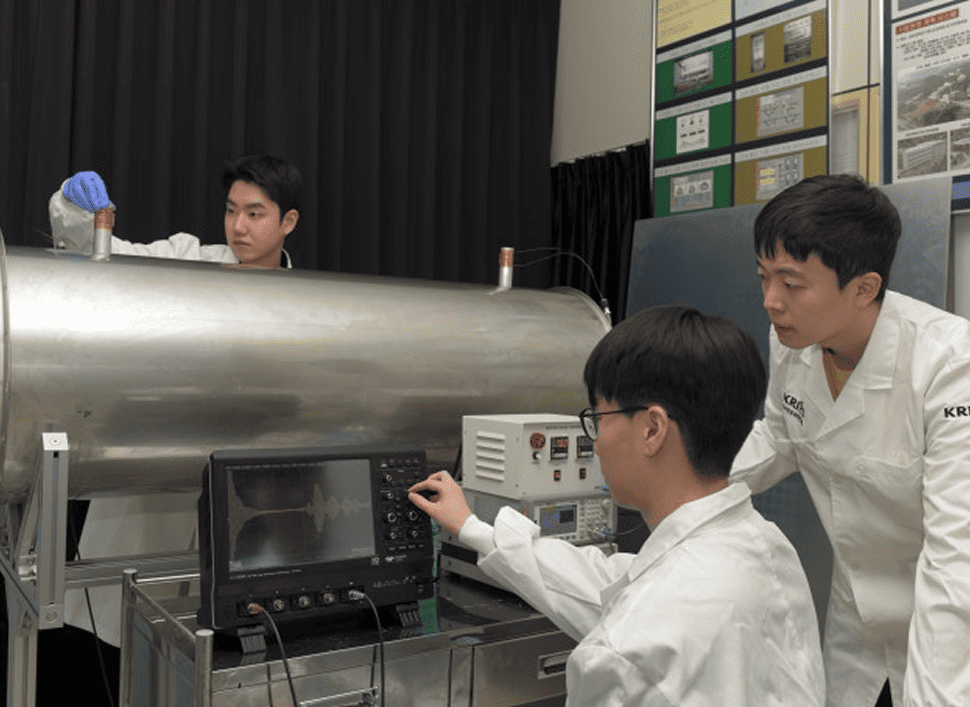
To address these challenges, the KRISS team designed a sensor that operates remotely using a cylindrical waveguide. The waveguide directs ultrasonic waves efficiently while controlling their reflection and refraction, allowing the sensor to transmit energy without direct attachment to the structure being inspected.
The system generates torsional vibrations inside the cylindrical waveguide and transmits them to the inspection target, enabling ultrasonic waves to spread uniformly in all directions. This allows precise defect detection even when the sensor is positioned at a distance from the structure.
Performance testing demonstrated that the waveguide-based ultrasonic sensor achieved 95% directional uniformity and produced high-purity signals distributed evenly across the inspection area. Compared to conventional segmented sensor systems, the signal strength was found to be more than 13.7 times higher, significantly improving detection speed and coverage. The technology also maintained clear signal quality in liquid environments, making it suitable for inspecting large submerged structures.
The waveguide design can be adapted using different materials and shapes, with tips that can be modified to match curved or complex surfaces. This flexibility allows the sensor to be applied across a wide range of industrial structures and environmental conditions.
In addition to its technical advantages, the new sensor is expected to reduce inspection costs, as it is less expensive than conventional ultrasonic systems while covering a larger inspection area.
“Based on its high reliability and versatility, it can be immediately applied to accident prevention systems in various industrial facilities,” said Seung. “It can significantly contribute to preventing major disasters by detecting blind spots that were previously uninspected.”
The development marks a significant advancement in non-destructive testing technology, with potential applications across nuclear energy, chemical processing, marine infrastructure and other safety-critical industries.
Reference: https://www.dongascience.com/en/news/76487