
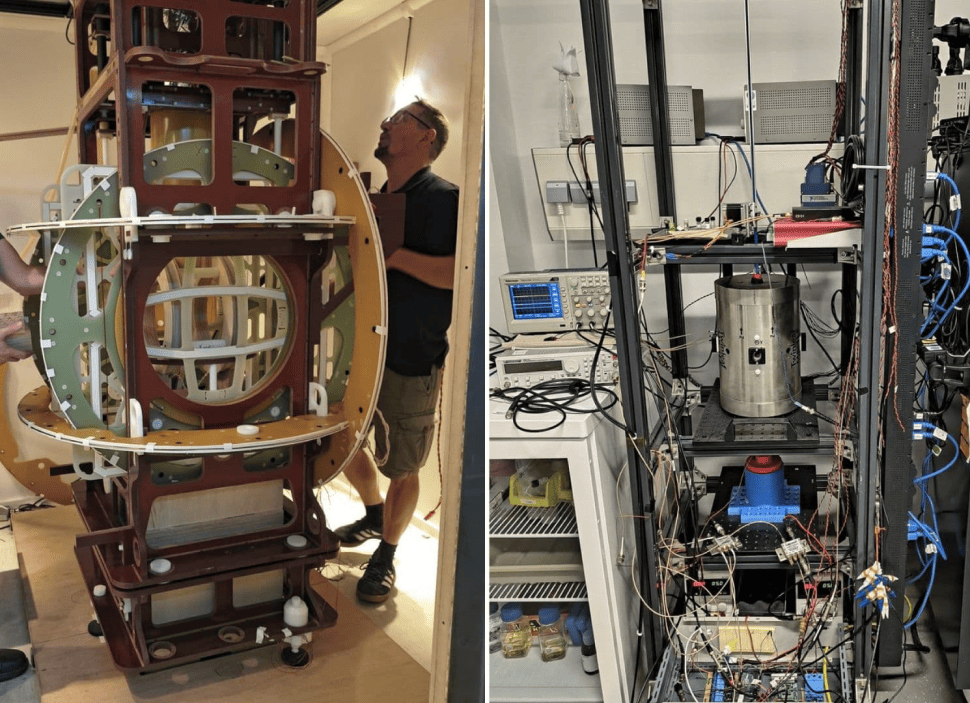
An international research team has developed a new non-destructive technique that can visualize the internal condition of rechargeable batteries without opening their metal casings. The breakthrough could help detect electrolyte degradation and other chemical changes that affect battery performance in devices ranging from smartphones to electric vehicles.
The research was conducted by scientists from the Helmholtz Institute Mainz and New York University. Their approach uses a specialized form of nuclear magnetic resonance known as Zero-to-Ultra-Low-Field Nuclear Magnetic Resonance (ZULF NMR), allowing researchers to examine the chemical state of battery electrolytes through metal enclosures.
“We examine the batteries using what is known as zero-to-ultra-low-field magnetic resonance. The casings are transparent for this technique, allowing us to see inside,” said Anne Fabricant, the study’s co-first author.
Rechargeable batteries rely on electrolytes to transport charged particles between electrodes during charging and discharging cycles. Over time, this chemical medium can degrade, leak or dry out, reducing performance and potentially creating safety risks such as overheating or fire. Until now, evaluating electrolyte condition typically required opening the battery, a process that destroys the cell and prevents further use.
“Reliable methods for nondestructive testing of the battery condition are currently lacking, as the quantity and chemical composition of the electrolyte cannot be determined through the housing using conventional techniques. This is exactly where our research comes in,” Fabricant added.
The research team demonstrated that ZULF NMR can detect and quantify chemical components inside commercial battery cells, including solvents and lithium salts. Unlike conventional magnetic resonance systems that require strong external magnetic fields, the ZULF approach allows measurements to be performed through metallic casings.
“These were realistically packaged battery cells, including so-called pouch-cell geometries used in electric vehicles. We have thus proven the concept and paved the way for a practical application of the technology,” said Dmitry Budker, who conducts research at the Helmholtz Institute Mainz and Johannes Gutenberg University Mainz.
The technique could support the growing need for battery diagnostics as electric vehicles and renewable energy storage systems expand worldwide. Real-time battery health monitoring is becoming increasingly important to ensure operational safety and extend the lifecycle of energy storage technologies.
Future applications may include operando measurements, allowing researchers and engineers to analyze battery chemistry while the battery is operating. This capability could enable electric vehicles to detect chemical instability early, alerting users before performance declines or safety risks emerge.
“The ability to nondestructively characterize electrolyte volume and composition supports superior battery design and serves as a vital quality control tool throughout a cell’s lifecycle,” said Alexej Jerschow, a collaborator on the project.
Researchers are now working to scale the technology by developing faster and more cost-effective sensors capable of inspecting large battery packs used in electric vehicles and grid-scale energy storage systems. If successfully commercialized, the approach could improve battery safety monitoring, support predictive maintenance and accelerate the development of next-generation energy storage technologies.
Reference: https://interestingengineering.com/science/method-visualize-real-time-ev-battery-health