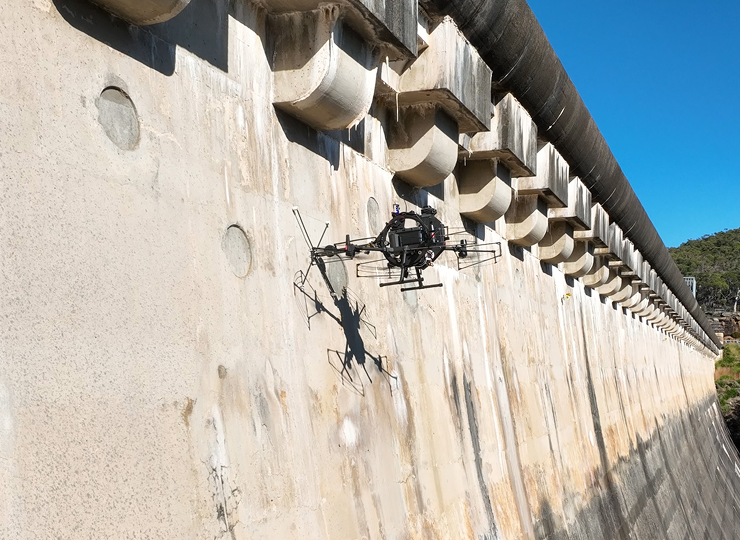
As Hong Kong’s bridges continue to operate under some of the world’s highest traffic densities, The Hong Kong Polytechnic University (PolyU) has introduced a next-generation, intelligent bridge inspection platform that integrates advanced non-destructive testing (NDT) with artificial intelligence. Developed by a research team led by Prof. Tarek Zayed of the Department of Building and Real Estate, the system has already been deployed across 11 bridges citywide, cutting inspection time by 50% and increasing accuracy to 80%.
Traditional visual inspection methods across the region rely heavily on manpower, subjective assessment, and disruptive road closures, while often missing hidden subsurface deterioration. PolyU’s newly developed multi-tier system replaces these limitations with a combination of drones, ground-penetrating radar (GPR), and infrared thermography (IRT). AI models then process the multimodal data to automatically identify structural concerns with speed and precision.
Central to the new framework is drone-enabled crack detection supported by a proprietary deep convolutional neural network model named Smart Bridge Deck Efficiency (SBDE). The model demonstrated significantly higher reliability than existing object-detection systems, even under low-light conditions or shadowed surfaces, reducing false identifications and improving detection of small or complex cracks.
For subsurface evaluations, the team introduced an automated GPR data interpretation system capable of identifying rebars with more than 98% precision. The platform also maps potential corrosion zones using advanced amplitude clustering, streamlining processes that traditionally required extensive manual review.
To address concrete deterioration challenges such as spalling and delamination, PolyU researchers also developed an optimum thermal gradient threshold (OTGT) system for IRT. This adaptive tool adjusts to environmental conditions and produces automated delamination maps, enabling more consistent and accurate diagnostic results.
“This hybrid system— for surface and subsurface defects—enhances both the efficiency and accuracy of bridge inspection through an integrated, AI-powered approach,” said Prof. Tarek Zayed. “We have also standardised inspections with a five-point severity scale to facilitate diagnosis and prioritise repairs. The comprehensive SBDE tool thoroughly assesses bridge conditions based on data collected from various sensing devices.”
Prof. Zayed added, “We are currently exploring further collaboration with relevant government departments and industry partners to implement this system for regular bridge inspections in the City, marking a significant step towards smarter infrastructure management in Hong Kong. Our goal is to ensure that Hong Kong's bridges remain safe and reliable for decades to come."
Supported by the Smart Traffic Fund, this two-year initiative has already been featured in leading journals such as Construction and Building Materials, Automation in Construction, and Advanced Engineering Informatics. The research team plans further advancements to strengthen the role of smart NDT technologies in future infrastructure projects across Hong Kong.
Reference: https://www.miragenews.com/polyu-unveils-smart-bridge-inspection-system-1576492/