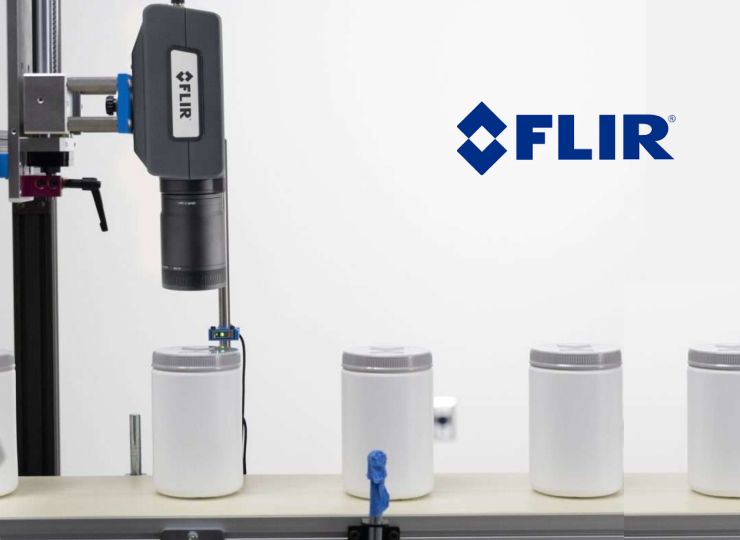
FLIR has introduced a new mid-wave infrared (MWIR) thermal imaging system designed to enable continuous monitoring across industrial automation, process control and non-destructive testing (NDT) environments. The A6450 Long-Life Cooled MWIR camera addresses long-standing limitations that have restricted the use of cooled thermal imaging systems on production lines.
“Historically, the timing and cost of maintaining cooled thermal cameras limited their use in production-line applications,” explains Flir’s global director for automation, Matthew Hasty. “With the A6450, we’ve fundamentally changed that equation, delivering long-life cooled MWIR performance that manufacturers can confidently deploy across continuous production processes.”
MWIR cameras operate in the 3–5 µm wavelength range, detecting thermal emissions rather than reflected light. This capability differentiates them from short-wave infrared (SWIR) cameras and allows them to capture heat signatures with high contrast, particularly in environments involving elevated temperatures. Compared with long-wave infrared (LWIR) systems, MWIR cameras offer enhanced performance for hotter targets, making them well suited for demanding NDT and inline inspection applications.
Designed for Long-Term Industrial Deployment
At the core of the A6450 system is a MWIR detector paired with a linear cooler rated for up to 27,000 hours of operational life. The extended lifespan significantly reduces maintenance requirements, enabling manufacturers to move from short service intervals to multi-year operational planning. By lowering downtime and service costs, the system positions cooled MWIR imaging as a viable long-term solution for industrial NDT and automation.
The camera is engineered for time-critical inspection tasks. With a 125 Hz frame rate, it can capture fast thermal events and subtle temperature variations on moving products, supporting applications such as inline non-destructive testing, process monitoring and quality assurance.
High thermal sensitivity allows the system to detect early-stage defects, material inconsistencies and process deviations before they propagate downstream. This capability supports defect prevention strategies by reducing scrap, rework and unplanned shutdowns in high-throughput production environments.
Integration and Flexibility for NDT Applications
The A6450 supports GigE Vision, GenICam and other industry-standard protocols, enabling straightforward integration into existing automation and inspection systems. Customer-driven interfaces, commands and triggers allow rapid deployment without the need for extensive custom development.
Plug-and-play compatibility with FLIR Research Studio software enables users to test, tune and validate NDT inspection setups prior to full system integration. The camera also offers a broad optics portfolio and extensive calibration options, with the ability to store hundreds of calibration profiles onboard. This flexibility supports multiple products, materials and inspection scenarios, particularly in facilities with frequent production changeovers.
A single camera platform can therefore support a wide range of non-destructive testing applications across multiple production lines, reducing system complexity and hardware redundancy.
Advancing Continuous NDT and Quality Assurance
By enabling continuous thermal monitoring, the A6450 supports automation strategies that reduce reliance on manual inspections and associated risks. Subtle temperature variations revealed through MWIR imaging can indicate seal defects, material deformities, uneven curing or incomplete bonding—issues that are often invisible to conventional inspection methods.
Early detection of overheating or equipment stress also allows manufacturers to intervene before defects escalate, strengthening overall process stability and product quality. With its long-life design and high-performance thermal imaging capabilities, the new MWIR camera marks a step forward in making continuous, inline NDT a practical reality for modern production environments.
Reference: https://drivesncontrols.com/mwir-cameras-overcome-barriers-to-24-7-monitoring-of-production-lines/