Industrial computed tomography (CT) has become an essential inspection technology for manufacturers seeking to evaluate internal structures, verify critical dimensions, detect porosity, and inspect complex components without damaging them. However, the technology has traditionally remained limited to specialized laboratories due to its size, operational complexity, and infrastructure requirements.
A new system, COREX ONE, is aiming to change that by bringing industrial CT inspection directly into production environments.
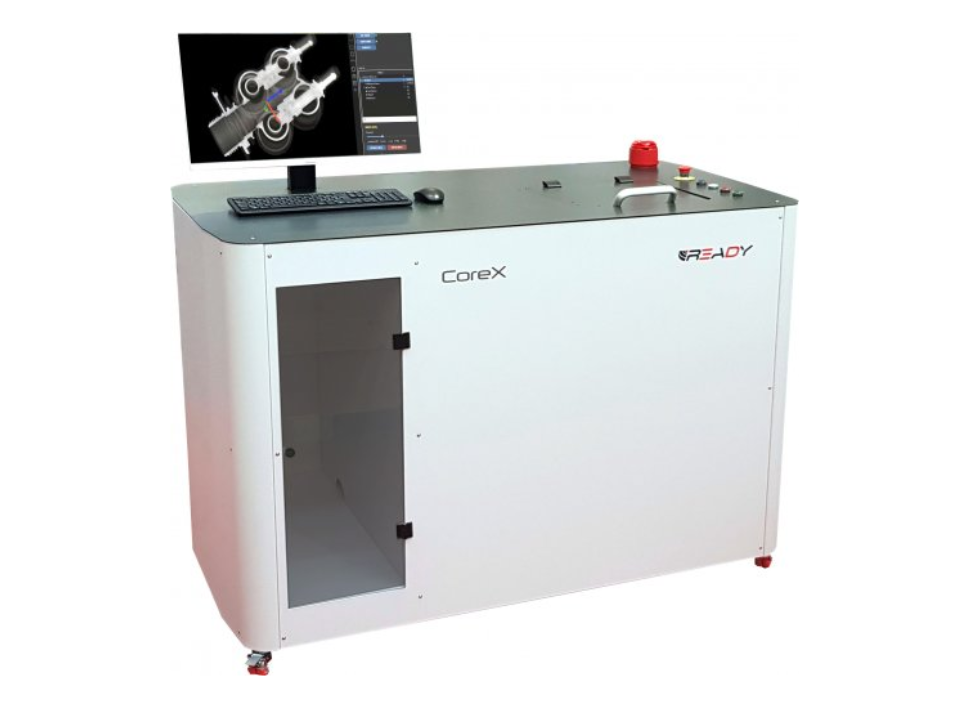
Designed specifically for shop-floor deployment, COREX ONE combines industrial CT capabilities with a compact, self-shielded architecture that eliminates the need for dedicated bunkers, shielded rooms, or additional radiation protection infrastructure. The system can be installed alongside manufacturing operations, enabling inspection activities to be integrated directly into production workflows.
The platform features a top-loading design intended to reduce floor space requirements while simplifying loading and unloading procedures for production personnel. By moving CT inspection closer to the manufacturing process, the system seeks to shorten feedback loops and support faster quality control decisions.
One of the primary barriers to wider industrial CT adoption has been the expertise required to operate conventional systems and interpret complex inspection data. COREX ONE addresses this challenge through a simplified workflow designed for production operators rather than CT specialists.
Inspections are initiated through a straightforward start-button operation, while measurement results are generated automatically within seconds. Instead of presenting users with complex three-dimensional datasets, the system displays results through two-dimensional sectional views similar to those commonly used in traditional profile projector inspections.
A traffic-light evaluation system provides immediate pass/fail indications, allowing operators to quickly assess component conformity. Additional information, including dimensional trends and corresponding sectional views, can be accessed to support process monitoring and early identification of manufacturing deviations.
Behind the simplified interface is a fully automated CT measurement process. Measurement references and coordinate systems are established directly on either acquired three-dimensional volume data or STL models. Reference features such as planes, cylinders, and points can be defined using process-related characteristics, enabling the system to automatically extract virtual sections and perform dimensional evaluations during inspection.
This approach allows manufacturers to inspect both internal and external features without manual intervention while maintaining the familiarity of conventional dimensional inspection workflows.
Beyond dimensional verification, COREX ONE incorporates several advanced inspection capabilities associated with industrial CT technology. These include automated porosity detection and evaluation, surface comparison using color-map analysis, trend monitoring through statistical displays and histograms, and instant report generation for traceability and quality documentation.
The ability to identify internal defects such as porosity, cavities, and blowholes from a single scan is particularly valuable for manufacturers producing components where structural integrity and sealing performance are critical.
The system has been developed for a wide range of manufacturing sectors, including plastics processing, aluminum and light-alloy casting, rubber products, glass components, carbon-fiber structures, titanium parts, and extrusion-based manufacturing.
For industries that traditionally rely on destructive sectioning and sample preparation for dimensional verification, COREX ONE offers a non-destructive alternative. Components can be scanned directly, allowing operators to evaluate internal cross-sections and critical dimensions without physically cutting the part.
Manufacturers operating injection molding and die-casting processes may also benefit from the system’s capability to inspect internal porosity and cavity formation, providing additional insight into product quality and process stability. The platform can also support rapid setup verification during production changeovers and batch transitions.
By combining automated measurements, intuitive operation, internal defect analysis, and a compact self-shielded design, COREX ONE seeks to make industrial CT inspection more accessible to production environments. The system represents a shift toward integrating advanced non-destructive testing and inspection technologies directly into manufacturing operations, enabling faster quality assurance and more comprehensive inspection of critical components.
Reference: https://metrology.news/corex-one-brings-industrial-ct-inspection-directly-to-the-production-floor/