BMW Group has introduced a terahertz-based measurement system at its Leipzig plant, marking a significant advancement in non-destructive testing (NDT) within automotive production. The new technology enables automated, precise and reproducible inspection of paint layer thickness on plastic exterior components directly in series production.
As part of its broader push toward digitalisation, the Leipzig facility has scaled the system to operate inline, allowing quality inspections to be conducted without interrupting the manufacturing process. The implementation reflects a shift toward real-time, data-driven quality assurance in industrial environments.
“Terahertz measurement technology replaces complex manual inspection with a fully automated solution, taking quality assurance to an entirely new level,” says Christoph Theiselmann, Head of Exterior Plastics, Production at Plant Leipzig.
At the core of the deployment is the “Irys” terahertz measurement system, developed by das-Nano. Designed specifically for industrial inline inspections, the system performs contactless and non-destructive measurement of multi-layer paint systems while delivering real-time data.
Transition from Destructive Testing to Inline NDT
Previously, paint layer thickness inspections at the Leipzig plant relied on manual methods involving scalpels and microscopy, resulting in the destruction of tested components and delayed detection of deviations. The introduction of terahertz-based NDT eliminates these limitations.
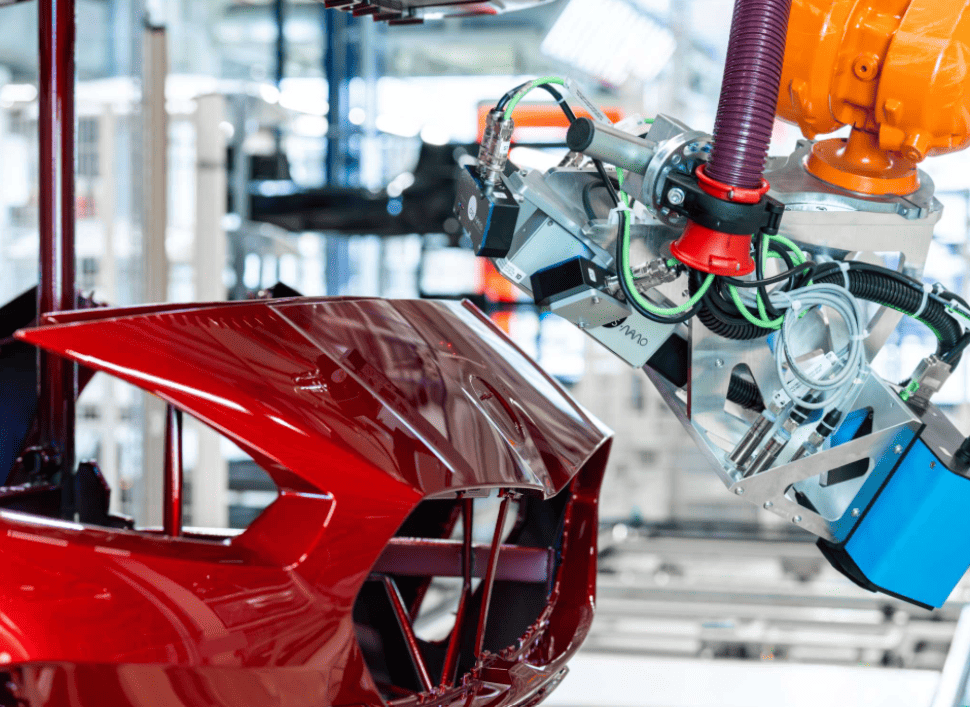
Sensors mounted on robotic systems within the end-of-line measurement cell automatically position themselves relative to each component. By analysing the time-of-flight of reflected terahertz waves, the system measures individual paint layer thicknesses within seconds, achieving micrometre-level accuracy.
This transition not only removes the need for destructive testing but also enhances process efficiency, reduces material waste and supports cost-effective operations. The ability to detect deviations early strengthens process control and improves overall product quality.
“The combination of higher measurement accuracy, direct process integration and full digitalisation delivers tangible benefits across the entire production chain, strengthening quality, economic efficiency and resource conservation in equal measure,” Christoph Theiselmann adds.
Advancing Digital Paint Shop Operations
The integration of terahertz measurement technology follows the plant’s earlier implementation of automated surface inspection in 2024, representing another step toward a fully digital paint shop for plastic components. The system generates fully digital measurement and quality data, enabling advanced analysis and future integration with AI-based tools for trend evaluation and process optimisation.
Setting New Benchmarks in Automotive NDT
By industrialising terahertz-based inspection, the Leipzig facility has become the first within the BMW Group to deploy this technology in in-house production. It also establishes a benchmark in the plastics segment, being the first to apply terahertz technology for inspecting paint layer thickness on plastic components.
Following successful piloting and ramp-up, the system is now compatible with all component carrier systems and is being extended to support all colour variants. The technology also presents opportunities for broader implementation across other production facilities and supplier networks.
The Exterior Plastics team at Leipzig, comprising 450 employees, continues to support multiple BMW Group plants, including Dingolfing and Regensburg, by manufacturing injection-moulded components such as bumpers, side sills and spoilers, further reinforcing the role of advanced NDT in modern automotive manufacturing.