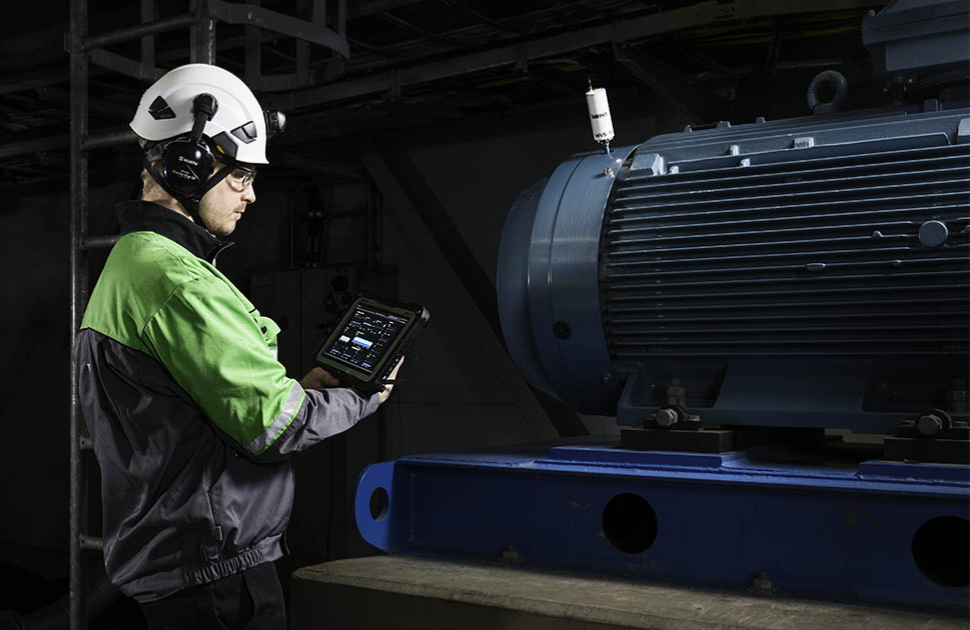
Every plant has this story. A critical pump passed its scheduled inspection on a Friday. The paperwork was clean, every box ticked. And on Monday morning the same pump seized and took half a shift of production down with it.
The teardown told the truth: the bearing had not failed suddenly; it had been dying for weeks. The vibration had crept up, the temperature had drifted, and fine metal particles had been collecting in the oil. That machine had been announcing its own funeral for a month, in a language nobody was listening to.
That, in one story, is what condition monitoring is about. It is the practice of learning to listen to machines before they get loud.
I have spent more than two decades in nondestructive testing, most of it around pipe mills, pipelines, and heavy manufacturing, where inspection usually meant something with a date on it: show up, test, report, come back next quarter. Condition monitoring quietly changes that rhythm, and I believe it is one of the most important shifts in our industry right now. So let me explain it in plain words: what it is, how it works, where NDT people fit in, and a few things the sales brochures will not tell you.
So what exactly is condition monitoring?
Strip away the jargon and the idea is simple. Condition monitoring means watching the health signals of a machine or structure while it operates, over time, so trouble can be caught early and handled on your schedule instead of the machine's.
The comparison I always reach for is the doctor's visit versus the fitness watch. A traditional NDT inspection is like an annual physical: thorough, professional, but a snapshot. A fitness watch is nowhere near as thorough, but it sits on your wrist all day and notices when your resting heart rate drifts. “Something is different” is often the most valuable sentence in maintenance.
Condition monitoring is the fitness watch for machinery. It does not replace the doctor; it makes the doctor's visits smarter. And it changes the question we ask. Conventional inspection lives by absolute values; monitoring cares about the trend. A vibration reading of 4 mm/s means little on its own. (Illustrative example only; interpretation depends on machine type, operating speed, applicable standards, and historical trend.) But if the same bearing read 1.5 mm/s six weeks ago and has climbed every week since, that trend is practically shouting, even while every single reading stays “acceptable.”
In short: condition monitoring is the smoke detector, always on; NDT is the fire investigator who tells you what, where, and how bad.
The curve that explains the whole idea
Ask anyone in the reliability world to explain all this with one picture, and they will draw the P-F curve in Figure 1.
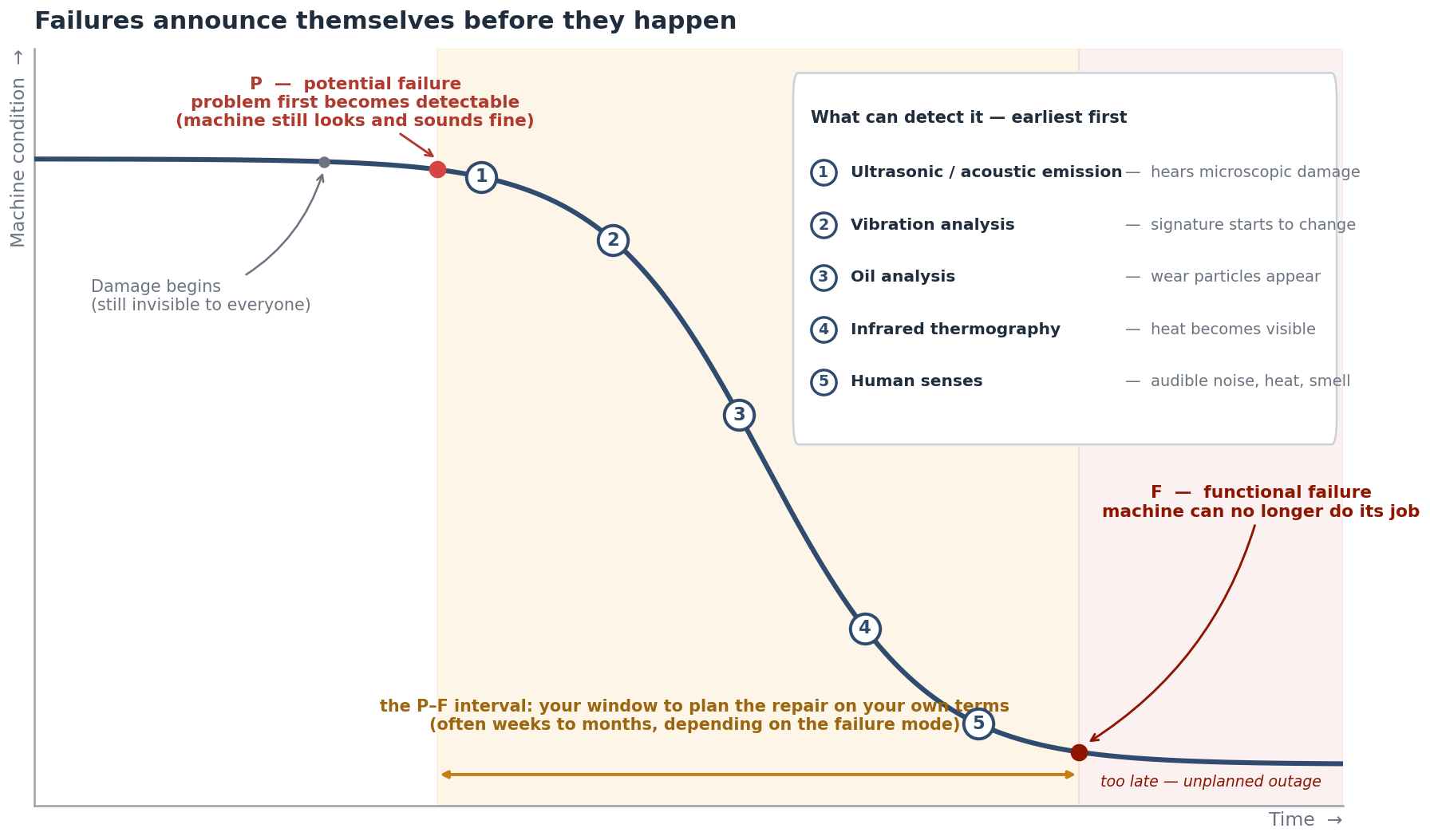
Figure 1. The P-F curve. Damage becomes detectable at point P long before the machine finally stops at point F. The numbered markers show the order in which different technologies pick up the warning; the earlier the catch, the wider your planning window.
A healthy machine cruises along the top. Then something begins: a fatigue crack, a corrosion pit, the first tiny spall on a bearing race. At point P, the potential failure, the problem first becomes detectable even though the machine still looks and sounds fine. Much later comes point F, the functional failure, where the machine can no longer do its job.
The gap between them is the P-F interval, and it is the most valuable stretch of time in maintenance. Inside that window you can order parts, plan the shutdown, and do the repair in daylight, on a date you chose. Outside it, the machine chooses the date for you. In my experience it usually picks a night shift, a long weekend, or the middle of your largest order of the year.
Notice how the technologies line up along the curve: ultrasonic and acoustic emission hear trouble earliest, while the defect is still microscopic, then vibration, then wear debris in the oil, then visible heat, and finally human ears. The whole game is to catch problems as far to the left as possible. The exact detection sequence varies with the failure mechanism, asset type, and operating conditions; Figure 1 illustrates one common example rather than a universal rule.
The toolbox, in plain words
A handful of techniques carry most of the industrial load. Table 1 gives the summary; here is the flavor.
Vibration analysis is the workhorse for anything that rotates. Every mechanical fault shakes the machine in its own way: imbalance at running speed, misalignment at twice running speed, a damaged bearing at frequencies you can calculate from its geometry. To a trained analyst, a vibration spectrum reads the way a UT A-scan reads to us: full of information, once you know the language.
Acoustic emission is, quite literally, one of ours: a recognized NDT method. Growing cracks, active corrosion, and leaks release tiny bursts of stress-wave energy that sensors pick up, often answering an important question that a snapshot inspection cannot: is this flaw active and growing right now?
Oil analysis is the blood test. One small sample tells three stories: wear metals say what is wearing inside, contamination says what got in from outside, and the oil's own condition says whether it can still protect the machine.
Three more will feel familiar. Installed ultrasonic thickness sensors are our own UT bolted on permanently, reporting wall thickness on a schedule and, more importantly, a corrosion rate you can trust. Guided wave ultrasonics screens tens of meters of pipe from a single collar; it will not size a defect precisely, but it is very good at saying “dig here, not there.” And motor current signature analysis may be the most surprising: broken rotor bars and eccentricity leave patterns in the supply current, so the motor tells on itself through its own power cable.
Table 1. The main condition monitoring techniques at a glance.
Why this belongs to NDT people
I sometimes hear inspectors describe condition monitoring as “the maintenance department's business.” I want to push back on that, gently but firmly.
Look at the toolbox one more time. Acoustic emission, thermography, ultrasonic thickness measurement: those are NDT methods by any definition. And the rest of the list runs on skills we already carry: baselines, calibration discipline, interpreting a signal instead of just recording it, and reporting honestly even when the finding is inconvenient. That is our daily bread, and condition monitoring programs are starved for it.
What changed in the last ten years
A fair question: none of these ideas are new. Vibration analysis has been around for generations, and the P-F curve came out of airline reliability studies in the 1970s. So why is condition monitoring suddenly everywhere? Because the economics flipped.
Sensors now cost a small fraction of what they once did, and battery-powered wireless versions run for years without attention, erasing the cabling cost that used to kill these projects at the quotation stage. Storage moved to the cloud, a reading from a remote compressor station now lands on a phone in seconds, and the software finally learned to help: modern systems study weeks of a machine's normal behavior and flag anything that departs from it, even at three in the morning with nobody at the screen.
This convergence of cheap sensing, connectivity, and machine intelligence is the heart of what many of us now call NDE 4.0; condition monitoring is where that revolution touches the plant floor. Figure 2 shows the journey in one picture.
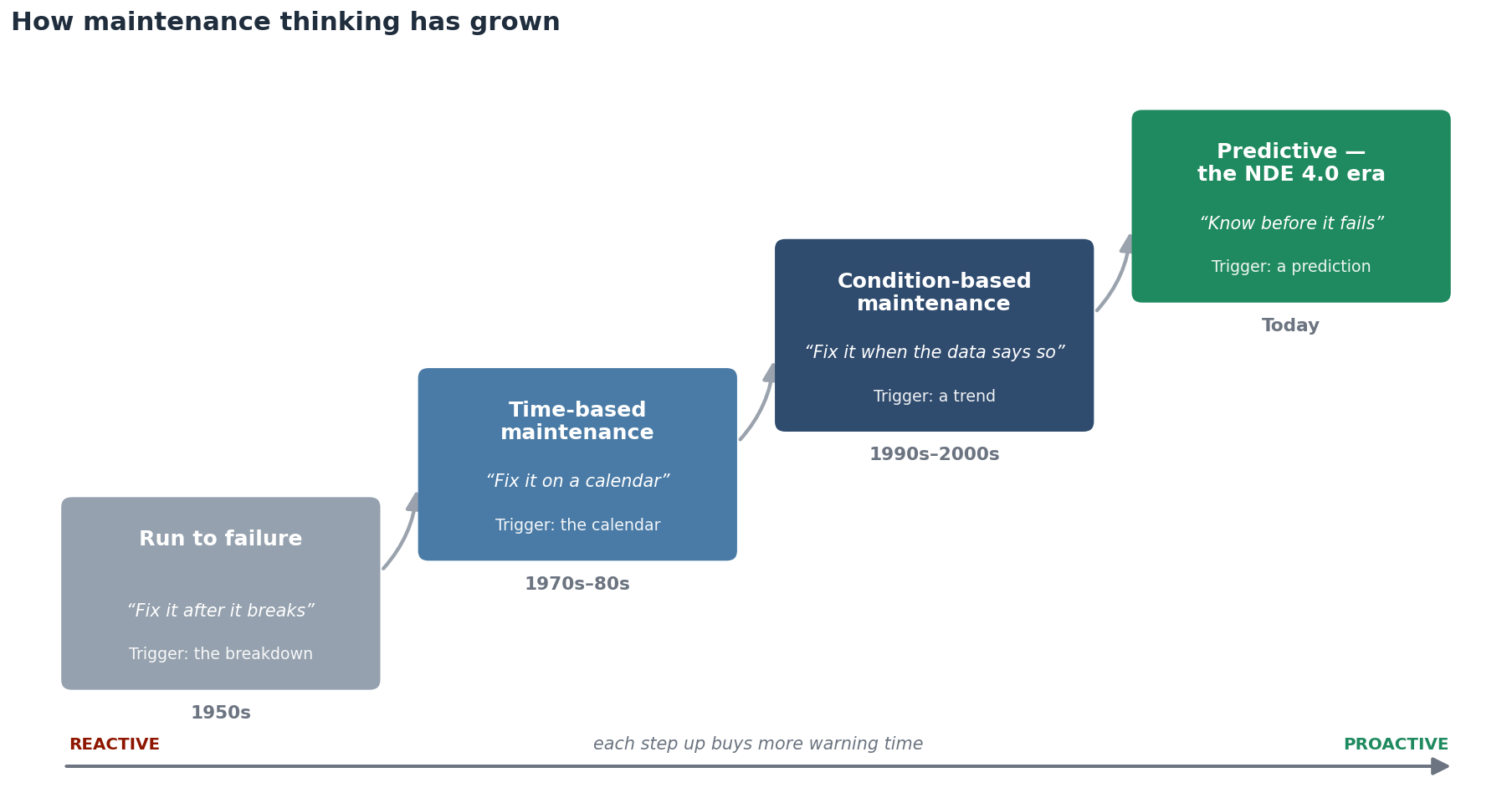
Figure 2. Four generations of maintenance thinking. Each step up the staircase buys more warning time, from repairing after failure to knowing before it happens.
One caution: the software flags patterns; it does not understand consequences. An algorithm can tell you a bearing signature has changed, not what that failure means for the people standing near the machine. Judgment stays with humans, and it should.
What it looks like on the ground
Let me bring this down to the industries I know best. In a pipe mill, the product gets enormous NDT attention, but the mill itself—the hydrotester pumps, forming presses, and drive rolls—is what keeps that product moving. An unplanned breakdown on any of those machines stops the whole line, so they deserve the same monitoring attention we give the pipe.
Storage tanks tell a similar story. Opening a large tank for internal inspection is brutally expensive, so acoustic emission testing of the floor, done while the tank stays in service, helps rank which tanks genuinely need opening and which can safely wait. And pipelines may be the clearest example of all: when an in-line inspection (ILI) run is compared against the previous one, the real question is not “is there metal loss?” but “how fast is it growing?” Rate, not snapshot: pure condition monitoring thinking.
The problems nobody puts in the brochure
I would be doing you a disservice if I only sang the praises. These programs fail regularly, and usually in the same handful of ways.
The first is drowning in data. A plant that mounts five hundred sensors and assigns nobody to review the output has bought five hundred expensive paperweights. Before any purchase order goes out, someone should be able to answer: who looks at this data, how often, and what happens when it crosses a limit?
The second is false alarms. Set thresholds too tight and the system cries wolf until people mute it, and then they miss the one alarm that was real. Tuning alarms is unglamorous work, but it is the difference between a system people trust and a system people ignore.
The third I call green-light syndrome. An all-green dashboard makes everyone relax, but sensors only see what they are pointed at, and a vibration sensor will not catch internal corrosion. Monitoring a few points does not retire proper periodic inspection.
The fourth is the baseline problem. Trends need history, so the program looks least impressive exactly when management is watching most closely. Companies expecting magic in the first quarter often kill it right before it would have started paying for itself. Log every catch from day one with what it would have cost at full failure; that logbook is your budget defense.
And the last is people. Vendors will happily install a system; far fewer people can say what the trends mean. Data without interpretation is just noise with a subscription fee, and interpretation is exactly what NDT people are trained for. If anyone worries this technology replaces inspectors, I would argue the opposite: somebody still has to verify the flag, investigate the finding, and make the call. What disappears is some of the blind, routine, nothing-found-again work, which, if we are honest, was never the part anyone loved.
Starting small, starting right
For a plant starting from zero, do not try to boil the ocean. Choose five or ten assets that genuinely hurt when they fail, and match the technique to the failure mode: vibration and oil for rotating equipment, installed thickness sensors for corrosion-driven statics, thermography for electrical gear. There is no prize for exotic technology; the prize is for catching the failures you actually have.
Record the baseline while things are healthy, because you cannot recognize abnormal if you never wrote down normal, and review the program honestly after six months. Nearly every successful program I have seen started embarrassingly small and grew on its own results; nearly every failed one started with a big purchase order and no plan for the data.
The part that stays human
After all the sensors, gateways, and learning algorithms, the finest condition monitoring system I have ever come across is still a senior operator who has worked the same unit for twenty years, lays a hand on a pump housing during the morning round, and says, “She doesn't sound right today.” That operator is usually right, and cannot fully explain how.
Everything in this article is, in the end, an attempt to give that instinct better ears, a longer memory, and the ability to stand beside a hundred machines at once. The technology does not replace such operators. It multiplies them.
The machines have been talking all along. Our industry is finally buying the hearing aids. For the NDT community, this is not a rival discipline knocking at the door. It is our own field growing up, stretching from “find the defect today” to “watch the health every day.” Same physics, same integrity, longer timeline. We should walk through that door like we own it. In many ways, we already do.
Author: Kuldeep Sharma, Ashok Kumar


There are no comments yet!