
Table of contents
- Introduction
- E1417, AMS 2647 and AMS 2644: who governs what
- The process, step by step
- Daily, weekly and periodic system checks
- AMS 2644 sensitivity levels
- Records and what an auditor checks
- Limits and common process-control mistakes
- Key takeaways
- FAQs
- Related reading on OneStopNDT
- References
Introduction
A process-control deep dive, not a basics refresher
Liquid penetrant testing (PT) catches hairline surface cracks that the eye alone would miss — but only if the line running it is in control. ASTM E1417/E1417M is the practice aerospace and casting quality teams write into drawings and purchase orders to make that happen: it sets minimum requirements for the process, independent of which part is on the table that day.
This article is a working reference for the checks a penetrant line needs to stay compliant with the current (2021) edition of E1417, how E1417 relates to the AMS 2644 materials specification and the AMS 2647 maintenance procedure, and what an auditor is likely to ask for. It assumes familiarity with the basic PT process — covered in OneStopNDT’s Liquid Penetrant Testing Guide and procedure walkthrough — and goes one level deeper, into process control, sensitivity levels and records.
E1417, AMS 2647 and AMS 2644: who governs what
Three documents get cited almost interchangeably around a penetrant line, and they are not interchangeable.
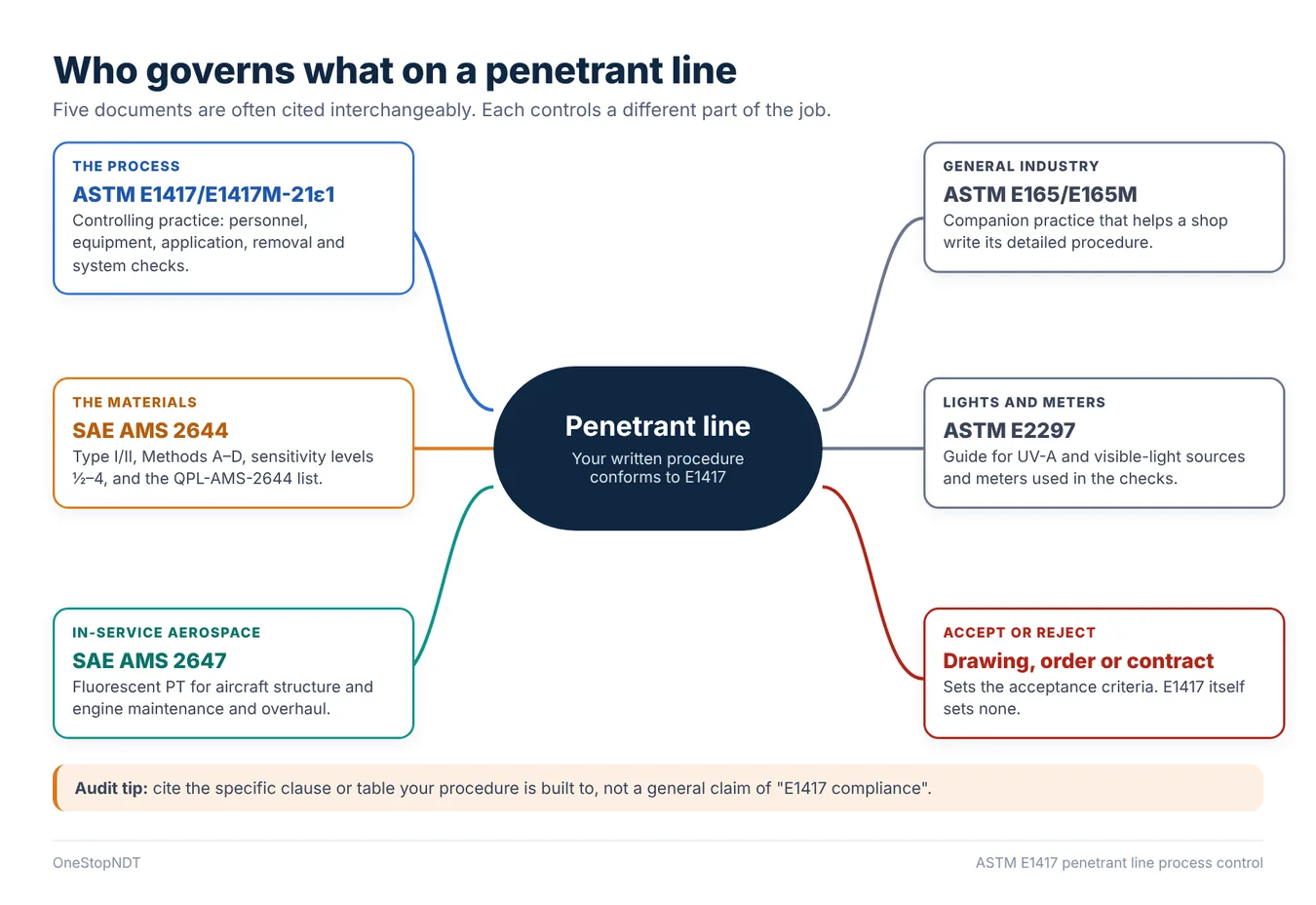
- ASTM E1417/E1417M is the controlling practice for the process. The current edition, E1417/E1417M-21ε1, sets minimum requirements for liquid penetrant examination of nonporous metal and nonmetal components — personnel, equipment, and application and removal methods — across in-process, final and maintenance (in-service) examination. Per its own §4.1, E1417 is written to be specified on engineering drawings, specifications or contracts; it is not itself a step-by-step inspector procedure. A shop writes its detailed procedure to conform to E1417, often using the companion general-industry practice ASTM E165/E165M, which explicitly sets no acceptance criteria of its own.
- SAE AMS 2644, “Inspection Material, Penetrant,” governs the materials: it classifies penetrants by type (Type I fluorescent, Type II visible) and removal method (A–D), sets the fluorescent sensitivity levels (½ through 4), and sits behind the Qualified Products List, QPL-AMS-2644. E1417 cross-references AMS 2644 rather than restating it — for example, E1417 defines its water-washable Method A(W) penetrant using AMS 2644’s water-content definition, and names QPL-AMS-2644 solvents as acceptable swab solvents for redeveloping indications.
- SAE AMS 2647 is a fluorescent penetrant specification. Despite claims sometimes seen online, it is not an ultrasonic method or a fuel-tank-specific spec. Its current title, AMS2647G, is “Fluorescent Penetrant Inspection, Aircraft Structures and Engine Component Maintenance” (the AMS2647F revision, also cited here for historical contrast, has since been superseded). It is the aerospace maintenance-and-overhaul counterpart to E1417/E165 — written for in-service aircraft and engine parts rather than new manufacture — and it references AMS 2644 for materials the same way E1417 does.
- ASTM E2297 is a different kind of companion: a guide for the UV-A and visible-light sources and meters used in penetrant and magnetic particle testing, not a materials or process-acceptance spec. It belongs with the light-intensity checks below, not with AMS 2644 or AMS 2647.
The process, step by step
E1417 structures the examination around the same core stages as any penetrant line, but ties several of them to specific checks and records.
- Pre-clean and dry. The surface must be free of contamination (oil, scale, paint, prior-process residue) and dry before the penetrant goes on; residual cleaning fluid or moisture dilutes the penetrant and can mask real indications.
- Apply penetrant. Dip, spray or brush, matched to the AMS 2644 type and method already qualified for the part: Type I (fluorescent) for most aerospace and casting work, Type II (visible) where UV lighting is impractical; Method A (water-washable), B (post-emulsifiable, lipophilic), C (solvent-removable) or D (post-emulsifiable, hydrophilic). The 2021 edition of E1417 added Method A(W) — a water-washable penetrant containing 20% or more water by volume per the AMS 2644 definition — and requires a weekly refractometer check of that water content.
- Dwell. The penetrant stays on the surface long enough to draw into any surface-breaking discontinuity before removal; dwell time is set by the written procedure, not by a single number in E1417 itself, and varies by material, method and expected flaw type.
- Remove excess penetrant by the method qualified for that penetrant: a timed water spray for Method A (the 2021 edition added a final spray-rinse step to Method A’s immersion-removal option); emulsifier application plus a water rinse for Methods B and D; a lint-free wipe followed by solvent on a separate cloth for Method C, never a direct solvent flood of the surface.
- Apply developer — dry powder or a wet developer — to draw bleedout to the surface and amplify the indication; dry developer is checked for contamination and replaced once roughly 10 fluorescent specks appear in a 10 cm (4 in) circle.
- Inspect, under UV-A (fluorescent) or adequate white light (visible), within the developing time set by the procedure.
- Record and post-clean. Log the result against the acceptance criteria in the governing drawing or spec — E1417 itself sets none — then remove developer and any remaining penetrant residue from the part.
If an indication needs a closer look, the 2021 edition of E1417 permits swabbing and redeveloping it using isopropyl alcohol, acetone, or a solvent/remover already qualified to QPL-AMS-2644.
Running a compliant E1417 line also means having qualified consumables and system equipment on hand — companies such as Baugh & Weedon supply penetrant inspection systems and consumables to aerospace and casting shops.
Daily, weekly and periodic system checks
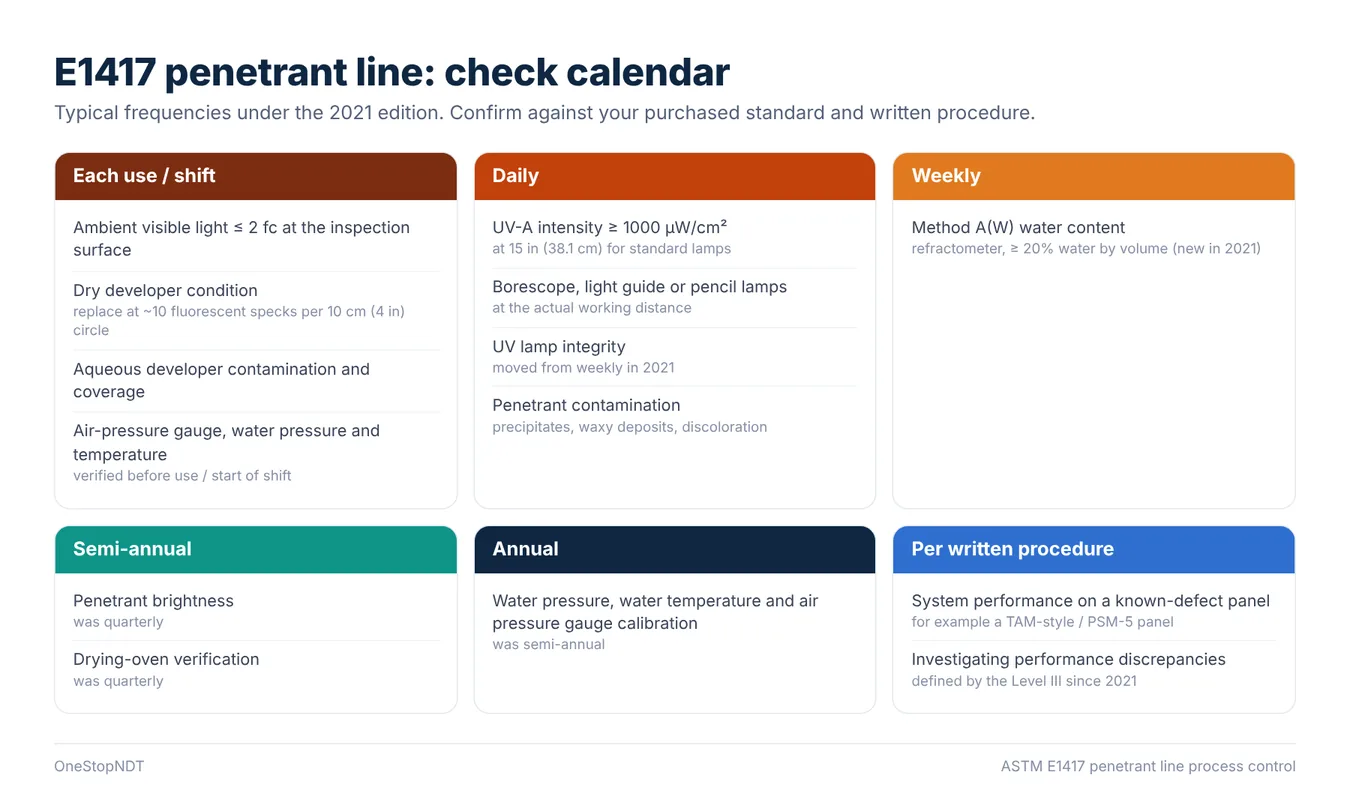
The 2021 edition of E1417 (E1417/E1417M-21) tightened several check frequencies in its system-check table. The table combines the 2021 changes with Magnaflux’s daily-check guidance. Confirm the exact clause and table numbers in your purchased copy of the standard before using it as a controlled checklist.
Check | What it verifies | Typical frequency | Source |
|---|---|---|---|
UV-A (black light) intensity, standard lamp | ≥1000 µW/cm² at 15 in (38.1 cm) | Daily (the 2021 edition moved the UV lamp integrity check from weekly to daily) | ASTM E1417-21; Magnaflux |
UV-A intensity, borescope/light guide/pencil | ≥1000 µW/cm² at the actual working distance | Daily | Magnaflux |
UV-A LED compliance | No 10-minute warm-up required (non-LED sources still need it) | At installation/as applicable | Magnaflux |
Ambient visible light at inspection surface | ≤2 foot-candles | Each use | Magnaflux |
Penetrant system performance (comparative check vs. a known-defect standard, e.g., a TAM-style panel) | In-use penetrant still performs to its qualified sensitivity | Per written procedure — the 2021 edition removed the old new-vs-in-use comparative clauses and leaves scope of investigation to the Level III | ASTM E1417-21; TAM panel data |
Penetrant brightness | Fluorescent output has not degraded | Semi-annual (moved from quarterly in the 2021 edition) | ASTM E1417-21 |
Dry developer condition | No contamination | Each use; replace at ~10 fluorescent specks per 10 cm (4 in) circle | Magnaflux |
Aqueous developer | No contamination; uniform coverage | Each use | Magnaflux |
Method A(W) water content | ≥20% water by volume per AMS 2644 | Weekly (refractometer) | ASTM E1417-21 |
Water pressure and temperature (rinse) | Within procedure limits | Verified before use; gauge calibration annual (moved from semi-annual in the 2021 edition) | ASTM E1417-21; Magnaflux |
Air-pressure gauge | Within procedure limits | Start of each shift | Magnaflux |
Drying-oven verification | Correct drying condition | Semi-annual (moved from quarterly in the 2021 edition) | ASTM E1417-21 |
Penetrant contamination (precipitates, waxy deposits, discoloration) | Material still fit for use | Daily | Magnaflux |
AMS 2644 sensitivity levels
Fluorescent (Type I) penetrants carry formal AMS 2644 sensitivity levels; visible (Type II) penetrants are not graded the same way.
AMS 2644 level | Relative sensitivity | Typical use | Trade-off |
|---|---|---|---|
½ | Very low | Where high background fluorescence must be tolerated | Misses the smallest flaws |
1 | Low | General-purpose, lower-value parts | May miss very fine flaws |
2 | Medium | General aerospace/casting work | Balances sensitivity and background |
3 | High | Fatigue-critical or high-value parts | More background fluorescence to manage |
4 | Ultra-high | Smallest-flaw detection requirements | Most background fluorescence; most demanding process control |
Levels are assigned on qualification to QPL-AMS-2644, not chosen freely by the end user. E1417 does not define or assign these levels — that is AMS 2644’s role — but a shop’s written procedure specifies which AMS 2644 type, method and sensitivity level applies to a given part, and the E1417-governed process must be run and checked in a way that keeps the penetrant performing at its qualified level, which is exactly what the brightness and system-performance checks above are for.
Records and what an auditor checks
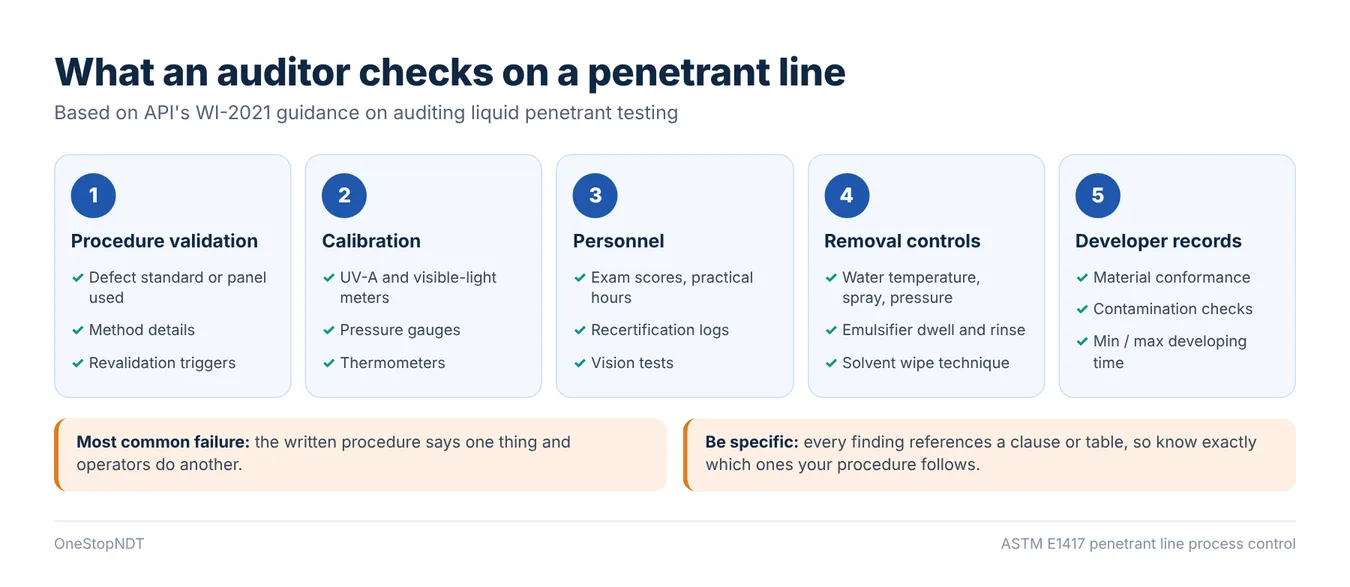
API’s WI-2021 Guidance on Auditing Liquid Penetrant Testing is one of the few public documents that states what an auditor actually looks for on a PT line. Expect an audit to check:
- Procedure validation records: which defect standard or panel validated the written procedure, method details, and what triggers revalidation.
- Calibration records for UV-A/visible-light meters, pressure gauges and thermometers.
- Personnel competence records: exam scores, practical hours, continuance/recertification logs, and vision-test records.
- Method-specific removal controls, checked against what is actually practiced — temperature, spray method and pressure for water-washable removal; emulsifier dwell and rinse for post-emulsifiable methods; wipe technique and solvent handling for solvent-removable. The API guidance frames the real failure mode here as a mismatch between the written procedure and what operators actually do, not ambiguity in the standards themselves.
- Developer records: type/material conformance, dry-developer contamination checks, minimum/maximum developing time, and for aqueous developers, contamination/concentration checks.
Every audit finding “must reference specific requirements from normative documents” — so an auditor working an E1417 line will ask for the specific clause or table your procedure is built to, not a general claim of “E1417 compliance.”
Limits and common process-control mistakes
- E1417 is a controlling practice, not an acceptance-criteria document — a line can be fully E1417-compliant and still pass or fail a part depending entirely on what acceptance standard the drawing calls out separately.
- Confusing AMS 2647 (aerospace maintenance/overhaul) with AMS 2644 (materials) or E1417 (the general process practice) is a common and consequential mix-up — citing the wrong one on a procedure can mean referencing requirements that do not actually apply to the part in front of you.
- Reported real-world nonconformances cluster around three areas: UV-A intensity measured at the wrong distance (a borescope or light-guide check needs its own working-distance measurement, not the standard 15 in/38.1 cm figure); a written procedure’s stated method not matching what is actually practiced on the line; and dry-developer contamination going unchecked until bleedout is visibly degraded. These are common failure patterns reported in industry training material, so treat them as areas to watch.
Key takeaways
- ASTM E1417/E1417M-21ε1 governs the penetrant process (personnel, equipment, application and removal methods); acceptance criteria must be specified in the order, contract or drawing (§6.2), not in E1417 itself.
- AMS 2644 governs the penetrant materials — type, method and the ½–4 fluorescent sensitivity levels — and sits behind QPL-AMS-2644.
- AMS 2647 is the aerospace maintenance and overhaul fluorescent-PT spec, not an ultrasonic or fuel-tank-specific method.
- The 2021 edition of E1417 tightened several check frequencies (UV lamp integrity moved to daily, penetrant brightness to semi-annual) and added the Method A(W) water-washable classification with its weekly water-content check.
- Audits lean on procedure-validation, calibration and personnel records, and on whether the written procedure matches actual practice — not a general claim of “E1417 compliance”.
FAQs
Does ASTM E1417 set acceptance criteria for penetrant testing?
No. E1417 is a controlling process practice; acceptance criteria come from the governing drawing, specification or product code cited separately.
What’s the difference between AMS 2644 and AMS 2647?
AMS 2644 qualifies and classifies penetrant materials (type, method, sensitivity level). AMS 2647 is a maintenance-and-overhaul fluorescent-PT procedure for in-service aircraft structures and engine components that references AMS 2644 for its materials.
How often does UV-A intensity need to be checked?
Daily. Standard lamps need at least 1000 µW/cm² at 15 in (38.1 cm), and borescopes and light guides are checked at their actual working distance. The 2021 edition of E1417 also moved the UV lamp integrity check from weekly to daily.
What is Method A(W) penetrant?
A water-washable classification added in the 2021 edition of E1417, defined as containing 20% or more water by volume per AMS 2644, requiring a weekly refractometer water-content check.
What are the AMS 2644 sensitivity levels?
Five fluorescent (Type I) levels — ½, 1, 2, 3 and 4 — running from lowest to highest sensitivity, assigned on qualification to QPL-AMS-2644.
Is a TAM panel required by E1417?
Not by name. TAM-style test panels (e.g., the Sherwin PSM-5) are the panels commonly used for E1417’s penetrant system performance check, but treat them as accepted practice and confirm the panel your procedure and customer require.
How long must penetrant inspection records be kept?
Retention periods are typically set by the customer’s or prime contractor’s quality specification, so check the purchase order and quality requirements that apply to the part.
Can expired penetrant still be used?
Under the 2021 edition of E1417, penetrant past its stated shelf life may still be used if it passes the required performance checks, without manufacturer recertification — except for aerosols and single-use materials.
Related reading on OneStopNDT
- Liquid Penetrant Examination: In-depth Procedure — the general step-by-step PT procedure this article builds on
- Fluorescent Penetrant Testing: A Comprehensive Guide — fluorescent PT basics
- Magnetic Particle and Penetrant Testing: Process Control and Acceptance — the companion MT/PT hub this article extends
References
- ASTM International, E1417/E1417M-21ε1, “Standard Practice for Liquid Penetrant Testing” — store.astm.org
- ASTM International, E165/E165M-23, “Standard Practice for Liquid Penetrant Testing for General Industry” — store.astm.org
- ASTM International, E2297-23, “Standard Guide for Use of UV-A and Visible Light Sources and Meters Used in the Liquid Penetrant and Magnetic Particle Methods” — store.astm.org
- Quality Magazine, “ASTM E1417: Key Changes and Updates” — qualitymag.com
- Magnaflux, “9 Daily Performance Checks for Liquid Penetrant Inspection Systems” — magnaflux.com
- Magnaflux, “Specifications Overview” — magnaflux.com
- Magnaflux, “AMS 2644 Penetrant Sensitivity Levels” — magnaflux.com
- SAE International, AMS2644J, “Inspection Material, Penetrant” — saemobilus.sae.org
- Sherwin Inc., “PSM-5 Penetrant System Monitor Panel” technical data sheet — callington.com
- SAE International, AMS2647G, “Fluorescent Penetrant Inspection, Aircraft Structures and Engine Component Maintenance” — saemobilus.sae.org
- SAE International, AMS2647F (superseded), “Fluorescent Penetrant Inspection, Aircraft and Engine Component Maintenance” — saemobilus.sae.org
- API, “WI-2021 Guidance on Auditing Liquid Penetrant Testing” (2023-12-22) — api.org
There are no comments yet!