
Table of content
- Why three separate codes
- API 510: Pressure Vessel Inspection Code
- API 570: Piping Inspection Code
- API 653: Tank Inspection, Repair, Alteration, and Reconstruction
- Side-by-side comparison
- Who publishes in this space
- Common mistakes
- Key takeaways
- FAQs
- References
- Related reading on OneStopNDT
Why three separate codes
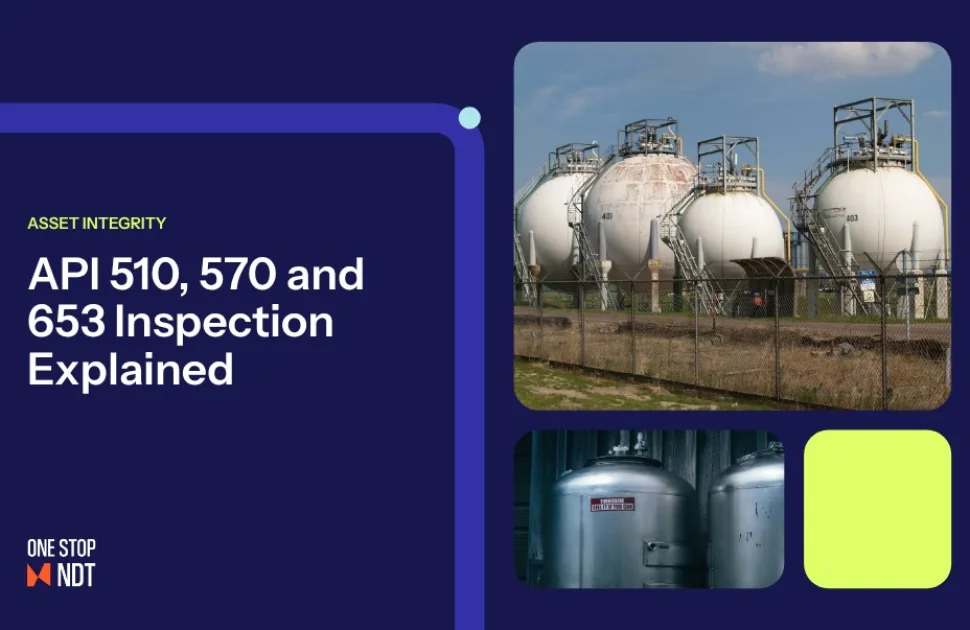
API 510, 570, and 653 govern in-service inspection of three distinct asset classes — pressure vessels, piping, and aboveground storage tanks — after original construction and ASME/API certification. None of the three governs new construction; that falls to ASME Section VIII (vessels), ASME B31.3 (process piping), and API 650 (tanks) respectively. Each in-service code sets its own inspection-interval logic, its own inspector certification, and references the NDT methods appropriate to how its asset class actually degrades: vessels and piping lose wall thickness relatively uniformly and are checked largely by UT and visual inspection on a risk- or time-based schedule, while tanks additionally need floor-specific methods (MFL, UT floor scanning) because bottom-plate corrosion is a distinct failure mode from shell thinning.
All three certifications — API 510 Pressure Vessel Inspector, API 570 Piping Inspector, and API 653 Aboveground Storage Tank Inspector — share the same ANSI-accredited (ISO/IEC 17024) certification structure, exam format, and recertification cycle, which this article covers once rather than three times. Where the codes genuinely diverge is in their interval-setting formulas, especially API 653’s, which uses a different, more granular corrosion-rate-driven structure than the simpler half-remaining-life rule in API 510 and 570.
API 510: Pressure Vessel Inspection Code
Scope. API 510 covers in-service pressure vessels in petroleum, chemical, and petrochemical service after original ASME Section VIII construction and certification — inspection, repair, alteration, and rerating of vessels already in operation, not new fabrication.
Inspection intervals (default, non-RBI). Internal or on-stream inspection interval is the lesser of half the vessel’s remaining life or 10 years. External visual inspection interval is the lesser of 5 years or the required internal/on-stream interval. If calculated remaining life is under 4 years, the interval may be set to the full remaining life, capped at 2 years. A facility running formal risk-based inspection (RBI) per API RP 580/581 can adjust these default intervals based on its own RBI program.
Inspector certification — API 510 Pressure Vessel Inspector. ANSI-accredited under ISO/IEC 17024, valid for 3 years. Eligibility is based on education and experience within the last 10 years working with an authorized inspection agency: a bachelor’s degree (or 3+ years military technical service) requires 1 year of pressure-vessel inspection experience; a 2-year associate degree or 2 years military technical service requires 2 years; a high school diploma requires 3 years; no formal education requires 5+ years — in each tier, at least 1 year must include inspection supervision or performance. A dishonorable discharge disqualifies military experience credit. The exam runs 7.5 hours in person at designated test centers: a 2.75-hour closed-book portion and a 3.75-hour open-book portion (with code PDFs available on-screen), separated by a 45-minute lunch break, covering 170 questions (140 scored, 30 unscored pretest items; 110 closed-book, 60 open-book). Recertification every 3 years requires either 20% of work time in pressure-vessel inspection plus 24 continuing-education hours across at least 2 categories, or a 6-year, 25-question open-book web quiz with one retake allowed.
NDT methods. Ultrasonic thickness gauging and flaw detection, radiographic testing, magnetic particle testing, liquid penetrant testing, and visual inspection are the methods referenced in established industry practice for API 510 vessel inspections, consistent with ASME Section V NDT methods and cross-references to API 577 (welding inspection), 578 (PMI verification), and 579 (fitness-for-service).
API 570: Piping Inspection Code
Scope. API 570 covers in-service metallic and FRP (fiber-reinforced plastic) piping systems, specifically process piping — inspection, repair, alteration, and rerating of piping already in operation.
Inspection intervals — by piping class. API 570 sorts piping circuits into four classes with their own maximum intervals: Class 1 piping requires thickness measurement and external visual inspection at a maximum of 5 years each; Class 2 requires thickness measurement at a maximum of 10 years but external visual at a maximum of 5 years; Class 3 allows both at a maximum of 10 years; Class 4 makes both optional. In every class, the thickness-measurement interval is also capped at half the piping’s calculated remaining life, whichever is shorter. Both long-term and short-term corrosion rates are calculated, and the Authorized Inspector selects the more conservative (shortest-remaining-life) rate, typically with input from a corrosion specialist. As with API 510, a facility running RBI per API RP 580/581 can adjust these default class-based intervals.
Inspector certification — API 570 Piping Inspector. Identical structure to the API 510 certification: same ANSI-accredited (ISO/IEC 17024) 3-year cycle, same education/experience eligibility tiers, same 7.5-hour, 170-question exam format (2.75-hour closed-book plus 3.75-hour open-book), and the same recertification options (20% work-time requirement plus 24 CPD hours, or a 6-year open-book web quiz).
NDT methods. Established industry practice applies the same core methods as API 510 — ultrasonic thickness surveys at condition monitoring locations (CMLs), radiographic testing, and visual inspection — adapted to piping circuits rather than vessel shells.
API 653: Tank Inspection, Repair, Alteration, and Reconstruction
Scope. API 653 covers aboveground storage tanks (ASTs) built to API 650 or earlier tank standards — shell, bottom/floor, and roof — inspection, repair, alteration, and reconstruction of tanks already in service.
Inspection intervals — a distinct, zone-specific structure. Unlike API 510 and 570’s single half-remaining-life rule, API 653 sets different interval formulas for different parts of the tank, each driven by a corrosion-rate-based remaining-life calculation:
- Routine in-service inspection, performed by owner personnel (not necessarily a certified inspector): at least monthly.
- External formal inspection by the Authorized Inspector: interval is the lesser of 5 years or one-quarter of the shell’s calculated remaining life — a quarter-life rule, not half-life.
- External UT shell-thickness measurement: if the corrosion rate is unknown, the interval is capped at 5 years; if known, the interval is the lesser of 15 years or half the shell’s remaining life.
- Internal (out-of-service) bottom inspection: the interval is half the floor’s remaining life (based on actual thickness, minimum required thickness, and the highest measured bottom corrosion rate), with a ceiling driven by a combination of corrosion-rate data availability and specific credited safeguards (a release-prevention barrier, cathodic protection, lining, or added bottom thickness per API 653 Table 6.1) — 20 years where such data or credits apply, defaulting to a 10-year baseline ceiling absent them. An outer ceiling of 20 years applies without a release-prevention barrier, extending to 30 years with one.
- RBI per API RP 580 can adjust these prescriptive intervals but must itself be reviewed at least every 10 years.
Inspector certification — API 653 Aboveground Storage Tank Inspector. Same ANSI-accredited structure, exam format, and recertification cycle as API 510 and 570 (above).
NDT methods — distinctive to this code. Magnetic Flux Leakage (MFL) and ultrasonic scanning of tank floors are the hallmark methods for API 653, distinct from the vessel/piping methods above because bottom-plate corrosion is a separate failure mode from shell thinning. MFL is effective only on ferrous materials and carries a documented false-negative risk under epoxy linings, with resolution trade-offs between single-sensor and robotic MFL array systems. UT floor and shell scanning has its own limitations — surface-preparation requirements and scan-grid gaps that can miss localized pitting between scan lines — with phased-array UT (PAUT) and EMAT variants also in field use. Standard visual inspection and UT shell-thickness surveys round out the method set.
Side-by-side comparison
API 510 | API 570 | API 653 | |
|---|---|---|---|
Asset | In-service pressure vessels | In-service metallic/FRP process piping | Aboveground storage tanks (ASTs) |
New-construction code it follows | ASME Section VIII | ASME B31.3 | API 650 |
Default interval logic | Half remaining life (cap 10 yrs internal; 5 yrs external visual) | Class-based table (1–4) plus half-remaining-life cap on thickness measurement | Zone-specific: quarter-life (external visual), half-life with 15-yr cap (external UT shell), half-life with 10/20-yr cap (internal bottom) |
RBI option | API RP 580/581 can adjust defaults | API RP 580/581 can adjust defaults | API RP 580 can adjust defaults; RBI itself reviewed every ≤10 yrs |
Certification | API 510 Pressure Vessel Inspector | API 570 Piping Inspector | API 653 AST Inspector |
Exam format | 7.5 hrs, 170 questions (same for all three) | Same | Same |
Recert cycle | 3 yrs | 3 yrs | 3 yrs |
Distinctive NDT angle | UT, RT, MT, PT, VT (general vessel methods) | UT thickness surveys at CMLs, RT, VT (piping-circuit methods) | MFL and UT floor scanning (bottom-plate corrosion is a distinct failure mode) |
The certification structure — exam format, recertification cycle, eligibility tiers — is identical across all three codes; what genuinely differs is each code’s interval-setting formula and, for API 653, the addition of floor-specific NDT methods that neither API 510 nor 570 need.
Who publishes in this space
TechCorr is a working inspection provider in the refinery/petrochemical sector.
API itself publishes the authoritative certification and Body-of-Knowledge pages for each inspector credential — API 510, API 570, and API 653 — the strongest available source for exam format, eligibility, and recertification requirements used throughout this article.
Reliamag publishes a dedicated interval-comparison guide across all three codes, citing specific code editions and addenda; useful as a secondary cross-reference but not a certification body.
Common mistakes
- Applying API 510/570’s half-remaining-life rule to a tank under API 653. API 653 does not use a single half-life rule — it has separate quarter-life (external visual), half-life-with-15-yr-cap (external UT shell), and half-life-with-10/20-yr-cap (internal bottom) formulas. Carrying the simpler 510/570 logic over to a tank produces the wrong interval.
- Treating API 653’s monthly routine inspection as equivalent to a formal inspection. The monthly routine check is performed by owner personnel and is not a substitute for the Authorized Inspector’s external or internal formal inspection on its own schedule.
- Skipping floor-specific NDT on a tank because shell UT came back clean. Shell thinning and bottom-plate corrosion are distinct failure modes under API 653; a tank needs MFL or UT floor scanning in addition to shell thickness surveys.
- Assuming RBI removes the need for a review cycle. Under API 653, an RBI program that adjusts prescriptive intervals must itself be reviewed at least every 10 years — RBI is not a one-time substitute for the code’s default schedule.
- Confusing certification exam format across the three codes. All three (510, 570, 653) share the same 7.5-hour, 170-question, closed-book-plus-open-book exam structure and 3-year recertification cycle — inspectors sometimes assume one code’s exam is harder or structured differently, which is not supported by API’s own published format.
Key takeaways
- API 510 (pressure vessels), API 570 (process piping), and API 653 (aboveground storage tanks) each govern in-service inspection of a distinct asset class, none of which covers new construction.
- API 510 and 570 share a simple half-remaining-life interval logic; API 653 uses a more granular, zone-specific structure — quarter-life for external visual, half-life with different caps for shell UT and bottom inspection.
- All three inspector certifications share an identical ANSI-accredited exam format (7.5 hours, 170 questions) and 3-year recertification cycle — the codes differ in interval logic and NDT emphasis, not certification mechanics.
- API 653 is the only one of the three that requires floor-specific NDT methods (MFL, UT floor scanning) because bottom-plate corrosion is a distinct failure mode from shell thinning.
FAQs
Do I need all three certifications, or can one inspector hold multiple? The three credentials are separate exams and certifications, but it’s common for inspectors covering mixed-asset facilities (refineries with vessels, piping, and tanks) to hold more than one. There is no combined exam.
Which code governs a tank’s shell versus its floor? Both fall under API 653, but the code treats them with different interval formulas — the shell uses a half-remaining-life rule (with a 15-year cap once the corrosion rate is known), while the floor uses a separate half-remaining-life rule with its own 10/20-year ceilings tied to data availability.
Can risk-based inspection (RBI) replace these default intervals entirely? RBI per API RP 580/581 can adjust the default intervals under all three codes, but it isn’t a one-time override — under API 653 specifically, the RBI program itself must be reviewed at least every 10 years.
What NDT methods are unique to API 653 versus 510/570? Magnetic Flux Leakage (MFL) and UT floor scanning for tank bottoms are distinctive to API 653, because bottom-plate corrosion is a separate failure mode from the shell/wall thinning that UT, RT, MT, and PT address under API 510 and 570.
How long is each certification valid, and what’s required to recertify? All three (510, 570, 653) are valid for 3 years, renewable with either 20% of work time in the relevant inspection discipline plus 24 continuing-education hours, or a 6-year open-book web quiz with one retake allowed.
References
- API. “API 510 Pressure Vessel Inspector Certification.” api.org/products-and-services/individual-certification-programs/certifications/api510.
- API. “API 570 Piping Inspector Certification.” api.org/products-and-services/individual-certification-programs/certifications/api570.
- API. “API 653 Aboveground Storage Tank Inspector Certification.” api.org/products-and-services/individual-certification-programs/certifications/api653.
- Reliamag. “API 510/570/653 Inspection Intervals” guide. reliamag.com/guides/api-510-570-653-inspection-intervals.
- Open Exam Prep. “API 653 — Inspection Intervals & Service Limits” and “Minimum Bottom Thickness Formulations” study guides. open-exam-prep.com.
- OSNDT. “Risk-based inspection of atmospheric storage tanks.” onestopndt.com/ndt-articles/risk-based-inspection-of-atmospheric-storage-tanks.
- OSNDT. “Tank floor inspections” and “The truth about magnetic flux leakage as applied to tank floor inspections.” onestopndt.com/ndt-articles/tank-floor-inspections; onestopndt.com/ndt-articles/the-truth-about-magnetic-flux-leakage-as-applied-to-tank-floor-inspections.
- Asset Integrity Inspection: API 510, 570, 653 and RBI — the broader asset-integrity hub this explainer sits under
- Damage Mechanism to NDT Method Matrix (API 571) — which damage mechanisms drive the inspection intervals discussed here
- CUI Detection Compared: PEC, Guided Wave, Profile RT, Thermography — method comparison for a damage mechanism common to all three asset classes
- ASME Section V Article Pages — the underlying NDT method requirements these API codes cross-reference
There are no comments yet!