
AI has become one of the most talked-about topics – and inspections are no different. At nearly every conference these days, you get the impression that about half of the presentations deal with AI in some form. Given its potential, this attention is not surprising, but at the same time, the widening gap between the promises and the effort it takes to make it work in day-to-day operations is becoming increasingly concerning.
In most consumer applications, an AI mistake is a minor annoyance - if a photo app blurs something incorrectly, no one is harmed. But most people have already encountered AI mistakes, whether it's a chatbot inventing facts, a search tool delivering inaccurate information, or AI-generated images blurring the line between real and fake. These examples highlight a broader challenge: trust. If users cannot reliably judge when AI is right or wrong, confidence in the technology quickly erodes. In Non-destructive Testing (NDT), critical parts are typically examined, and if an inspection misses a defect, the consequences can be severe, ranging from a costly recall to something far worse. Therefore, trust in inspection results is key. This is why the industry needs to be careful in separating genuine innovation from claims that sound convincing in a presentation but don't survive contact with a real inspection challenge.
What AI Overpromising Looks Like in Industrial Inspection
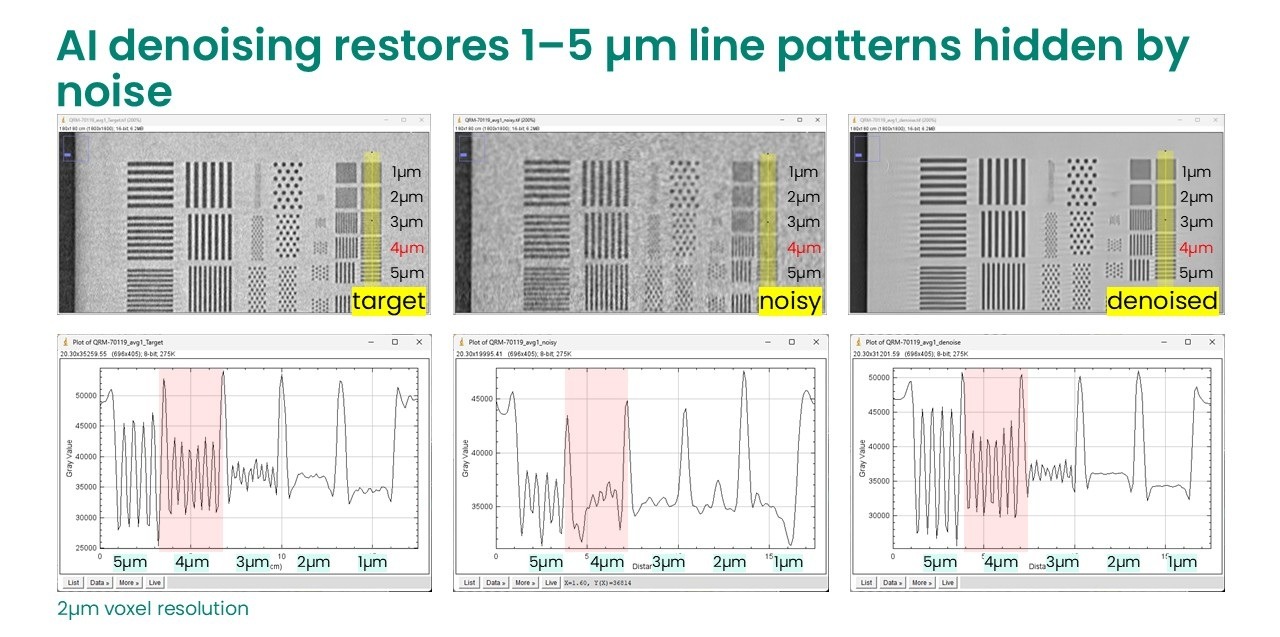
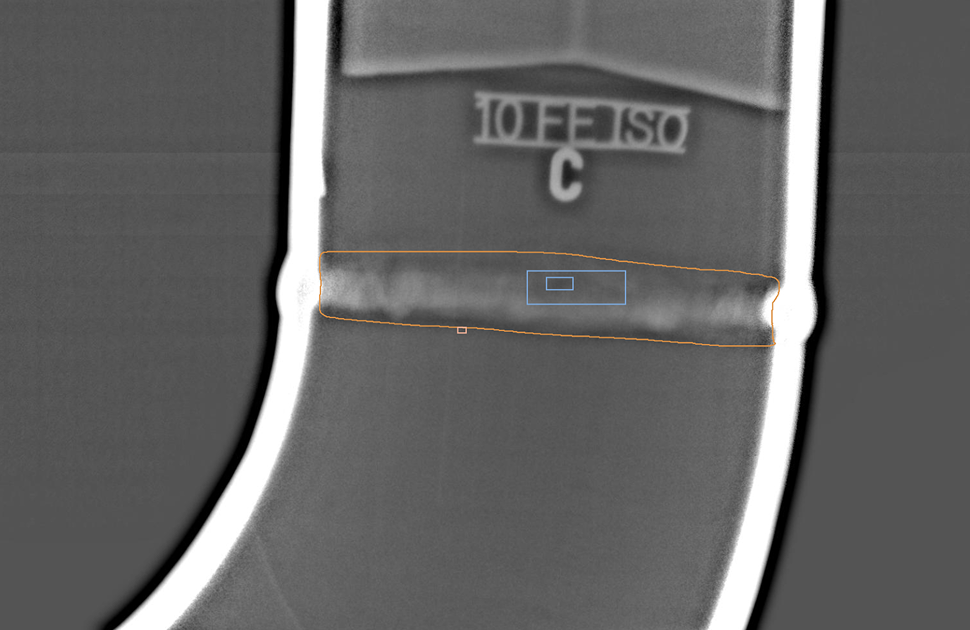
AI-powered CT denoising helps reduce image noise while preserving the inspection-critical details needed for reliable defect detection.
At this point, it is important to define the concern more precisely. The issue is not that AI is absent – there are a lot of solid AI projects in our field. The bigger issue is overpromising and oversimplifying, presenting AI as if it solves every inspection challenge immediately, without complication.
A good example where this happens is Automated Defect Recognition, or ADR. For several years, ADR has been the most attractive selling point in the industry. The idea is easy to explain to a customer: instead of an operator deciding whether a part is good or bad, an algorithm makes that decision automatically. It is a relatable story. It is also a promise that is genuinely difficult to deliver on. Today, ADR algorithms can be developed for almost every inspection task. But in practice, they are highly application- and workflow-specific, which makes them difficult to transfer from one use case to another. If they are set up properly, they can be extremely valuable. But setting them up and maintaining them requires significant effort and investment, so the cost-/benefit equation is not always attractive for every application.
Automatically detecting defects in various application areas is difficult because each application is unique. A solution designed to detect particles in a battery cannot simply be applied to a crack in a turbine blade or a void in a printed circuit board. Each case requires its own training data, its own validation measures, and its own understanding of the customer’s specific conditions. Usually, it is unrealistic to present a single AI solution as the answer to every inspection challenge. If something sounds too good to be true, it probably is.
AI Is Just a (Very Powerful) Tool
It is useful to regularly step back and clarify what AI actually is. AI is a tool, a piece of technology - on its own it does not solve anything. But when deployed responsibly, AI can enhance inspection workflows by reducing the burden on inspectors, enabling faster scans, greater throughput, and more efficient use of human expertise. The real question is always what problem you are trying to solve, and how much you are prepared to invest in solving it.
Building a working AI solution takes a lot of training data, careful engineering, and ongoing validation, and none of that comes cheap. This means a solution provider has to choose carefully where to put its resources. Usually, an investment is justified when the resulting technology has a wide application horizon. With enough investment, you can technically build a solution for almost any specific defect on almost any specific part. Whether that investment pays off is a different question, especially as customers increasingly want to keep their defect data in-house and are investing in their own data science teams to develop specific, customized AI models. That is one of the reasons a recent development by Waygate Technologies focused on something that works across applications: denoising in computed tomography or ‘CT denoising’.
A Practical Example: AI-Powered CT Denoising
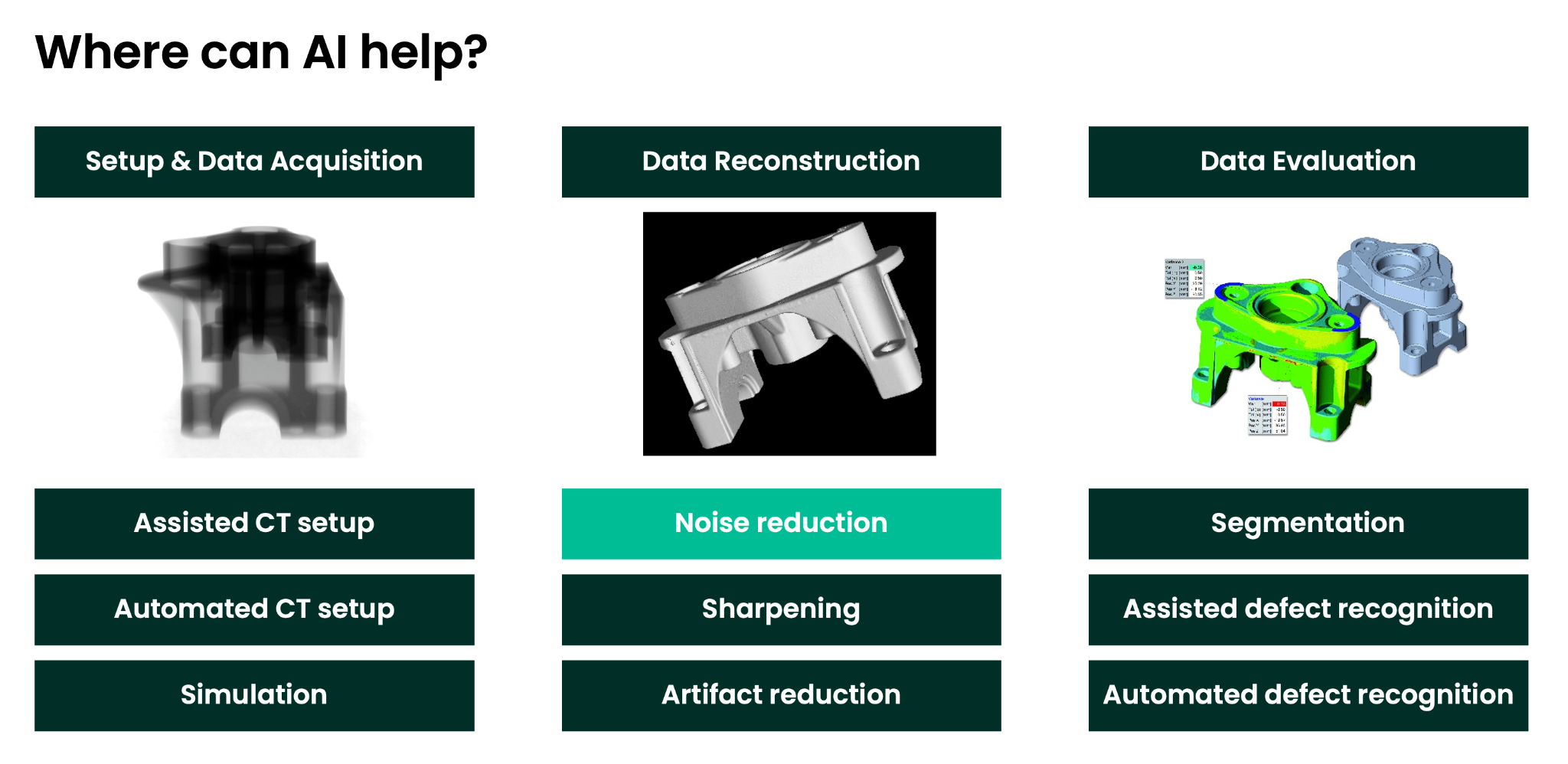
The future of AI in NDT is about giving inspectors better tools to work with.
CT inspection is expensive, and system utilization and throughput are a major cost driver. The faster a part can be scanned, the lower the cost per scan, and in some cases a faster scan can even save a customer from having to buy a second CT scanner. The catch is that scanning faster usually comes at the cost of decreased image quality by introducing additional noise, which can obscure the very defect the inspection is meant to detect.
As a long-standing solution provider with deep application expertise and access to large volumes of real-world CT data, Waygate Technologies developed a denoising model that learns how the noise behaves and reduces it while keeping the relevant information intact. This is different from traditional filtering or image smoothing, which tends to blur the whole image. The goal was to remove the noise without touching the information a CT scan actually contains, so a fast, noisy scan becomes just as usable for inspection as a slow, high quality one.
Validation Before Commercialization
The value of AI depends on evidence, not promises. AI can be approached from many different angles, and there are several technical routes to solving a given inspection challenge. When we began developing this technology a few years ago, we deliberately explored different avenues, tested what was technically possible, and discarded approaches that did not prove reliable enough. Only through extensive validation did we identify the most robust path forward and ensure that the technology reduces noise without obscuring relevant inspection information.
Since then, the team has run extended feasibility studies and validated the results against quantitative image quality measures defined by societies like ASTM. These measures make it possible to compare a scan before and after denoising in objective terms. Numbers alone only tell part of the story, so the engineers complemented this with case study after case study, comparing a standard scan, a fast standard scan, and the denoised fast scan side by side, and having experienced inspectors judge whether the defect they were looking for was still visible.
Evidence from Multiple Industries
The developed denoising technology is CT specific, so it only works with CT data, but it is industry and part type independent. It got tested for a wide range of application spaces, such as electronics, aviation, material science, casting, additive manufacturing, and EV battery inspection, and in each of these areas the team saw a real benefit for the customer.
To give a sense of scale, in casting inspection, where the goal is often to detect safety critical porosities and foreign particles, the trials have shown scan time improvements of around a factor of three without having an impact on the detectability of these defects. Figures like this will vary depending on the application and on what exactly is being inspected for, but they give a realistic sense of what becomes possible once the noise is properly removed rather than simply smoothed over.
Why Responsible AI Will Win
The future of AI in NDT is not about replacing the expertise of inspectors, it is about giving them a better tool to work with. AI by itself is not a standalone solution, and success always starts with defining the right problem.
What can be seen is that more and more customers are looking for validated, trusted AI capabilities rather than the biggest promise. Progress in this field will come from close collaboration between developers, data scientists from both sides, and the inspection experts who understand the parts and the defects on a daily basis. Our industry should move away from asking "does it use AI?" and start asking "has it been proven to work for my inspection challenge?"
Partnering for Trusted AI in CT Inspection
Over the past six months, we have conducted a pilot phase for our CT denoising technology, working with a dozen customers from various industries, including several global leaders in fields such as electronics and battery manufacturing. Every month, we hold roundtable discussions in which I, our engineers, and our customers participate to evaluate performance and discuss the findings they have observed.
There is a wide variety of AI technologies, but the key is to understand what you can expect from them for your specific use case – and, above all, where the limitations lie. Because if you’re looking for a very specific defect or a very specific conclusion from your data and want to know whether this will work or not, we need to work together to determine where the limitations lie. We work together to identify the challenges and then find the best approach to minimize them. It really comes down to trust and collaboration, because there will never be a one-size-fits-all solution. We have to be closely connected to our customers to understand this technology and then realize its benefits.
That's why we took our time to really understand what we are bringing onto the market. You have to be able to really trust the technology, and the only way to get there is to thoroughly test and validate it.
Author:

Florian Knigge
Senior Product Manager – Radiography Systems
Waygate Technologies
There are no comments yet!