
TABLE OF CONTENTS
1. Episode Overview
2. Meet the Panelists
3. How They Found NDT — Stories From the Panel
4. Challenges Women Face in NDT
5. Addressing Stereotypes: The Elephant in the Room
6. What Can We Do to Drive Change?
7. Where Do We Need More Women in NDT?
8. Looking Ahead: NDT in 10 Years
9. Key Q&A Highlights
10. Key Takeaways
11. FAQ
1. Episode Overview
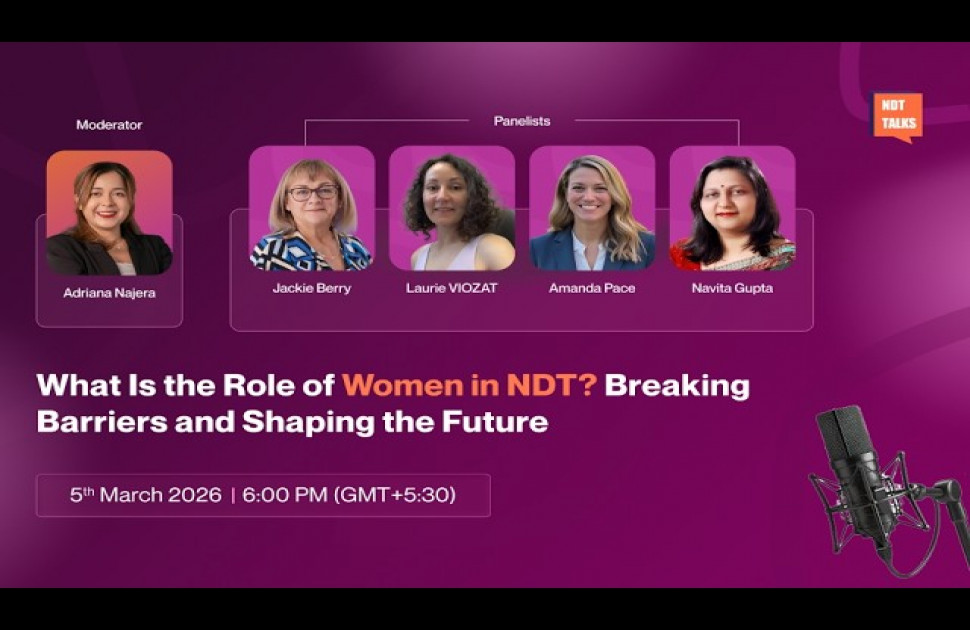
The timing of this March session of NDT Talks could not have been more fitting — just days away from International Women’s Day, and the topic being explored felt very relevant not just for the occasion but for where the NDT industry needs to go. What is the role of women in NDT? How are they breaking barriers and shaping the future of Non-Destructive Testing?
Traditionally, NDT has been seen as a male-dominated space. It is technical, field-heavy, and safety-critical. But the reality today is that women are showing up in technical roles, in commercial leadership, and in decision-making positions across the globe. That shift deserves a real conversation — not a feel-good celebration, but an honest discussion about real experiences, what has changed, what has not, and what still needs to.
<9% Women in the NDT workforce today | 20+ Years combined NDT experience on this panel | 4 Countries & regions represented |
|---|
2. Meet the Panelists
Moderator Adriana Nazera, Marketing Manager at Wiro — a company doing genuinely exciting work in aerial robotic-enabled inspections, rethinking how NDT gets done in places that are hard to reach or dangerous to access — brought together four outstanding women whose perspectives span the full spectrum of the NDT industry.
JB Jackie Berry Global Distributor RelationshipsGuided Ultrasonics Limited | LB Lori Bazaar Film Radiography Sales, Europe & CISVGE Technologies (Baker Hughes) | AP Amanda Peace NDT Business DevelopmentNorthstar Imagine | NG Navita Gupta DirectorSatya School of NDT |
|---|
3. How They Found NDT — Stories From the Panel
One of the most striking themes that emerged immediately was how each panelist came to NDT — not through deliberate planning, but through what they affectionately called a “lucky accident.” This is itself revealing: NDT is not yet a field that young people, particularly young women, actively seek out. But once they arrive, they almost universally stay — by choice.
Amanda Peace — From Furlough to Passion
AP | Amanda Peace | NDT Business Development, Northstar Imagine “It actually happened by accident. I was furloughed from a large casting company where I did in-process inspections. What started as an unexpected opportunity to get me through COVID actually turned into a defining career path. I was trained in RT and PT, and I just took to it like a duck to water. I had a natural ability to do it. And that’s the first time in my entire life that I really latched onto something and excelled. With that confidence came a level of knowing exactly where I’m at and what I’m doing with my life.” |
|---|
Lori Bazaar — Passion Recognised at the Door
LB | Lori Bazaar | Film Radiography Sales, VGE Technologies “I’m French originally and after graduating I spent some years abroad developing my foreign language skills. When I came back to France I took a limited contract at GE — when WGE was still General Electric — as a sales assistant in the NDT world. When the contract ended I was looking for a sales manager position and they contacted me three months later: ‘You were very passionate — you are the only one who tried to understand something about ultrasound and X-ray.’ And here I am, 15 years later, still here.” |
|---|
Jackie Berry — Born to Sell, Stayed for the Industry
JB | Jackie Berry | Global Distributor Relationships, Guided Ultrasonics Limited “I’ve always been in a male-dominated industry — I came out of school and went into electronics, and at that point there were very few women there either. I was born to sell. I talk for England and I get on with people. One of my clients manufactured time-of-flight diffraction and phased array equipment. The boss’s wife had swimming lessons with my daughter, we started chatting — and the rest was history. That was back in 2003, so I’ve been in the industry for 23 years. Love every minute of it.” |
|---|
Navita Gupta — From Engineering Professor to NDT Director
NG | Navita Gupta | Director, Satya School of NDT “NDT was purely an accident. My background is in electronics engineering — I was a professor in an engineering college, happy teaching students, had a cool life. But then kids happened and I was finding it difficult to balance a full-time job. My husband was in the field of NDT. He said, ‘Come, I’ll let you play with ultrasonics.’ So I just played. I liked it. All my spare time I was playing with ultrasonics, magnetic particle. It was happening so gradually and organically that I quit my job and now I’m full-time into this — it’s almost 25 years.” |
|---|
★ A pattern worth noting: Every panelist entered NDT by chance — not because the industry was actively marketed to them. This points to one of the sector’s most significant untapped opportunities: proactive outreach and visible career pathways for women. |
|---|
4. Challenges Women Face in NDT
The conversation turned honest and direct when the panel discussed the specific barriers women have encountered — and in many cases, still encounter — in the NDT industry.
Lack of Visibility and Role Models
Jackie highlighted that the biggest barrier has historically been a simple lack of awareness. NDT was not something that people, particularly women, actively learned about even twenty years ago. Jobs were word-of-mouth, and in a male-dominated industry it was males who recruited males. Without role models to look up to or mentors who had built long careers, the profession was far less visible as a viable path for women.
Being Taken Seriously
AP | Amanda Peace | NDT Business Development, Northstar Imagine “Statistically, women still only make up less than 9% of the workforce — believe that or not. That’s insane. Early on, some of those barriers were visibility, representation, and sometimes just being taken seriously. I am challenged with being underestimated. And I think that is what drives me every day. If you underestimate me, I’m going to silently work my way to the top and then look back.” |
|---|
Physical Demands and Outdated Perceptions
Jackie pointed out that historically the job was perceived as purely physical work — shift work, offshore inspections, travel to refineries and pipelines. The infrastructure simply was not built for women: PPE was not available in female sizes, accommodation and toilet facilities in remote locations were inadequate. These were real, daily obstacles that have only recently begun to be addressed.
Proving Technical Credibility
NG | Navita Gupta | Director, Satya School of NDT “When I started going out into the industry, they always thought that if you are a lady, you are only into the admin part — you cannot be a trainer, you cannot be a technical person. They were looking behind me, expecting a male trainer. They bombarded me with technical queries — some basic, some challenging — just to test me. They thought it was heavy for me to pick up the V1 block. But one day into it, they were all eating out of my hands.” |
|---|
Work-Life Balance and Parenthood
Lori raised something rarely discussed openly: the reality of combining a demanding technical career with parenthood. The charge on women’s shoulders remains heavy, and when progressing in one’s career, the timing of starting a family can become — consciously or not — a factor in decision-makers’ minds, regardless of gender.
5. Addressing Stereotypes: The Elephant in the Room
Moderator Adriana invited the panel to speak about something most events shy away from: the stereotypes that still exist in NDT, and the specific ways they play out in day-to-day professional life.
“Decisions Don’t Always Happen in the Boardroom”
NG | Navita Gupta | Director, Satya School of NDT “One thing that hasn’t changed is that the majority of decisions do not happen in the boardroom. They happen over drinks the previous night, or at parties — which, as women, many of us don’t enjoy because once the work is over, I would prefer going back home. There are glass ceilings which you have to find your own ways around. You may reach the top, but there will be one step of the pyramid which is not decided in the boardroom in a fair way.” |
|---|
Jackie confirmed this, noting that when she stopped drinking for health reasons, clients and colleagues genuinely treated her differently when she asked for a Diet Coke instead of wine. These cultural norms, informal as they are, create invisible barriers that formal diversity policies cannot easily address.
The “Too Something” Trap
AP | Amanda Peace | NDT Business Development, Northstar Imagine “It’s the thought of being too something — too bossy, too friendly, too outgoing — that you have to be mindful of. As a woman, if you’re too friendly, it looks like you’re trying to use your feminine wiles to move up. I am a very outgoing person, so I have to get a read on the room and taper that down sometimes. I talk to newer NDT techs about this — don’t minimize yourself. Don’t do that. Be who you are. It’s sad that we have to tell women that.” |
|---|
Physical Strength Myths
The perception of NDT as a job requiring brute physical strength is still present, though increasingly outdated. Equipment has become far more portable and the work is increasingly about technical skill, interpretation, and precision — areas where women are demonstrating high competence, backed by certifications, conference contributions, and research publications.
6. What Can We Do to Drive Change?
Be Visible — At Every Level
Amanda, who serves as Chairwoman for Women in NDT at ASNT, emphasised the importance of changing the narrative from a closed-door conversation to an open, inclusive dialogue. Men who are unaware of the daily experiences of their female colleagues are far more likely to understand and act when those experiences are shared openly. “If we just talk about it behind closed doors, men are not going to be aware of the things we still run into.”
Conference Papers, Standards Committees, Publications
Jackie emphasised becoming visible through active participation — on standards committees, at conferences, in professional organisations such as BINDT and ASNT. Women contributing to papers and publications signals unambiguously that they are part of the industry, not an addition to it.
Mentorship — The Most Powerful Tool
AP | Amanda Peace | NDT Business Development, Northstar Imagine “Mentoring is so big. I will stand on any soap box and explain that that is how we drive people into NDT, especially women. There are women who would be fantastic in this. So just getting them in and helping them succeed. Representation still matters, but influence matters more. And we are steadily building both.” |
|---|
Competence Commands Respect
NG | Navita Gupta | Director, Satya School of NDT “In principle, men are not against women working in their fields, but they think NDT is a difficult field and they don’t want to work with someone who becomes a liability. Respect cannot be demanded — you have to command it with your actions. If you work well, if you are competent, nobody is going to question you. Whether you are a man or a woman, your gender doesn’t matter if you are competent and you can prove yourself.” |
|---|
7. Where Do We Need More Women in NDT?
Leadership, Management, and the C-Suite
Amanda referenced The Broken Rung, a book examining the data behind why — despite women making up a significant portion of college graduates — they account for only around 10% of C-suite executives. Improving work-life balance for women in NDT would be the most effective multiplier for increasing female representation at senior levels.
Customer-Facing and Commercial Roles
Jackie noted that as the industry evolves, there are more choices available in customer-facing roles — the people who bridge the technical side with the commercial side. Communication strengths and relational intelligence, qualities women frequently bring, are enormously valuable in these spaces.
Data Interpretation, AI, and Advanced Technology
NG | Navita Gupta | Director, Satya School of NDT “NDT is not only about physical work anymore. We have so much interpretation to do — wire rope inspection, phased array, AI interpretation. It’s all about brains. We have AI and so much interpretation from AI — all of that is being done by women. I think there’s enough space for everybody.” |
|---|
Training, Education, and Certification
Navita’s own role as Director of the Satya School of NDT highlights one of the most strategically important areas: shaping the next generation before they begin. The people who train, certify, and mentor incoming professionals have an outsized impact on industry culture over time. More women in these roles means more visible role models at the earliest career stage.
8. Looking Ahead: NDT in 10 Years
LB | Lori Bazaar | Film Radiography Sales, VGE Technologies “As a little girl, I didn’t have any prospect of doing a technical job. The dream of little girls in my region was princesses, maybe veterinary — nothing with science or technical things. This is different now. I have two daughters, and the books available to them make them dream of anything. Two weeks ago I was with a main power contractor in France and the Level 3 was a very young girl — extremely passionate, extremely competent and technical. I see more and more of these people.” |
|---|
NG | Navita Gupta | Director, Satya School of NDT “NDT is in for a big change — not because women have brought that change, but because of the new generation. Gen Z and Gen Alpha are so particular about work-life balance. They are not afraid. I see girls so focused on their careers that they are Level 3s working in oil rigs, in refineries, with no qualms about whether it is a tough job. This generation will just not talk about man or woman.” |
|---|
JB | Jackie Berry | Global Distributor Relationships, Guided Ultrasonics Limited “I talk to my daughter and she laughs at me. She says, ‘Why are you working at 7? How come you’re working on a Sunday? I wouldn’t do that.’ That’s a different world. And I think we can only build on that. With AI and all the technical aspects, working remotely is now way more productive. We’ve allowed this generation to come in without feeling what we felt — and we should pat ourselves on the back for that.” |
|---|
Adriana’s reflection from the moderator’s chair: “We are this generation that has what we have because of you. Because women in the past made the way in — building, starting, talking. Now Gen Z and Gen Alpha can finally be fearless and say, this is what we want and this is what we should have. It’s teamwork at the end.” |
|---|
9. Key Q&A Highlights
Q How did you each end up in NDT? |
|---|
Every panelist described entering NDT by accident rather than design — through furlough, a temporary contract, a networking connection, or a spouse’s invitation to play with equipment. All of them stayed not because they had to, but because they found genuine passion in the work. |
Q What is the single biggest barrier for women in NDT today? |
|---|
While the industry has evolved significantly, the panelists pointed to a combination of factors: lack of early visibility of NDT as a career option; still-prevalent underestimation of women’s technical capabilities; and informal decision-making cultures — drinks, golf, late-night networking — where women are structurally disadvantaged. |
Q How do you earn credibility when you’ve been underestimated? |
|---|
The consistent answer was: competence. Navita described facing a full day of deliberate technical interrogation on her very first training assignment — and winning her audience over by demonstrating genuine expertise, practically and theoretically, by the end of day one. |
Q Is it possible to have an NDT career and a family? |
|---|
Yes — but the panelists were candid that it requires intentional support structures. Lori noted that this combination still weighs more heavily on women’s shoulders than men’s. Amanda referenced data from The Broken Rung suggesting that better work-life balance is the single most powerful lever for increasing female C-suite representation. |
Q What is the most important thing companies can do right now? |
|---|
Visibility, mentorship, and open dialogue. Ensure women are presenting at conferences. Build structured mentoring programmes. Have honest conversations — including with male colleagues — about the day-to-day experiences of women in the field. As Amanda put it: give NDT people data, because NDT people love data, and use it to drive the change. |
10. Key Takeaways
- Women currently make up less than 9% of the NDT workforce — a figure that underscores both the challenge and the opportunity.
- Most women in NDT arrived by accident, not by design. The industry needs to become a proactive, visible career destination.
- Credibility is earned through demonstrated competence — gender is never a substitute for expertise, and expertise is never diminished by gender.
- Informal networking cultures still create structural disadvantages for women, and honest acknowledgement of this is the first step to changing it.
- Mentorship is the most powerful tool currently available for bringing more women into NDT and supporting their growth to senior levels.
- Work-life balance is not a women’s issue — it is an industry issue, and improving it is the most effective way to retain female talent.
- Gen Z and Gen Alpha are entering the workforce without the career-gender conditioning of previous generations — and this is a genuinely positive force for change.
- The conversation has shifted from “can women succeed in NDT?” to “how are women shaping the future of NDT?” — the panelists are living proof.
11. Frequently Asked Questions
What percentage of the NDT workforce are women?
According to Amanda Peace in this session, women currently make up less than 9% of the NDT workforce. This figure — while representing growth from previous decades — highlights the significant opportunity that remains for greater gender inclusion across the industry.
Is NDT a good career for women?
Absolutely. All four panelists — each with between 15 and 25 years of NDT experience — describe it as a deeply rewarding career that offers variety, technical challenge, global travel, and increasingly flexible working arrangements. The industry is evolving rapidly, with data interpretation, AI, and remote inspection all opening new pathways that are not dependent on physical strength.
What are the main challenges for women in Non-Destructive Testing?
Key challenges include: lack of early visibility of NDT as a career option; the need to earn technical credibility in environments that may initially underestimate female expertise; informal decision-making cultures that create structural disadvantages; work-life balance pressures that fall disproportionately on women, particularly around parenthood; and limited female representation at senior and leadership levels.
What is ASNT Women in NDT?
ASNT (American Society for Nondestructive Testing) has a Women in NDT initiative that Amanda Peace chairs and Jackie Berry participates in. It supports, represents, and advocates for women across the NDT profession — running forums, producing data on gender representation, and building mentorship pathways.
There are no comments yet!