Published on 11-Aug-2026
Ultrasonic Testing Across Borders: How Standards, Expectations and Certifications Vary Around the World
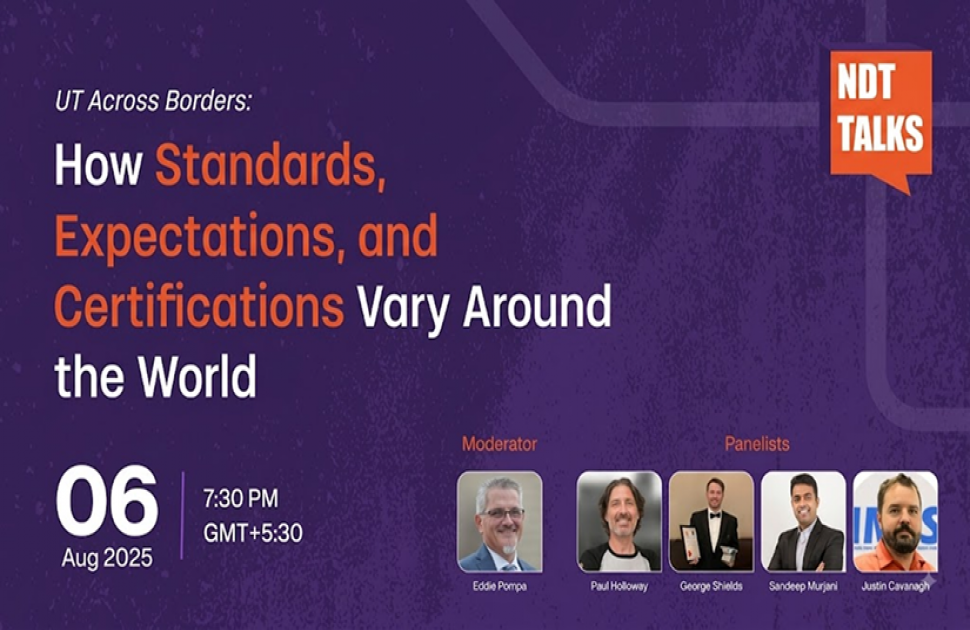
Table of Contents
- Session Overview
- Meet the Panel
- Unexpected Challenges When Working Across Borders
- Where Ultrasonic Testing Standards Genuinely Diverge
- Amplitude-Based vs Fracture Mechanics Acceptance Criteria
- The AWS D1.1 Debate and How Canada Diverged
- Advanced UT Methods: Is Anyone Standardising Them?
- Why Code Committees Move So Slowly
- Certification Schemes: Sector Limits and Scope
- Employer-Based Certification and What It Actually Means
- Competence, the Code of Conduct and Keeping Skills Current
- The One Thing the Panel Would Change: File Format Interoperability
- Lightning Round
- Key Takeaways
- Frequently Asked Questions
1. Session Overview
This edition of NDT Talks took on a question that affects almost everyone working in inspection internationally: how do ultrasonic testing practices actually shift from country to country? Not in theory, but in the field, at the joint, with a client standing over your shoulder.
The panel spanned Australia, Canada, India and the Middle East, and the United Kingdom, covering conventional and advanced ultrasonic testing across refineries, offshore wind, structural welding and aerospace-adjacent work. The conversation ranged across acceptance criteria, calibration philosophy, certification scheme differences, employer-based qualification, and the practical realities of turning up in a country whose codes and expectations do not match the ones you trained on.
Whether you are a technician, a QA lead, or someone trying to understand why a perfectly good inspection was rejected in one jurisdiction and accepted in another, the discussion covered ground that rarely gets aired this openly.
Watch now : NDT Talks Episode 3 — A Global Panel on UT Practice, Codes and Competence
2. Meet the Panel
3. Unexpected Challenges When Working Across Borders
The panel opened with a deceptively simple question: what was the most surprising ultrasonic testing challenge you faced working in another country? The answers split neatly into two categories, technical shock and administrative shock.
Encountering an Unfamiliar Code
Mr. Justin Kavanagh — Managing Director, IMIS Group at Caval Industries
“In Australia we work quite heavily with ASME codes. We have Australian standards, and more recently we are using the ISOs because all of our Australian standards have been superseded. AWS D1.1 was an interesting standard to me, because I had never come across it in about 20 years. When I got to use it, it sort of messed with my head a bit. It is comparative, it uses comparative reflectors to judge whether an indication is in or out, and I had never come across that before. All of our standards size by height, length and defect type before something becomes rejectable. It was completely foreign to me at the time.”
The Certification Surprise
Mr. Sandeep Murjani — Regional Director, The Phased Array Company
“I know a gentleman, a well-known personality in India for refinery jobs. It was a very basic job, thickness measurement. He was Level II at that time. When he visited Dubai for the first time and started working, following all the criteria he was qualified for, the end customer's supervisor came and he was surprised to know the customer had demanded PCN certification. He was ASNT Level II at that time. Same application, same kind of customer, but the reporting formats, this customer in Abu Dhabi was expecting a lot more detail than he was used to. When you cross borders, even a few hundred kilometres, it is really difficult. You have to be very well aware.”
The Boxes You Have to Tick Before You Fly
Mr. Holloway made a point that resonated with the whole panel: in NDT, the call to travel often comes with almost no notice, and the paperwork rarely keeps pace with the urgency.
Mr. Paul Holloway — President, Holloway NDT; P.Eng and UT Level III
“I have actually said no to working in other countries more than I have worked in other countries. In NDT we get those phone calls all the time, go here now. You check the boxes and you go, I do not have this, I do not have that. They drive on the other side of the road. Even if I was able to go, they want me to rent a work van and I am supposed to have fall arrest training, and from which jurisdiction do I need it? You do not want to get over there and find out you are here illegally.”
Practical advice from the panel: do your due diligence before accepting international work. Confirm visa requirements, work permits, duration limits, driving licence recognition, and which jurisdiction's safety training the client will accept. Mr. Holloway described nearly being caught out by a visitor visa requirement for Vietnam, resolved only by a last-minute paid fast-track service.
4. Where Ultrasonic Testing Standards Genuinely Diverge
Asked whether ultrasonic testing standards actually diverge in practice, or whether the differences are largely cosmetic, the panel's answer was nuanced. On calibration and general method, most standards converge. On acceptance criteria and documentation expectations, they can be very far apart indeed.
Mr. Justin Kavanagh — Managing Director, IMIS Group at Caval Industries
“I grew up on the Australian standards. This changeover to ISO is quite foreign to me, because it is far more complex, particularly around magnetic particle. But generally everything else I have worked to seems to gel up. Calibrations are similar. There are idiosyncrasies within them, but they are similar enough that you can understand why they have done what they have done. Some of the hole sizes have a slight change when you compare, but not so much that it would be a drama.”
Mr. George Shields — Co-founder, International Testing Services; PCN Level III
“A lot of my background is the ISO standards. When you look at ASME and AWS, even the way the standards are written, never mind the content, they are totally different documents to deal with. NDT people, it does not matter where you are from, we all speak the same language technically. We are quite a unique small breed. But the standards can be quite some distance apart, and quite rarely so, I suppose.”
The Same Job, Different Requirements
Mr. Sandeep Murjani — Regional Director, The Phased Array Company
“From an Indian perspective, depending on the industry or the customer requirement, we follow ASME codes, we follow DIN, and nowadays we follow ISO. One good example: I was with a customer and we started following what we used to do, ASME-based DGS calibration, and suddenly we came to know, no, we have to do TCG. It is how open you are at the site and how you align to the testing requirements.”
Standards Commonly Encountered in Cross-Border UT Work
5. Amplitude-Based vs Fracture Mechanics Acceptance Criteria
One of the most technically substantial exchanges of the session concerned the fundamental philosophical split in ultrasonic testing acceptance criteria: sizing by amplitude comparison versus sizing by actual flaw dimensions.
Mr. Paul Holloway — President, Holloway NDT; P.Eng and UT Level III
“In North America it is almost all of what we do. I am interested to see how the Australian standards get away from it, because using a non-amplitude base, like a fracture mechanics based approach, if you are trying to find the height of things that is the best way to do it, but it is so complicated.”
Mr. Justin Kavanagh — Managing Director, IMIS Group at Caval Industries
“A lot of the stuff I do is refineries, operating plant that has already been manufactured. One of the plants is 50 years old now. So a large amount of what we are doing is crack detection rather than looking at new welds. You are doing a lot of sizing, trying to understand what the defect is. When I understood the AWS standard was mainly around new welds, it was like, oh cool, for a technician it is just, it is this high, you can reject it, move on. So much less stress on the brain. I can imagine you can cover a lot of work that way.”
The Honest Assessment
Mr. Paul Holloway — President, Holloway NDT; P.Eng and UT Level III
“It is not the most accurate way to do things. All of us here probably understand the physics of NDT enough to know that if that reflector tilts a little bit, the amplitude goes way down. It is still the same size, it just does not reflect as much sound. However, we do not have an epidemic in industry of things falling down because we used the wrong amplitude. So it does not work very well, but it works well enough.”
This distinction matters enormously for anyone moving between jurisdictions. An inspector trained exclusively on amplitude-based workmanship criteria will find fracture-mechanics-based sizing conceptually and procedurally unfamiliar, and the reverse is equally true. Neither approach is wrong. They were designed to answer different questions: is this new weld acceptable, versus how much life does this ageing component have left.
6. The AWS D1.1 Debate and How Canada Diverged
Mr. Holloway, who sits on the Canadian code committee, gave a detailed account of why Canada moved away from the AWS approach and what replaced it.
Mr. Paul Holloway — President, Holloway NDT; P.Eng and UT Level III
“Canada has its own welding code, CSA W59. It followed AWS D1.1 very closely since we started it. Then in 2018 we diverged. We offered the ability to do a proper TCG rather than just comparative amplitude to the hole on the IIW block. When we were going through that exercise we did some research, and that AWS code, the way everything is written, sizing on the one hole in the IIW block and then having the different levels A, B, C, D, that goes back to 1969. That is almost 50 years. Look how much has changed in UT.”
Mr. Paul Holloway — President, Holloway NDT; P.Eng and UT Level III
“In 1969 there was not a whole lot of field operators doing NDT with oscilloscopes. Fifty years later we have phased array, TFM, plane wave, PCI, all sorts of things, and we still have the meat and potatoes of that document. If you had not seen it before and you uncovered it in the jungle and opened it up, you would go, what is going on here?”
What the Canadian Alternative Looks Like
- A conventional TCG is used, built on a block containing side-drilled holes, with all indications called relative to that curve.
- The D equals A minus B minus C equation of the legacy approach is eliminated entirely.
- The table restricting beam angle by material thickness is removed. The technician selects whatever angle is appropriate for the joint.
- A single hole size is retained, consistent with the structural welding tradition, but the acceptance level varies with weld thickness. Thin welds permit only small indications; thicker welds permit larger ones.
- Both methods currently coexist. The legacy approach is formally called the fixed attenuation technique. The stated hope is that the 2028 revision can retire it after ten years of parallel operation.
7. Advanced UT Methods: Is Anyone Standardising Them?
With guided wave ultrasonic testing, EMAT, full matrix capture and total focusing method all seeing increasing field use, the panel was asked whether consistent standards are being applied globally, or whether adoption remains region-specific and approved case by case.
Mr. George Shields — Co-founder, International Testing Services; PCN Level III
“More and more of the tier one suppliers for offshore wind projects are wanting us to go fully phased array, with even things like MPI getting replaced with phased array in a single pass with a rover unit. It is really fast. The standards agencies all around the world would find it tough to keep up even if they were flexible and dynamic organisations, and they tend not to be. All the advanced methods are sort of case by case. There is a product, put some defects in it, let us test it, let us make sure we have got coverage or we get 80 to 90 per cent of those defects. I do not see any massive shift away from that until the methods and specifications mature.”
Technology Outpacing Codes
Mr. Paul Holloway — President, Holloway NDT; P.Eng and UT Level III
“My feeling with the new technology is that it is really fascinating and useful. However, it gets pushed first by the instrument manufacturers in order to sell a shiny box, and I do not mean that in an insulting way. It does sell a nice box and it is very effective. However, it takes the codes a long time. So what you end up with is a tool that can do inverse wave extrapolation, some sort of cool thing, but you have nowhere to apply it. Everything would be a non-code inspection until such time as the code catches up.”
The Human Variable
Mr. Murjani added a third dimension beyond region and application: the individual reviewer. Acceptance is not only region-specific and case-by-case, it can also come down to whether the person signing off is personally comfortable with the technique.
Mr. Sandeep Murjani — Regional Director, The Phased Array Company
“I have personally faced this. It was rejected by a Level III because he was not very well versed with TFM and FMC, but the job was very well done. So it is human specific and region specific and project specific.”
8. Why Code Committees Move So Slowly
Mr. Holloway offered the clearest explanation anyone on the panel gave for why standards lag technology so persistently, and it is worth quoting at length because it reframes a common industry frustration.
Mr. Paul Holloway — President, Holloway NDT; P.Eng and UT Level III
“Code committees tend to be run by 50 or 100 people. Imagine we are having a tug of war, but we do not have 50 people on this side and 50 on the other, because I want to go in a different direction than Justin and Sandeep and George and Eddie. So imagine a 50 or 100 pointed star, and each of us is pulling on a rope, and there is a flag in the middle balancing over a target, and each of us is pulling as hard as we possibly can in our own direction. The flag does not move. So no wonder it takes the AWS committee 50 years to change anything. Decision by committee takes a long time.”
Mr. Murjani noted that this same committee composition explains the geographic variation in acceptance. Committee members come from different regions with different industrial priorities, so even where a procedure is formally approved, its practical reception varies from one region to another.
9. Certification Schemes: Sector Limits and Scope
The most practically useful segment for anyone planning to work internationally concerned how differently certification scope is defined between schemes.
PCN: Highly Segmented
The UK PCN scheme divides ultrasonic testing certification by product and configuration. As the panel discussed, a technician may hold a scope covering butt welds in plate but not T, K or Y joints, with separate scopes required for other configurations. This granularity means a PCN certificate states precisely what the holder is qualified to inspect.
Canada: Broad Scope
Mr. Paul Holloway — President, Holloway NDT; P.Eng and UT Level III
“In Canada, if you have a UT Level II, knock your socks off, go do whatever you want to do. That is the way it has been here. But it is like getting your driver's licence and handing you the keys to either the Tercel or the Porsche. I am like, but I cannot drive the Porsche, it has got a six speed manual and 900 horsepower. And they are like, well, you are ticketed.”
Australia: The Conversion Problem
Mr. Justin Kavanagh — Managing Director, IMIS Group at Caval Industries
“We have UT2 for welds, and during our examination you will do a TPS or crucible, which gives you that ability to do nozzles and nodes. We get a lot of guys coming across from the UK and they will come in with a certification which says they can do a weld but only a butt joint. When their five years is up and their certificate is about to expire, when they want to convert it, it does not convert directly over. So these guys have to go back and do more training to get to where we are at. There is no limited certification here. You basically have to step up to what we would call a UT2 and be able to cover a crucible or a cruciform or a T-piece.”
ISO 9712 Sector Limitations
An audience contributor raised that ISO 9712 does provide for sector limitations, which the panel confirmed. In Canada, the sectors include aerospace and EMC, covering engineering, materials and composites, with most practitioners outside aerospace holding EMC. Mr. Holloway noted that ISO 9712 also permits limited certification, for example in thickness testing only, though neither Canada nor Australia issues certificates on that basis in practice.
10. Employer-Based Certification and What It Actually Means
The panel identified a widespread and consequential misunderstanding about employer-based certification schemes such as those written to ASNT SNT-TC-1A.
Mr. Paul Holloway — President, Holloway NDT; P.Eng and UT Level III
“The purpose or function of that is misunderstood at the inspector level in industry. Somebody will say, oh I am a UT Level II. What they mean is that they have been certified to their employer's written practice once, and the quality can vary because the employer has to make stuff and push it out the door. That person's certification only counts when they are within the boundaries of that office or shop. As soon as they leave, that is worth nothing. You are a UT2 for XYZ Company, but as soon as you leave XYZ Company you are no longer a UT2. You have to jump through the hoops again.”
Where Employer-Based Certification Works Well
Mr. Kavanagh offered a counterpoint from experience, arguing that employer-based certification has genuine value when it is used as designed: to qualify personnel very precisely for a specific, well-characterised application.
Mr. Justin Kavanagh — Managing Director, IMIS Group at Caval Industries
“We had an example where we were doing particular railway type components, and we designed the test and we actually designed the training for the specific test for the guys to use, only within the boundaries of what we had given them. If you gave someone else the job and had not given the specific training, they would not be as good as the guys we had doing it. There is definitely a good reason to have it when you use it correctly.”
Client-Specific Requirements in the Middle East
Mr. Sandeep Murjani — Regional Director, The Phased Array Company
“In oil and gas companies in Dubai and Saudi Arabia, in addition to being UT Level II, they have their own procedures and their own qualification criteria. For boilers, or for oil and gas, they have their own certification to work in the plant. Companies like ADNOC and Saudi Aramco have very stringent procedures and their own training and certifications in addition to your levels.”
11. Competence, the Code of Conduct and Keeping Skills Current
The discussion turned to a subject the panel clearly felt strongly about: the gap between holding a certification and being genuinely current in the method.
Mr. Paul Holloway — President, Holloway NDT; P.Eng and UT Level III
“When you get your NDT certification, everybody has to sign a code of conduct from their certification body. Basically it says you can only do things that you are trained to do and competent to do. I do not think enough people remember they have signed this, because they will get into situations where, oh, you have a current ticket, great, go ahead and do remote field testing on that bundle. That is just not something I am going to do.”
Mr. George Shields — Co-founder, International Testing Services; PCN Level III
“That is the real definition of competence, knowing where the limit of your competence is and knowing when to ask. I have certainly had clients who have had issues with phased array operators who do not have phased array tickets.”
Whose Career Is It?
Mr. Holloway made what he acknowledged was a deliberately blunt argument about where responsibility for currency sits, prompted by the common situation of a certified technician whose employer has not put an instrument in their hands for years.
Mr. Paul Holloway — President, Holloway NDT; P.Eng and UT Level III
“It is your career, not your employer's. If you are certified to be a UT Level II, you had better keep your skills up, because you are a fireman. The fire department needs you to be able to put out a fire whether or not you have put one out in six months. I am a professional engineer. If my boss dropped paperwork on my desk and said I need you from first principles to do beam deflection calculations for this crane boom, and I did not know how, I would be embarrassed. I would go home and crush the books all night. That is on me, because it is my career, not your career.”
Mr. George Shields — Co-founder, International Testing Services; PCN Level III
“You could dissect that further. Different techniques, on the UT side, plate and pipe, T, K, Y joints, partial penetration nozzles, or just corrosion mapping with manual UT. If you take someone who has done welds all the time and then say critically size that wall thickness, people are not as sharp. PCN seems very much test these welds and you will be fine. It is not based on specific codes and specific applications, which maybe would be a better direction for the industries, though it would mean techs would need specific certifications for each application, which would not be popular either.”
12. The One Thing the Panel Would Change: File Format Interoperability
Asked what single change they would make to how ultrasonic testing works across borders, the panel converged almost unanimously on an answer that has nothing to do with codes or certification.
Mr. Paul Holloway — President, Holloway NDT; P.Eng and UT Level III
“My number one is the file format. Just like DICOM in the medical industry, where Justin can shoot somebody's leg with one manufacturer's unit and Sandeep can shoot it with another, and we all share the same files because they have the same extension and everything loads fine. We need to do the same thing with UT. They do it with industrial radiography with the DICONDE format. That is why on the OmniScans they started saving files as NDE files rather than the older proprietary format, because that was open source, and the idea was to get everybody on board so that eventually you could open everybody else's data on your system.”
He described the practical cost of the current situation: his preferred daily instrument produces files most of the industry cannot open, so when he captures something worth sharing he has to rescan the same component with a second instrument purely so colleagues can view it.
Mr. Sandeep Murjani — Regional Director, The Phased Array Company
“If I am a flag bearer for equipment manufacturers, I can say that the work is going on in the background. I hope to see that happen. It is a big pain. We should have a single format and it should be easy to access with any manufacturer.”
Mr. Kavanagh noted that at least one major manufacturer has made coding access available publicly, which he expects will make third-party conversion tools likely in the near term. Mr. Shields raised the practical caveat that some instruments handle scan orientation differently, so conversion may be less trivial than it first appears.
13. Lightning Round
A country or region where UT practice impressed you
Germany, unanimously nominated by Mr. Holloway on the strength of surface preparation and site organisation. The panel laughed in recognition, with Mr. Kavanagh noting that in his experience surface preparation typically means an angle grinder. The underlying point was serious: preparation quality directly determines coupling, scan consistency and ultimately data quality.
One outdated UT practice you would gladly see retired
Amplitude-only evaluation, and specifically the legacy AWS D1.1 methodology, drew immediate agreement from Mr. Holloway and Mr. Murjani. Mr. Murjani offered a more measured position, arguing that rather than retiring techniques outright, the industry should complement legacy methods with new technology, since a technique that is outdated for one application may remain entirely appropriate for another.
Your go-to advanced technique
Phased array ultrasonic testing was the answer from Mr. Murjani, Mr. Shields and Mr. Kavanagh. Mr. Holloway agreed but added plane wave imaging, arguing that the practical difference between it and conventional TFM is minimal while the speed gain is substantial.
One item you always carry on international jobs
- Mr. Holloway: a spare splitter, because people routinely forget one or bring the wrong pitch, at which point no law files will run.
- Mr. Shields: a twin 70 degree probe, useful for confirming or discounting indications.
- Mr. Murjani: a small V2 calibration block, since there is no guarantee a suitable block will be available on site.
- Mr. Kavanagh: also the V2 block, plus a steel ruler.
14. Key Takeaways
- Ultrasonic testing calibration and general method are broadly consistent internationally. Acceptance criteria and documentation expectations are where standards genuinely diverge.
- The fundamental split is between amplitude-based comparative criteria, dominant in North American structural work, and dimension-based fracture mechanics approaches used more widely for in-service and integrity assessment.
- Amplitude-based evaluation is technically imperfect, since reflector orientation strongly affects signal amplitude, but it has proven adequate in practice for workmanship acceptance of new welds.
- Canada diverged from AWS D1.1 in 2018 via CSA W59, introducing a TCG-based technique that removes the beam angle restriction table and the legacy sizing equation.
- Advanced methods including guided wave, EMAT, FMC and TFM remain largely outside code coverage and are approved case by case through demonstration on representative flawed samples.
- Code committees move slowly because consensus among 50 to 100 members pulling in different directions produces very little net movement.
- Certification scope differs dramatically between schemes. PCN is highly segmented by product and joint configuration; Canadian and Australian Level II certification is broad.
- Certifications do not always convert cleanly between jurisdictions. UK-certified inspectors moving to Australia commonly need additional training to meet the broader local scope.
- Employer-based certification under schemes such as SNT-TC-1A is valid only within the certifying employer's organisation and written practice.
- Every certification scheme includes a code of conduct restricting practitioners to work they are genuinely competent to perform. The panel felt this is widely signed and rarely remembered.
- Responsibility for maintaining currency sits with the individual, not the employer, even where the employer has not provided recent opportunity to practise.
- The single most requested change across the panel was an interoperable UT data file format, comparable to DICOM in medical imaging or DICONDE in industrial radiography.
15. Frequently Asked Questions
What is ultrasonic testing?
Ultrasonic testing is a non-destructive testing method that uses high-frequency sound waves introduced into a component to detect internal discontinuities, measure wall thickness, and characterise flaws. A transducer transmits sound into the material, and reflections from interfaces, discontinuities or the back wall are received and interpreted. It is used across welding inspection, in-service integrity assessment, corrosion mapping and material characterisation.
Do ultrasonic testing standards differ between countries?
Yes, though less in method than in acceptance criteria. Calibration approaches and basic technique are broadly comparable across ASME, ISO, AWS and national standards. The significant differences lie in how indications are evaluated and accepted, in reporting detail expected by clients, and in which calibration approach is mandated. Australia has largely moved to ISO adoption as national standards were superseded, while North America continues to rely heavily on AWS and ASME.
What is the difference between amplitude-based and fracture mechanics acceptance criteria?
Amplitude-based criteria compare the signal height from an indication against a reference reflector, and reject the indication if it exceeds a threshold. It is fast and straightforward but does not measure the actual flaw dimensions, and signal amplitude is affected by reflector orientation. Fracture mechanics based criteria size the flaw by height and length and assess it against engineering critical assessment criteria. It is more accurate and more complex, and is generally preferred for in-service assessment of ageing plant.
Is an ASNT Level II certification recognised internationally?
Not universally. Certification recognition depends on the scheme, the client and the jurisdiction. The panel described a case where an ASNT Level II technician working in the UAE found the end client specifically required PCN certification. Employer-based certification under SNT-TC-1A carries no validity outside the certifying employer. ISO 9712 based certification is the most widely portable, though sector limitations still apply.
What is ISO 9712?
ISO 9712 is the international standard for qualification and certification of NDT personnel. It defines levels, examination requirements, and sector limitations such as aerospace or general engineering, materials and composites. Many national schemes are derived from or aligned to it, including the Canadian CAN/CGSB 48.9712.
Are there standards for phased array, TFM and FMC ultrasonic testing?
Coverage is limited and uneven. The panel's consistent view was that advanced ultrasonic testing methods are largely applied outside formal code coverage, with procedures qualified case by case through demonstration on representative samples containing known flaws. Acceptance frequently depends on the reviewing Level III's familiarity with the technique, which introduces variation between projects and regions.
Does UT certification transfer between countries?
Not automatically, and not always cleanly. Scope definitions differ substantially. A UK PCN certificate limited to butt welds in plate does not map directly onto an Australian UT Level II, which expects competence across cruciform and T-piece configurations. Practitioners moving jurisdictions should expect to demonstrate additional competence rather than assume direct conversion.
Where can I watch this NDT Talks session?
The full session is available on the OneStop NDT YouTube channel: https://www.youtube.com/watch?v=2sctdELF45U
Ads