Published on 05-Aug-2026
Remember Film? Is Digital and Computed Radiography Finally Making It Obsolete?
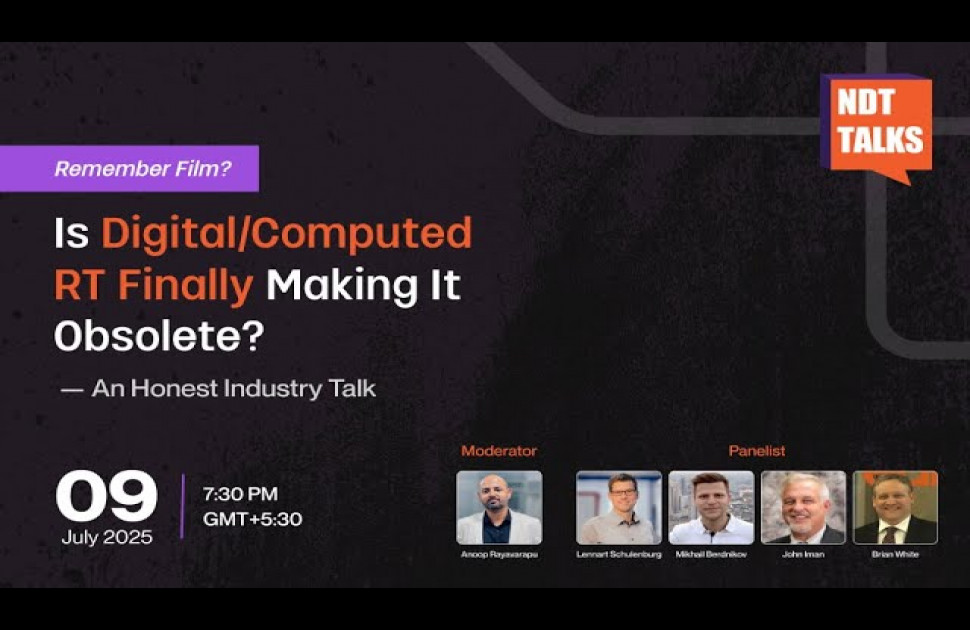
Table of Contents
- Session Overview
- Meet the Panel
- What Is Radiographic Testing? Setting the Baseline
- Is Digital or Computed Radiography Making Film Obsolete?
- Where Film Still Holds an Edge
- Film Digitisation: Does It Still Make Sense?
- Image Quality: Can Digital Radiographic Testing Match Film?
- The Cost Question: Is the Investment Worth It?
- Why Companies Resist the Switch
- Standards, Codes and Certification
- Workflow, Cloud and Remote Collaboration
- AI-Assisted Interpretation: The Next Frontier
- Detector Life and Durability
- Audience Q&A Highlights
- Key Takeaways
- Frequently Asked Questions
1. Session Overview
This second panel discussion of NDT Talks tackled a question that sits on a great many minds across the inspection industry: film versus digital. Has the time finally come to retire radiographic film, or does it still have a place in the modern toolkit?
The session brought together four global experts spanning radiography innovation, standards development and hands-on practice. The goal was an honest industry conversation about where radiographic testing is heading, what is working, what is not, and what it means for technicians, engineers and business leaders planning investments in imaging technology.
Moderator Mr. Anup Buru opened with an observation that framed the whole discussion. A senior colleague of his in Russia used to say that NDT is always the stepchild of the medical industry, in that advancements in technology, whether digital radiography or ultrasonic developments, arrive first in medical imaging and only later filter across to industrial NDT. That relationship, and whether it is finally inverting, ran through the entire conversation.
To learn more about the transition from film to digital RT, watch the complete expert debate here.
2. Meet the Panel
3. What Is Radiographic Testing? Setting the Baseline
For readers newer to the method, radiographic testing is a volumetric non-destructive testing technique in which penetrating radiation, either X-rays from a tube or gamma rays from an isotope source such as iridium-192, is passed through a component. Variations in material thickness or density change how much radiation reaches the imaging medium on the far side, producing an image in which internal discontinuities such as porosity, inclusions, lack of fusion and cracks become visible.
What has changed over the past two decades is not the underlying physics but the imaging medium. Radiographic testing now exists in three broad forms, and understanding the distinction between them is essential to following this debate.
The panel's discussion centred on where each of these belongs today, and how quickly the balance between them is shifting.
4. Is Digital or Computed Radiography Making Film Obsolete?
The moderator opened with the blunt version of the question: are we switching completely from conventional film radiography to digital? Every panelist answered no, but for meaningfully different reasons.
Mr. Brian White — Imaging Scientist and ASTM Standards Committee Vice Chairman
“The answer to that is no, not completely. There are a lot of trade-offs between the technologies. Film is flexible, it is thin, it is easy to use, but it is not digital. You cannot do calculations on it, you cannot send your image around the world in a couple of seconds. So what we are seeing is people that are converting, or have converted, or are trying to convert, but it still tends to be a kind of mix-and-match situation.”
Mr. Mikhail Bernikov — Regional Director, DR Systems, Asia-Pacific
“I do not think that DR or CR completely took over the film. Digital radiography, if we talk about industrial application and especially onsite conditions, is going to cover up to 70 or 80 per cent, either sooner or later. But the film will definitely remain for some applications. First of all for companies who cannot afford going for digital, because if you are doing just odd jobs from time to time you cannot buy expensive equipment. If you have a couple of projects for the whole year it does not really make sense.”
The Economics Are Shifting Faster Than the Technology
Mr. Schulenburg offered what became one of the most quoted observations of the session: the pressure to convert is coming as much from film economics as from digital capability.
Mr. Lennart Schulenburg — CEO, VisiConsult
“I talk to manufacturers of X-ray film quite a bit, and it has been flatlining and even slightly growing. Despite DR and CR converting a big fraction of the film market, there will always be these pockets where film will remain, and with global GDP growth and industrial growth that seems to compensate. But what I see recently is an acceleration. Film is a fixed cost production process, and the less film you consume the higher the cost increase will be. There is also the big silver price increase in recent years that is definitely making film a lot more unattractive.”
Mr. John Iman — Commercial Leader, Varex Imaging NDT Solutions
“Economics does have a big piece to play here. As long as it can still be a business to serve the industrial market, I think the manufacturers will certainly keep it. But there might be a point of no return. I do not know what day or year that is. But with technology continuing to advance around the applications and the cost getting higher, I think we might see that inversion, hopefully in my lifetime.”
NDT Is No Longer Just Inheriting Medical Technology
Responding to the moderator's opening framing about NDT trailing medical imaging, Mr. Iman argued that this relationship has genuinely started to invert on the detector side.
Mr. John Iman — Commercial Leader, Varex Imaging NDT Solutions
“We have as an industry piggybacked off a lot of research, development and commercialisation on the medical side, and we got away with it without having to pay for a lot of the money medical put into it. But when you look at the amount of detectors on the market now compared to even ten years ago, all different types and sizes, a lot of those are for the industrial workplace, whereas in the past you had to force-fit a medical detector into our world. In a large area, we are finally standing on our own.”
5. Where Film Still Holds an Edge
Asked what made film the gold standard, and where it still genuinely wins today, Mr. White gave the clearest technical account of the session.
Mr. Brian White — Imaging Scientist and ASTM Standards Committee Vice Chairman
“Industrial radiography film was duplitised, which means the emulsion was coated on both sides of the film, and then we used lead intensifying screens. Especially in high energy applications like iridium gamma work out in the field, film works really well and has for a long time, and the image quality has always been there. From an image quality perspective it is really pretty close to what you can achieve with the digital systems. And because film is only used once, compared to computed radiography, you do not get into issues with artefacts on imaging plates.”
Specific Scenarios Where Film Still Wins
- High energy gamma work in the field, particularly with iridium-192 sources, where film performance and familiarity remain strong.
- Thick castings, for example wall thicknesses of 100 to 150 mm, where a small piece of film can be placed inside the component in a way that is not feasible with a digital detector.
- Very small or awkward geometries requiring the imaging medium to be cut to size and pushed into tight areas.
- Low-volume operators running only a handful of projects per year, where the capital cost of digital equipment cannot be justified.
- Applications where the governing code or client specification does not yet permit a digital replacement.
The Flexible Detector Changed the Calculation
A recurring theme was that the historical objection to digital, namely rigid flat panels that could not be wrapped around pipework, has now largely been addressed. The moderator described the practical consequence from his own field experience in Kuwait, where a shutdown at a large plant left no spare time and the team had to revert to conventional radiography for small-diameter work until flexible panels became commercially available. Mr. White noted that flexible digital detector arrays now include corrections that prevent the artefacts that historically limited them.
6. Film Digitisation: Does It Still Make Sense?
Asked where film digitisation sits in the landscape, Mr. Bernikov drew a sharp distinction between digitising an existing archive and using digitisation on new work.
Mr. Mikhail Bernikov — Regional Director, DR Systems, Asia-Pacific
“When you raise the question of film digitisation, you just add another process, another operation. When you work with film you need a longer exposure in the first place, then you need to develop the film, then dry the film, and then you take it to the scanner and digitise it. Meanwhile you can just place the detector, make a short exposure which is times faster, and get your image already in a digital format. Why would you spend so much time? You definitely can and should use digitisers to convert your existing archive of previously made films, because you do not want to keep them in your warehouse for decades. But using it for new projects and new construction obviously does not make sense.”
Mr. John Iman — Commercial Leader, Varex Imaging NDT Solutions
“Digital radiography by far and away. Different applications, the whole nine yards, plus you have true measurement capability and you have got the raw image on top of that. The biggest thing you really get out of digitisation is that you get to archive it in a digital form and you get to save some space in whoever's film room that is. Other than that, there are a lot more benefits from the other solutions on the table currently.”
Panel position: film digitisation is a legitimate archiving and space-recovery tool, and it is a genuine digital means. It is not a substitute for acquiring digitally in the first place on new work.
7. Image Quality: Can Digital Radiographic Testing Match Film?
On the question of whether digital methods have ever fallen short of film on challenging materials, Mr. Schulenburg made a deliberately strong claim, then qualified it carefully.
Mr. Lennart Schulenburg — CEO, VisiConsult
“In most cases, if you can deploy the right digital equipment, the results of a digital inspection workflow will exceed the results of film. Now reality hits, and there are restrictions. Certain things cannot be deployed, either in terms of tube technology where you have to use isotopes, or geometries that are not ideal, or you have to deploy detectors in a way that is not ideal in terms of geometric magnification and resolution. So I would make the case that you could absolutely achieve the same or better image quality with digital as with film, if the geometry permits.”
The Objective Function Question
The most transferable idea from this segment was Mr. Schulenburg's point that different parts of the industry are optimising for entirely different goals, and that much of the film versus digital disagreement comes from people talking past one another.
Mr. Lennart Schulenburg — CEO, VisiConsult
“If our objective function is to increase image quality, that is a completely different objective function from meeting the minimum required image quality and optimising for cost. Somebody inspecting a rocket would optimise for catching even smaller defects. Somebody on a shutdown project would optimise for getting the job done two days sooner. Somebody in a manufacturing environment would optimise for higher throughput. It is really important, because we can all say the same things but understand different things, and then the rocket person does not understand the shutdown person, and the shutdown person does not understand the manufacturing person, because they have different objective functions.”
Before deciding whether a transition is worthwhile, the panel recommended working through the specific case: inspection volume, shots per day, consumable consumption, fixed capital investment, and the actual quality requirement that must be met rather than the highest quality theoretically achievable.
8. The Cost Question: Is the Investment Worth It?
Switching to digital radiographic testing involves significant upfront investment in equipment, training and procedure development. The moderator put the question directly on behalf of small and medium operators.
Mr. Brian White — Imaging Scientist and ASTM Standards Committee Vice Chairman
“What I have found over the years is that once people make the decision to make that investment, through training, through the knowledge and experience gained by their staff, through changing the procedures, the advantages outweigh the trade-offs. In the film environment it simply takes longer to get the results, you have to deal with processing chemicals, you have to have a lot of water usage. In the digital environment you can see an image quality advantage with the image processing filters, you have the ability to zoom, and you can use a lot of tools in the software. I did that conversion well over a decade ago, and I would not want to go back. That does not mean I do not shoot film, because I still do for some things.”
Payback in Months, Not Years
Mr. Mikhail Bernikov — Regional Director, DR Systems, Asia-Pacific
“It strongly depends on the price of different systems, but as per our experience, if you work with the equipment every day, at least one full shift, you get your payback very fast. We are not talking years, we are talking months.”
The Billing Model Problem
Mr. Iman raised a commercial dynamic that is rarely discussed openly but which quietly slows adoption across the inspection services sector.
Mr. John Iman — Commercial Leader, Varex Imaging NDT Solutions
“Inspection service providers are notorious for being very fluent and expert in time and material. There is another model here where you get paid per part, per hour, per whatever, and that can drive efficiencies and productivity. Oftentimes with time and material, guess what, I am fine with film if it takes me four more hours, because I have got billable hours. Is that helping anybody? It is helping a few people. Inspection service providers do have the opportunity to change the game and make money differently.”
The moderator added the operational version of the same test from the service provider side: if a Level II technician can shoot 20 joints in an eight-hour shift on film, the transition only makes commercial sense if the same or more can be achieved digitally. The panel agreed this is exactly the right question, and Mr. Schulenburg was explicit that without a positive business case he would advise against investing, even as a supplier of digital equipment.
9. Why Companies Resist the Switch
Mr. Mikhail Bernikov — Regional Director, DR Systems, Asia-Pacific
“Most inspection companies would not like to spend money if it is not required by the market, if it is not required by the end users and project owners. Why should they invest several thousands of dollars to buy a DR or computed radiography system? Of course they would like to stick with film, even considering that in the long run they will spend much more on consumables, on chemicals. In the long run they will lose money, but initially they just do not want to spend their own money on investment.”
He noted a geographic pattern in how adoption starts. In some countries the push comes from inspection companies wanting first-mover advantage over competitors. In others it starts entirely from the project owner end, which is why his own focus has shifted toward demonstrating the benefits directly to asset owners and end clients, who can then drive the requirement down through the supply chain.
It Is Not Primarily a Technical Problem
Mr. Lennart Schulenburg — CEO, VisiConsult
“On the technical side there are plenty of options. You can make your tests, shoot your film, shoot your DR or CR image, compare the quality, see whether the form factor fits. It is not a very complex problem, it just needs to be done. What is more complex is the stakeholders. There is the customer, the management, the Level III, and it starts with certification. Maybe the Level III is film certified but not digital certified, so you need to invest in workforce education before procuring any equipment. Then somebody needs to go to the asset owner and ask for certification for DR, which is a hassle. Then we are talking capex for digital equipment versus opex for film. The organisation is used to billing film to the end customer but not to booking capex.”
Mr. Lennart Schulenburg — CEO, VisiConsult
“In nearly every case it is a cheaper and better process. But the system has so much inertia that many people still do not do it despite it being the better technical and commercial option. My recommendation to everybody is do not be driven by that change, because suddenly everybody will look for it. Be ahead of the wave, and see what you can do step by step over time, because it is a journey.”
10. Standards, Codes and Certification
Standardisation came up repeatedly as both an enabler and a brake on adoption. Mr. Bernikov pointed out that the regulatory picture is far more mature than it was a decade ago.
Mr. Mikhail Bernikov — Regional Director, DR Systems, Asia-Pacific
“There are now a lot of standards which regulate the application of digital technologies, either DR or CR. You have a very detailed ISO standard, and with every customer, whether they are new to digital technology or not, we advise studying ISO 17636 very thoroughly, because it gives a lot of detail and it is a very useful document. We also have a new revision of ASME Section V. In general the application of digital radiography is far more standardised now than ten years ago, when nobody knew what digital radiography was.”
Key Standards Referenced by the Panel
Mr. White explained the structure of the ASTM framework: for both computed radiography and digital detector array radiography there are four key standards each, comprising a tutorial guide, a standard practice describing how to use the technology, a performance monitoring standard, and a manufacturing characterisation standard. Notably, there is no standard that specifically governs the transition itself. The film standards and the digital standards stand alone.
Codes Lag Technology by Roughly Three Years
Mr. John Iman — Commercial Leader, Varex Imaging NDT Solutions
“Everybody needs to be vigilant, despite all the technology, with regard to the laggards sometimes with codes and standards. It is very important that we understand as an industry and meet those codes, because at the end of the day that is what we are governed by. The cycles within codes are not quick. The technology outpaces code qualifications and writing, on average, by probably three years.”
A Structural Weakness Inherited From Film
Mr. Schulenburg identified a subtle problem in how digital standards were written. Because many film standards tell you whether you can see a defect rather than quantifying it, and because the digital standards were largely derived from the film standards, that lack of quantification has been carried across. He argued this is a real shortcoming on the standardisation side, and that the industry still has a long way to go in writing digital standards that are genuinely native rather than digital copies of film-era documents.
11. Workflow, Cloud and Remote Collaboration
Asked how digital methods improve workflow in remote or resource-limited environments, Mr. Iman argued that the technology had been capable for years but that behaviour only changed recently.
Mr. John Iman — Commercial Leader, Varex Imaging NDT Solutions
“If there is one thing that COVID actually helped us with, it was that finally, between video calls and remote collaboration, people actually started understanding the workflow, and they made it work because they had to. That workflow was capable since the early 2000s. As an industry, with as much technology as we have, sometimes we get right up to that line and we just do not want to cross it, because we are comfortable. When I first started, if I was at an asset owner and I mentioned the word cloud with key stakeholders, I was almost escorted out of the building. Now that is different.”
Cloud-Based Image Repositories
In response to an audience question about whether cloud-based DR repositories are coming, Mr. Schulenburg was emphatic that this is the next logical step. He described the practical use case of a skilled interpreter working from a truck during a shutdown while technicians in the field escalate images for a second opinion. He noted the obvious constraints: reliable connectivity is required, remote pipeline projects may not have it, though satellite services are changing that, and defence work may prohibit uploading images entirely. For a global inspection company, however, having a cloud image repository accessible from all sites at all times is a substantial operational advantage.
12. AI-Assisted Interpretation: The Next Frontier
The panel was unanimous that artificial intelligence represents the next major transition, and equally unanimous that digitisation is the mandatory precondition for it.
Mr. Lennart Schulenburg — CEO, VisiConsult
“We have been moving from film to digital for the last 20 to 25 years. The next big frontier is definitely AI-assisted interpretation of images, where you have either a fully automated workflow or an assisted workflow where the human is supported by AI. Obviously that requires digitalisation first. The biggest shortage in our industry will be Level IIs to read all these images that we acquire, and we will have to really rethink how we do this going forward. AI is showing very interesting potential on weld inspection, exceeding 95 per cent detection rates, really being in human territory already.”
What AI Is Already Doing in the Field
- Complete image qualification: automatically detecting IQIs, evaluating them and entering the result into a report.
- Optical character recognition of lead numbers, serial numbers and other identifiers within the image.
- Automatic optimisation of acquisition parameters, setting kV and exposure settings for X-ray tube systems, an area where Level I and Level II personnel often struggle in the field.
- Assisted defect recognition with reasonable detection accuracy, deployed as a second opinion rather than a replacement for the interpreter.
An Assist, Not a Replacement
Mr. Brian White — Imaging Scientist and ASTM Standards Committee Vice Chairman
“Assisted defect recognition is just that, an assist. It is another tool for the Level II to do their job faster and better. It is a software tool, just like a line profile tool or a ruler tool. It is way more advanced than those, but I know from personal experience of using assisted defect recognition that it is a nice way to have a little more confidence in the call you are making on a defect, or to move a little faster. People who are not in the digital game may find themselves left behind, that they will not be able to compete any longer for their inspection services.”
Asked whether the role of the Level III will need to expand to include AI and machine learning education, Mr. Schulenburg answered without hesitation that it will, and not only for Level IIIs. He expects these technologies to be absorbed into training curricula and into the skill set expected at every certification level, whatever those levels eventually look like.
13. Detector Life and Durability
An audience question about the working life of a DR panel under high-strength radiographic sources produced one of the more memorable exchanges of the session.
Mr. Mikhail Bernikov — Regional Director, DR Systems, Asia-Pacific
“The proper answer is that you will first break it physically, then it will be broken by the radiation. According to our statistics, we have sold around 1,500 detectors. When people buy their first detector they are very careful, they hold it with both hands and place it very carefully. Then they buy five more units, ten more units, and after a few months or years they tend to be not so careful. It is the same as with your car. Out of 1,500 detectors, only two were broken by radiation itself, and that was 24/7 non-stop direct exposure at around 300 kV for roughly ten months, because the factory had messed up the procedures completely.”
Mr. Brian White — Imaging Scientist and ASTM Standards Committee Vice Chairman
“We get asked that quite often and I come back with the car analogy. How long will your car last you? It depends on how you drive it and how you take care of it. In radiography it is even worse, because you have the mechanical aspects of people dropping it and abusing it, and you also have the radiation hardness aspect. It depends on how the detector is designed, how much shielding it has, the geometry of the shielding, the scatter conditions. What manufacturers do is give a radiation hardness assessment, and for field portable detectors people typically quote 100 kilorad of absorbed dose. But that absorbed dose is a function of the energy type and the kV you are using. It is really an impossible question to answer precisely.”
Practical takeaway: detector life is governed far more by handling discipline than by radiation exposure in normal field use. Properly shielded and protected detectors can last many years. The panel noted that damaged detectors returning for service are often in a condition that suggests sustained mishandling rather than a single incident.
14. Audience Q&A Highlights
What standards govern the transition from film to digital, particularly for crack detectability in aerospace?
Mr. Schulenburg acknowledged this is not an easy question, because cracks are among the hardest discontinuities to detect in 2D radiography given the limitations of X-rays with tight or narrow cracks. He suggested modern simulation tools as a route forward: creating a digital twin of the X-ray system and simulating digitally induced defects using Monte Carlo and other advanced simulation methods, allowing defect detectability to be verified against known ground truth. He also identified the root of the problem, namely that film standards often specify whether a defect can be seen rather than quantifying it, and the digital standards inherited that gap.
The moderator added the broader NDT principle: fine cracks are difficult to catch in radiography of any kind, digital or conventional, and method selection matters more than imaging medium. As Mr. Schulenburg put it, if you were asked to look for stress corrosion cracking, X-ray would not be the method of choice.
What is in the ASME 2025 update relating to DR?
Mr. White, a former member of the radiography working group, noted that in Section V, Article 2 covers radiography, Appendix 8 covers computed radiography and Appendix 9 covers digital detector array radiography. The most notable change he was aware of for the 2025 code concerns qualification of systems into service. Alongside the existing procedure block used for digital detector arrays, a procedure pipe was to be introduced for flexible digital detector arrays as a new addition to Appendix 9. Mr. Iman noted that ASME Section V was released on 1 July and encouraged attendees to review the qualification changes directly.
Have pulsed X-ray generators taken a back seat?
Mr. White explained that pulsed battery systems such as the XRS-4 are around 370 kV equivalent, but deliver only around 2 to 8 mR per second per pulse, so dose levels are very low. That makes them better suited to materials that are not thick and do not have high density. Iridium-192 can penetrate up to roughly an inch and a half of steel. A further trade-off is that pulsed systems tend to burn out and require replacement, whereas a gamma source has no electronics and simply decays according to its half-life.
If film became unavailable, what would replace it in its niche applications?
Mr. White pointed to computed radiography as the natural substitute for film's form-factor advantages. Imaging plates can be cut up much like film and are relatively thin, so a combination of digital detector arrays for most work and CR for awkward geometries would cover most of what film currently handles.
Can CNR be measured directly on the object image rather than on the IQI?
Mr. White advised against it. The standards define contrast-to-noise ratio measurement on the 4T hole of a hole-type penetrameter. He cautioned that you need sufficient pixels in the denominator of the CNR calculation to obtain a reliable standard deviation, which is precisely why the standards specify the 4T hole. Measured elsewhere, those numbers can change dramatically.
15. Key Takeaways
- No panelist expects film to disappear entirely. The consensus target is roughly 70 per cent of industrial radiography moving to digital detector arrays, with around 15 per cent computed radiography and 15 per cent remaining on film.
- Film retains genuine advantages in high energy gamma work, very thick castings, tight geometries requiring the medium to be cut to size, and for low-volume operators who cannot justify capital equipment.
- The strongest pressure to convert is now economic rather than technical. Film is a fixed-cost production process, consumption is falling, and silver prices have risen sharply.
- Where geometry permits and the right equipment is deployed, digital radiographic testing can match or exceed film image quality.
- Different segments of the industry optimise for entirely different objectives, and much of the film versus digital disagreement stems from that mismatch rather than from genuine technical dispute.
- Film digitisation is valuable for archiving legacy radiographs and recovering storage space, but it adds process steps and makes little sense for new work.
- Payback on digital equipment is measured in months rather than years for operators running at least one full shift per day.
- The main barriers to adoption are organisational, not technical: certification of personnel, client approval, and the shift from an opex consumables model to a capex investment model.
- Standards for computed radiography and digital radiographic testing are now mature, but codes lag technology by roughly three years, and digital standards inherited quantification gaps from their film-era predecessors.
- AI-assisted interpretation is the next major transition, and digitisation is its mandatory precondition. Operators still on film cannot apply AI because they have no digital images.
- Detector life is limited far more by physical mishandling than by radiation exposure under normal field conditions.
16. Frequently Asked Questions
What is radiographic testing?
Radiographic testing is a volumetric non-destructive testing method in which penetrating radiation, either X-rays from a tube or gamma rays from an isotope source such as iridium-192, passes through a component and produces an image on an imaging medium. Variations in thickness and density reveal internal discontinuities such as porosity, inclusions, lack of fusion and cracks. The method exists today in three forms: conventional film radiography, computed radiography using reusable phosphor imaging plates, and digital radiographic testing using digital detector arrays.
What is computed radiography?
Computed radiography uses a reusable phosphor imaging plate in place of film. The plate is exposed in much the same way as film, then read by a laser scanner to produce a digital image. Its main advantage over digital detector arrays is form factor: imaging plates are thin and can be cut to size, much like film, making them suitable for tight geometries. Because plates are reused, artefacts on the plate are a consideration that does not arise with single-use film.
What is the difference between computed radiography and digital radiographic testing?
Computed radiography requires a separate reading step after exposure, using a scanner to convert the latent image on the phosphor plate into a digital file. Digital radiographic testing using a digital detector array produces the digital image directly and immediately, with no intermediate reading step and no consumable plate. DR is faster and offers a fuller software toolset, while CR retains the flexible, cuttable form factor that film users are accustomed to.
Is digital radiography replacing film completely?
Not completely, and no panelist in this session expects it to. The working expectation shared was around 70 per cent of industrial radiography converting to digital detector arrays, with roughly 15 per cent using computed radiography and 15 per cent remaining on film for applications where geometry, thickness, cost or code requirements make film the practical choice.
Is digital radiographic testing worth the investment for a small inspection company?
It depends on utilisation. The panel advised that if equipment is used for at least one full shift per day, payback is typically measured in months rather than years. For companies running only a handful of radiography projects per year, the capital cost is much harder to justify and film may remain the sensible option. The panel was consistent that without a positive business case, the investment should not be made.
Does digital radiography meet the same image quality as film?
Where the geometry permits and the correct equipment is deployed, digital can match or exceed film image quality. Constraints arise where isotope sources must be used instead of X-ray tubes, where geometric magnification is unfavourable, or where the detector cannot be positioned optimally. Image quality should be assessed against the actual requirement for the application rather than in the abstract.
What standards apply to computed and digital radiography?
ISO 17636 covers radiographic testing of welded joints including digital techniques. ASME Section V, Article 2 covers radiographic examination, with Appendix 8 for computed radiography and Appendix 9 for digital detector array radiography. On the ASTM side, E2446 covers CR system classification, E2736 covers digital detector array radiology, E1025 covers hole-type image quality indicators, and E2002 covers unsharpness determination.
Ads