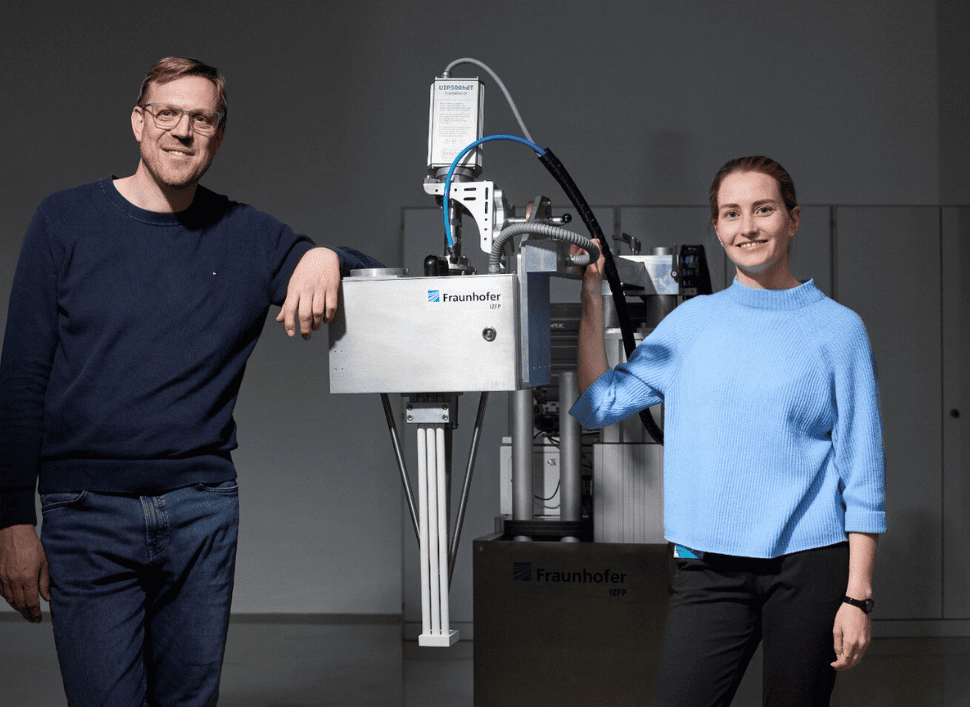
The Fraunhofer Institute for Nondestructive Testing IZFP will present its award-winning “AloX” measurement system at SENSOR+TEST 2026 in Nuremberg, introducing an advanced ultrasound-based solution for the rapid and precise detection of non-metallic inclusions in aluminum melts.
The international trade fair for sensor, measurement, and testing technology will take place from June 9 to 11, 2026, at the Nuremberg Exhibition Center. Fraunhofer IZFP experts will demonstrate the AloX system at Hall 1, Booth 1-317.
The technology addresses a critical challenge in aluminum casting, where non-metallic inclusions can significantly affect component quality and mechanical performance. Such inclusions often act as cracks or stress concentrators within finished components, creating potential risks in industries such as automotive and aerospace manufacturing.
As aluminum continues to gain importance due to its lightweight properties, recyclability, and energy-efficient processing, ensuring high material purity during production has become increasingly important for manufacturers focused on safety and sustainability.
Fraunhofer IZFP’s AloX system introduces a new approach by adapting ultrasonic measurement technology for use directly in aluminum melts. The system uses ultrasonic backscattering principles, where ultrasound waves are introduced into the melt and reflected signals are analyzed to determine the number, size, and distribution of inclusions.
The system enables continuous, fast, and reliable monitoring of melt quality during production. Unlike previous methods that were often time-consuming, expensive, or highly dependent on specialist expertise, AloX is designed for practical foundry operation and can be used without advanced expert knowledge.
The measurement system offers flexibility for both channel and crucible measurements and can also operate effectively in difficult measurement positions, supporting seamless melt quality monitoring across various foundry environments.
Fraunhofer IZFP researchers Dr. Thomas Waschkies and Andrea Mroß will present the technology live at SENSOR+TEST, where visitors will have the opportunity to see the system in operation and discuss its applications directly with the project leaders.
Looking ahead, the researchers are exploring the expansion of the technology to additional metal melts beyond aluminum.
“What works in aluminum melts could also work in other melts. For now, we are primarily focusing on low-melting-point alloys, particularly magnesium, tin, and zinc, all of which have melting points below 600°C. In the long term, however, steel could also be considered as a target melt,” explain Dr. Thomas Waschkies and Andrea Mroß.
The development highlights the growing role of advanced ultrasonic NDT technologies in improving material quality assurance, process reliability, and sustainable manufacturing practices across modern metal production industries.
Reference: https://idw-online.de/de/news871420