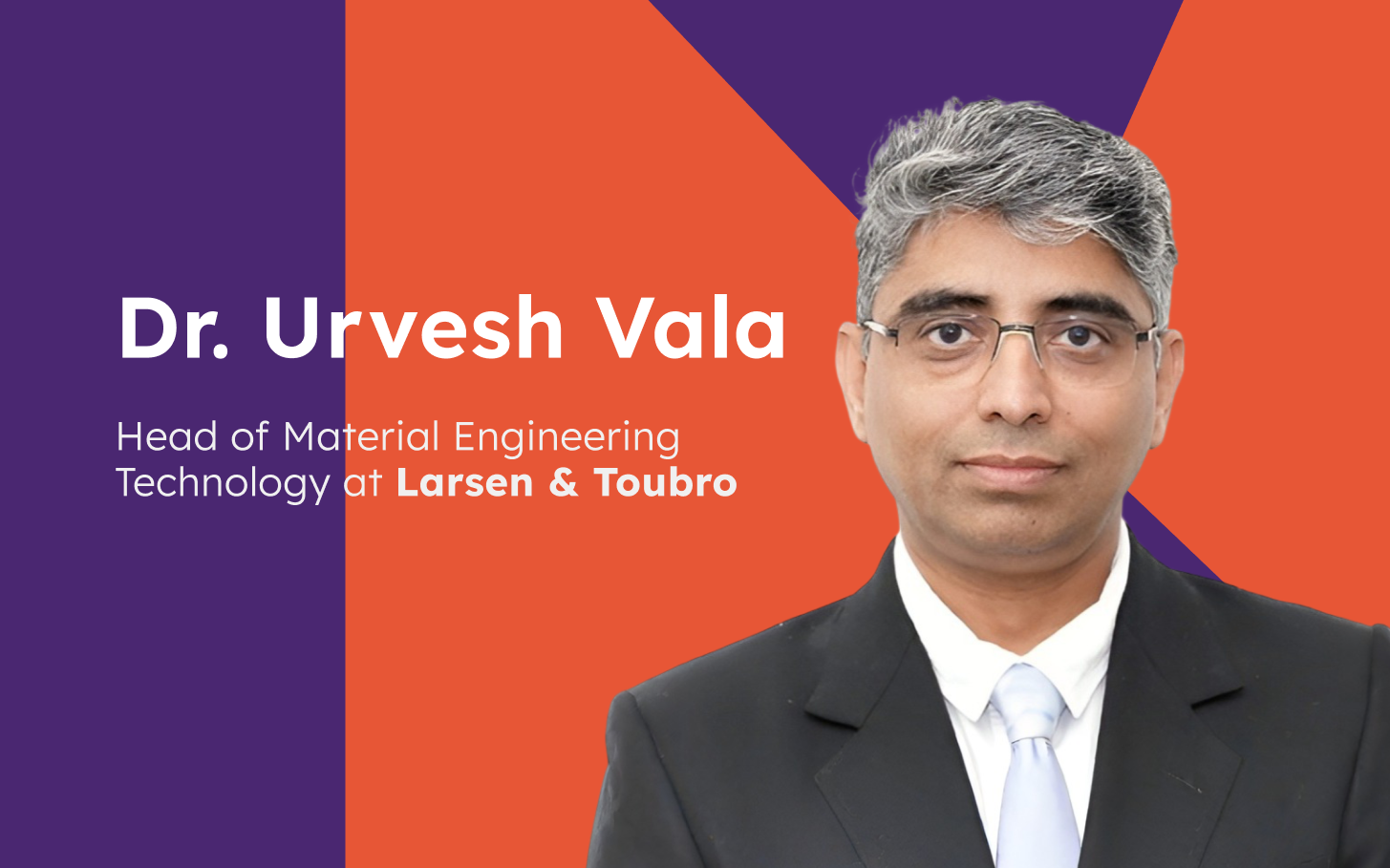
With extensive experience across global EPC organizations such as INOXCVA, Bechtel, Technip Energies, and Larsen & Toubro, Dr. Urvesh Vala currently leads Materials Engineering and Technology across domains including Green Hydrogen, Offshore, Cryogenics, Refinery, Corrosion, Integrity, and Decarbonization. In this conversation with OnestopNDT, he shares insights into the evolving role of materials engineering, advanced NDT, and digital integrity in enabling reliable and future-ready industrial infrastructure.
Dr. Urvesh, welcome to OnestopNDT — it’s a pleasure to have you with us. You currently lead Materials Engineering Technology at Larsen & Toubro with mandates spanning Green Hydrogen, Offshore, Cryogenics, Refinery, Corrosion, Integrity & Decarbonization. Could you begin by walking us through your professional journey and how these diverse technology domains converged into your current leadership role?
Thank you for inviting me. It’s great to be here. When we talk about materials engineering today, we are no longer talking about selecting metals from a datasheet, Material Selection Report, or Material Selection Diagram. We are talking about engineering reliability with respect to process conditions like upset scenarios and depressurization rate calculations, which affect material integrity for the design life of the asset in present industrial demand, with optimized material selection along with high-end corrosion and testing requirements.
My journey has been quite diverse, starting from cryogenics with INOX India, moving through global EPC environments like Bechtel and Technip Energies, and now leading Materials Engineering at Larsen & Toubro Energy Hydrocarbon.
What makes my journey interesting across all my experiences is material selection, corrosion, and coating. Whether it's LNG, offshore, or hydrogen, the core challenges revolve around corrosion, integrity, and reliability. Over time, these disciplines naturally converged into a more integrated leadership role. It includes advanced welding, advanced NDT, and automation in fabrication and testing.
Every engineering system ultimately fails or survives because of how well we understand materials in their real operating environment.
Over the last decade, L&T has been deeply involved in complex EPC/EPCM projects across hydrocarbons, offshore structures, hydrogen, and nuclear. From your vantage point, how has the role of materials engineering, corrosion control, welding, and NDT evolved within project lifecycles?
Traditionally, engineering relied on compliance with standards such as ASME, ASTM International, and ISO frameworks, which defined boundaries for material selection, corrosion damage mechanism confirmation, welding, and NDT evaluation with respect to the project lifecycle. But modern systems like hydrogen infrastructure, deepwater assets, and cryogenic storage are generally operated beyond static assumptions, and their standards for welding and NDT need to be interpreted based on material behavior and corrosion damage mechanisms.
We are now moving toward materials intelligence for material selection, corrosion damage management, welding, and NDT, where:
- Design is governed by mechanism-based understanding (API 571 damage mechanisms)
- Integrity is evaluated through fitness-for-service (API 579 / ASME FFS-1)
- Inspection is optimized via risk-based frameworks (API 580 / 581)
So instead of asking, “Is this material compliant?”, we ask, “How will this material degrade over 25 years under coupled mechanical, thermal, and chemical loads, and how early can we detect it?” This adds more in-depth understanding for new and running assets for material, welding, and NDT method selection and helps provide correct specifications based on international standards.
You’ve played a critical role in advancing Green Hydrogen and electrolyzer engineering at L&T. From a materials, corrosion, and inspection standpoint, what are the biggest challenges in enabling reliable GH₂/LH₂ infrastructure — especially around embrittlement, storage, and H₂ pipelines?
Hydrogen changes the game completely. Hydrogen is not just another fluid; it is an atomic disruptor of material stability.
We deal with:
- Hydrogen embrittlement
- Permeation and leakage
- Material degradation under cyclic loading
At a fundamental level, hydrogen interacts with lattice structures, altering dislocation behavior and fracture resistance:
- HELP (Hydrogen Enhanced Localized Plasticity)
- HEDE (Hydrogen Enhanced Decohesion)
This leads to macroscopic failures such as:
- HIC (NACE TM0284)
- SSC (NACE MR0175 / ISO 15156)
- Accelerated fatigue crack growth
From an engineering standpoint, this forces us to rethink:
- Strength vs. toughness trade-offs
- Weld metallurgy and residual stresses
- Barrier coatings and diffusion control
So, material selection is no longer a straightforward decision for metallurgists; it requires deep metallurgical understanding combined with advanced inspection techniques with respect to process conditions.
In hydrogen systems, reliability is not designed at the macro scale but is engineered from the microstructure upward.
Coming to cryogenics and LNG/LH₂ systems — domains where INOXCVA, Bechtel, and L&T have significant footprints — how do you view the interplay between Welding, NDE, vacuum systems, helium leak testing, and marine/offshore certification standards for ensuring integrity?
In cryogenic systems, everything must work flawlessly at extremely low temperatures. The ductile-to-brittle transition temperature is important for inspection and testing. Welding and NDT, including monitoring sensors, play an important role in asset management and are considered advanced NDT in the present scenario.
In cryogenic systems, especially LH₂, temperature shifts materials into the brittle fracture regime. This means:
- High-quality welding with automation
- Advanced NDE like PAUT/TOFD with automation (robots and cobots)
- Helium leak testing for tightness
Here, classical strength-based design is insufficient. Instead, we rely on:
- Fracture mechanics (K_IC, CTOD, J-integral)
- ASME Section VIII Div 2 (Design by Analysis)
- Impact toughness validation (ASTM E23)
Welding becomes a critical variable not just for strength, but for:
- Microstructural integrity
- Residual stress distribution
- Crack initiation resistance
And then comes leak integrity because, in LH₂ systems, even microscopic leakage is unacceptable. Helium leak testing down to 10⁻⁹ mbar·l/s sensitivity becomes not just a QA tool but a design validation philosophy.
It’s really about ensuring zero-failure-tolerance systems.
Regarding marine offshore certification standards for ensuring asset integrity, significant innovation in welding, NDT testing, and asset management has been implemented by AMPP, ASME, DNV, NORSOK, and many end-user specifications. Aging industries also require more advanced welding, such as underwater welding, robotic welding, and NDT methods where no-man-zone concepts are emerging for subsea applications with high-tech sensors providing real-time data.
Across offshore jackets, topsides, risers, and subsea assets, standards like NORSOK and DNV drive strict compliance. How do integrity engineering, cathodic protection (CP), coatings, advanced NDE, and materials selection come together in offshore qualification and procurement decisions?
Offshore is one of the harshest environments. Standards like AMPP, DNV, and NORSOK push us toward excellence.
Offshore assets represent one of the most complex engineering environments:
- Mechanical fatigue from cyclic loading
- Chloride-driven corrosion
- Microbiologically influenced corrosion (MIC)
- Cathodic protection interactions
Standards like DNV and NORSOK don’t just enforce compliance but also embed experience from decades of failures and learnings. It’s a complete ecosystem of integrity management.
What’s critical here is integration:
- Advanced materials (duplex, super duplex, CRA)
- Coatings (ISO 12944, NORSOK M-501)
- CP systems (DNV-RP-B401)
- Advanced inspection strategies with high-end technologies (i.e., advanced NDT)
This is where integrity engineering becomes a systems engineering discipline for offshore material qualification and procurement actions. With these international standards, offshore material procurement is a challenge considering very stringent specifications for steel material grades, surface preparation and coating requirements, NDT, etc., based on DNV and NORSOK standards that must be followed strictly.
You’ve worked with licensors, IOCs, EPC/EPCM players, and global suppliers—from Aramco and Shell to BP, ExxonMobil, Total, and others. When selecting NDT vendors, inspection technologies, or materials solutions for such projects, what criteria become non-negotiable?
When working with global leaders like Saudi Aramco, Shell, or ExxonMobil, there’s no compromise.
Key expectations for selecting NDT vendors are:
- Proven capability with respect to advanced NDT methods
- Trained operators and their interpretation skills with respect to the NDT process
- Calibration of equipment with respect to MOC
- Compliance with global standards
- Reliability and transparency
- Digital record maintenance
- Non-conformance compliance for asset integrity
Hydrogen, cryogenics, and offshore are all high-consequence environments. How do you personally evaluate risk vs. inspection strategy vs. lifecycle reliability when deciding between conventional NDT, advanced NDE (PAUT/TOFD), helium leak testing, or emerging digital integrity methods?
It’s always about balancing risk and cost. We evaluate:
- Criticality of assets
- Failure consequences
- Inspection effectiveness
Advanced NDT vs. conventional NDT is about seeing beyond the surface, as modern NDT is no longer just about detecting defects; it is about quantifying uncertainty and enabling predictive decisions.
Take the example of PAUT with FMC/TFM:
- It allows full matrix data capture
- Enables total focusing at every pixel
- Provides near-radiographic resolution
If we consider TOFD:
- It gives precise crack tip diffraction
- Provides reliable sizing independent of amplitude
Based on advanced NDT, we move into:
- Industrial CT → true 3D defect characterization
- Pulsed Eddy Current → corrosion detection through insulation
- Guided Wave UT → long-range screening
- Acoustic Emission → real-time damage evolution
Then we decide between conventional NDT, advanced NDE, or specialized techniques like helium leak testing. Acoustic testing with high-end automation is the demand for future-ready industries.
The real shift in NDT is this: inspection is no longer discrete but is becoming continuous, data-rich, and a physics-informed systematic approach toward determining the remaining design life of assets.
You’ve led RBI/RCM/IOW, CP/ICCP systems, corrosion monitoring, and digital integrity dashboards in collaboration with LTTS. Do you believe Digital Twins and predictive corrosion analytics can substantially change how we perform inspection, maintenance, and anomaly detection in the near future?
Digitalization is transforming everything by converting data into engineering decisions. With platforms like L&T Technology Services (LTTS), we’re moving toward Digital Integrity Architecture:
- Sensor networks (corrosion probes, UT sensors)
- Data lakes integrating inspection history
- AI/ML models predicting degradation
- Digital twins (aligned with ISO 23247)
This enables:
- Remaining Life Assessment (RLA)
- Predictive maintenance
- Real-time anomaly detection
The future engineer will not just interpret data but will interact with digital replicas of assets with respect to RBI/RCM/IOW, CP/ICCP systems, and corrosion monitoring. For more information on RBI and IOW, international standards like API can be referred to, and their data should be systematically collected and used through high-end software available in the market. Similarly, RCM can be studied for rotary, instrument, and electrical assets.
CP systems can be monitored through sensors, and data can be generated for Digital Twin platforms to evaluate protection effectiveness. Corrosion monitoring through sensors, especially in CUI-affected equipment and piping, enables predictive maintenance, particularly when inspections need to be delayed. This requires systematic data analysis for Digital Twin models to track asset degradation.
This is shifting us from reactive to predictive maintenance.
With energy transitioning toward low-carbon systems, do you see metallurgical innovation, high-performance alloys, and new coating systems keeping pace with H₂, offshore wind, GH₂/LH₂ storage, and nuclear advancements—or is there still a technology gap waiting to be filled?
We’ve made progress with respect to new technologies for sure, but challenges remain, especially in:
- Hydrogen-compatible materials requiring clean steelmaking processes, advanced NDT testing, and advanced metallurgical testing laboratories
- Cost-effective alloys with high durability with respect to equipment and piping design life
- Long-term performance validation
- Offshore material selection
- Surface preparation and coating based on ISO 12944 with corrosivity categories such as C5 or C5X
- Cyclic service coating selection from cryogenic to high temperature, which is challenging, especially when operating temperatures do not exceed 100°C
There is still room for innovation based on industrial demand for next-generation advanced materials.
From your experience across EPC manufacturing and project execution, how do you see welding automation, qualification standards, and NDE training evolving for the next-gen workforce? Are we prepared for electrolyzer gigafactories, offshore modularization, and nuclear-grade QA/QC expectations?
The future workforce needs to adapt quickly. We will see:
- Welding automation—where instead of welders, we have welding operators who can perform welding remotely
- Robotics and cobots as new-generation advancements in welding and NDT
- Advanced NDT skills and qualifications playing an important role in asset analysis
Robotics is redefining inspection accessibility where traditional NDT has limitations. Inspection is increasingly moving into environments where humans cannot safely operate. Robotics is addressing this through:
- Magnetic crawlers for tank floors
- UAV drones with LiDAR and thermography
- ROVs for subsea inspection
- Robotic PAUT scanners for automated weld inspection
But the real advancement is not just mobility—it is integration.
Welding: The Silent Determinant of Integrity
Welds are often the weakest link, not because of poor execution but due to:
- Metallurgical heterogeneity
- Residual stresses
- Heat-affected zone transformations
- With increasing automation:
- Orbital welding
- Laser hybrid welding
- Robotic welding
We are improving repeatability but also introducing the need for:
- Advanced qualification (ASME Section IX, ISO 15614)
- High-resolution inspection
Robotics + Welding/NDT + AI = autonomous inspection ecosystems. Training and certification will be critical to meet future demands.
You've moved through organizations like INOXCVA, Bechtel, Technip, and now L&T—all demanding high discipline in inspection, qualification, and compliance. In your view, what does “best-in-class NDT procurement” look like for large capital projects over the next 5–10 years?
NDT procurement is evolving based on current industrial demands:
- Digital integration with respect to innovation in NDT testing
- AI-based inspection
- Data-driven decision-making
It’s no longer just about inspection; it’s about intelligence.
On a personal note, outside of engineering, corrosion, and hydrogen—how do you unwind? What hobbies or interests keep you energized when you're not solving reliability challenges at work?
Outside work, I enjoy learning, mentoring, and staying updated with new technologies. That balance helps me stay energized.
Finally, if you look ahead—what gives you confidence about India’s position in hydrogen, offshore, EPC, and nuclear materials technology over the coming decade? And what storyline do you believe will define L&T’s contribution?
India has a strong opportunity in hydrogen and EPC.
With companies like Larsen & Toubro, we are well-positioned to lead globally in engineering and sustainable infrastructure.
India stands at a unique intersection of:
- Engineering capability
- Manufacturing scale
- Energy transition momentum
Organizations like Larsen & Toubro are not just executing projects but are building future-ready engineering ecosystems.
Before we close—platforms like OnestopNDT aim to aggregate knowledge, bridge stakeholders across NDT, materials, integrity & safety, and democratize access to insights globally. From your experience, how important are such ecosystems for industry collaboration and technology adoption?
In this rapidly evolving landscape, platforms like OnestopNDT play a crucial role. They enable:
- Connecting industry professionals
- Sharing knowledge globally
- Accelerating innovation
- Knowledge democratization
- Cross-industry learning
- Faster adoption of advanced technologies
Key Insights from the Discussion:
- Hydrogen introduces new challenges like embrittlement and permeability, requiring advanced material strategies
- Offshore and cryogenic systems demand integrated approaches combining materials, coatings, CP, and NDE
- Digital twins and predictive analytics are transforming inspection and maintenance practices
- Future NDT will be driven by AI, automation, and data-centric decision-making
- Workforce readiness in welding automation and advanced NDE is critical
Looking Ahead
India is strongly positioned to lead in hydrogen and EPC, with organizations like Larsen & Toubro playing a key role in shaping the future.
Equally important are platforms like OnestopNDT that enable knowledge sharing and collaboration across the global ecosystem.
Dr. Urvesh’s perspectives highlight the ongoing transformation in engineering—from conventional, compliance-driven practices to integrated, data-driven, and predictive approaches. As industries move toward hydrogen, offshore, and low-carbon technologies, the role of advanced materials engineering, welding, NDT, and digital solutions becomes increasingly critical. His insights emphasize that future-ready infrastructure will depend on innovation, skilled workforce development, and collaborative ecosystems that enable reliability, safety, and long-term asset performance.