
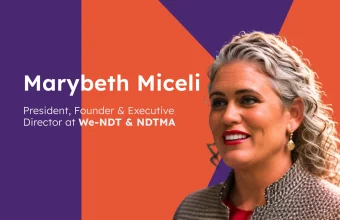
With more than three decades of experience spanning infrastructure engineering, nondestructive testing, structural health monitoring, technology consulting, and business leadership, Ms. Marybeth Miceli has worked at the intersection of technology and real-world infrastructure challenges. As President of Miceli Infrastructure Consulting she has focused on helping asset owners make informed decisions through actionable inspection and monitoring data. She is also the co-founder of the We-NDT Marketing Network and Executive Director of the Nondestructive Testing Management Association, dedicated to Advancing the Business of NDT. In this interview with OnestopNDT, she discusses technology selection, structural health monitoring, NDT workforce challenges, infrastructure inspection, digital technologies, and the importance of collaboration across the NDT ecosystem.
Ms. Miceli, welcome to OnestopNDT—it’s a pleasure to have you with us. With more than three decades of experience spanning infrastructure engineering, NDT, technology consulting, and business leadership, could you share how your journey evolved into your current role as President of Miceli Infrastructure Consulting?
Miceli Infrastructure Consulting was the first business in this space that I founded. When I was working as the Chief Operating Officer of a start-up, Material Technologies, I was meeting with bridge owners and other asset owners on a regular basis. At this time, structural health monitoring was really just starting to become more accepted in the industry. However, owners did not know how to utilize structural health monitoring to get the answers that they really needed. So, I decided to start my own company to help bridge owners and technology providers get on the same page about obtaining actionable data from structural health monitoring so that they could make real decisions about their bridges to either assess damage or extend the service life of their structure in a meaningful way.
Through Miceli Infrastructure Consulting, you work closely with asset owners, technology manufacturers, and service providers. When an owner faces a structural challenge, how do you determine which inspection or monitoring technology is actually appropriate for their needs?
When working with asset owners, I always advocate for a backwards approach, which may sound strange. But I encourage owners to start by determining what data they need in order to make the best decisions for the challenges that they’re facing and then, from there, figure out which systems can most efficiently and effectively give them the accurate data that they need. When I first started the business, many owners were simply trying out different systems to see how they worked, which ended up using a lot of funding and not getting a lot of real results for their structures.
Your approach emphasizes using technology for a specific purpose rather than adopting technology simply because it is new. What factors should asset owners consider when evaluating an emerging NDT or structural health monitoring solution?
It’s really all about what data you need and what challenges you are facing. Are you doing testing to meet a certain specification or standard? Are you worried about the condition of your structure? Are you trying to make sure your structure remains safe while planning a replacement or a rehab? There’s a list of questions that we ask our asset owners when we start working with them to determine which technology, or usually group of technologies, will get them the answers they need in the most cost-effective way possible.
You have worked extensively with advanced NDT, structural health monitoring, materials testing, and remaining-life assessment. How do you see these technologies complementing one another in modern infrastructure management?
In order to get the full picture about your structure’s condition and performance, all of these things work together. Advanced NDT will give you a snapshot in time about the condition of your structure, whereas structural health monitoring will give you an idea about the performance of your structure under loading conditions. But in order to understand how those affect the structure, you need to understand the material properties through materials testing. For example, knowing the actual fracture toughness of the material that was used in a structure allows you to see how resistant it is to fatigue cracking, and this allows you to see how to categorize it when you are trying to determine remaining life.
Infrastructure owners often have to balance deterioration severity, available budgets, access limitations, and life-extension requirements. How can they make inspection and monitoring decisions that deliver the greatest value over an asset's lifecycle?
This is really all about making the right fixes at the right time. All of this testing can be used to determine what those fixes should be and when they should occur. A lot of asset management systems will incorporate deterioration modeling into their programs, and NDT and SHM can be incorporated to calibrate the model with real-world data. I have seen some state DOTs be very successful at utilizing deterioration modeling and rehab and repair scenarios in order to show legislators how investing a little bit more now in the right fixes ultimately saves the state and the taxpayers a lot of money later on. By illustrating this in a simple manner, states have been able to help justify increases in gas taxes and other revenue-generating legislation to show they are responsibly using the money.
Your experience includes failure analysis and remaining-life assessment, as well as work on major structures such as the Empire State Building antenna, Miller Park, transit infrastructure, and signature bridges. How have these experiences shaped your understanding of the relationship between inspection data and real-world structural decision-making?
A lot of the work that I’ve done on remaining-life assessment has to do with fatigue cracking in various structures. The work done at Lehigh University to categorize weld details and model fatigue crack growth has been key in determining remaining life for many different steel structures, including bridges, trains, and buildings. I love how we can instrument a structure with strain gauges and be able to see the exact number of cycles on these weld details under real loading conditions and then extrapolate remaining life from that. That’s an example of materials testing, NDT, structural health monitoring, and remaining-life assessment all working together to help engineers and managers make responsible decisions now as well as plan capital improvements for the future.
As Executive Director of the Nondestructive Testing Management Association, you work closely with professionals involved in managing NDT personnel, technology, and regulatory requirements. What are some of the biggest management challenges facing the NDT industry today?
It’s not a new problem in the NDT industry, but it’s continuing to get worse as more NDTers continue to retire. We need more technicians, and not just warm bodies pushing probes. We need technicians who understand the different methods and what a signal really means, where to look for problems, and what the codes and standards say about it. We need better on-the-job training and guidelines for what that should entail. We have a lot of guidelines on the classroom education side of certification but very few guidelines about what the OJT should look like. Is the technician carrying equipment or actually learning something? And this is not a problem that’s going to be solved by one solution. It’s not just apprenticeship, or specialized OJT facilities, or automation, or AI data processing, or marketing to get more techs—it’s all of those things.
I’m so proud to say that NDTMA is working on all of these things in order to move the needle on this problem. We are fostering collaboration between groups that certify and govern NDT, such as API, ASNT, CINDE, AWS, AMPP, EPRI, ASTM, and more. We are producing successful videos aimed at teens to spark their interest in NDT as an exciting career. We have established an Education Forum to directly connect educational organizations in the space with service providers to establish and address gaps. The focus of this year’s NDTMA was on AI and automation to take a hard look at opportunities and challenges. We are actively working to advance the business of NDT, and we are committed to continuing this hard work because it’s so important.
You also serve on the ASNT Foundation Board of Trustees and have contributed to committees focused on infrastructure and bridge testing. From your perspective, where is greater collaboration needed between standards organizations, technology developers, NDT professionals, and asset owners?
In terms of the infrastructure sector, we are really lacking meaningful NDT certification. Dr. Glen Washer performed a POD study, taking technicians from other industries and bringing them to the bridge industry to assess if inspectors certified in accordance with TC-1A could go from oil and gas or aerospace to the bridge industry, and the answer was a resounding no. Without industry-specific certifications, the bridge sector will continue to lag behind in terms of requiring ASNT-certified technicians. Additionally, we utilize different methods in infrastructure such as GPR, Infrared Thermography, and LiDAR, for which there are no certification standards available. ACI has started developing some of those, but in general, we are still relying on licensed professional engineers to sign off on inspections when they are not required to have any NDT knowledge to obtain that license.
It’s a significant disconnect in this sector.
Through your work with We-NDT Marketing Network, you have focused on strengthening the visibility and business value of NDT. Why do you think communicating the value of NDT effectively remains important for the industry?
NDT is often seen as an “added expense”. I once had a bridge owner tell me they didn’t want to test their bridge because they, “have too many problems they already know about, why would I want to find more?” And they weren’t joking, unfortunately. Communicating the ultimate value of NDT to engineers and managers is the only way we will stop this “low bid” world we find ourselves in. We either need to change the requirements by potentially using AI to help ensure quality on projects, or we need to clearly show numbers that indicate what happens when inspections are done by the lowest bidder instead of the most qualified. There’s a happy medium somewhere in there, but when it comes to public safety, profit cannot be the only deciding factor.
You have experience working with both technology providers and infrastructure owners. What can technology developers do differently to ensure that their solutions address actual field requirements and gain greater acceptance among asset owners?
For bridge owners, the fewer people we have to put in work zones, the better. Companies are using augmented reality, drones, digital twins, crawlers, automated sounding vehicles, and more to help people inspect more remotely. Some of these technologies can be accepted within the current standards, but some face uphill battles, and technology manufacturers need to be very aware of the codes, standards, and legislation that govern these kinds of solutions in each state. Also, adoption in the infrastructure space is often slower than in other sectors, which is why we advocate for what I’ve coined as “parallel technology transfer”. We take proven technology solutions from other industries and bring them to the bridge industry to speed up the adoption process.
On a personal note, with your involvement across consulting, industry organizations, infrastructure projects, and technology initiatives, how do you like to spend your time away from work? Do you have any hobbies or interests that help you unwind?
I love spending time with my husband, Damien, my 16-year-old son, Sammy, and my 13-year-old daughter, Mary Leigh. In fact, we all do taekwondo together—Sammy and I are 5th-degree black belts, and Damien and Mary Leigh will be testing for their 5th-degree black belts in the fall. I also lift weights, sing and play my flute in the church choir, volunteer teaching taekwondo and self-defense at an all-girls school, and read fiction novels.
Having worked across engineering, business development, technology transfer, and leadership, what advice would you give to professionals who want to build a career at the intersection of NDT, infrastructure, and emerging technology?
Now is a great time to get into this field because, as the old guard is starting to retire, we are seeing more openness and even excitement to use technological solutions in the space. We now have a generation who has only ever known a digital world, and they want their infrastructure to be sensitized and managed just like our cars and homes are digitally optimized. Of course, that brings up some significant security and IT challenges, but Gen Y and Gen Z will not sit around and rely on older, less effective methods when they see the proof of more cost-effective life-cycle management in everything else around them.
Finally, platforms like OnestopNDT aim to bring together NDT professionals, technology providers, researchers, and asset owners to exchange knowledge and stay informed about industry developments. From your perspective, how valuable are such platforms in accelerating technology adoption and strengthening collaboration across the NDT community?
Certainly, open-source platforms such as OnestopNDT, NDT.net, Quality Magazine, and of course, NDTnow.com are the backbone of open communication in the NDT industry. Bringing emerging technologies, case studies, and news stories to everyone worldwide with just a few clicks has revolutionized how information is exchanged in the NDT industry. Sometimes it results in information overload, but these platforms are making the information accessible to managers, engineers, and NDTers alike in a neutral way, where people can access a variety of solutions to their challenges and often engage with technology providers directly to help solve their problems from anywhere in the world. This kind of collaboration is exactly what the NDT industry needs to move the industry and public safety forward.
Throughout the conversation, Ms. Miceli highlights the importance of using NDT and structural health monitoring as decision-making tools rather than simply adopting technology for its own sake. She also emphasizes the need for stronger NDT competency, industry-specific certification, collaboration, and responsible adoption of emerging technologies. As infrastructure moves toward increasingly digital and data-driven asset management, her insights underline the importance of connecting technology, expertise, and practical field requirements to improve safety and extend asset life.


