
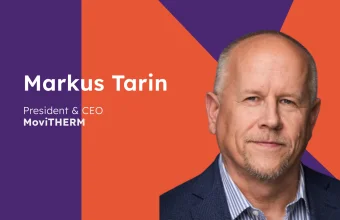
In this exclusive conversation with OnestopNDT, Mr. Tarin, an entrepreneur with a background in embedded systems, industrial automation, and infrared imaging, discusses his journey from manufacturing and plant operations to building moviTHERM. He shares his perspectives on thermal imaging, AI-powered inspection, industrial innovation, technology partnerships, entrepreneurship, and the future of condition monitoring.
Mr. Tarin, welcome to OnestopNDT. You've spent more than three decades building technology-driven businesses. Could you take us through your entrepreneurial journey and what inspired you to establish a company focused on thermal imaging and industrial innovation?
I trained in Germany in radio and television engineering and embedded system design, graduating in 1996. That background is less exotic than it sounds — it's fundamentally about signals, sensors, and turning raw data into something a human can act on. That's still what I do.
I came to the U.S. and spent three years in textile manufacturing in Los Angeles, first commissioning and automating what was, at the time, the world's largest continuous dyeing range, then running the plant's maintenance and engineering operation. In 1999, I started moviTHERM as an engineering consultancy — custom software and product development. Clients kept bringing me imaging problems, and increasingly, those problems lived outside the visible spectrum: things you cannot see but can measure as heat.
I didn't set out to build a thermal imaging company. I followed the problems. What kept pulling me toward infrared was that it answers questions no other sensor answers cheaply — is this bearing failing, is there a fire starting inside that pile, is there a void under that composite skin? Once you see how much decision-making value sits in a temperature signature, it's hard to work on anything else.
MoviTHERM has grown into a company delivering solutions from infrared NDT and package inspection to AI-powered IoT monitoring for early fire detection. What vision has guided this evolution, and how have customer needs influenced your innovation roadmap?
The vision hasn't changed much in 27 years: take complicated imaging science and make it deployable by people who are not imaging scientists.
Thermal imaging has always worked. The barrier was never physics — it was integration. A customer would buy a good camera and then discover they'd bought a component, not a solution. They still needed someone to handle optics selection, calibration, analytics, alarm logic, networking, and the thousand small decisions that separate a demo from a system that runs for five years in a dusty yard.
Our roadmap is written almost entirely by customers. Nuisance alarm filtering exists because operators told us they were ignoring alerts. Environmental sensing exists because a customer needed wind data to interpret a hot spot. Industrial protocol connectivity exists because plants wanted the data inside their existing control systems, not in yet another dashboard.
The discipline is separating what one customer wants from what the market needs. We built the second. If three unrelated customers describe the same pain in different words, that's a product. If one customer describes it, that's a project — and we'll do the project, but we won't confuse it with a roadmap.
In your experience, what advantages does thermal imaging offer over traditional inspection approaches in industrial environments?
Four things, mainly.
- It's non-contact and it works on energized equipment. You inspect a live switchgear cabinet or a running motor without shutting anything down. That alone changes the economics.
- It's full-field, not point-based. A contact probe gives you one temperature at one spot. A thermal camera gives you tens of thousands of measurements at once, so you find the problem you weren't looking for.
- It sees energy, not appearance. A visual inspection tells you what a surface looks like. Thermal tells you what's happening underneath — a loose connection, a failing bearing, a void in a composite, moisture in insulation.
- It's inherently continuous. Most traditional methods are events. You schedule them. Thermal can simply run all the time, at a cost per hour that no manual method approaches.
I'll be honest about the limits too, because overselling this technology has hurt our industry. Emissivity matters, reflections lie to you, and a thermal image is not a diagnosis — it's evidence. Anyone who tells you infrared replaces every other method is selling, not engineering. It's a powerful screening and monitoring tool, and it works best alongside ultrasound, vibration, and visual inspection, not instead of them.
Your solutions combine thermal imaging, machine vision, cloud connectivity, and artificial intelligence. How do you see these technologies working together to redefine the future of industrial inspection and asset monitoring?
Each one solves a different part of the same problem, and none of them is sufficient alone.
Thermal gives you the physical signal. Machine vision gives you context — where in the frame this is happening, and what object it's happening to. AI gives you discrimination: separating a real developing fault from a sun reflection or a forklift driving through the scene. Cloud gives you distribution — the right person knowing at 2 a.m. without being on site.
The important architectural point is where the intelligence sits. We run detection at the edge, on-premise, because a monitoring system that fails when the internet fails isn't a monitoring system. The cloud is a visibility and management layer, not a dependency.
Where I think this genuinely redefines things is in the shift from inspection as an event to monitoring as a condition. Historically, you inspected something on a schedule and hoped nothing happened in between. When sensing is continuous and the analytics are good enough to be trusted, the question changes from "what did we find during the survey" to "what is changing right now, and how fast." That's a different discipline, and it's where the field is heading.
Why is continuous thermal monitoring becoming increasingly important for industries operating critical infrastructure?
Because failures don't wait for the inspection schedule.
Take a recycling facility. Route-based thermography might survey the yard monthly, maybe weekly. A lithium-ion battery buried in a pile of material can go from ambient to ignition in a matter of hours. The odds that your quarterly survey lands in that window are effectively zero. The inspection wasn't wrong — the sampling rate was.
The same logic applies to electrical assets, motors, bearings, and transformers. Thermal degradation is a trend, not a state. One reading tells you a temperature. A continuous record tells you a direction, and direction is what lets you intervene before failure instead of documenting it afterward.
There's also a hard economic driver right now. Insurance carriers in several of the industries we serve have raised premiums sharply or withdrawn coverage entirely after fire losses. For some facilities, demonstrable continuous monitoring has become a condition of staying insurable. That has moved this from a nice-to-have engineering upgrade to a business-continuity requirement, and it happened faster than most people expected.
How do you transform an innovative concept into a commercially successful solution while ensuring it addresses real industry challenges?
The failure mode I see most often — and I've been guilty of it — is engineers building the thing that's technically interesting rather than the thing someone will pay for.
My rough process:
- Start with the pain, not the technology. Go to the site. Watch how people actually work. The gap between what a customer describes on a call and what you see on the floor is where the real product is.
- Validate that they'll pay before you build. Interest is free. A purchase order is data. If a customer won't fund a pilot, that tells you something honest about the priority.
- Build the smallest version that solves the whole problem. Not a partial solution done thoroughly — a complete solution done simply. A customer can't evaluate half a system.
- Deploy it somewhere hard and let it break. Our field environments are dusty, hot, wet, and electrically noisy. Lab performance predicts nothing.
- Then engineer for repeatability. This is the step most technical founders skip. A system that works because you personally configured it isn't a product. It's a hobby with an invoice.
The commercial test is simple: can someone other than the inventor sell it, install it, and support it? Until that's true, you don't have a product yet.
Before founding moviTHERM, you led manufacturing operations and automation initiatives as Plant Manager. How did those early experiences influence your understanding of quality assurance, process optimization, and industrial technology?
Those three years shaped everything.
I started at a Los Angeles textile plant — about 650 employees — by installing and automating what was then the world's largest continuous dyeing range. I was later promoted to plant manager, running roughly 35 mechanical and electrical staff across three shifts, responsible for keeping the entire machine park running 24/7 for high-volume, time-critical production.
Three lessons stuck permanently.
Downtime is the real currency. When a continuous process stops, you don't just lose the hour — you lose material in the machine, you lose schedule, and you lose customer trust. Every product I've built since is aimed at buying the operator time before a stop, not explaining it afterward.
Formal beats are heroic. I inherited a maintenance culture built on individual expertise — a few people who knew which machine made which noise. It worked until they were on vacation. Putting in a structured maintenance program and training the workforce was less glamorous than any automation project and delivered more.
Technology that operators don't trust is technology that gets bypassed. I watched good systems get switched off because they alarmed too much or made someone's shift harder. That's why nuisance alarm filtering is not a feature to me. It's the whole game.
When selecting a technology partner, what factors do you believe matter most beyond technical specifications?
Specifications are the easy part, and frankly, most serious vendors' specs are close enough that they're not the deciding factor. What separates them:
- Application engineering, not just sales engineering. Will they tell you when your application won't work? A vendor who has never talked a customer out of a purchase is not advising you — they're closing you.
- Who shows up when it breaks. Not "is there support" — everyone has support. Ask who physically comes to the site, how fast, and whether they know your installation. Ask for a reference from a customer who had a problem, not a customer who didn't.
- Longevity and continuity. Industrial systems live ten to fifteen years. Will this company exist then, and will they still support this generation of hardware? I've watched customers stranded by acquisitions more often than by technical failure.
- Willingness to be measured. A partner who agrees up front on what success looks like — and on how you'll know if it isn't working — is a partner who intends to deliver it.
The underlying question is whether you're buying a transaction or a relationship. Multi-site industrial monitoring is unavoidably a relationship. Buy it that way.
You've worked with technologies spanning machine vision, motion control, medical product development, and infrared imaging. How has cross-industry experience helped you identify new opportunities for innovation?
Almost every innovation I've been part of was a transplant, not an invention.
I've worked as lead architect on imaging projects across defense, aerospace, medical research, and industrial automation, and across the full spectrum — near, shortwave, midwave, and longwave infrared. What that teaches you is that industries solve the same problems independently and never talk to each other. Aerospace developed rigorous active thermography methods for composite inspection — lock-in and pulsed techniques — while general manufacturing was still doing spot checks with a handheld. Medical device development taught me a level of validation discipline and documentation rigor that most industrial products never see, and that discipline is exactly what earns trust in a safety-critical application. Machine vision solved the problem of making a camera make a repeatable pass/fail decision decades before anyone asked a thermal camera to do it.
So the useful skill isn't inventing something new. It's recognizing that a problem in front of you is structurally identical to one that was already solved somewhere else, in a field that doesn't attend your conference. Reading outside your industry is one of the highest-return things an engineer can do.
You've been an active member of Entrepreneurs' Organization and Vistage. How important is continuous learning and peer collaboration for CEOs leading technology companies?
I spent four years in EO, where I mentored founders of early-stage companies, and about seven years in Vistage. Both were worth it, for a reason I didn't anticipate going in.
Technical learning was never the problem. Engineers are good at learning technology — it's what we do for fun. What I lacked was everything else: hiring, delegation, communication, building a team that performs without me in the room.
The single biggest change was moving away from micromanagement. As a technical founder, you're usually the best engineer in the building at the start, and that becomes a trap. You keep making every decision because you can make it faster and, at first, better. Then you become the bottleneck for everything, and the company can only grow to the size of your calendar. Peer groups are where I got that reflected back to me honestly — by people with no stake in flattering me.
The other value is simply that other CEOs have already made the mistake you're about to make. That's not something you can read. You need people who will tell you the unglamorous version of what happened to them.
Outside of leading innovative businesses, how do you like to spend your free time?
Hiking, fishing, and adventure travel.
There's a common thread, and it's not subtle: all three take me somewhere without a screen and without a schedule. Fishing in particular is good for an engineer's brain. It's patient, it rewards observation over effort, and no amount of forcing it makes a fish bite. That's a useful counterweight to a job where the instinct is always to push harder on the problem.
The best product ideas I've had did not arrive at my desk. They arrived on a trail, three days into somewhere with no signal, when my brain finally stopped triaging and started connecting things. I've come to treat that as part of the work rather than time away from it.
Adventure travel does something similar at a different scale — it puts you in places where your assumptions don't apply, which is a healthy annual reminder for anyone who runs a company. And practically speaking, if you're going to lead a team over decades rather than years, you need something that genuinely refills the tank. Burnout is a slow failure mode. It looks fine on the trend line right up until it doesn't.
Looking ahead, how do you see artificial intelligence, automation, and predictive analytics transforming industrial inspection and condition monitoring over the next decade?
Three shifts, in order of confidence.
From detection to prediction. Today, most systems, ours included, are very good at telling you something is wrong right now. The next step is credible time-to-failure estimation — not "this bearing is hot" but "this bearing's trend puts it outside tolerance in roughly three weeks." That requires long baselines of real field data, which is the actual moat in this business. Not the algorithm — the data.
From alarms to autonomous responses. Systems will increasingly act, not just notify: adjusting thresholds to conditions, dispatching suppression, throttling a process. That's technically achievable now. The gate is trust and liability, not capability, and it should be — we should earn that authority slowly.
From specialists to everyone. Interpretation has always required a trained thermographer. As analytics improve, the technology reaches facilities that could never justify a certified thermographer on staff. That's the largest market expansion in our field, by far.
What won't change: physics, emissivity, and the need for someone with judgment to decide what to do about the finding. AI is a very good screener. It's not accountable, and accountability is a human function.
For entrepreneurs and young engineers building technology companies in industrial automation or inspection, what lessons from your own journey would you consider most valuable?
Work in the industry before you try to fix it. My three years in a plant taught me more about what industrial customers need than any amount of market research would have. Take the operations job. It's not a detour.
Sell before you build. Falling in love with technology instead of the problem is the most common way technical founders fail. The market does not reward elegance.
Industrial sales cycles are long — plan your finances around that. Reliability has to be proven, and proving it takes seasons, not sprints. Undercapitalizing a long sales cycle kills more good companies than bad technology does.
Reliability outranks features. In our world, a system that does three things flawlessly for ten years beats one that does thirty things and needs attention. Customers remember downtime forever.
Get out of your own way early. Build a team that can execute without you sooner than feels comfortable. I waited too long.
Be patient. moviTHERM is 27 years old. There was no single breakthrough moment — just compounding. Very few overnight successes in industrial technology are actually overnight, and the ones that look like it usually had ten quiet years first.
From your perspective, how valuable are platforms like OnestopNDT in accelerating innovation, fostering collaboration, and increasing awareness of emerging inspection technologies?
Very, and for a specific reason: our field's biggest constraint has never been technology. It's awareness.
There are plant engineers today solving problems the hard way because they don't know a method exists. The technique they need was published fifteen years ago in a conference proceeding they'll never encounter. NDT is unusually fragmented — the ultrasound community, the radiography community, the thermography community, each with its own conferences, journals, and vocabulary, often describing similar problems in mutually unintelligible terms. Platforms that cut across those silos do real work.
They also help buyers evaluate honestly. When a facility manager can compare methods and hear directly from practitioners, vendors have to compete on substance rather than on marketing volume. That's healthy, and companies with real technology should welcome it.
For a company like ours, it's simply how you reach an engineer with a problem you can solve. That's not a small thing — most of the value in this industry is lost in the gap between an existing solution and the person who needed it and never found it.
This is also why I spend time on education generally, including co-hosting The Thermal Review. The more people who understand what infrared can and cannot do, the better this whole industry performs.
The conversation with Mr. Tarin highlights how the future of industrial inspection is moving beyond periodic checks toward continuous, data-driven condition monitoring. His experience also underscores an important principle for the NDT and industrial technology community: innovation is not only about developing more advanced technologies, but about making those technologies practical, reliable, and trusted by the people who use them.


