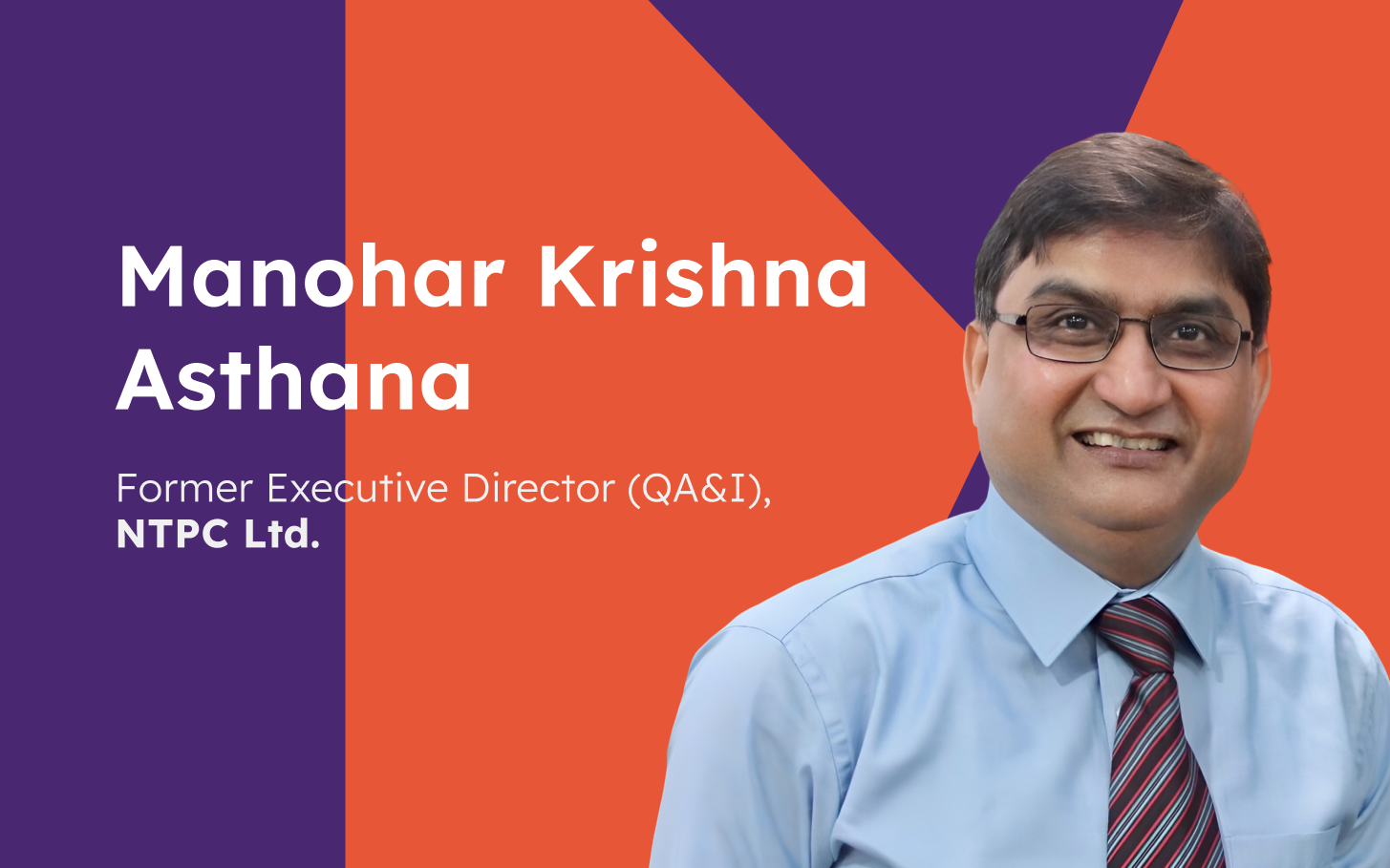
With nearly three decades of experience at NTPC Limited and an academic background in Power Generation Technology from Indian Institute of Technology Delhi, Mr. Manohar Krishna Asthana, Former Executive Director (QA&I), NTPC Ltd., has been closely involved in advancing quality systems and inspection practices in India’s power sector. In this interview with OnestopNDT, he shares insights on NTPC’s evolving quality management approach, the role of advanced NDT technologies, and the importance of skill development and industry collaboration.
Mr. Asthana, welcome to OnestopNDT—it’s a pleasure to have you with us today. To begin, could you share how your journey evolved—from your academic foundation in Power Generation Technology at IIT Delhi to nearly three decades at NTPC, where you served as Executive Director overseeing Quality Assurance & Inspection, Welding Research, and New Initiatives—and how NTPC’s approach to quality and inspection has matured over time?
NTPC Limited has a well-defined Quality Management System (since its inception in 1975), which is uniformly implemented across all ongoing projects, new projects, and operating stations to assure quality at every stage. The Quality Management System has well-defined quality procedures that keep evolving at regular intervals based on feedback, experience gained, and the adoption of the latest developments.
For new projects, quality is assured at every stage. The first stage is the finalization of quality requirements for each package (for example, in thermal projects—steam generator, steam turbine, material handling system, etc.) based on all governing standards and codes related to material, manufacturing, welding, NDT, and erection, as well as based on experience gained from the execution of previous projects. The next stage of quality assurance is conducted during post-award discussions. The manufacturers are listed and controlled for all critical items of each package. Acceptance is given to those manufacturers who were previously assessed and accepted, and with whom NTPC has prior experience. To ensure flexibility for main suppliers, NTPC also gives them the opportunity to propose new manufacturers during the post-award discussion stage or even during the execution stage. The manufacturing capability of every new manufacturer is assessed by Corporate Quality as per a well-defined written procedure based on four domains—manufacturing capabilities, testing capabilities, quality management systems, and experience. Subsequently, prior to the start of manufacturing any item or equipment, the Manufacturing Quality Plan (MQP) is finalized. This plan lists all checks related to raw material, in-process inspection, and final inspection in a sequential manner. The responsibilities of inspection for the manufacturer, main supplier, and NTPC are clearly defined. NTPC mostly carries out inspections during the final stage, witnesses the checks identified in the approved MQP, and reviews all related quality documents. Inspections are conducted by NTPC’s own inspection engineers or quality engineers.
Since its inception in 1975, the NTPC Quality Assurance and Inspection Team has gained immense experience and knowledge of manufacturing processes, applicable design standards, materials, welding, NDT, and other testing methods with various manufacturers. Therefore, reference quality plans and standard quality plans have been developed listing all sequential checks of raw materials, in-process inspections, and final inspections. Over time, NTPC Corporate Quality Assurance & Inspection, with more than 50 years of experience, rationalized quality plans so that manufacturers and main contractors became more responsible for raw material and in-process inspections, while NTPC witnesses were defined during the final inspection stage. During my career in the CQA&I department of NTPC Limited, I extensively worked on standardization by developing Reference Quality Plans and Standard Quality Plans for various items.
Quality engineers and inspection engineers are regularly trained in manufacturing processes such as casting, forging, welding, fabrication, machining, etc., as well as in NDT techniques to strengthen their understanding of manufacturing processes and inspection methods. This ultimately results in better quality control, quality assurance, and thorough inspection. In this way, NTPC’s approach has transformed significantly over time.
NTPC operates infrastructure that directly supports national power generation. From your perspective, how strategic is NDT and inspection reliability in ensuring lifecycle performance, asset integrity, and uninterrupted operations in power plants?
There are several types of rotating equipment, pressure vessels, heat exchangers, heavy structures, piping, tubing, valves, etc., involved in 200 MW and 500 MW sub-critical steam thermal power units as well as in 660 MW and 800 MW supercritical/ultra-supercritical units. There are critical castings used in turbines, pumps, valves, etc., and forgings used for rotors. Similarly, boilers involve a huge quantity of seamless tubing of varying metallurgy to sustain high temperatures. The manufacturing of these components involves complex processes, including welding and heat treatment in many cases. NDT techniques are extensively used to check the soundness of the material and welded joints. Welding and NDT activities are governed by applicable national and international standards. During the manufacturing stage, inspections are conducted as per elaborate Manufacturing Quality Plans. Reliability of inspection is ensured by deploying NTPC’s experienced inspection engineers who are well trained in manufacturing processes, welding, and NDT.
Similarly, during the erection of equipment at project sites, a huge amount of welding is involved in boiler tubes exposed to high pressure and temperature, power-cycle piping, low-pressure piping, and structures. Every welding joint, whether at the manufacturer’s works or during erection, is carried out according to a well-defined Welding Procedure Specification (WPS). NDT is mandatory to check the soundness of these welding joints.
Ensuring the soundness of all components and fabricated items during manufacturing, as well as ensuring the soundness of every welded joint during erection through suitable NDT techniques, is essential for reliable and trouble-free power generation. For example, the soundness of butt weld joints in boiler tubes is checked using Phased Array Ultrasonic Testing (PAUT), an advanced NDT technique with a high probability of defect detection. A boiler tube failure during operation can shut down a unit for a significant period, leading to considerable revenue loss. Therefore, to ensure “zero defect” conditions and avoid equipment failure due to material integrity or weld joint issues, immense focus is placed on reliable inspection through NDT techniques.
To support this, NTPC ensures in-depth knowledge and competency in conventional NDT techniques such as Ultrasonic Testing, Radiographic Testing, Magnetic Particle Testing, and Dye Penetrant Testing, along with advanced techniques such as PAUT and Time of Flight Diffraction (TOFD). Certification training programs are conducted through internationally reputed organizations such as ASNT and TWI.
For large-scale power assets, selecting the right inspection methods, equipment, and service partners becomes critical. What factors do you prioritize when evaluating NDT equipment manufacturers or service providers? Is it capability, reliability, certification, digital traceability, cost, or a combination?
To assure that the defined NDT checks assess component material integrity and soundness and/or the soundness of a weld joint, it is essential to ensure that a well-defined NDT procedure is available confirming to applicable standards. A competent agency must be engaged to conduct the NDT. The NDT equipment used should be from a reputed manufacturer, reliable, and meeting all requirements as per the procedure or governing standard.
The NDT operator must also be competent and possess the required NDT competency certificate. The operator should be able to completely understand the NDT procedure, demonstrate competency in equipment setting, and correctly examine known defect samples. Additionally, the NDT equipment should have provisions for data storage, digital traceability, and online real-time connectivity.
You recently presented at NDE2025 about quality challenges in 660 MW/800 MW Supercritical and Ultra-Supercritical units. What specific inspection or metallurgical challenges arise in these environments, and how have advanced NDT techniques contributed to mitigating them?
In 660 MW and 800 MW Supercritical and Ultra-Supercritical boilers, specific challenges were faced in achieving sound welding in high-alloy steel grades such as T91, T92, and T23 in tube-to-tube weld joints. These challenges were mitigated through proper training by enabling engineers and high-pressure welders to understand the advanced metallurgy, the applicable Welding Procedure Specification, and onsite welding training on mock-up test pieces simulating highly constrained welding positions, such as those in reheater and superheater areas.
Special attention was given to ensuring correct fit-up, edge preparation, preheating, maintaining inter-pass temperature, post-weld heat treatment, and finally conducting Radiographic Testing and Phased Array Ultrasonic Testing (PAUT) to examine the soundness of each weld joint.
Therefore, thorough visual inspection, radiographic examination, and final examination by Phased Array Ultrasonic Testing (PAUT), an advanced NDT technique conducted as per a well-defined procedure, contributed greatly to assessing the weld joints. PAUT proved to be very effective in detecting lack of side-wall fusion, a common unacceptable defect that often could not be revealed properly through radiographic examination.
Welding has been a recurring theme in your recent engagements—from PVUNL to JSL Hisar and NTPC Solapur. How central is welding quality to plant performance, and where does inspection provide the most value across fabrication, erection, and commissioning stages?
Welding is extensively involved not only during the manufacturing of various components and equipment of power plants but also during the erection of systems at the power plant site. The quantum of welding during erection is huge—almost more than 50,000 tube-to-tube butt weld joints are involved in boiler erection, apart from approximately 7,000 to 10,000 butt weld joints in power-cycle piping and other piping.
In addition, a huge amount of welding is involved during the fabrication of boiler structures, turbine structures, and material handling structures. Fabrication activities take place at the fabricator’s works, and welding is also required during the erection of those structures.
Welding quality is extremely important to ensure trouble-free operation of the units. It is ensured that welding at every joint (during manufacturing or erection) is carried out according to a well-defined and approved Welding Procedure Specification. Welders are tested and qualified before engaging in actual welding, and the welding joints are examined using suitable NDT methods.
A thorough inspection is carried out by welding and quality engineers of the manufacturer (during manufacturing), the contractor and erection agency (during erection), and NTPC’s inspection and quality engineers as per the applicable quality plan. Therefore, thorough inspection involving various NDT techniques provides value at every stage—fabrication, erection, and commissioning.
NTPC has been actively promoting competency development in welding and advanced NDT. From a national perspective, where do you see skill or competency gaps today, and how can industry, OEMs, and training bodies strengthen this ecosystem?
I was promoted in 2018 as General Manager (New Initiatives – Welding Research) at NTPC Limited and was assigned one of the important roles of Competency Development in Welding & NDT among young NTPC executives in the domain, because at that time the erection of several 660 MW / 800 MW units was going on across many projects in which several challenges were noticed in the domain of welding and NDT.
These units of 660 MW / 800 MW are designed for Supercritical (SC) and Ultra-Supercritical (USC) steam, where the temperature of main steam / reheat steam goes up to 595°C–605°C. Such high steam temperatures necessitate the use of advanced metallurgy—high alloy steel grades (Grade 91, 92, 23, etc., in which the chromium percentage is high apart from other alloying elements) in high-temperature steam circuits. Similarly, stainless steel Super 304H grade and 347H grade are used in high-temperature steam circuits. Achieving sound welding in tube-to-tube weld joints in such high-temperature steam circuits with advanced metallurgy was definitely a challenge, and it requires a complete understanding of metallurgy, the behavior of materials during welding, understanding and compliance with the applicable Welding Procedure Specification (WPS), and the necessary skill and competency development in welding.
Similarly, advanced NDT techniques such as Phased Array Ultrasonic Testing (PAUT) and Time of Flight Diffraction (TOFD) were increasingly coming into use at that time because of their high probability of defect detection, portability of equipment, quick results (in comparison to RT), and the absence of radiation hazards. These advanced NDT techniques require very high skill levels both to conduct the tests correctly and to interpret the results accurately.
At that time, it was strongly felt by the top management to educate and train young NTPC executives and arrange certification training programs from internationally renowned and recognized training schools such as TWI and ASNT, in order to develop the required competency levels in welding and advanced NDT among them.
Therefore, under this New Initiative, several certified competency development programs such as CSWIP 3.1 & 3.2 Certified Welding Inspector and Level II certification in PAUT, TOFD, UT, RT, and DPT as per ISO 9712 / ASNT 9712 were organized at NTPC projects as well as at NTPC – Power Management Institute, Noida, for young NTPC executives. With these initiatives, around 200 executives in NTPC are now well trained in welding and advanced NDT, and they are ready to take up present as well as future challenges. These programs are now a regular feature in NTPC.
Therefore, from the NTPC perspective, through these new initiatives NTPC has adequately trained a sufficient number of executives in welding and advanced NDT and continues to do so with a futuristic approach. However, from the national perspective, there is still a huge gap. Ongoing construction activities in India demand a very large number of highly qualified and skilled high-pressure welders, structural welders, and welding and NDT engineers to ensure and assure the desired quality in welding. Addressing this gap requires an enormous drive from industries, OEMs, and training bodies to strengthen this ecosystem.
Adoption of digital inspection solutions—such as digital radiography, automated UT, or phased array systems—is accelerating across industries. How do you see digital QA and traceability shaping the future of inspection in the power sector?
Digital Quality Assurance and traceability are essentially the future of inspection in the power sector. Many initiatives have already been taken by NTPC in this regard. The quality systems at NTPC are digitized and available online, accessible to NTPC quality and inspection engineers. Engineers can work with these systems from anywhere in India or even globally. Quality documents generated during manufacturing and inspection are stored online and can be accessed for future reference and traceability. Efforts are also ongoing to digitize field quality assurance activities and the welding and NDT records generated at project sites. Artificial Intelligence also has significant application potential in this domain.
You’ve recently interacted with industry leaders such as PVUNL, Adani, and JSL Stainless, along with international experts at NDE2025. How important is cross-industry collaboration for improving quality culture and advancing inspection standards?
Cross-industry collaboration, including sharing knowledge, experiences, and case studies through conferences, workshops, visits, and personal interactions, is always helpful in improving quality culture and advancing inspection standards. I always engage in such exchanges not only with cross-industry professionals but also with all stakeholders. These interactions have consistently proven to be immensely useful. In fact, I have tried to share practical experiences gained in welding and NDT with professional bodies such as the Indian Institute of Welding, ISNT, and ASNT, as well as with training institutions, so that training modules can be developed with practical perspectives to enhance learning.
When new inspection technologies emerge, what influences their acceptance in power utilities—proven reliability, code compliance, risk perception, or operator skill availability?
Whenever a new inspection technology emerges, its acceptance in power utilities depends on its capability to detect all types of defects with clarity and sensitivity, along with consistency and reliability. Compliance with applicable codes, instrument robustness, smooth functioning in extreme conditions, ease of handling, and operator skill competency also play major roles.
For example, based on the acceptability of these factors and proven track records in defect detection, Phased Array Ultrasonic Testing (PAUT) is now widely used, especially for examining the soundness of weld joints.
Major power projects involve OEMs, EPCs, and suppliers across the supply chain. From a QA standpoint, what are the common pain points you’ve observed, and how can early-stage inspection strategies help prevent downstream quality issues?
Quality is still not the primary focus for many manufacturers in India, including several erection agencies. There is often a lack of proper understanding of quality norms and standards related to materials, welding, and NDT among their engineers. In simple terms, quality culture is often missing, and a quality-conscious power utility like NTPC must put in extra effort to ensure quality.
Therefore, NTPC places strong emphasis on ensuring proper understanding of codes and standards among stakeholders through regular interactions during the finalization of quality plans, conducting quality audits, surveillance checks, technical discussions, and organizing training workshops from time to time.
Looking at the lifecycle of power plants—from commissioning to aging units—how does NTPC approach long-term asset integrity, corrosion monitoring, and risk-based inspection methodologies?
NTPC adopts a proven short-term and long-term strategy for asset (power generating units) integrity to ensure that units generate rated-capacity, quality power uninterruptedly throughout their life and even beyond. There are live examples: the 200 MW units established at Singrauli and Korba have been generating full-capacity power for more than 200 days uninterruptedly even after 40 years of commissioning.
Therefore, for every power generating unit—whether 200 MW, 500 MW, 660 MW, or 800 MW capacity—there are well-defined short-term and long-term overhauling and maintenance plans for each and every piece of equipment, based on OEM guidelines, previous experience, and knowledge gained by the NTPC team. During these maintenance schedules, all possible and applicable NDT techniques and inspection methodologies are adopted to thoroughly check equipment components such as rotors, casings, bearings, welding joints, valves, pipelines, and structures. Wherever required, corrosion mapping is also carried out.
That is why all generating units of NTPC produce power smoothly and consistently at part load or full load as per the requirements of the grid.
At a leadership level, staying updated on evolving inspection technologies, standards, and research becomes essential. How do you personally stay informed?
I stay updated and informed on evolving inspection technologies, standards, and ongoing research in the field of NDT by reading articles, reading NDT magazines, interacting with NDT equipment manufacturers and NDT agencies, and through the internet. The annual conferences organized by professional bodies such as ASNT and ISNT, in which internationally reputed NDT equipment manufacturers, academic institutions, and research scholars participate, provide an excellent platform to stay updated on the latest developments. I make it a point to attend those conferences.
Beyond your professional contributions to quality, welding, and inspection, how do you spend your time away from work? Are there any hobbies or personal interests that help you unwind?
I have several personal interests, passions, and hobbies that help me unwind after work. Among these, listening to music, spending quality time with family, reading books, playing, and teaching are my favorites.
Finally, as someone who engages with both industry and technical communities, how do you view platforms like OnestopNDT? Do you see value in such platforms for knowledge sharing, staying updated, and connecting stakeholders across inspection ecosystems?
OnestopNDT is a wonderful platform for knowledge sharing, staying updated, connecting with experts and stakeholders across the inspection ecosystem, and finding solutions to unique problems. OnestopNDT is providing a great service to the NDT fraternity, industries, academic institutions, and research organizations. In fact, this initiative by OnestopNDT to conduct interviews through thought-provoking questions is quite unique and proves to be helpful not only for industries but also for several other stakeholders.
Mr. Asthana’s insights highlight the critical role of structured quality management, advanced NDT techniques, and continuous competency development in ensuring reliable power generation. As technologies evolve, collaboration, digital inspection systems, and knowledge-sharing platforms will play an increasingly important role in strengthening inspection practices across the power industry.