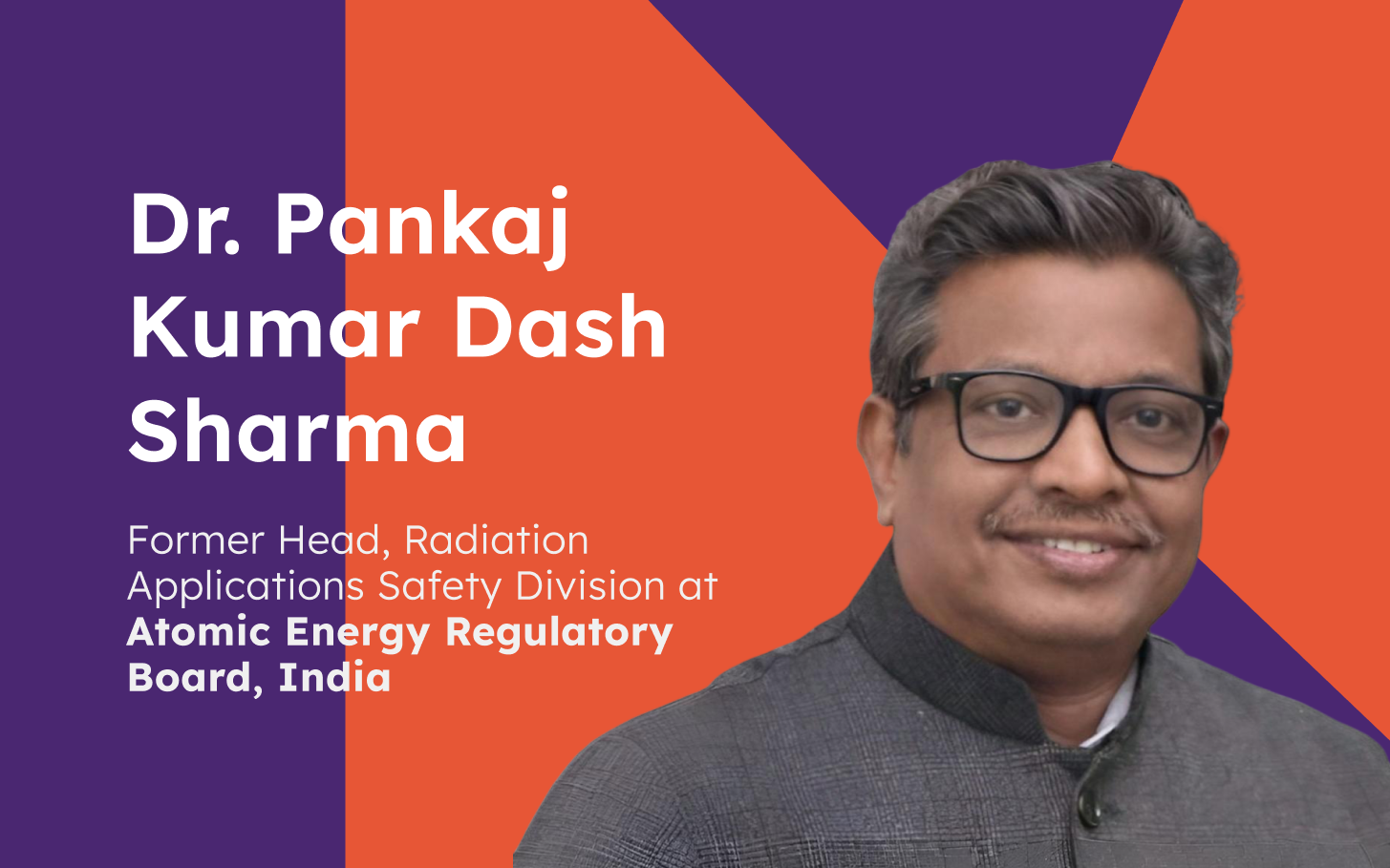
With over three decades of distinguished experience spanning research, regulation, industry, and healthcare, Dr. Pankaj Kumar Dash Sharma has played a pivotal role in strengthening India’s radiation safety ecosystem. From his early career at BARC (Bhabha Atomic Research Centre) to leading the Radiation Applications Safety Division (RASD) at AERB (Atomic Energy Regulatory Board), his journey reflects deep scientific rigor, regulatory insight, and an unwavering commitment to safety. In this conversation with OnestopNDT, he shares reflections on his professional journey, regulatory evolution, technological advancements, and guidance for future professionals in radiation safety and NDT.
Dr. Sharma, welcome to OnestopNDT — it’s a privilege to have you with us. You bring over three decades of experience across regulatory, industrial, research, and healthcare environments, including leading the Radiation Applications Safety Division at Atomic Energy Regulatory Board (AERB). Could you walk us through this remarkable journey and how your roles have evolved from BARC (Bhabha Atomic Research Centre) to AERB?
Thank you for the warm welcome. I would like to sincerely thank OnestopNDT for providing me with an excellent opportunity to share my views with the stakeholders of NDT practice.
My professional journey began at BARC after acquiring experience with an NDT company as a Radiological Safety Officer (RSO) and at a Radiation Therapy Centre as a Medical Physicist/RSO. The experience thus gained helped me immensely during both my Research & Development (R&D) activities at BARC and later during regulatory functions at AERB.
At BARC, I was directly involved in R&D activities, particularly in the field of radiation safety and dosimetry across medical, industrial, and research applications. During the later phase of my tenure at BARC, I was also engaged in advisory services for radiation facilities.
AERB was established in 1983 as an independent regulatory authority to ensure that the use of ionizing radiation and nuclear energy in India does not cause undue risk to public health or the environment. However, even after its establishment, BARC continued to provide advisory and regulatory services to radiation facilities across the country. It was only in 2001 that a few officers from BARC, including myself, were transferred to AERB to strengthen regulatory oversight.
Over the years, my responsibilities expanded to include policy formulation, development of regulatory documents, safety evaluations, licensing, inspections, incident investigations, and enforcement actions. As Head of the Radiation Applications Safety Division (RASD), I was responsible for overseeing radiation safety across medical, industrial, and research applications nationwide.
This progression enabled me to develop a holistic understanding of radiation risk management—balancing technological advancement with occupational and public safety.
You began your academic journey in physics with an M.Sc. and went on to complete a Dip.R.P. and later a Ph.D. from the University of Mumbai. How did this strong scientific foundation shape your long-term orientation toward radiation safety, compliance, and regulatory oversight?
After completing my M.Sc. in Physics from Sambalpur University in 1987, I began my career as a Physics teacher, which was personally fulfilling, as I have always been passionate about teaching.
At that time, access to information was limited compared to today’s digital era. When I was selected for the Diploma in Radiological Physics (Dip.R.P.), I joined primarily because of the association with ‘BARC,’ without fully understanding the scope of the course. However, the one-year rigorous training in this applied branch of physics completely transformed my professional trajectory.
Although the course content was primarily oriented toward Medical Physics in oncology settings, limited job opportunities led me to begin my career as a Radiological Safety Officer (RSO) in an industrial radiography company. Later, I joined a cancer hospital as a Medical Physicist-cum-RSO. These early experiences provided me with first-hand exposure to both industrial and medical radiation practices before joining BARC in 1992.
I completed my Ph.D. from the University of Mumbai after moving to AERB.
My combined experience in industry, medical institutions, BARC research, and regulatory oversight shaped my professional outlook decisively. The strong scientific foundation helped me adopt a risk-based regulatory approach rather than a checklist-driven model. It also enabled effective communication with licensees, radiographers, and safety professionals—bridging theory with field realities.
I am pleased to note that this scientific rigor and professional integrity earned me recognition as a strict yet fair regulator among stakeholders. This approach aligns closely with international radiation protection philosophies promoted by agencies such as the IAEA.
Radiation safety intersects both technology and governance. In your early years as a Medical Physicist and later as Scientific Officer at BARC, what foundational lessons did you carry forward that proved critical when transitioning into a regulatory leadership role?
Mankind has benefited immensely from the use of radiation sources, including both radioactive materials and radiation-generating equipment such as X-ray systems. However, ionizing radiation is a double-edged sword and must be handled with utmost care, as it can cause significant harm to living beings.
A major challenge is that radiation cannot be detected by human sensory organs.
One foundational lesson from my early career was that radiation incidents are rarely caused solely by equipment failure. More often, they stem from human and organizational factors—fatigue, time pressure, inadequate supervision, or communication breakdowns.
From a regulatory perspective, I repeatedly observed that procedures existed and equipment was certified, yet safety steps were bypassed under commercial pressure. This reinforced my conviction that effective regulation must address safety culture, human factors, and managerial accountability—not merely technical compliance.
As Head of RASD (Radiation Applications Safety Division), you oversaw regulatory inspections, safety documentation, and radiation protection across medical, industrial, and research sectors. From your vantage point, how have India’s standards, compliance culture, and regulatory maturity evolved over the last two decades?
Over the past two decades, India’s radiation regulatory framework has evolved substantially. Licensing processes have become more structured, inspections more systematic, and training requirements clearly defined.
During my tenure, AERB revised all Safety Codes and Guides pertaining to radiation applications, aligning them more closely with international standards. In December 2025, AERB published a unified Safety Code on Radiation Sources, Equipment, and Installations (AERB/RF/SC), enhancing coherence across sectors. Additionally, five practice-specific Safety Guides—including the Safety Guide on Industrial Radiography (AERB/RF/SG/IR)—were issued.
These guides provide flexibility, allowing end users to adopt alternative compliance approaches with AERB approval, thereby improving practicality without compromising safety.
After 2001, a clear regulatory separation emerged, and AERB strengthened enforcement and awareness initiatives. Through sustained outreach, seriousness toward radiation safety and compliance increased significantly among end users.
Industrial users—particularly in NDT—operate sealed sources, radiography cameras, X-ray systems, and other radiation-emitting devices. From a regulator’s perspective, what factors determine whether user industries are prepared, compliant, and safety-conscious in their operations?
Industrial radiography is one of the most challenging radiation applications globally due to mobile worksites, night operations, and demanding working conditions.
Unlike fixed facilities, radiography services are often performed at third-party premises not fully controlled by the radiography company. Since the entry cost is relatively low, intense competition sometimes results in shortcuts.
From a regulatory perspective, preparedness is reflected not in documentation alone but in day-to-day behavior—visible management commitment, empowered Radiation Safety Officers, realistic work scheduling, fatigue management, and strict exposure control.
Incident reviews consistently show that lapses occur when commercial urgency overrides safety discipline. Organizations that embed safety as a core operational value demonstrate superior compliance and fewer incidents.
One of your major contributions was steering the eLORA e-Governance initiative, which transformed licensing, compliance, and inspection workflows. What drove its development, and how significantly has it reshaped regulatory transparency and ease of doing business for radiation users?
It became evident that regulating a rapidly growing number of radiation facilities with limited manpower required digital transformation. Manual systems lacked traceability and efficiency.
The solution was a comprehensive IT-enabled platform—eLORA—which established a centralized database of institutions, sources, equipment, trained manpower, and lifecycle tracking mechanisms.
eLORA modernized regulatory workflows and enabled graded (risk-based) oversight. Low-risk applications could be auto-cleared using embedded business logic. During the COVID era, eLORA ensured uninterrupted regulatory functioning.
The system was recognized as a ‘Good Practice’ by the IAEA during its review of AERB.
For NDT companies, eLORA simplified licensing, source tracking, and compliance reporting, enhancing transparency and ease of doing business while strengthening oversight.
For organizations deploying radiography or radiation-based NDT, what key factors should guide their procurement decisions—whether it’s equipment design, safety interlocks, operator training, lifecycle compliance, or source management?
Procurement decisions in industrial radiography are fundamentally safety decisions. Beyond cost and performance, organizations must consider: (i) equipment reliability, (ii) robust safety interlocks, (iii) availability of spares, (iv) training support, and (v) source return and disposal arrangements.
AERB grants Type Approval to sources and equipment after design scrutiny. Users must procure only approved devices.
International experience shows that poorly planned procurement leads to long-term safety and compliance challenges. Lifecycle compliance must therefore be considered at the procurement stage itself.
Technology continues to evolve, with digital radiography, portable X-ray systems, AI-based interpretation, and integrated safety architectures becoming more prevalent. How do regulators view such advancements, and how should industry prepare for the next phase of modernization?
Regulators welcome advancements that reduce reliance on high-activity gamma sources. Digital radiography and portable X-ray systems offer substantial risk reduction potential.
Radiation safety combines ‘Built-in Safety’ and ‘Operational Safety.’ Open-field gamma radiography relies heavily on operational controls, whereas enclosed radiography and the use of radiation-generating equipment offer better inherent safety.
However, technology alone does not eliminate risk. Regulators expect proper validation, retraining, and updated operational procedures. Human competence must evolve alongside technological advancement.
There is often a narrative gap between regulators, equipment manufacturers, and end users. From your experience, what mechanisms or collaborative forums could help bridge these perspectives and strengthen India’s radiation safety ecosystem as a whole?
This gap exists globally. Regulators observe repeated non-compliances, while industry perceives rigidity.
Structured engagement—workshops, guidance documents, and shared learning—bridges this divide. AERB regularly organizes platforms such as the National Conference on Regulatory Interface, encouraging dialogue without compromising safety.
Collaboration improves safety outcomes more effectively than enforcement alone.
Midway through our conversation, we want to highlight an important achievement—your recent selection for the prestigious DAE–Homi Sethna Chair, which enables continued contribution to radiation safety frameworks at AERB. Could you share what the focus areas of this three-year tenure will be and what impact you envision?
The DAE–Homi Sethna Chair enables experienced retired professionals to continue contributing meaningfully.
Though I am yet to formally join, this is a great honor. My focus areas are expected to include stakeholder engagement, simplification of regulatory processes, alignment of regulatory documents under the SHANTI Act, 2025, and providing structured feedback to strengthen compliance without compromising safety.
Training and competency play a central role in radiation protection. Based on your experience, what gaps still remain in awareness, certification, or operator-level responsibility—especially within industrial radiography and NDT segments?
Industrial radiography involves high-activity sources and limited built-in safety, making operator competence critical.
Given challenging working conditions and limited financial incentives, attracting and retaining skilled manpower remains difficult.
Despite certification systems, gaps remain in refresher training, supervision, and accountability. Many near-misses reveal that principles were understood but not applied under operational pressure.
Continuous competency development is essential beyond one-time certification.
Given your interactions with hospitals, research facilities, industrial radiography companies, and regulators, how do you see India balancing innovation with safety—particularly when industries demand faster workflows, lower costs, and increased productivity?
Advancements in equipment design have improved inherent safety. Earlier shutter-based cameras were more vulnerable to misuse. Modern devices provide improved source security.
Newer isotopes, such as Selenium-75-based cameras, offer shielding advantages for thinner jobs.
Indigenous manufacturing initiatives by BRIT are expected to enhance cost-effectiveness and productivity.
Globally, shortcuts often result in incidents and reputational damage. Safety must therefore be seen as a productivity enabler rather than a constraint.
Balancing innovation with safety is central to modern regulatory thinking worldwide and is essential for sustainable industrial growth.
On a personal note, you’ve always been passionate about teaching and knowledge-sharing. What drives that interest, and how do you like to spend your time outside work? Also, do you see academia–industry–regulatory collaboration strengthening in the coming years?
Teaching has always been close to my heart. Nation-building requires knowledge-sharing.
I have never hesitated to share knowledge fully, believing that collective competence strengthens institutions. Teaching embeds safety institutionally rather than individually.
I remain optimistic about stronger academia–industry–regulatory collaboration as technologies and standards evolve.
To conclude, what message would you like to share with young professionals entering radiation safety, regulatory sciences, industrial radiography, and NDT domains—especially at a time when technology, standards, and workforce skills are rapidly evolving? And how do you view the role of platforms like OnestopNDT in bridging knowledge, community learning, and industry–academic–regulatory collaboration going forward?
My message to young professionals is simple: never underestimate radiation risk. Familiarity must not breed complacency. Professional competence must always align with ethical responsibility.
Platforms like OnestopNDT play a vital role in disseminating best practices, fostering dialogue, and strengthening global NDT collaboration.
Thank you once again for this opportunity.
Dr. Sharma’s journey reflects not only technical excellence but also a profound commitment to safety culture, regulatory integrity, and knowledge-sharing. His insights underscore the importance of balancing innovation with responsibility, enforcement with collaboration, and competence with ethics. As radiation technologies continue to evolve, such leadership perspectives remain invaluable in guiding the next generation of professionals and strengthening India’s radiation safety framework.