
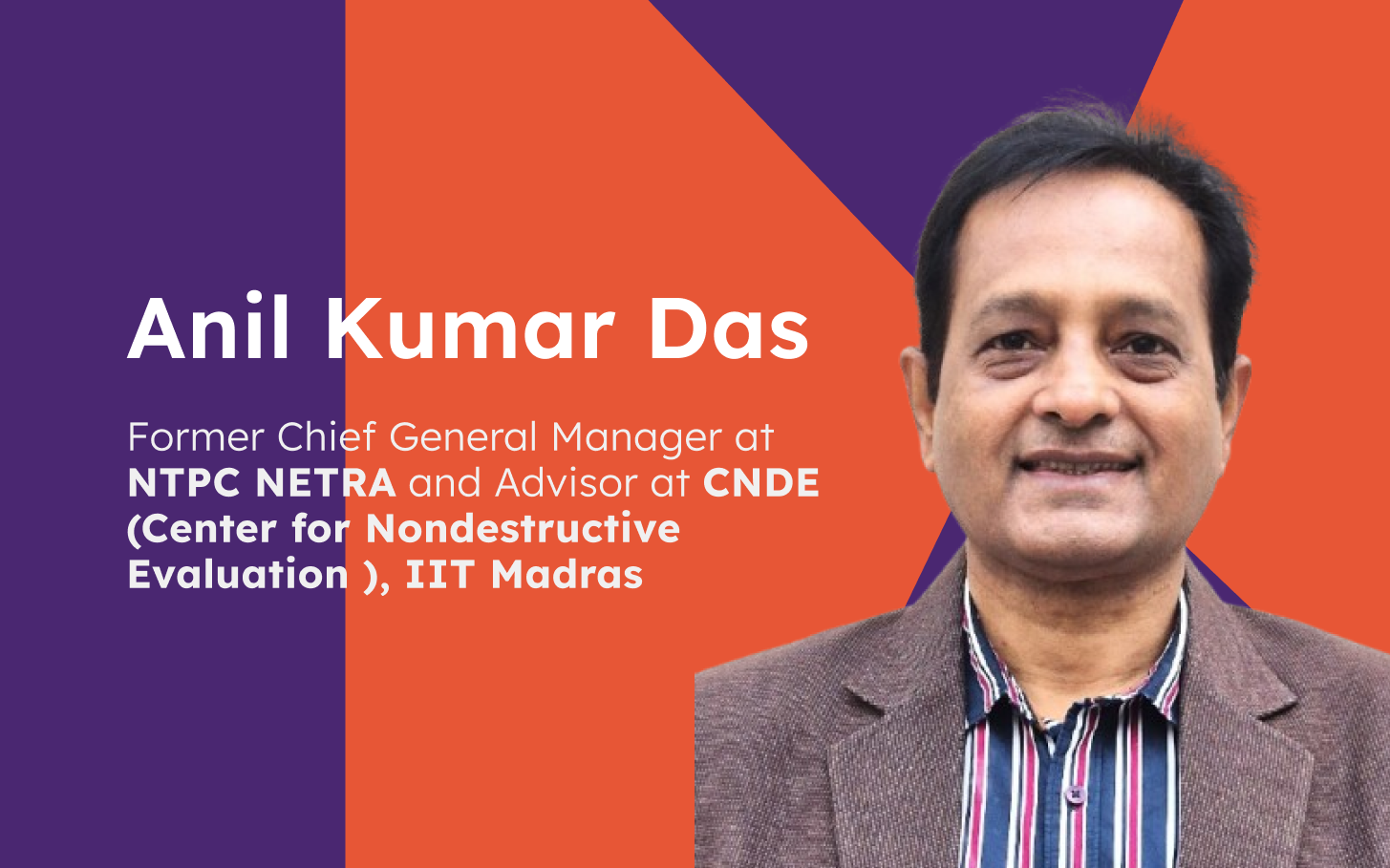
With decades of experience in power plant diagnostics, asset integrity, and advanced non-destructive evaluation (NDE), Mr. Anil Kumar Das, Former Chief General Manager at NTPC NETRA (NTPC Energy Technology Research Alliance) and Advisor at CNDE (Center for Nondestructive Evaluation ), IIT Madras, has played a pivotal role in strengthening inspection and reliability practices across India’s power generation fleet. Having contributed extensively to research-driven diagnostics and life assessment methodologies, his work has helped integrate advanced NDT technologies into large-scale utility operations. In this conversation with OnestopNDT, Mr. Das reflects on his journey at NTPC, the evolution of inspection science in the power sector, and the growing importance of advanced diagnostics, digitalization, and collaborative research in ensuring the reliability of critical infrastructure.
Could you take us through your journey at NTPC and how your professional focus evolved toward R&D and advanced diagnostics?
First of all, my thanks for this opportunity to share my career journey. I joined NTPC through campus placement after completing both my B.Tech. and M.Tech. from I.I.T. Kanpur. The selection by NTPC was specifically for its R&D division, unlike its regular recruitment of Executive Trainees (ETs) for graduate professionals. Hence, the start of my career was with the NTPC R&D centre, which was later merged with another division and renamed NETRA (NTPC Energy Technology Research Alliance) to encompass various energy technologies for sustainable power generation in India. Being the largest power utility in India, NTPC provided me with extensive opportunities and freedom to explore research in areas related to scientific services for power plants, which was essential for a growing utility with a strong footprint in thermal power generation. Condition monitoring and health & life assessment took a central role to ensure the reliability & availability of power plants, which were primary goals in those days. This naturally led to my focus on advanced diagnostic tools to increase coverage and reliability of critical components.
How did you see research-driven insights translating into large-scale operational reliability across India’s power generation fleet?
During my initial years at R&D/NETRA, we broadly identified three categories for our research efforts in diagnostics. In the first category, there were advanced NDE methods and systems being used abroad either directly for power plants or for some components of other industries. There was a clear need to adapt these advanced NDE methods for our specific applications in Indian power plants. I would specifically like to mention Phased Array Ultrasonic Testing (PAUT), for which there were references in the literature for being used for inspection of turbine blades and welds on pipes & tubes. I recall writing a technical review paper back in 2005 on the applications of PAUT for power plant components in the NTPC R&D Journal. We familiarized ourselves with PAUT, procured a 32:128 PAUT system, and commenced PAUT of 500 MW LP turbine blades in 2011 during a forced shutdown of the unit due to blade failure. In subsequent years, we encouraged its use for pipe inspections by making it a mandatory tool for Residual Life Assessment (RLA) of critical piping of NTPC power plants.
Around 10 years ago, we began laboratory experiments to extend the use of PAUT for inspection of welds on boiler tubes using customized probes, wedges, and scanners. With hundreds of kilometres of boiler tubes being used in power plants, it is imperative to inspect them during erection as well as in service. This exercise with PAUT was done to explore the reliability of this tool as an alternative to Radiography Testing (RT), as parallel maintenance/erection activities are stopped while carrying out RT of tubes to avoid radiation exposure to working manpower. We compared PAUT results with RT and found that PAUT offered superior sensitivity for planar defects, which are critical for weld integrity. Even for porosity and slag, its performance was satisfactory. However, convincing plant personnel for its large-scale implementation during annual overhauls or boiler erection was a major challenge. With strong support from our Operation Service (OS) departments and various field demonstrations by our colleagues at NETRA, plant personnel eventually realized its benefits. Now it is part of the Standard Operating Guideline (OGN) for boilers in NTPC and is performed on a large scale. Also, with increased demand, we identified external vendors and shared the test procedure. Now PAUT of welds on boiler tubes is done extensively and, in some sections, there is 100% coverage with RT (NTPC ensures RT percentage to comply with IBR requirements). Various research-backed initiatives of this type have been helpful in improving the reliability of power plants.
What are the most pressing integrity challenges facing aging thermal power assets today?
The concern for the integrity of power plants, especially boilers, gained prominence in the nineties as 200/210 MW units crossed 100,000 hours of operation. Similarly, concerns for maintaining the integrity of gas turbines increased during the end phase of OEM warranties with gradual depletion of costly mandatory spares. Utilities had to either buy the costly spares or try to extend the life of the components through in-house assessment and refurbishment, if feasible. For generators and steam turbines, efforts focused mostly on ensuring their healthiness and efficiency.
The Indian Boiler Amendment Bill of 1998 envisaged NDT-based life assessment for boilers after specific operating intervals. However, IBR regulations 391A related to this only mentioned the tests without any guidelines on test locations or explicit acceptance criteria. Moreover, for static components like pipes & headers, there was no test recommended for direct life calculation, except an empirical method based on in-situ metallography. All these were left to the discretion of the authorized RLA agencies carrying out the inspection.
As one of NTPC R&D’s major objectives has been to support plants with advanced scientific services, building expertise in health and life assessment became imperative. With the gamut of coal and gas-based power plants in NTPC, the task was quite challenging. Metallurgy for coal and gas-based plants differs significantly; Nickel- and Cobalt-based superalloys dominate gas turbines, while Carbon, Low alloy, CSEF, and Austenitic steels are used for coal based power plants.
I strongly believe NDE experts must be conversant with what I call the 'DLSR' approach. The ‘DLS’ part relates to ‘D-D-L-L-S-S’: Drawing (dimensions/material), Damage mechanisms, Locations (critical areas), Location of expected defects (ID/OD/subsurface), and the Size and Shape of defects. This must be supplemented with knowledge of ‘RRR’ (Run, Repair, Replacement) decisions to complete the chain. While these acronyms are simple, they require significant effort and training to develop a proper understanding of the various materials and their damage mechanisms under different operating conditions.
Furthermore, while “RRR” decisions are often in compliance with OEM guidelines, having a good knowledge of them is vital for Utilities lacking prompt OEM support. This is especially important for costly hot gas path components in gas turbines, where there is often scope for life extension with periodic refurbishments. Combining the roles of a 'pathologist' with a 'treating physician' to cover the entire health-assessment chain is challenging but necessary. Beyond the challenge of having the right experts for assessment and recommendations, the significant uncertainty in the figure of estimated life is another hurdle, which is why I emphasize periodic NDE assessments to obtain a realistic idea of component integrity.
How critical is early detection through advanced NDT in preventing catastrophic failures and unplanned outages?
Even with low PLF, maintaining high availability and reliability of a power plant is a major priority for a Utility. Any unplanned outage is very costly—a forced outage of an 800 MW unit for 3 days on account of boiler tube leakage can result in a direct operational profit loss of approximately ₹6 crore. This does not take into account the indirect economic burden on industries forced to use other modes of electricity at higher cost. The outage periods can be even longer in case of problems with turbines, generators, or transformers.
In many situations, applying advanced NDE beforehand helps in identifying defects during fabrication or in service so that corrective actions can be taken. For example, in NTPC, we started using PAUT long ago for detecting cracks in the root area of installed LP blades; this helped in increasing overhauling intervals of the turbine. Similarly, extensive use of PAUT ensured timely identification of defective welds in many boiler tubes.
We have also utilized external vendors for LFET/RFET-based boiler tube inspections to identify tubes with significant thickness loss during service. Similarly, for gas turbines, we used FSECT (Frequency Scanning Eddy Current Testing) to non-destructively assess coating degradation on blades and vanes to decide on inspection intervals and refurbishment. We developed an ultrasonic parameter-based systematic procedure for detection of hydrogen damage in waterwall tubes, which helped in early identification of affected tube sections for their timely replacement. We developed (and also patented) MCF (Magnetic Coercive Force)-based methods to identify and quantify exfoliated oxide build-up at stainless steel boiler tube bends to prevent blockage and subsequent overheating and failure. Furthermore, we extended MCF applications to assess the adequacy of PWHT for T91 tube welds to avoid failure.
We also developed a miniature robotic device with CMERI for internal visual inspection of headers and more than 500 headers have been inspected across NTPC to identify any foreign objects likely to block steam flow or any service-induced defect. NTPC remains at the forefront of adopting advanced NDE methods to enhance plant reliability and these advanced methods have helped avoid or reduce recurrent failures.
How do you evaluate when to deploy advanced NDT techniques versus conventional inspection methods?
This is a very interesting question. Based on my experience in the power sector, I do not undermine conventional NDE methods, and they in-fact constitute a significant portion of NDE inspections for power plants. For specific applications, such as gas turbines, a majority of hot gas path components are inspected by DPT for the detection of surface cracks, as they are made of non-magnetic superalloys. Similarly, MPI is a very sensitive method for detecting surface and subsurface defects in magnetic components like steam turbines, headers, and pipes. My only suggestion is to be aware of the 'dos and don'ts' or the 'myths and realities' of these methods, as these tests are mostly supervised while workers execute the testing.
We all know that many advanced NDE methods are often extensions of conventional ones—like PAUT and ToFD for UT, or Digital RT for film-based radiography, Eddy Current Array, and various advanced Electromagnetic Testing methods as extensions of conventional methods based on distortion of the magnetic field or induced current. These advanced NDE methods often provide better sensitivity and enhanced coverage in a reasonable time compared to the conventional inspection methods.. Preference for these methods should depend on the criticality of the application. I would discourage using advanced NDE, where conventional methods offer similar results; for example, there is no benefit in using PAUT for the detection of debonding or thickness mapping. With some modification of conventional methods, some specialized NDE tools have also been developed that are quite useful- like, electromagnetic-based methods for creep assessment and for detection of internal loss in austenitic boiler tubes. My only advice to Utilities is to use reference samples with known defects to evaluate the reliability of newer NDE tools.
How do you balance operational urgency with the need for deeper forensic investigations and root-cause analysis?
As it often happens, plants need to restore the units at the earliest, making the availability of the components difficult for detailed investigation. Fortunately, in many cases, like the failure of boiler tubes, the failed portion can be cut and made available for detailed analysis. NTPC has an Advanced Failure Analysis Lab with experts at its NETRA campus, receiving ~250 samples annually from NTPC and external Utilities for detailed condition and failure analysis. For various recurrent failures, NETRA has successfully identified root causes, which may include stress corrosion cracking, hydrogen damage, overheating, fatigue, etc., which has helped the plants take corrective actions to avoid recurrent failures. In many cases, our expertise in identifying failure patterns and analyzing fracture surfaces, supported by information on operational parameters, helps in the early identification of the root cause without detailed investigations.
How do you see digital twins, predictive analytics, and AI influencing life assessment methodologies in the power sector?
The mandatory requirements of life evaluation, at least for boilers, after certain operating hours are still based on conventional NDE, metallography, deposit analysis, and tensile testing. However, Utilities that are aware of the relevant developments in AI in their areas of interest have gradually started exploring their aaplications. A major challenge in this regard is the availability of data related to initial material properties and operational history, which are vital for reliable results. Furthermore, various design parameters required for life assessment software are only available with OEMs and are not known to the Utilities. Also, to take advantage of these advancements and the benefits of NDE 4.0 developments, digitization and digitalization are major requirements. A few Utilities, like NTPC, have realised this and are making efforts to generate more digital data for such applications. Plant personnel are gradually realizing the importance of digital twins for inspection, and drone-based inspections of chimneys, switchyards, coal stockpiles and solar panels are now common. Various software solutions for predictive maintenance and efficiency optimization are already in use across various plants.
How important is industry–research–government collaboration in advancing inspection science in India?
The chain from idea conceptualization to commercialization requires strong linkages among research institutions, industries, and vendor partners. The necessary inputs, scope, and funding for the same are often provided by the concerned industries or the government. Some companies may have in-house R&D for this purpose, while others can leverage the expertise of CSIR labs or academic institutes to avoid reinventing the wheel. Strong collaborations exist between organizations and research labs or academic institutes to explore solutions to the concerned problems, reach higher TRL levels, or conduct field validations. In NDE, CNDE (IIT Madras) and labs like NML and CMERI are very forthcoming in offering inspection solutions to industrial requirements. This approach helps in optimizing resources and time for obtaining solutions. NTPC has been very active in knowledge networking with institutions at national and international levels. Even collaborations with start-ups are encouraged nowadays for their focused dedication and flexibility.
What key factors influenced investment decisions in advanced inspection technologies?
NTPC has always put great emphasis on the availability and reliability of power plants. NTPC provides around one-fourth of the power to India, with around a one-sixth share in the total installed power capacity of the country. NETRA Labs, as part of the Central R&D of NTPC, have been aiming to be a Centre of Excellence, making it natural to have state-of-the-art facilities to support NTPC and other power stations in achieving high efficiency and reliability. As the saying goes, investment in the right inspection tools and quality compliance does not increase costs; rather, it returns the cost with benefits. This is very apt for NETRA too. With the deployment of these tools, if even a few outages can be avoided, or if it results in improvement in efficiency and availability, the investment is worth it. With this philosophy, NTPC has been very forthcoming in investing in lab-based analytic tools as well as inspection systems for field-based investigation.
How do you build a culture where inspection findings are translated into decisive management action?
This is an interesting dimension. Being part of India's largest power utility, NETRA has the advantage of having different fronts/stations available for validation of in-house developed inspection tools with their various iterations. Often, test samples are made available for repeated experimentation. This, coupled with the availability of advanced tools and a better understanding of metallurgy and damage mechanisms, helps in the development of reliable inspection tools. Generally, these specially developed tools or procured hardware are not easily available and provide the stations with opportunities to have reliable inspection with enhanced coverage. NETRA recommendations based on these inspections and subsequent analysis are appreciated by the stations as they help them to make better decisions.
On a personal note—after decades in high-responsibility roles, how do you unwind?
Thanks for this question on a separate note. Since my school days at Netarhat Residential School—a famous government boarding school emphasizing all-round development—I have been very active in sports-, playing football, volleyball, hockey, and table tennis. At IIT Kanpur too, I was in the Institute Volleyball team. Hence, in my leisure time, I enjoy playing different sports, including table tennis. Apart from that, listening to music and, on a lighter note, even singing relaxes me. Also, as Head of the Scientific Service Division of NETRA, one needs to delve into areas like NDE, metallurgy, corrosion, water chemistry, coal combustion, and diagnostics based on lubricating and transformer oil analysis, etc. Studying interesting concepts in these diverse areas and interacting with respective domain experts provide a great opportunity to unwind.
Do you foresee changes in inspection philosophy with India’s evolving energy mix and renewables?
I appreciate your question regarding the future of NDE. We must keep in mind that while the share of coal-based installations has reduced to ~50% of India's installed capacity, its share in generation is still over 70%. So, coal-based generation will remain relevant for a few more decades. As these coal-based plants age, they will require more periodic NDE inspections and specific tools to maintain their availability. There is increasing emphasis on integrating AI, robotics, and simulation to increase coverage and reliability.
For power generation from other sources, NDE has a different scope. In hydro plants, it focuses on the turbine area, where erosion is the major damage mechanism. For wind power, inspection of wind turbines is critical and requires specialized setups due to height restrictions, though the NDE methods remain similar. In solar stations, drone-based inspection of scattered PV panels for checking their integrity and luminescence would be a major requirement.
What advice would you offer to young engineers building careers in NDT and asset life assessment?
As mentioned earlier, I prefer a holistic approach for health and life assessment involving the 'DLSR' approach, which requires familiarity with the component—its material, damage mechanism under the operating condition, along with knowledge of the critical locations to be inspected and an idea of expected defect morphology. This helps NDE experts in selection of the right non-destructive techniques and parameters. Knowledge of 'RRR' decisions makes one more confident in providing recommendations. I would advise young engineers to keep the above approach in mind as it not only helps in developing expertise but also increases the value of the expert. One should always make efforts to keep abreast of the latest developments in one’s respective area for career advancement.
From a utility CXO perspective, how valuable are platforms like OnestopNDT in strengthening the inspection ecosystem?
In the field of NDE, there are various forums for knowledge exchange, with some providing open-access databases of technical literature and proceedings of conferences and workshops. OnestopNDT is a valuable platform that connects individual professionals and researchers with service providers and manufacturers into a global NDT community. As NDE is a multidisciplinary inspection tool applicable across multiple industries globally, such forums are of great importance for market connectivity and for staying updated. The thoughts of great visionaries, industry leaders, and NDE experts shared through this forum are helpful to all stakeholders, including aspiring NDE professionals, in broadening their vision.
The insights shared in this discussion highlight the critical role of advanced diagnostics, systematic inspection methodologies, and collaborative research in ensuring the long-term reliability of power generation assets. With decades of experience at NTPC NETRA, the former Chief General Manager has contributed significantly to integrating advanced NDT practices into large-scale utility operations. As India’s energy landscape continues to evolve with aging infrastructure and emerging renewable technologies, the importance of robust inspection ecosystems, skilled professionals, and knowledge-sharing platforms will remain central to maintaining safety, efficiency, and reliability across the power sector.


