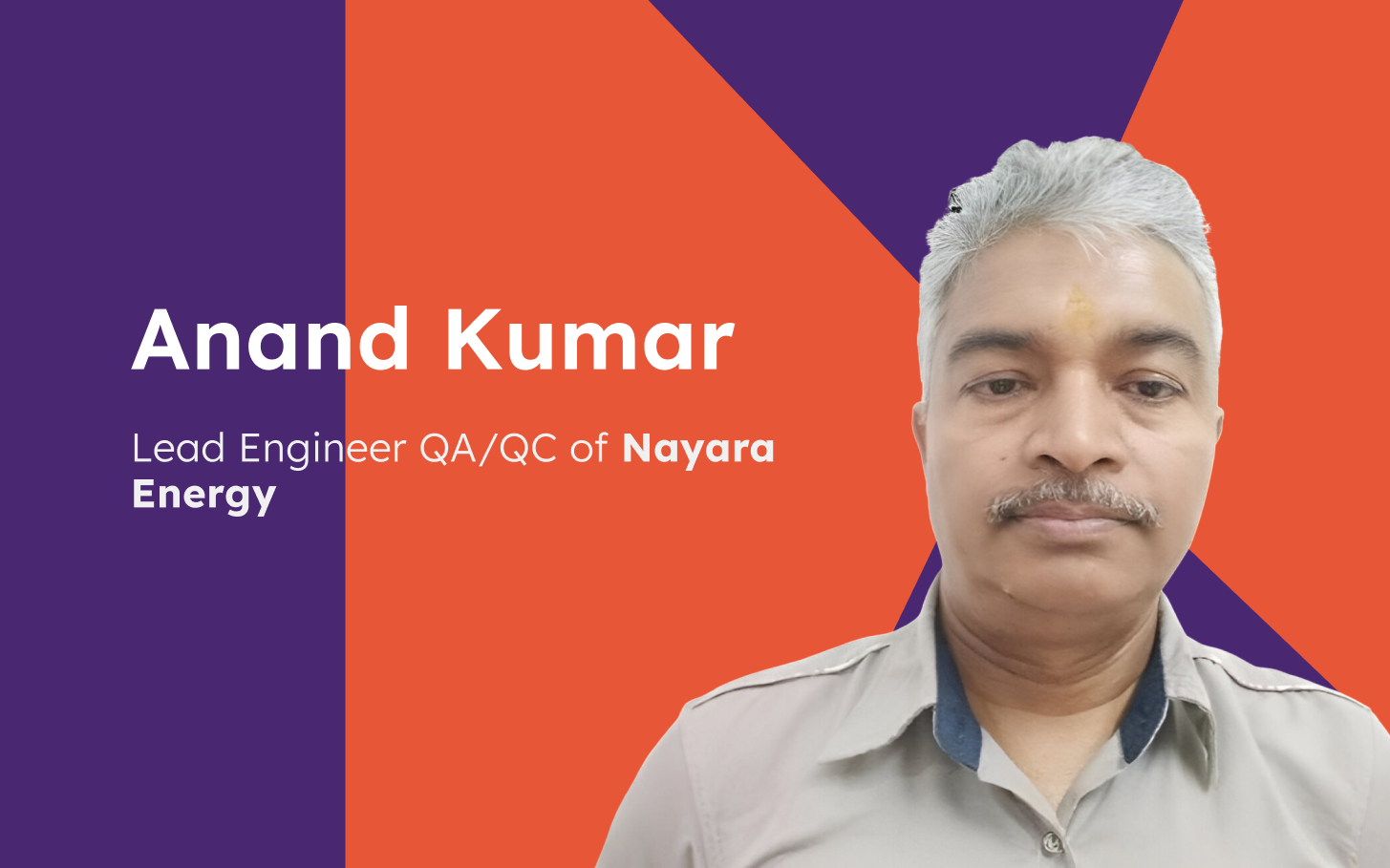
In this exclusive conversation with OnestopNDT, Mr. Anand Kumar shares insights from a career spanning over two decades across petrochemical, fertilizer, and refinery sectors. From hands-on construction exposure to leading reliability and inspection functions at major organizations like KRIBHCO, Reliance, and Nayara Energy, he reflects on how curiosity, discipline, and deep technical grounding shaped his journey. This interview explores asset integrity, inspection philosophy, evolving NDT practices, and the future of reliability engineering.
Mr. Anand, welcome to OnestopNDT—it’s a pleasure to have you with us today. To begin, you’ve spent over two decades across petrochemical, fertilizer, and refinery sectors in roles spanning QA/QC, reliability, inspection, and now contributing at Nayara Energy. Could you share how this journey evolved and what initially drew you toward the reliability and inspection domain?
I had a love for machines during my childhood. So, when I got the opportunity, I selected Mechanical Engineering in my college. My journey started with SVC Supechem, a petrochemical (Purified Terephthalic Acid) plant, in May 1997 as a Graduate Engineer Trainee just after finishing my final semester exam. The plant was in the construction phase at that time. There was no formal training program in the company, and very little information was available in textbooks about the construction of a petrochemical plant. Project-specific documents were also not easily available for reference in those days. You simply had to follow the instructions of seniors. So, I had to learn on my own by talking to my seniors, technicians, fitters, welders, gas cutters, grinders, helpers, and riggers.
My curious nature and compassion for human beings helped me navigate through this difficult time. Difficult times make strong people, and so I am. The plant was commissioned in April 1998. At the same time, I got the opportunity to work with KRIBHCO. KRIBHCO has one of the best training programs for Graduate Engineers. After the formal training at KRIBHCO, there was an evaluation, and I was judged as the best engineer. As per KRIBHCO culture, the best engineer is assigned to the inspection and condition monitoring department, also called the NDT department. This initially drew me toward the reliability and inspection domain.
Your work at Nayara Energy and previously at Reliance involved bridging both construction and in-service reliability. How has that dual exposure shaped your perspective on equipment life cycle—from fabrication to commissioning to long-term inspection?
Dual exposure experience in both the fabrication and manufacturing of equipment and its operation, maintenance, and inspection fundamentally transforms the perspective on the equipment life cycle from a linear, siloed process to an integrated, “cradle-to-grave” view. This dual perspective bridges the gap between design intent and field reality, enabling a more proactive and cost-effective approach to asset management.
Understanding that small, early-stage fabrication defects, such as improper welding or material selection, become major and costly inspection failures years later reinforces the need for rigorous, high-standard initial fabrication.
Commissioning is no longer seen merely as a “check-the-box” handover but as the critical foundational moment for gathering performance data. This phase is used to identify infant mortality failures (premature failures) before they affect production, ensuring that site-installed equipment behaves as designed in the field.
The perspective shifts from corrective maintenance (fixing when broken) to predictive and preventive maintenance, using inspection data to predict failure points based on early manufacturing knowledge of weak points.
Over the years, RBI (Risk-Based Inspection) frameworks have become central to asset integrity management. From your experience, what are the key success factors when implementing RBI in brownfield facilities versus greenfield projects?
Implementing Risk-Based Inspection (RBI) in brownfield facilities differs significantly from greenfield projects, primarily due to data availability, asset condition, and the ability to redesign.
Key success factors for brownfield implementation include gathering and validating existing inspection data, maintenance records, and corrosion reports to determine the actual condition of assets.
Key success factors for greenfield implementation include using design data, material specifications, and manufacturer information as the primary basis for calculating initial Probability of Failure (POF) and Consequence of Failure (COF). The RBI process should be utilized early to identify potential future failure points and to design equipment to be more inspectable, such as allowing easier access or optimized material selection. Establishing a robust, high-quality “as-built” baseline inspection acts as the foundation for all future inspections.
You have deep working familiarity with standards such as API, ASME, ASTM, TEMA, and NACE. How do you see standard harmonization advancing, and which areas still pose challenges for practitioners in developing inspection or maintenance strategies?
Based on deep working familiarity with API, ASME, ASTM, TEMA, and NACE, the landscape of standards is shifting from fragmented, document-specific rules toward a more integrated, risk-based ecosystem. However, practitioners still face significant hurdles in bridging the gap between design-focused codes and in-service inspection realities. Harmonization is advancing through closer collaboration between organizations.
The division of responsibility is becoming clearer. ASME (Section VIII, B31.3) acts as the foundation for design and construction, while API (510, 570, 653) dominates in-service inspection, repair, and alteration. Recent updates emphasize a seamless transition, where API 510/570/653 directly references ASME PCC-2 for repair techniques and ASME Section V for NDT, creating a more cohesive life-cycle management approach.
API 580/581 is increasingly used to bridge the gap, allowing practitioners to set inspection intervals based on risk rather than fixed, arbitrary time cycles. This is harmonizing how ASME-designed equipment is maintained across different regulatory environments.
NACE (now AMPP) MR0175/ISO 15156 is being better integrated with ASTM material specifications and ASME design allowable stresses to prevent premature failures in sour service.
TEMA standards for heat exchangers are now routinely combined with ASME Section VIII, with ASME handling pressure boundary compliance and TEMA governing detailed mechanical tolerances, resulting in more robust exchanger designs.
Despite these advancements, several areas remain challenging. While API 579-1/ASME FFS-1 provides a common framework for evaluating damaged equipment, interpreting the results—particularly for complex geometries or combined corrosion and fatigue—remains difficult and requires high-level expert judgment.
While ASTM ensures material quality, matching the right ASTM specification to NACE MR0175 requirements for sour service is often mismanaged, leading to improper material selection.
While API 510/570 rely on ASME Section V for NDT, acceptance criteria can differ between the construction code (ASME) and the repair code (API/PCC-2). This causes confusion regarding whether a weld flaw is acceptable for continued operation.
In summary, harmonization is reducing friction between standards, but practitioners must still possess deep, specialized knowledge to bridge gaps between design codes, material standards, and in-service assessment practices.
NDT has been at the core of your expertise, particularly in In-Service Inspection systems. How has the role of NDT evolved in refinery and petrochemical plants, and are we seeing a shift toward more advanced modalities or higher automation?
Credit goes to KRIBHCO for NDT being at the core of my expertise. When I joined KRIBHCO in April 1998, it had the most advanced NDT technologies available in-house, including Visual Inspection, Dye Penetrant Testing, Magnetic Particle Inspection, Ultrasonic Flaw Detection and thickness gauging, Radiographic Testing, Eddy Current Testing of heat exchanger tubes (non-magnetic), Eddy Current Testing of reformer tubes with crawler units, Helium Leak Detection systems, Thermography, In-situ Metallography, and Positive Material Identification (X-ray fluorescence and spectroscope). All ASNT handbooks were available to understand the technology. There was freedom from management to experiment with technology to improve plant availability at optimum cost.
With in-house expertise, some major asset cost savings were achieved, including extended reformer tube life, salvage of four carbamate condensers, extended life of four UREA strippers, and extended life of four UREA reactor liners.
NDT gives the best results when it is performed by the end user of assets who has deep knowledge of the technology, because they understand the consequences of failure.
In-service inspection in refineries and petrochemical plants has shifted from reactive, time-based maintenance to proactive, risk-based, and automated real-time monitoring. The role of NDT has evolved toward enhancing safety and operational efficiency. Widespread use of drones, crawling robots, and remotely operated systems has started for inspecting hazardous or difficult-to-access areas. There is a move away from scheduled shutdowns toward real-time monitoring to anticipate failures. These advancements enable tighter control over asset integrity, reducing downtime while improving safety by limiting personnel exposure to high-risk environments.
Root Cause Analysis (RCA) has been pivotal in failure mitigation. In your experience, what are the most common failure modes encountered in refinery and fertilizer assets, and how has RCA helped in improving reliability culture within organizations?
As refinery and fertilizer plants are aging, Corrosion Under Insulation (CUI) is the biggest threat to static assets. Advanced NDT can play a major role in the detection of CUI. However, there is still a wide gap between the expectations of end users and the advanced NDT available in the market.
The most common failure modes encountered in refinery and fertilizer plants are well documented in API 571.
High-temperature hydrogen attack in syngas loops and high-temperature creep and carburization of reformer tubes in ammonia plants are common failure modes. End users are still not getting reliable NDT methods for these failure modes. Carbamate corrosion in UREA reactor liners, UREA stripper tubes, and carbamate condenser tubes is also a common failure mode.
Root Cause Analysis (RCA) is essential in process industries like refineries and fertilizers to transition from reactive “fire-fighting” to proactive reliability. In these high-stakes environments, the most common failure modes are often rooted in corrosion and mechanical degradation. RCA drives a shift from blame-oriented investigation to systemic improvement, changing the reliability culture in the following ways:
- Moving beyond “human error”: Instead of stopping at operator mistakes, RCA uncovers why the error occurred, such as poor procedural design, unclear HMI, fatigue, or lack of training.
- Fostering a “no-blame” learning culture: Organizations that successfully use RCA encourage open reporting of near misses and minor failures.
- Data-driven decision making: RCA relies on hard evidence, such as laboratory analysis of failed metals, rather than speculation.
- Focus on systemic failures: Using tools like the 5 Whys or Fault Tree Analysis helps identify organizational, design, or maintenance procedure flaws.
- Improved maintenance strategies: RCA findings are fed back into Reliability-Centered Maintenance (RCM) programs, transforming schedules into condition-based monitoring rather than fixed-time overhauls.
In summary, RCA transforms culture by ensuring every failure is treated as an opportunity for learning and institutional improvement, significantly reducing unplanned downtime and enhancing safety.
Having led reliability and static equipment functions, what do you believe are the most critical elements for building an effective inspection and QA/QC organization people, tools, digital systems, or processes?
Based on experience leading reliability and static equipment functions, an effective inspection and QA/QC organization is not built on a single element but on a prioritized, hierarchical approach.
People are the most critical element, followed closely by processes that standardize their actions, while tools and digital systems act as force multipliers.
Here is the breakdown of the most critical elements in order of importance:
1. People (Competency and Culture)
Technical competency: Inspectors must have deep knowledge of standards, NDT, and damage mechanisms.
Integrity and culture: Inspectors must have the authority to make decisions without fear of retribution. The culture must shift from “checking boxes” to “ensuring safety and reliability.”
Ownership: Inspectors should feel responsible for the entire lifecycle of the equipment, not just the inspection event.
2. Processes (Standardization and Strategy)
Risk-Based Inspection (RBI): A robust RBI program is critical to focusing resources on high-risk equipment.
Standardized Procedures (SOPs): Inspection tasks must be consistent across the organization.
Clear ITPs (Inspection and Test Plans): Well-defined acceptance criteria prevent conflicts.
Defect management (RCA): A process to track non-conformances and identify root causes is crucial to prevent recurrence.
3. Digital Systems (Information and Data)
Inspection Data Management Systems (IDMS): Reliability cannot be managed without a robust database.
Automated reporting and workflows: Digital tools ensure timely action.
Traceability: A centralized asset register ensures documentation of inspections and repairs.
4. Tools (Technology and Capability)
Advanced NDT techniques: Accurate techniques improve detection of hidden flaws.
Calibration management: Ensuring tools are calibrated is fundamental to quality.
If we have great people but poor processes, results will be inconsistent. If we have great tools but poor people, data will be incorrect. The most effective approach is to build a high-competency team, supported by robust processes and enabled by reliable digital systems and tools.
Digital transformation has entered the reliability and maintenance space, whether through RBI software, corrosion modeling, or digital twins. Where do you see digital adoption having the most practical impact in the near term?
RBI software and corrosion modeling are being used in most refineries. However, the problem is that refineries often do not know much about the software, and companies selling the software do not know much about refineries. Software is just a tool. If users do not have deep knowledge of corrosion and damage mechanisms, it will not serve its purpose. In the end, refineries are spending a lot of money on software but not on their people.
From a QA/QC and construction perspective, what are the key challenges when transitioning an asset from project phase to operational phase, particularly in complex refinery environments?
Transitioning a complex refinery asset from the project (construction) phase to the operational phase is a high-risk process where a majority of the challenges are non-technical. From a QA/QC and construction perspective, the key challenges involve bridging the gap between “as-built” reality and “operable” requirements, ensuring safety, and managing documentation handover.
Here are the key challenges:
Incomplete Documentation and Data Handover (the “Data Dump”)
Lack of Structure: Operations teams often receive massive amounts of data (PDFs/paper) that are not organized for maintenance management systems (CMMS), making it difficult to find critical information.
Inaccurate As-Builts: Discrepancies between the final construction (“as-built”) drawings and the actual, modified, or repaired equipment create long-term maintenance issues.
Missing Certification: Delayed or missing QA records, material test reports (MTRs), and compliance certificates (e.g., PSV calibration, vessel pressure tests) can prevent legal operation.
Punchlist Management and “Quality Drift”
Minor Item Proliferation: A common challenge is managing the transition from mechanical completion (MC) to operational readiness with lingering punchlist items (defects/snags). In complex refineries, these minor items can significantly hinder commissioning.
Premature Release: Construction teams under schedule pressure may try to hand over systems that are not truly ready, shifting the burden of completion onto the operations team.
Documentation vs. Reality: Sometimes, QC documentation indicates that a weld has passed, but physical inspection by operations reveals a different story, causing distrust between project and operational teams.
“Live” Plant Integration (Brownfield Challenges)
Isolation Risks: Safely isolating new, completed segments from existing, live refinery operating units is critical. Incorrect isolations can lead to hazardous hydrocarbon leaks.
Material Compatibility: Ensuring that new or upgraded materials are compatible with existing, potentially degraded piping and vessel materials in a brownfield environment.
Site Congestion: Working in high-pressure, high-temperature environments means that construction activities often take place adjacent to running units, increasing safety risks.
Technical and Operational Readiness Gaps
Ineffective Knowledge Transfer: Commissioning teams often move to the next project before operators are fully trained, leading to operational inefficiencies and safety risks.
Unclear “Care and Custody” Boundaries: A major challenge is determining responsibility for equipment during the transition phase, particularly when startup begins while construction work is still ongoing.
Missing Preservation Data: Equipment that sat for months during construction may have degraded, and a lack of records on preservation (e.g., nitrogen purging, desiccant replacement) can lead to early failure.
Compliance and Statutory Requirements
Regulatory Approval: Ensuring that all necessary environmental permits and safety inspections are completed before the first introduction of hydrocarbons.
Safety-Critical Elements (SCE): Verifying that all safety-critical systems (e.g., emergency shutdown systems, fire suppression systems) have been rigorously tested and validated by a third party.
Strategies for Mitigating Challenges
Early Involvement of Operations: Involving operational personnel during the design and construction phase rather than only at the end.
Progressive Handover (Segmented PA): Breaking the project into smaller, manageable subsystems (e.g., by system or unit) instead of a single final handover.
Digital Documentation Control: Utilizing digital platforms to manage, track, and transfer documentation throughout the project lifecycle, ensuring that “as-built” data is immediately usable for maintenance.
Standardized Checklists: Utilizing a rigid pre-commissioning checklist for QA/QC to ensure that no item is missed.
You’ve worked across organizations with different maturity levels—fertilizer, petrochemical, and refinery. Have you observed differences in reliability mindsets between these sectors, and what lessons do you think each can borrow from the other?
I have observed differences in reliability mindsets across different companies, but these differences are not sector-specific.
Midway on a lighter note—outside work, how do you unwind? Any hobbies or interests that help you balance the demands of large technical projects and teams?
I love to play badminton. If not badminton, it may be table tennis, swimming, or cricket, depending on availability.
Looking ahead, how do you expect the profile of QA/QC and inspection professionals to evolve over the next decade? Will multidisciplinary competence covering inspection, integrity, standards, NDT, and digital become the norm?
I believe that over the next decade, QA/QC and inspection professionals will evolve into “techno-inspectors,” leveraging AI-driven, predictive, and autonomous tools for proactive quality management. They will have multidisciplinary competence, integrating NDT, digital skills, and data analysis for asset management.
However, the problem I am facing is that people are becoming much more dependent on technology rather than their own knowledge. I firmly believe that nothing can replace human intelligence.
With cleaner fuels, energy transition, and new material challenges emerging, do you foresee significant shifts in inspection strategies or maintenance philosophies in refineries and petrochemical plants?
I do not foresee any significant shift in inspection strategies or maintenance philosophies in refineries and petrochemical plants due to cleaner fuels, energy transition, or new material challenges. These will be handled through proper management of change.
Finally, platforms like OnestopNDT aim to connect industry stakeholders, share knowledge, and advance inspection and integrity technologies. From your perspective, how valuable are such platforms for the professional community, especially for young reliability and NDT engineers entering the field?
Platforms like OnestopNDT are exceptionally valuable for the NDT and reliability engineering community by acting as centralized, accessible hubs for industry news, technical knowledge, and networking. They accelerate the learning curve for young engineers, helping them stay updated on evolving technologies and best practices.
For young professionals entering the field, these platforms offer a true “one-stop” resource to bridge the gap between academic knowledge and practical industry application. I hope that young reliability and NDT engineers will receive the same respect that radiologists receive in the medical profession.
Through this conversation, Mr. Anand highlights how deep technical grounding, hands-on learning, and a strong reliability culture are essential for sustaining complex industrial assets. His insights reinforce the importance of people-driven inspection, disciplined processes, and thoughtful use of technology to ensure safe, reliable, and long-term asset performance.