back to companies
 Canada
PICA: Pipeline Inspection and Condition Analysis Corp.
PICA is ISNetworld (safety) certified.
Canada Loading…Canada
Aging Infrastructure Challenges
· Pipelines may have unknown structural or hydraulic deterioration that negatively impacts pipeline operations.
· Detecting precisely where leaks and problem areas are occurring.
· Unexpected pipeline failures and subsequent spills.
· Increasing customer and community expectations for
service continuity and environmental stewardship.
Pipeline Condition Assessments Benefits
· Allocate the cost and schedule of rehabilitation efforts by knowing where problems are located and their severity.
· Save money with targeted repairs versus full replacement.
· Reduce unplanned, emergency repairs keeping pipelines in service more consistently.
·
Avoid negative
consequences with customers and communities.
PICA stands at the forefront of proactive pipeline condition assessment services which are the critical first step toward informed asset management programs. Our purpose is straight-forward and clear:
“We drive innovation in proactive inspections and condition analysis services to increase safety, reliability and extend the service life of critical pipeline assets in the world for a more sustainable future”
PICA distinguishes itself with “Best in Class” service delivery through:
· Technological Innovation
· Tailored Service Solutions
· Expert Analysis
· Industry Leadership
PICA’s suite of service solutions is second to none in the industry. PICA services specialize in inspections of pressurized and lined pipes setting PICA’s service offerings apart from competitors throughout the field.
Every Pipe is Unique. Every Client is Unique.
PICA offers customized high resolution electromagnetic,
multi-sensor and other technology inspection solutions to a diverse client base
in multiple industries with many different pipeline applications.
PICA specializes in:
· Inspecting pressurized and lined pipe applications for both in-service and out-of-service pipelines.
· Performing condition assessments on aging pipelines with unknown condition and uncertain remaining useful life.
· Detecting active and potential leaks.
PICA’s Spectrum of Service Solutions
Investing in PICA’s services is not a cost, but a strategic financial decision. PICA offers a suite of service solutions to provide the most value for clients across the spectrum of condition assessment, from leak detection to high resolution, proactive asset management and everything in between.
The spectrum of inspection solutions includes:
· Pre-screening NDT Services
o Multi-Sensor & Acoustic Sphere Technology
· Visual NDT Services
o CCTV, Laser and Lidar Technologies
· Standard NDT Services
o Near Field Eddy Current Electromagnetic Testing (NFT) Technology
· Intermediate NDT Services
o Handheld Electromagnetic & Ultrasonic Technologies for Spot Condition Assessments
· Advanced NDT Services
o Remote Field Eddy Current Electromagnetic
Testing (RFT) Technology
Here is an example of best in class asset management for water pipelines

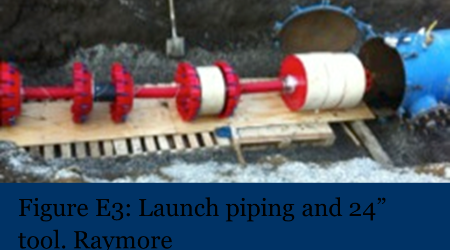
ADVANCED NDT (REMOTE FIELD TESTING)
PICA’s Advanced NDT service solution uses high resolution Remote Field Testing (RFT) technology to provide proactive asset management for metallic and reinforced concrete pressure pipelines ranging from 2 inches to 84 inches (5 cm to 213 cm) in diameter. RFT tools inspect metallic and reinforced concrete pressure pipes for corrosion through internal liners and scale deposits.
RFT is well suited for cast iron pipe, ductile iron pipe, steel pipe, concrete cylinder (bar-wrapped) pipe, reinforced concrete cylinder pipe and prestressed concrete cylinder pipe (PCCP).
Pipeline applications include:
· Water
· Wastewater
· Industrial water
· Raw water
· Sludge
· Slurry
· Hydrocarbons
· Multiphase (oil/gas/water)
INTERNAL IN-SERVICE ADVANCED NDT
For 2-inch to 36-inch (5 cm to 91 cm) Pipelines
Description:
· Fully autonomous, multi-channel, high resolution
· Free-swimming for in service pipelines, can be tethered
· Electromagnetic Eddy Current technology
· Tool models: HydraSnake, See Snake, Chimera
Expected Information from Analysis:
· High resolution, through-transmission, cross-sectional pipe wall thickness measurements.
· Detection of internal and external areas of wall loss, graphitic corrosion, cracks or local stress concentrators in metal pipes.
· Identification of potential critical failure locations, extent of damage (depth and length) looking at both sides (ID and OD) of the pipe for accurate integrity.
Includes wire break measurements, cylinder corrosion and loss of preload for concrete pressure pipes.
INTERNAL OUT-OF-SERVICE ADVANCED NDT
For 36-inch to 84-inch (91 cm to 213 cm)m) Pipelines
Description:
· Fully autonomous, multi-channel, high resolution
· Tethered/winched tools
· Electromagnetic Eddy Current technology
· Tool models: EMIT, RAFT
Expected Information from Analysis:
· High resolution, through-transmission, cross-sectional
pipe wall thickness measurements.
· Detection of internal and external areas of wall loss, graphitic corrosion, cracks, or local stress concentrators in metal pipes.
· Identification of potential critical failure locations, extent of damage (depth and length) looking at both sides (ID and OD) of the pipe for accurate integrity assessment.
· Includes wire break measurements, cylinder corrosion and loss of preload for concrete pressure pipes.
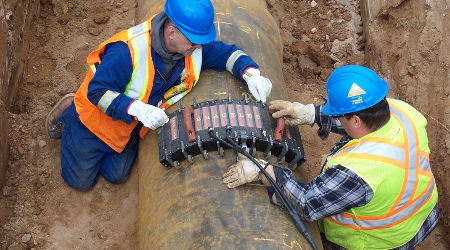
INTERMEDIATE NDT (Handheld EM & UT TOOLS)
PICA offers a wide range of handheld electromagnetic (EM) scanning tools to detect and measure wall loss in cast iron, ductile iron, and steel pipes 6+ inches (15+ cm) in diameter. These flexible, multi-channel, multi-frequency EM tools can be used both internally and externally (ID and OD) and allow for localized/spot inspections to detect wall thickness reductions, individual pits, graphitic corrosion, and erosion.
Handheld EM tools can identify potential critical failure locations and the extent of damage (depth and length) for accurate integrity assessment. PICA’s Bracelet Probe is also available in a version that inspects for corrosion under insulation (CUI).
Pipeline applications include:
· Water
· Wastewater
· Raw water
· Industrial water
· Slurry
· Sludge
· Hydrocarbons
· Multiphase
BRACELET PROBE
PICA’s Bracelet Probe technology quickly and easily
adapts to various pipe diameters greater than 6 inches (15 cm). The tool is portable,
flexible and identifies precise areas of localized wall loss, pits or
through-holes for a high-resolution condition assessment.
· Specialized Bracelet Probe software produces wall thickness variation data in real-time.
o Wall thickness can be quantified while the pipe.
is still excavated using PICA’s handheld UT probes.
· The Bracelet Probe scan width is 10 inches/25 cm (external)
or 24 inches/61 cm (internal)
· PICA offers three versions of the Bracelet Probe:
o External
o Internal
o Corrosion Under Insulation (CUI)
UT & EMAT PROBES
PICA uses handheld ultrasonic thickness (UT) probes to quantify wall loss in metallic pipes.
Electro-magnetic acoustic transducer (EMAT) probes can measure wall thickness through coatings without the need for a couplant.
UT & EMAT probes are used:
· In
conjunction with the Bracelet Probe to quantify wall loss
· To validate wall loss data from PICA’s RFT tools
· To measure wall loss through bare or coated pipe
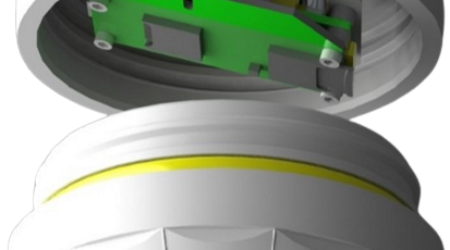
Pre-Screening NDT (NAVIGATOR)
PICA’s NAVIGATOR pre-screening NDT service solution is ideal for leak detection and is the critical first step in identifying other leading indicators for potential pipeline integrity issues. NAVIGATOR is an internal, free-swimming, adjustable buoyancy, multi-sensor, acoustic sphere deployed while pipelines are in service.
NAVIGATOR can be deployed in:
· Cast iron pipe
· Ductile iron pipe
· Steel pipe
· Concrete cylinder (bar-wrapped) pipe
· Reinforced concrete cylinder pipe
· Prestressed concrete cylinder pipe (PCCP)
· AC and plastic pipe
Pipeline applications include:
· Wastewater
· Raw water
·
Potable water
NAVIGATOR – Multi-Sensor Acoustic Sphere
Pre-screening NDT assessments are often followed up with standard, intermediate, or advanced NDT services for more accurate and detailed analysis of pipeline integrity issues.
Technical Capabilities
NAVIGATOR is
an internal, free-swimming, adjustable buoyancy, multi-sensor acoustic sphere
deployed while pipelines are in service. These small diameter (3.25-3.75 inch/8.3-9.5
cm) spheres travel freely within pipelines ranging from 4 inches to 78 inches (10
cm to 198 cm) in diameter, screening for local leaks, gas pockets, elevation
profile and other important pipe information from pressure and magnetometer
data.
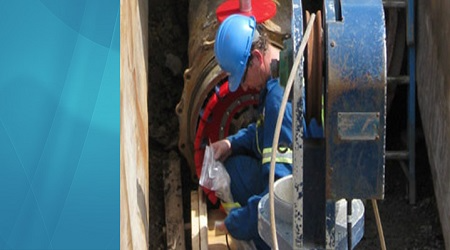
Do you have high risk water main pipelines?
Do you know the condition of your water main pipelines? Do you want to extend the life cycle of your existing pipelines? Do you want to save money by not having to needlessly replace pipelines that are in good condition?
PICA can help identify the condition of your pipelines using it's patented, state of the art, Remote Field Technology (RFT) See Snake Tools. Join the growing list of owners and operators of water pipelines around the world who have used our service. To date PICA has inspected over 660,000' (200 kms) of water mains.
Identify the problem to help save you money.
In a 2007 report released by the Environmental Protection Agency (EPA), an estimated 240,000 water main breaks occur every year in the United States. The number of breaks increase substantially near the end of the system's service life. Large utility breaks in the Midwest increased from 250 per year to 2,200 per year during a 19-year period.
The US Geological Survey estimates that water lost from water distribution systems is 1.7 trillion gallons per year at a national cost of $2.6 billion per year.
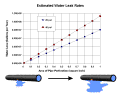
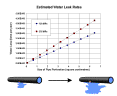
Click on graphics to enlarge (gallons (l.h.s) and litres (r.h.s.))
This simple estimation model is based on a formula presented in the following publication: The Texas Water Development Board: "A Guidebook for Reducing Unaccounted-for Water".
The See Snake Tool solution.
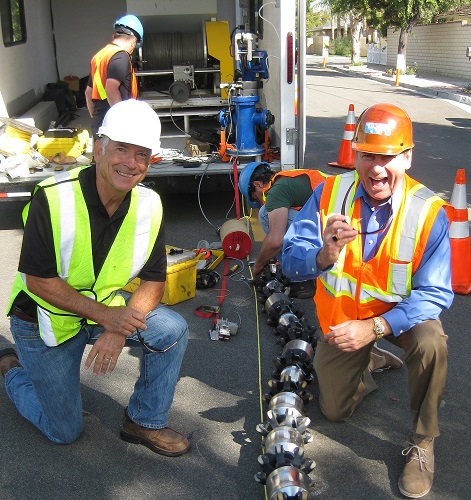
There is a demand in the market for improved probability of detection (P.O.D.) and exceptional accuracy for sizing of corrosion pits. Competing tools that use Magnetic Flux Leakage (MFL) require intimate contact with the pipe wall in order to achieve acceptable flaw sizing. Unfortunately many pipelines have internal deposits of scale and others are lined with cement mortar, epoxy or polyethylene, preventing the effective use of MFL tools. See Snake RFT technology, on the other hand, requires no contact with the pipe wall, and can measure through scale and non-magnetic liners. In fact, See Snake tools have a clearance of up to 2" (50mm) to allow passage of the Tools past tubercles, dents and internal deposits.
The See Snake Tool advantage.
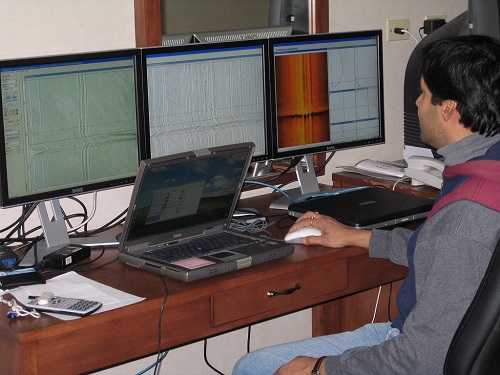
Semi-automatic Analysis Software
See Snake data analysis is semi-automatic and a report is created as the analysis is being performed. Depending on the line condition, analysis and reporting can be done in the field, but is usually done starting the next day, off-site, to reduce labour costs.
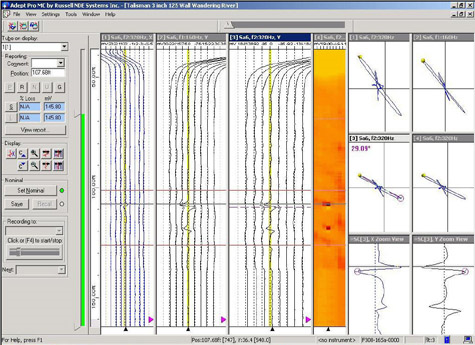
The multi-channel See Snake Tools inspect 360° of the pipe circumference for the full length of the pipeline. The data is displayed as color maps, strip-chart logs and voltage planes. The screen capture below shows two pits at the bottom (6 o'clock position) of the pipe, 40% and 60% deep.
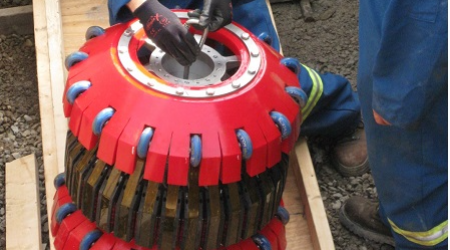
Tools are available for pipe sizes between 2" (50mm) to 36" (914mm)
Larger pipes can be inspected, but require the pipe to be empty.
Do you have high risk Waste Water, or Force Main pipelines?
In a report released by the Environmental Protection Agency (EPA), since 2003 hundreds of municipal sewer authorities have been fined for violations, including spills that make people sick, threaten local drinking water and kill aquatic animals and plants. Fines totaling $35 million were assessed.
The report indicates, 3 billion to 10 billion gallons of raw sewage spill accidentally every year, from the 1.2 million miles of waste water pipelines snaking underground across North America. Causes of these spills include corrosion pits/cracks in aging pipes.
Some examples are:
Don't let this happen to you! PICA can help identify the condition of your waste water pipelines using it's suite of patented state of the art Remote Field Technology (RFT) See Snake Tools. Join the growing list of water and waste water companies around the world who have used our Direct Condition Analysis (DCA) service to assess the condition of their pipelines. To date PICA has inspected over 660,000' (200 kms) of water mains using the RFT technique.
The See Snake Tool solution.
There is a demand in the market for improved probability of detection (P.O.D.) and exceptional accuracy for sizing of corrosion pits. Competing Tools that use Magnetic Flux Leakage (MFL) require intimate contact with the pipe wall in order to achieve acceptable flaw sizing. Unfortunately many pipelines have internal deposits of FOG (Fats Oil and Grease), scale or sand, and others are lined with cement mortar, epoxy or polyethylene, preventing the effective use of MFL Tools. See Snake technology, on the other hand, requires no contact with the pipe wall, and can measure through internal deposits, debris and non-magnetic liners. In fact, See Snake Tools have a clearance of up to 2" (50mm) to allow passage of the Tools without extensive pipe cleaning.
The See Snake Tool advantage.
Semi-automatic Analysis Software
See Snake data analysis is semi-automatic and a report is created as the analysis is being performed. Depending on the line condition, analysis and reporting can be done in the field, but is usually started the next day, off-site, to reduce labour costs.
The multi-channel See Snake Tools inspect 360° of the pipe for the full length of the pipeline. The data is displayed as color maps, strip-chart logs and voltage planes. The screen capture below shows two pits at 6 o'clock (bottom of the pipe) that are 40% and 60% deep. These indications can be seen on the charts as horizontal jogs in the signal, and as dark patches in the colour map.