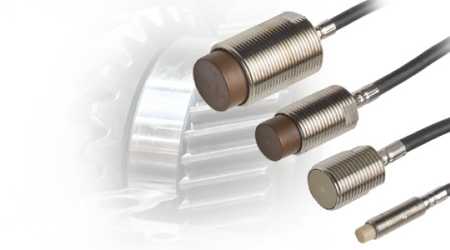
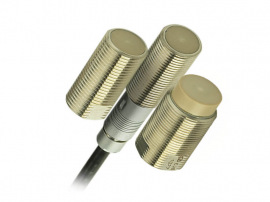
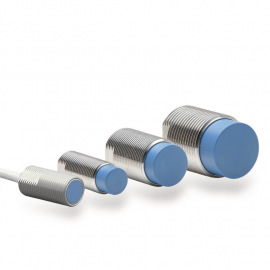
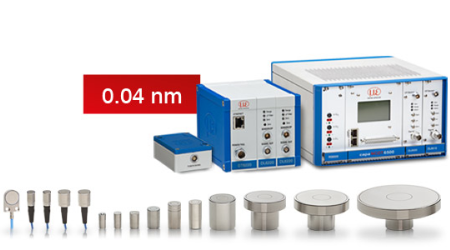
Capacitive sensors are designed for non-contact measurement of movements, distance and position, as well as thickness measurement. Thanks to the high signal stability and resolution, capacitive sensors are often used in laboratory environments as well as in industrial applications. For example, capacitive sensors are used in production monitoring to measure film thickness and the application of glue and binders. In machine installations, they measure distances and tool positions.
Advantages of the capacitive principle
- Non-contact measurement of movement, distance and thickness against electrically conductive materials as well as insulators
- Unmatched accuracy for laboratories and industry
- Custom sensors and control units
- All capaNCDT sensors, cables and controller units are fully compatible
- Lots of application areas thanks to a large product range
- The latest controller technology ensures easy operation
High immunity to magnetic fields
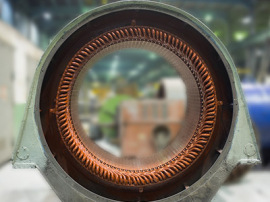
For environments with strong magnetic fields, Micro-Epsilon offers transducers and cables that are made of non-magnetic materials, such as titanium and stainless steel. The shielding achieved by the triaxial design provides extremely high immunity to interference
Vacuum and clean room applications
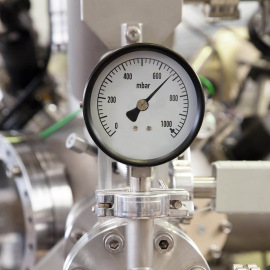
Capacitive position sensors from Micro-Epsilon are often used in vacuum and clean room applications where in particle-free environments they achieve resolutions in the subnanometer range. For vacuum applications, Micro-Epsilon offers special sensors, cables and bushings. These sensors and cables are largely particle-free and are used in cleanrooms up to cleanroom class ISO1.
Highest precision in extreme ambient temperatures
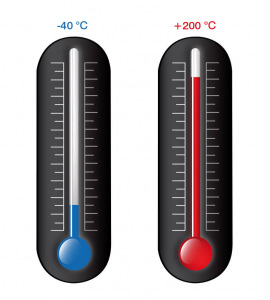
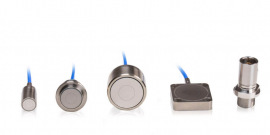
Unlike conventional non-contact measurement techniques, capacitive sensors from Micro-Epsilon are characterized by the highest measurement accuracy and stability. Since heat-induced conductivity changes of the measuring object do not affect the measurements, the measured values remain stable even at fluctuating temperatures. For example, capacitive sensors are used for distance measurements of superconducting magnets. The temperature-stable sensor design enables ambient temperatures up to -270° C while maintaining maximum resolution of the measured value.
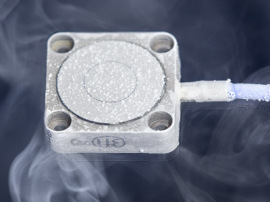
New: Precise measurements at high ambient temperatures
For measurements of high temperatures up to +800 °C, the new CSE HT sensors are used. The high-temperature sensors are operated with the high-performance capaNCDT 6228 controllers.
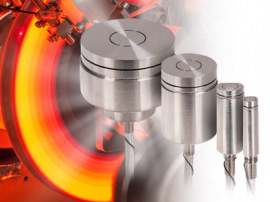
Full compatibility: Sensor and controller changes without the need for calibration

The capaNCDT sensors, cables and control units can be easily and quickly replaced. Thanks to the innovative technology, further calibration or linearization is unnecessary. Simple exchange of capaNCDT components and sensors with different measurement ranges can be quickly and easily carried out on site. Micro-Epsilon has the world's widest range of variants and combinations in capacitive distance measurement.
Modern and user-friendly control technology
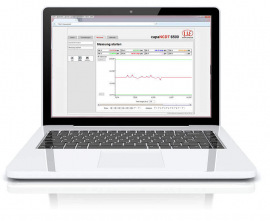
The modern capaNCDT control units are equipped with various interfaces such as analog, Ethernet and EtherCAT. The capacitive measuring systems can be easily set up and configured via the web interface displayed in the browser. The controller is connected to the PC via Ethernet interface. Settings, filters and arithmetic functions are saved as they go directly in the controller.
Sensors for customer-specific applications and OEM
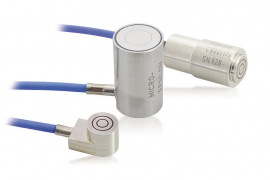
We can adapt our measurement systems to customer-specific measurement tasks, e.g. design, material calibration, cable lengths, modified measurement ranges or sensors with integrated control electronics.
Read more about sensor changes.
Capacitive transducers: How they work and when they are used
Capacitive sensors are based on the detection of change in capacitance. With a plate-type capacitor, the capacitance between two plates of constant size can be changed by changing their distance or by placing a dielectric in the measurement gap. With the capacitive measuring principle, the sensor (measuring electrode) and the conductive measuring object act as an ideal capacitor of platform. If an alternating current with a constant frequency flows through the sensor capacitor, the amplitude of the alternating voltage on the sensor is proportional to the distance to the measuring object (earth electrode). However, a constant dielectric between sensor and object is required for a constant permittivity.
Stable measurement with triaxial design
Since capaNCDT sensors are designed as protective capacitors, almost ideal linearity is also achieved in practice. Capacitive sensors from Micro-Epsilon are used in industrial measurement tasks to detect a medium in the measurement gap from a constant distance or to measure the distance from a conductive target with a constant medium or dielectric.



 Service
 Sweden