Lyft
Know MoreEquipments
 Loading…
 Product, Service
 Canada
Eddyfi Technologies provides the highest-performance Non-Destructive Testing (NDT) inspection technologies in the world, helping OEMs, asset owners and service companies enhance productivity, save lives, and protect the environment. Its mission is to push the limits of advanced NDT to new heights by featuring various NDT modalities and investing massively in product advancement.
Established in 2009 with the goal of pursuing and developing eddy current array (ECA) technology to its full potential for the benefit of the nuclear industry, Eddyfi Technologies has since become the reference in advanced NDT solutions. From this initial beachhead market, Eddyfi’s systematic and disciplined approach allowed successfully serving other key industries needing advanced NDT systems for the inspection of critical assets and components. Until 2016, Eddyfi’s footprint grew exclusively thanks to new applications, product development, and geographical expansion. The company then started a series of strategic acquisitions to broaden its product portfolio with synergistic modalities and complementary capabilities: Silverwing, TSC, Teletest, M2M and Inuktun all brought new NDT methods and technologies, along with an increased presence worldwide with offices in key regions to better serve customers. Simultaneously, realizing the ever-growing importance of software for industrial applications, the company increased its focus on advanced algorithms, and assisted analysis capabilities (including the use of machine learning/ artificial intelligence or AI), and was first to engineer an offering based on continuously improving software for the NDT equipment market. Since its inception in 2009, Eddyfi has always been keen on doing things differently and remains motivated – more than ever – to always be Beyond Current.
Eddyfi Technologies has the ambition to think differently and build more than just a business. We strive to positively impact our clients, competitors, employees and the communities where we operate. Simply said, we believe that we have a social responsibility and we are taking this very seriously.
At Eddyfi Technologies, we believe in contributing to building strong and healthy communities where we operate. We endeavour to support causes dedicated to the next generation of scientists, those that place perseverance (academic, sports, personal development) at the core of their actions, as well as those that aim at fighting poverty and empowering our youth. This includes significant support to United Way in Canada.
Each year, Eddyfi hosts its annual Community Week. The objective is simple: through team effort, employees spend a workday doing something of value to our communities, whether it be through helping those in need, working to prepare a communal park for the Summer, etc. This is an opportunity to show our passion, our team spirit and our commitment.
Eddyfi’s co-founder and CEO Martin Theriault was born and raised in the Quebec neighbourhood of Limoilou and lower downtown. This is a very interesting and diverse community which unfortunately faces several social challenges. As a special way to give back, a large portion of M. Theriault’s personal philanthropic involvement and financial contribution is focused on non-profits that impact the Limoilou community. This includes the Patro Roc-Amadour as well as the Centre Jacques-Cartier, two organizations near and dear to Martin' heart.
At Eddyfi Technologies, customer focus is a critical component of our strategy. Technical intimacy with our customers provides the insights that help us fulfil our mission and develop the next generation of products. We are dedicated, diligent, pragmatic in our execution, and we always go the extra mile. We meet our customer's requirements by fully understanding all their expectations, expressed or implied. We truly believe that if we can’t do it, no one can.
We take pushing the limits of advanced NDT technologies to heart. The love of physics, superior attention to detail, sheer technical beauty, and forward-thinking are at the core of what brings us together as a company. We channel our passion for our science into pushing industry performance to new heights.
We serve clients that perform mission-critical NDT inspections. Very often, clients rely entirely on us to meet and surpass their inspection programs and performances. We recognize that new, innovative, or custom solutions may bring unforeseen challenges. Nevertheless, in sync with our clients, we overcome these obstacles to ensure our clients’ success. As a company, we live up to our word. No excuses.
Eddyfi Technologies’ success and emergence is a result of doing what others could not do or simply not envision doing. As entrepreneurs, we leverage the resources around us to create and capture value as opportunities arise. We are smart, agile, and truly connected with our clients. Speed to market and accelerated learning is a crucial competitive advantages. Our work environment is flexible and nurtures this spirit by valuing initiatives and empowerment.

Equipments
Equipments
Equipments
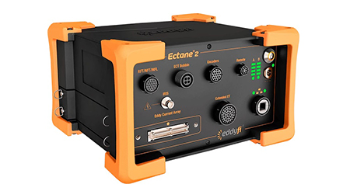
Over the last decade, Eddyfi Ectane® has become the undisputed reference for heat exchanger tubing inspection and surface eddy current array, all around the globe. Thanks to a compact form-factor and its unmatched robustness, the multi-technology instrument earned a reputation for being best-in-class.
The Eddyfi Ectane 2 test instrument is approximately 10 L (610 cu.in.) in volume and weighs in at 6.8 kg (15 lb), making it about three times more compact than other legacy test instruments. Ectane 2 is therefore easy to carry beyond being rugged. The instrument is also battery powered with 8 hours of autonomy that eliminate the need for an external power source.
Unlike some fragile systems on the market, Ectane was built for real-life conditions: cold, hot, dusty, humid (or simply wet!), where occasional shocks and drops are meant to happen. Ectane is the tester you can trust.

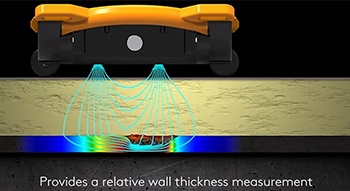
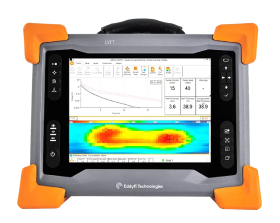
Flexible, Fast, and Reliable Corrosion Under Insulation (CUI) Integrity Management Solution.
Eddyfi Lyft® can scan through thick insulation, as well as aluminum, stainless steel, and galvanized steel weather jackets. It also benefits from a range of PECA, single-element PEC, and application-specific probes to support various applications. Who else but Eddyfi to reinvent an eddy current technique and redefine CUI programs. Got Lyft
Corrosion Under Insulation (CUI) is possibly the greatest unresolved asset integrity problem in the industry. Current methods for measuring wall thickness over insulation (Liftoff) without removing it all have severe limitations. Lyft® is a high-performance solution reinventing Pulsed Eddy Current
Lyft can scan through thick insulation, as well as aluminum, stainless steel, and galvanized steel weather jackets. It also benefits from a range of PECA, single-element PEC, and application-specific probes to support various applications. Who else but Eddyfi would reinvent an eddy current technique, integrate high-productivity array to the solution and completely redefine CUI programs?
The Lyft is packed with automation and advanced algorithms that remove operator-specific dependence, thanks to the power of the SmartPULSE™ technology. It automatically optimizes pulser and receiver parameters (gain, duration, time gates, filters, etc.). SmartPULSE also adjusts Wall Thickness (WT) measurements to ensure optimal performance and repeatability, while limiting the need for advanced knowledge of pulsed eddy current. The user-friendly multi-touch software also includes several innovative features, including real-time C-scan imaging (grid-mapping and dynamic modes), complete wall thickness measurements (ID and OD corrosion), as well as complete inspection management and reporting capabilities.

Under sizing is a well-known phenomenon for PEC where defects smaller than the probe’s averaging area appear shallower than they really are. The Lyft’s Compensated Wall Thickness (CWT) tool mitigates the phenomenon by quantifying the minimum wall thickness of a specific region in a C-scan. The CWT tool’s specialized algorithms isolated a defect’s contribution to the A-scan signal to more precisely compute its minimum wall thickness.

Lyft PRO enables advanced Lyft data analysis and features the same graphical user interface than the Lyft software, making it easy to learn and benefit from larger data layouts. This translates into Lyft instruments out in the field acquiring data while analysts work hard to extract value from acquired data. Lyft PRO makes it easier to plan inspections for several Lyft instruments. The software also has features to generate richer reports and tools to bridge calibration parameters between scan zones. Available for free to Lyft software subscribers.

SurfacePro3D is an advanced visualization and reporting software designed to automatically create components and overlay stitched C-scan data. Use it to import Lyft reports, create 3D components, and stitch color maps automatically. Easily import, export, create and edit report templates. Compile and merge inspection data with associated images, inspection parameters, and defect tables for fast and compelling reporting.
The Lyft solution includes several sizes of plug-and-play probes for the right balance between wall thickness and liftoff.
The PECA high-productivity probe is capable of a single-pass coverage of 457 mm (18 in) in grid or high-resolution encoded dynamic mode. It supports metal thickness 6–25 mm (0.25–1.0 in), insulation 0–102 mm (0–4 in), and stainless steel and aluminum weather jackets. CUI assessment has never been this fast, improving overall inspection productivity as much as 10 times.

The single-element PEC probe family supports metal thicknesses up to 100 mm (4 in), insulation as thick as 300 mm (12 in), and stainless steel/aluminium/galvanized steel weather jackets. They complement the array probes in limited-access, small-pipe, and thick-component inspections.
The patent-pending high-resolution PECA probe is designed specifically for the inspection of scabs and corrosion blisters. Using an array of dual sensors capable of spatial triangulation, the probe enables the detection of the smallest possible defects with PEC technology. It supports metal thickness 3–19 mm (0.12–0.75 in), insulation 0–50 mm (0–2 in) and a single-pass coverage of 75 mm (3 in) in dynamic or grid mode.

The tank floor probe enables the in-service inspection of storage tank annular rings. With its 4.8 mm (0.2 in) thick, super-thin titanium blade, the probe can slide up to 400 mm (16 in) under tank floor edges, assessing the remaining wall thickness of this critical region exposed to corrosion. The embedded remote controls and status LEDs are also perfect for one-person operation.
The patent-pending galvanized steel cladding probe (PEC-GS) is specifically designed to improve detection capabilities and sizing accuracy by reducing the footprint dimensions to normal. The design neutralizes the interference from the jacket, improving signal penetration, and prevents vibration for an unsurpassed signal-to-noise ratio.
The Splash Zone can tackle offshore applications, thanks to its rugged design, water tightness to 15 m (49 ft) in grid mode, and 25 m (82 ft) cable. The splash zone probe is flexible enough to support metal up to 76 mm (3 in) thick and insulation or marine growth up to 203 mm (8 in) thick.

Underwater probes can tackle deeper offshore applications. They are watertight down to 100 m (330 ft) and, through the long extension cable, are used with Lyft in grid-mapping mode. The embedded status LEDs ensure better control and synchronization with the topside team. The probes can be used on metal as thick as 100 mm (4 in), as well as insulation and marine growth as thick as 300 mm (12 in).
The Lyft instrument is sealed and designed for IP65. Its magnesium alloy casing is tough, water and dust resistant, and cools without any external air exchange. The adjustable stand, the top handle, and four corner anchor points make it practical for on-site inspections. The embedded and portable Windows® PC offers standard connect-anywhere capabilities and advanced productivity tools that optimize field testing. The premium-quality 26.4 cm (10.4 in) LED display is optically bonded, non-reflective, comes with 3 mm (0.12 in) strengthened glass, and is designed for gloved hands, under any lighting conditions. The system also comes with two, hot-swappable batteries for extended battery operation.

For its dedication to creating a power-packed product that solves one of the major challenges across industries, testing for corrosion under insulation, Frost & Sullivan presented Eddyfi with the 2016 Global Nondestructive Testing Equipment New Product Innovation Award,

"Eddyfi has further done away with the dependence on operators by packing Lyft with its SmartPULSE technology, wherein the system automatically iterates to find the best parameters for the inspection configuration.”
“Using an autoset feature, the probe can find the optimal configuration for measurements and repeatability, adjusting the pulse frequency, gains, and other parameters.”
Frost & Sullivan Principal Lead, Nikhil Jain
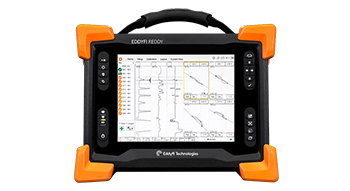
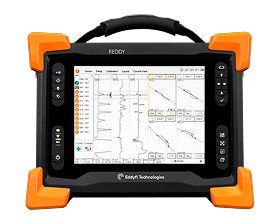
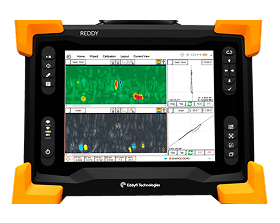
Eddyfi Reddy® is the solution designed to replace the wide range of aging ECT instruments for air-conditioner and ECT tubing inspections. Reddy supports all AC and ECT probes currently on the market without adapters or reference probes to balance the absolute channel. No other portable system is battery-operated or sealed, or features a bright display, automated acquisition sequences, or an analysis software for on-the-fly reporting.

Since air conditioners are similar to small Heat Exchangers (HX) in terms of number of tubes, they benefit greatly from the portability and minimal setup time provided by Reddy. Larger HX-generating massive amounts of data and requiring other inspection techniques (such as ECA ,RFT ,NFT ,NFA ,MFL , and IRIS)—are still, however, better served by a larger, multi-technology tester such as Ectane coupled to a laptop computer for optimal data visualization and file management.
All existing competitor system has small, low-resolution displays without multi-touch capabilities, offer very limited features, and have poor control ergonomics. Most of these systems need external power and absolute reference probes. They also lack easy-to-use embedded software with efficient reporting and waterproofing specifications. Post-inspection analysis are made easy with Reddy, which is most often not the case with any of these systems. Finally, available AC probes only offer limited detection capabilities when used with handheld units.

Reddy optimizes the time it takes to perform complete inspections because of its probe plug-and-play capabilities, 6-8 hours battery autonomy, 100 GB data storage capacity, and quick USB data/report transfer for final printed reports (include screenshots and pie charts).
Further, automated acquisition sequences are a huge time saver because they reduce the number of necessery operations for a complete inspection, such as starting/stopping an acquisition, recording data, and using foot pedals.

The software running on Reddy—Magnifi® GO—also enables you to quickly create tube lists, and it feature an optimized setup wizard and a unique reporting format. All data recorded with Reddy can be used in the industry-standard.
Eddyfi® only employs the most experienced field-application engineers around the globe. With our offices in the United States, Canada, UK, France, the UAE, Chaina and Africa, we can offer timely, high-quality support anywhere. This ensures a quick and seamless transition from older systems to Reddy, as well as provide you with access to on-site support.
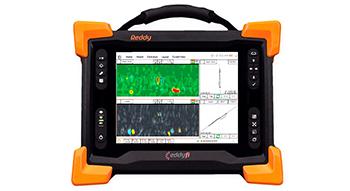
Packaged with the latest technology, Eddyfi Reddy and its embedded data analysis software offer the most intuitive user experience, which includes real-time C-scans, a modern, rugged, and large multi-touch interface, as well as many other features that enable fast, high-PoD surface inspections.
The Sharck is based on Tangential ECA (TECA™) technology, which was specifically developed for cracking in carbon steel. Not only does it enable measuring surface-breaking crack position and length, but also sizing cracks as deep as 7 mm (0.28 in). Furthermore, the Sharck allows simultaneously scanning the weld cap, toe area, and heat-affected zone for a longitudinal and transverse crack without surface preparation or paint removal.
Find out more about this application by watching our webinar with Marc Grenier.
MFL pipescans can adapt to a wide range of diameters (48 mm [1.9 in] to flat surfaces). The magnetic flux leakage option allows you to fully benefit from the Reddy® versatility in order to fast screen large areas for corrosion indications. The array of sensors provides large coverage and high-PoD. Liftoff and thick magnetic walls are now at reach.
Padded ECA probes adapt to geometry variations in almost every direction, making the probes perfect for examining weld beads, transitions, and Heat-Affected Zone (HAZ). The probe’s design enables detecting surface cracks 0.5–1 mm (0.02–0.04 in) long in welds with minimal surface preparation. The probe’s membrane is extra-tough to better withstand friction.
Semi-flexible ECA probes can adapt to a tank floor’s curvature and other geometric features, offering sufficient penetration to scan through thick aluminium/stainless steel (over 6.35 mm [0.25 in] thick). So doing, the solution is capable of detecting and characterizing corrosion-related defects such as pitting and thinning affecting as little as 10% of a plate’s thickness.
I-Flex probes are the most versatile ECA probes in the industry. Thanks to their multiple built-in topologies and flexible bodies, they can address a variety of applications. I-Flex probes are perfect for detecting Stress-Corrosion Cracking (SCC) in both ferrous and non-ferrous materials. Whether SCC is affecting the integrity of pipelines, pressure vessels, or tanks (on base metal or internal cladding), encoded scans performed with I-Flex probes allow efficient sizing of clusters.
This version of the Magnifi® software allows you to perform advanced analysis of the data acquired with Reddy directly on your computer. Magnifi R offers the same graphical user interface as Magnifi GO so any analyst can be up and running in next to no time, with a wider range of larger monitor data layouts than Magnifi GO. This means that Reddy units can be out acquiring data in the field while analysts are hard at work on their computers extracting value from the data. Furthermore, with Magnifi R you can easily plan and set up inspections for several instruments to make the most of your hardware.
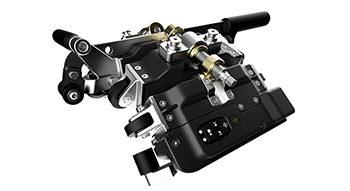
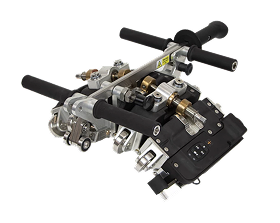
The Eddyfi Technologies Pipescan HD solution is designed to maximize speed, reliability, and confidence for the detection of corrosion and pitting in ferrous pipes and surfaces. It increases the total efficiency of integrity assessment campaigns by enhancing the productivity of the inspection team, optimizing the workflow to include on-the-spot reporting, and providing the asset owner with verifiable, recorded data.
Oil & Gas
Power Generation
The Pipescan HD is the highest resolution MFL scanner on the market. With a high Probability of Detection (PoD), the Pipescan HD is an effective and reliable pipe inspection solution for corrosion and pitting detection.
Pipescan deployment is easy with the unique single curvature adjustment tool allowing for a quick inspection setup. No couplant or complicated gate settings are required, connect the Pipescan to the data acquisition instrument, enter inspection details, and the system is ready to go.
Furthermore, all scanned data is automatically recorded and reports can be issued on the spot, giving asset owners immediate visibility on the health condition of their assets, enhancing productivity and efficiency.
MFL is a rapid, reliable, and robust corrosion screening technique that detects the volume of missing magnetic material in a component under inspection.
MFL requires limited surface preparation and no couplant is needed. Users require minimal training, and with scanning speeds up to 1m/s (3.2 ft/s), MFL is the ideal solution for fast, cost-effective corrosion detection.
Keeping with the goal of a fast and easy to use solution, the software has retained the adjustable reporting threshold feature, allowing the user to only report on what is relevant to the work scope. As all the data is recorded, the reporting threshold can be adjusted post-inspection. By retaining all the data, engineers have the knowledge to the true condition of the asset.
Efficiency tools include a one-click reporting tool designed to improve the overall workflow from inspection to report. Indications can be analyzed on the go, at the end of a scan or the end of a job. Once the analysis has been completed, simply select "generate report", then transfer to a USB key for distribution. Once the inspection is finished, so is the report.
Dedicated, rugged, battery-operated MFL data acquisition instrument. With a large, 26.4 cm (10.4 in), non-reflective, multi-touch display, Silverwing Swift-M offers crystal-clear views under any lighting condition.
Rugged, portable, and high-performance multi-technology instrument. Technologies include Eddy Current (EC), Tangential ECA (TECA), and MFL. Wide range of probes and accessories suitable for rapid crack and corrosion assessment.